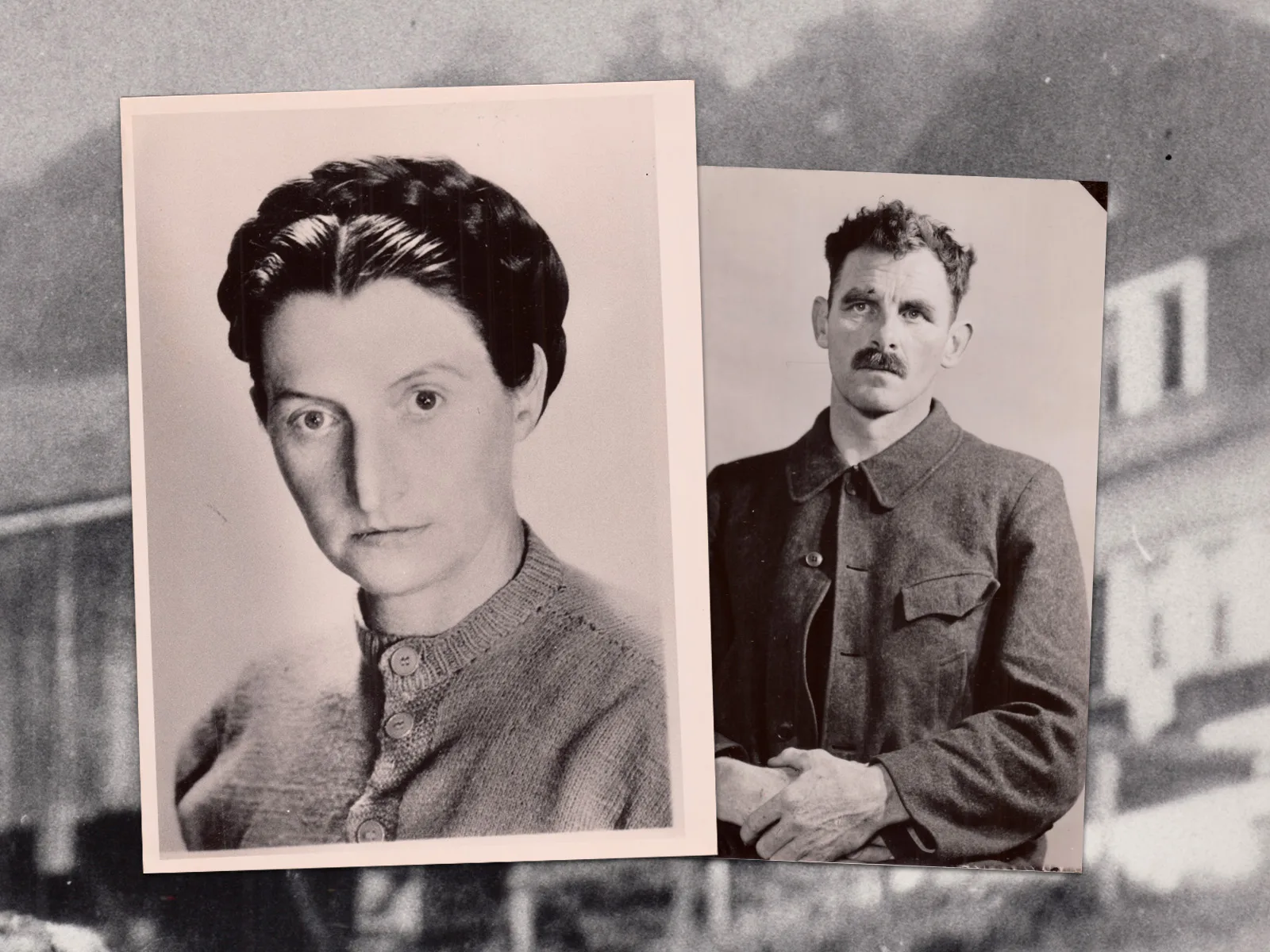
Maria Theresia Wilhelm and her future husband Ulrich Gantenbein were the victims of ‘compulsory social measures’.
Maria Theresia Wilhelm and her future husband Ulrich Gantenbein were the victims of ‘compulsory social measures’. Gantenbein family

What happened to Maria Theresia Wilhelm?

In July 1960, a woman went missing in the St. Gallen Rhine Valley, never to be seen again. She was a psychiatric patient and the mother of seven children who had all been taken into care. The story of Maria Theresia Wilhelm and her husband Ulrich Gantenbein is a tragic tale, marred by violence and the arbitrary actions of public authorities.

Stefan Keller

Stefan Keller

Stefan Keller is a historian and journalist whose works include the investigative report “Maria Theresia Wilhelm, spurlos verschwunden”, published in 1991.

At the time we began looking for her she would have been almost eighty, assuming she was still alive. David Gantenbein, one of her sons, told me her incredible story. His mother had been hounded by the local authorities in Grabs in the St. Gallen Rhine Valley region for decades and repeatedly institutionalised, until one day she vanished without a trace. By then, all of her children had been taken from her, one after the other. Having himself spent his younger years in foster care or as an indentured child labourer, David eventually left for Hamburg and a new life as a sailor, far beyond the reach of the Swiss authorities. It was only years later, when attending his father’s funeral in 1977, that he finally got to meet all his siblings. Now, he told me, he had come back to find his mother.

And so began a search for the truth that is still ongoing today. Our first port of call in the autumn of 1988 was a former neighbour of the family, who confirmed what David had told us. He then added that it was not only the mother, Maria Theresia Gantenbein, née Wilhelm, who had been forcibly committed to psychiatric institutions. The father, Ulrich Gantenbein, had been too.

A mountain romance
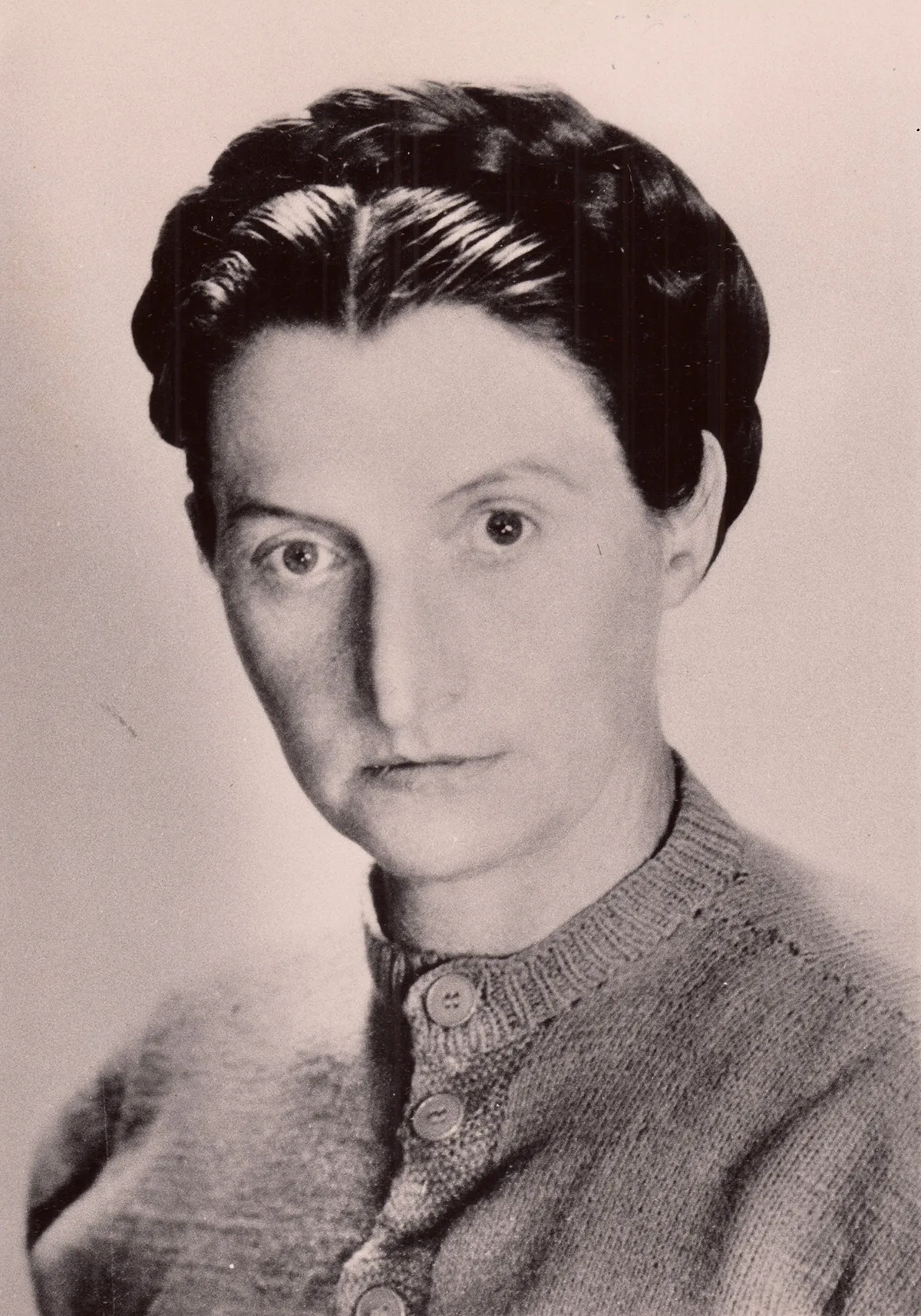
Maria Theresia Wilhelm, commonly known as Theres or Resi, was a young woman from the neighbouring Vorarlberg region of Austria. She came to the Rhine Valley on the Swiss side of the border in the 1930s to take up a position as a waitress. There, she became very friendly with one of the regular diners, Ulrich Gantenbein, also known as Ueli. The mountain farmer from outside Grabs also happened to be a former poacher who had literally become the cantonal gamekeeper. A particularly strong, well-built man who was not lacking in confidence, he was nevertheless prone to outbursts of anger. Gantenbein worked six hectares of fragmented farmland on the Studnerberg, known locally as Sandbühel.
Maria Theresia Wilhelm, undated photograph.
Maria Theresia Wilhelm, undated photograph. Gantenbein family
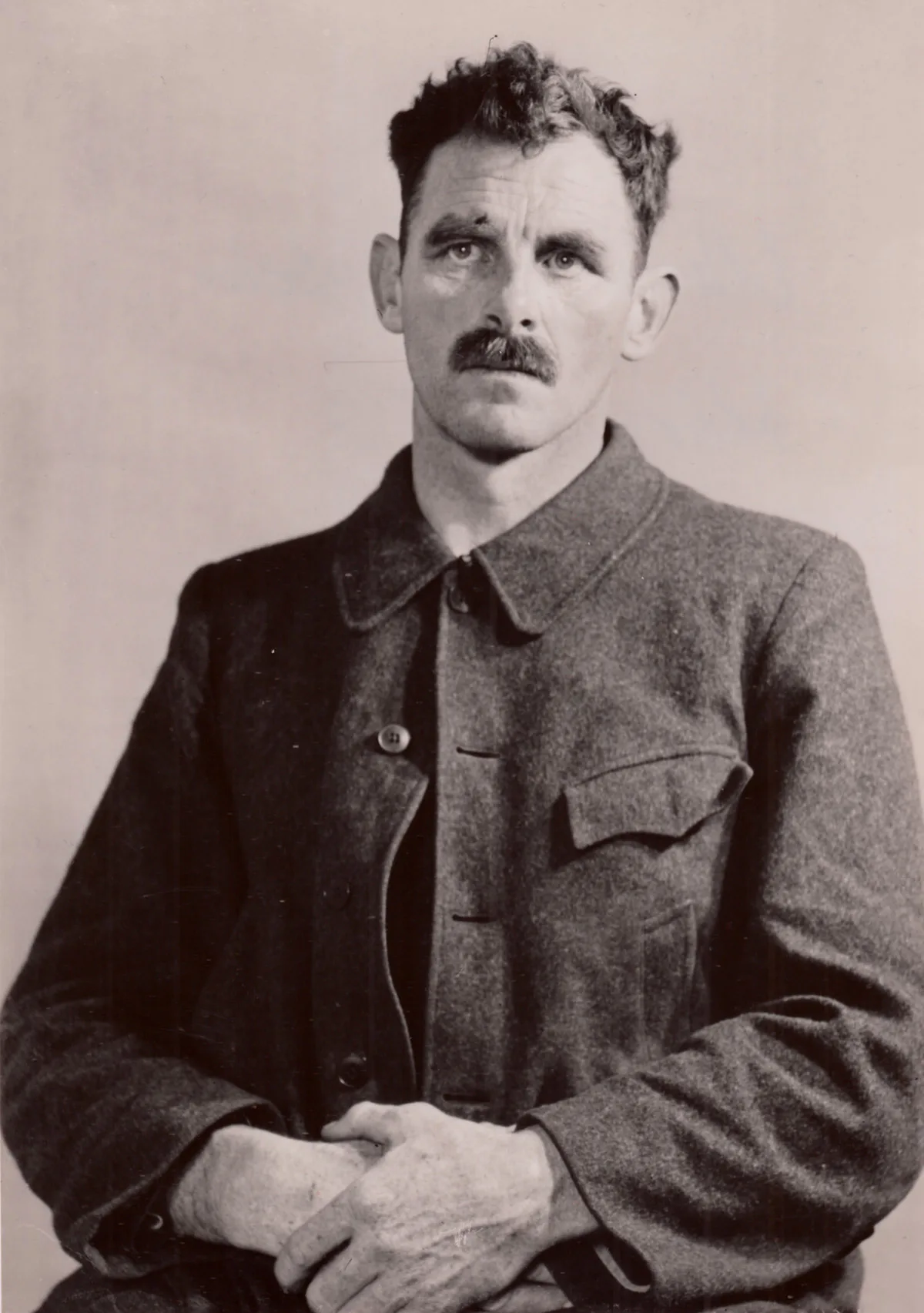
Ulrich Gantenbein, 1943.
Ulrich Gantenbein, 1943. Gantenbein family
Gantenbein was married to a local woman and they had five children together. When the wife moved out and ‘Resi from Vorarlberg’ moved in, the authorities intervened to put a stop to these extramarital relations. The young woman was placed under arrest in April 1936. Gantenbein, attempting to stand up for her, was also taken into custody. She was sent back to Austria, while he ended up in the psychiatric clinic in Wil after slapping a local politician. Following his release, a few weeks after his sweetheart had been deported, Gantenbein returned to Grabs, stepped down from his official position as gamekeeper and filed for divorce.
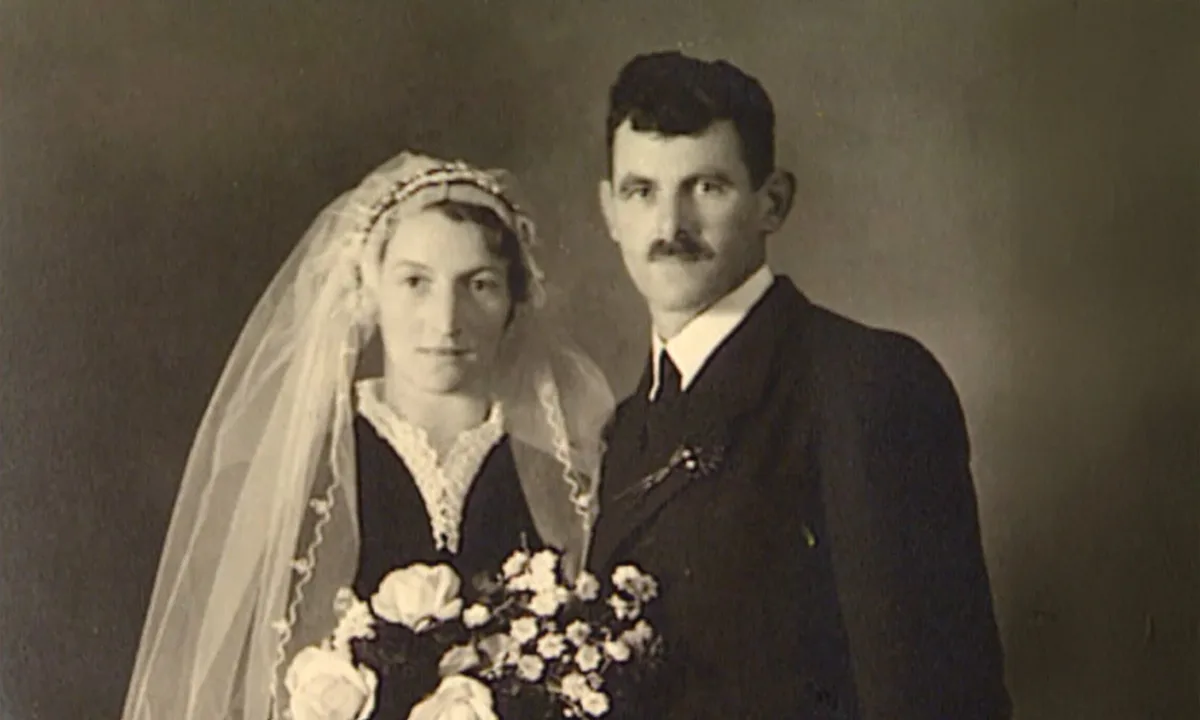
Maria Theresia Wilhelm and Ulrich Gantenbein on their wedding day in 1938.
Maria Theresia Wilhelm and Ulrich Gantenbein on their wedding day in 1938. SRF Rundschau
Nine months later, back in Austria, Theresia Wilhelm gave birth to a daughter. The little girl was born disabled and would spend the rest of her life in care homes in the Vorarlberg region. Resi married the by now divorced Ueli in 1938, thus gaining Swiss citizenship. But signs soon began to emerge that all was not well within the marriage: having gone back to poaching, Gantenbein was often away from home roaming around the mountains, and it was said that he neglected the farm.

In the end, Resi was no longer able to bear life at Sandbühel. Their neighbours in the village looked down on her no matter what she did, and the authorities considered her to be sexually promiscuous, and therefore dangerous, because she had tempted the farmer away from his first wife. Money was tight. In 1943, Theresia Gantenbein filed for divorce. She moved out of the farm and into the local poorhouse, finding work in the hospital laundry. By now, she and Ueli had another three children. Trying to persuade Resi to return home with him, Gantenbein became involved in a scuffle with the local police. He was arrested yet again and this time committed to the St. Pirminsberg psychiatric clinic in Pfäfers.
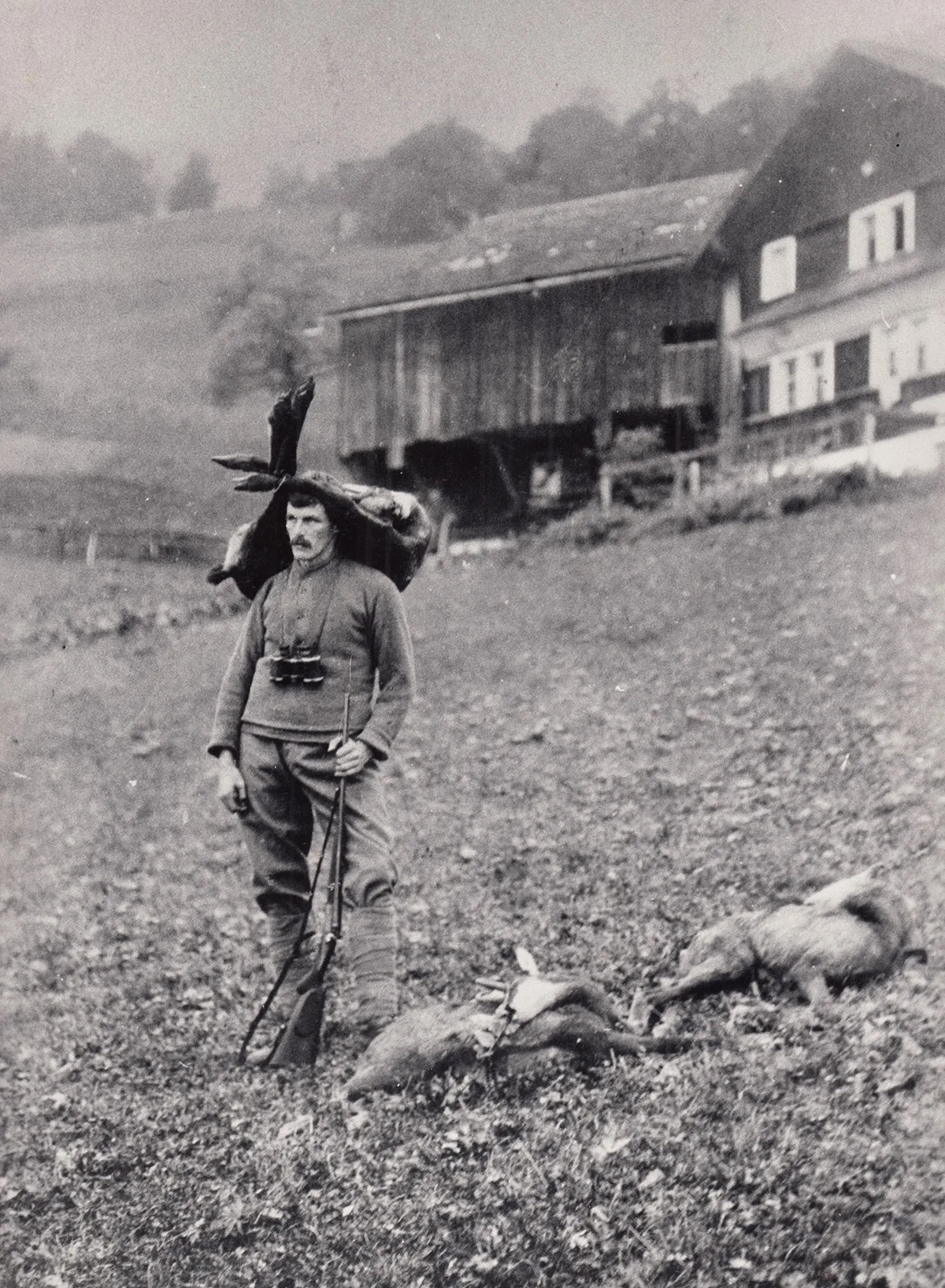
Ulrich Gantenbein with dead game in front of the Sandbühel farmhouse, undated photograph.
Ulrich Gantenbein with dead game in front of the Sandbühel farmhouse, undated photograph. Gantenbein family

Electric shocks and coercive hydrotherapy
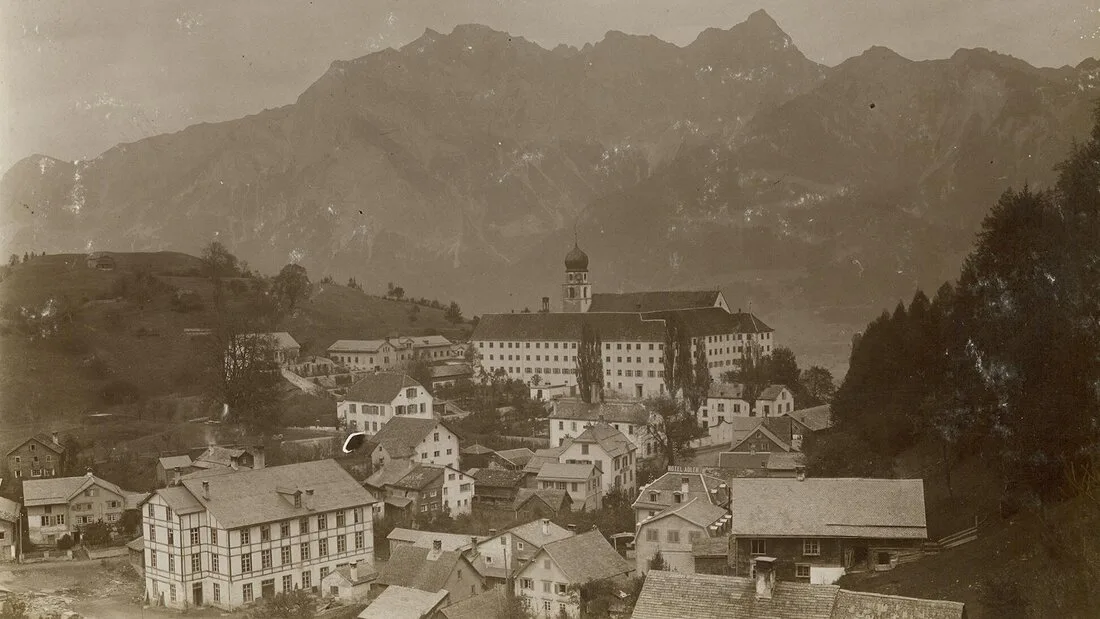
No sooner had Ulrich Gantenbein begun his confinement in Pfäfers in 1943 than the draconian treatment methods commonly used in psychiatric institutions at the time were inflicted upon him. He was subjected to continuous bathing, a form of therapy in which patients were forced to spend hours on end sealed inside an enclosed bathtub full of water. He was given electric shocks, in which electrical currents were passed through his brain, during which, records tell us, he fractured his teeth. Gantenbein managed to escape from the clinic, only to be caught and brought back.
The St. Pirminsberg psychiatric clinic in Pfäfers. This was where Maria Theresia Wilhelm and Ulrich Gantenbein were subjected to dubious therapies and punishments.
The St. Pirminsberg psychiatric clinic in Pfäfers. This was where Maria Theresia Wilhelm and Ulrich Gantenbein were subjected to dubious therapies and punishments. Sarganserländer newspaper
Husband and wife had meantime become reconciled and a fourth child was on the way. However, Resi was left to manage the running of the farm all on her own. The two wrote despondent letters to one another, but when he was released after six months it didn’t take long before she fled to the poorhouse once more.

In 1944, the local authorities had Ueli consigned to the workhouse. He was later placed in ‘administrative detention’, i.e. sent to prison without ever being tried and with no right of appeal, before being committed once more to a psychiatric facility. Left all alone and struggling to keep the family afloat, Resi had a nervous breakdown the following year. She too was admitted to the clinic at Pfäfers, where her electroconvulsive therapy began the very next day. The doctors also prescribed deep sleep therapy, numerous sessions of continuous bathing and other treatments which, according to the records, also invariably served as punishment for those displaying behavioural problems. The district authorities stripped the Gantenbeins of their parental authority. The children were placed with foster families or in homes, or sent to work on farms.
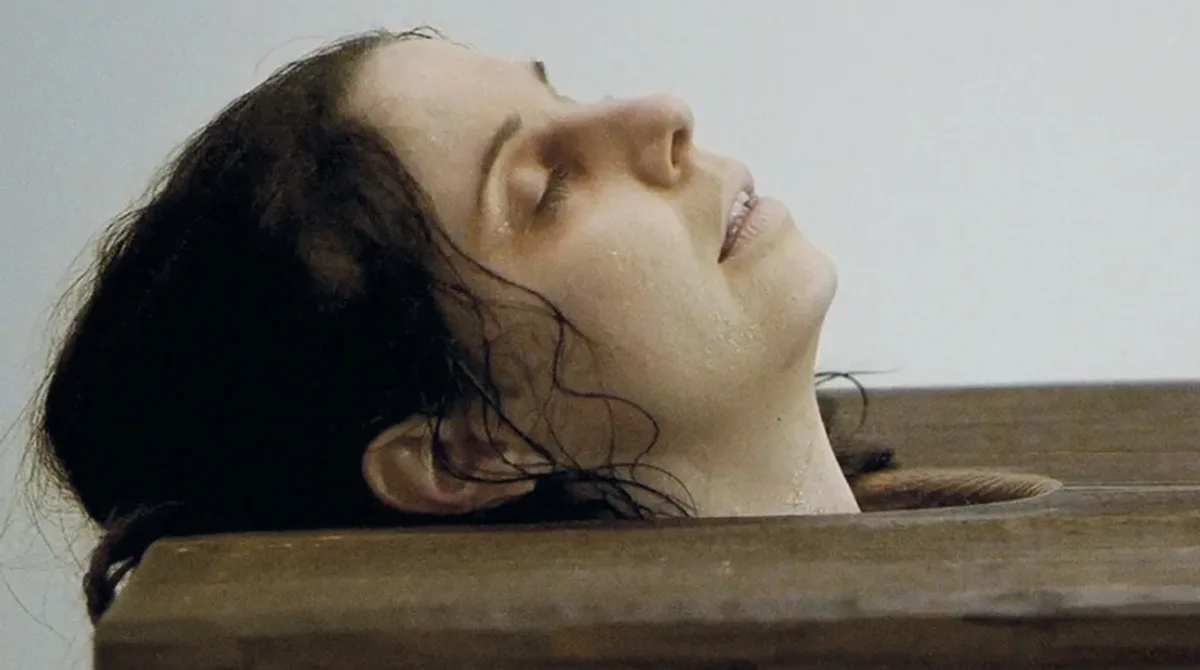
A form of therapy but also of punishment: still from the film “Das Deckelbad” (2014). The script was based on Maria Theresia Wilhelm’s story.
A form of therapy but also of punishment: still from the film “Das Deckelbad” (2014). The script was based on Maria Theresia Wilhelm’s story. Ascot Elite
Resi and especially Ueli repeatedly tried to escape from the institutions where they were being held, but they were caught time and again. Theresia Wilhelm had twins in 1947. Counting her daughter in Vorarlberg, she had now given birth to seven children, but these latest arrivals were also taken away from their mother.

Although in no way to blame for their parent’s situation, the Gantenbein children were subjected to compulsory social measures. Childhoods spent as despised and abused indentured labourers or unloved foster children scarred them for life. On one occasion, one of the sons was threatened by his master, who held a pitchfork to his neck and forced him to eat food from the dog’s bowl because he had stolen a pear to relieve his hunger.
One of Theresia Wilhelm’s daughters recalls her childhood and her parents’ fate (in German). SRF

Unexplained disappearance

In the summer of 1960, Maria Theresia Wilhelm, now divorced from Gantenbein, made her way from Grabs to the neighbouring village of Buchs to do a spot of shopping. She had been lobotomised at the cantonal hospital in Chur in 1950. In other words, part of her brain had been amputated in order to pacify her. In those days, such operations were mainly performed on women. When she nevertheless made a fuss, she was given further electric shocks in Pfäfers and subsequently made to take stronger psychiatric drugs. Only when she was unable to bear any more children was she released. She set off for Buchs five weeks later, never to return.

Ulrich Gantenbein was also eventually released. An expert opinion drawn up in 1953 suddenly found the bitterness he exhibited to be only human and all too understandable. From a medical point of view, it stated, there had never been a problem requiring therapy. He continued to search for Resi right up until his death, but he had as much success in finding her as we did many years later.
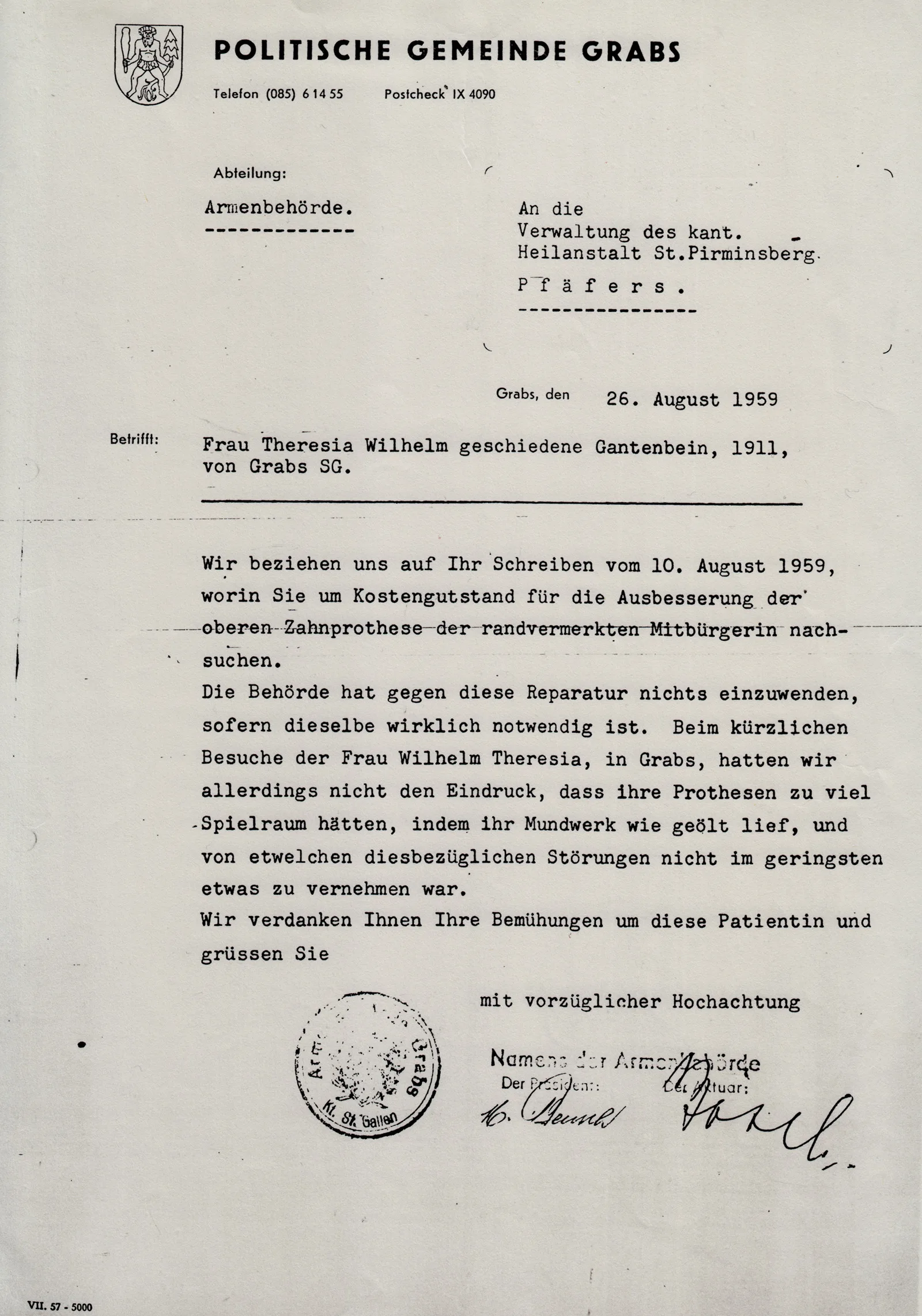
Letter from the authorities in Grabs, dated August 1959.
Letter from the authorities in Grabs, dated August 1959. Replying to a request to cover the cost of repairs to Maria Theresia Wilhelm’s dentures, the official in charge of poor relief wrote cynically that “there didn’t appear to be anything wrong with her mouth” on a recent visit. Gantenbein family

Just two of many

When David Gantenbein came back to Switzerland from Hamburg to find his mother, we asked the cantonal authorities of St. Gallen for access to both his parents’ records. We studied the notes made on their case histories along with welfare records. We spoke to people who were there on the scene in Grabs and Studnerberg at the time. And, with the assistance of a friendly psychiatrist, we were able to produce a series of newspaper reports plus a book, which became a best seller ‒ in Swiss terms. And so, the story of Maria Theresia Wilhelm and Ulrich Gantenbein was brought to light. Countless other cases remain hidden from view. The NRP 76 National Research Programme reported that several hundred thousand people – it is impossible to determine the exact number – had been affected by compulsory social measures and placements in the 20th century. Many of them experienced maltreatment, abuse and economic exploitation. They include children who were taken away from their families and placed in homes or with foster families, adults who were detained in institutions without having committed a crime, single women who were forced to give their children up for adoption, and people who were subjected to involuntary medical treatment or medical experimentation.

Further posts