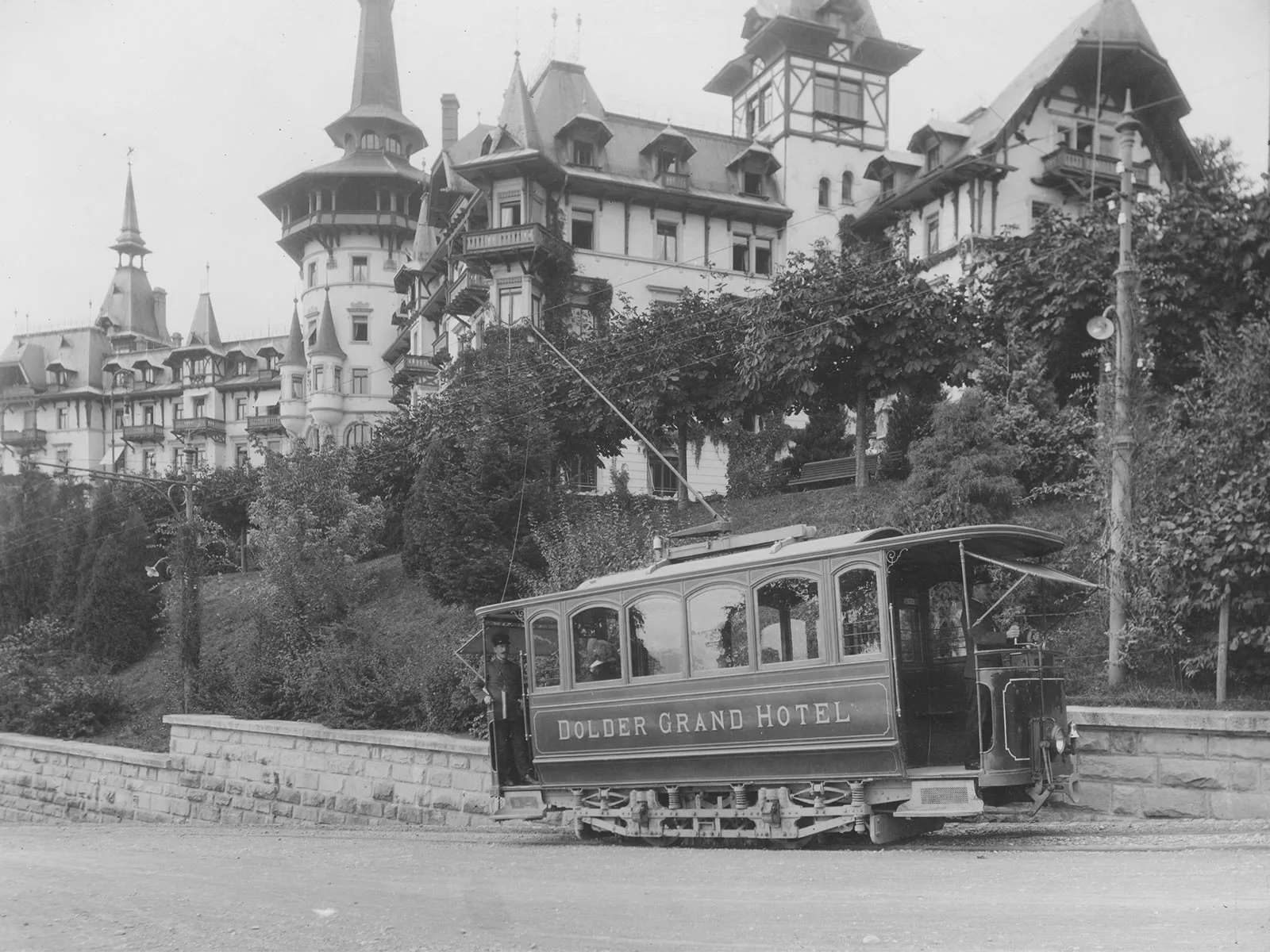
A photograph from 1905 of the Dolder tram on its way to the Grand Hotel high above the city of Zurich.
A photograph from 1905 of the Dolder tram on its way to the Grand Hotel high above the city of Zurich. Wikimedia / The Dolder Grand

Luxury hotel shuttles of yesteryear

During the Belle Époque, travel by privately owned car was more the exception than the norm. That’s why hotel buses or trams were a significant and popular means of transport for visitors.

Jürg Burlet

Jürg Burlet

Jürg Burlet is a historian and specialist in military history.

Special tram services transporting guests to hotels were once a common sight all over the world. However, most of them did not last until the 21st century. Only one of Switzerland’s five famous hotel trams survived into the new millennium, and even then only after a 40-year hiatus. Just a few photos and possibly some mementos are all that remain in most cases.
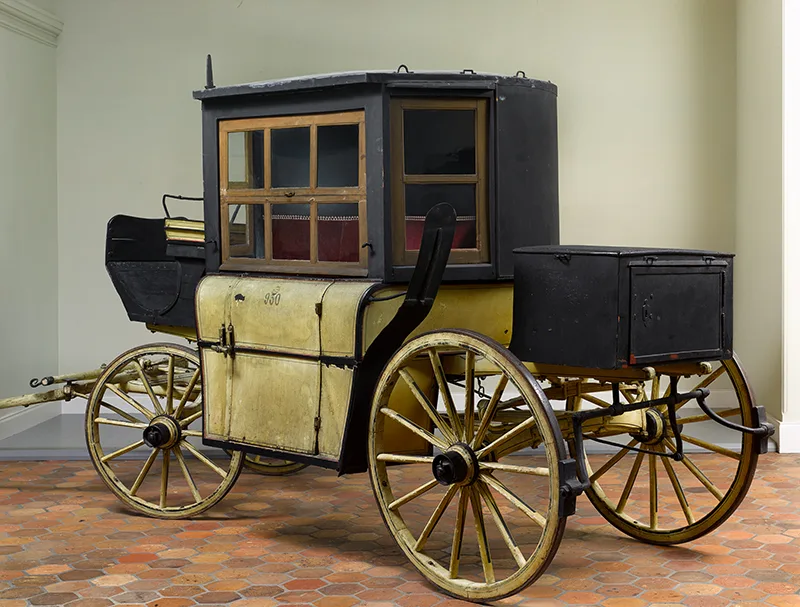
The rationale behind these hotel tram shuttles was primarily to provide a convenient means of transport to hotel guests transitioning from station to hotel, often laden with luggage. Other hotels also provided horse-drawn hotel omnibuses, which were once a popular means of transport. However, their use was not always compatible with the lie of the land. They were also rather costly to maintain, which is why the tram became the preferred means of transport. The best known examples are Tramway Bellavista on Monte Generoso, Pferdebahn Mürren (Mürren horse-drawn carriage), the Riffelalp tram, Doldertram and the tram from Aigle station to Aigle Grand Hôtel.

Tramway Bellav­ista

The oldest hotel shuttle was the 400-metre long horse-drawn tramway on Monte Generoso. It went from ‘Bellavista’ train stop to the Bellavista Hotel. The service commenced operations in 1891 and transported guests who had travelled from Capolago on the rack railway built in 1890 to their lodgings. The hotel was built by doctor and politician Carlo Pasta and featured a large dining room and a number of attractions including a telescope, library and billiard room.
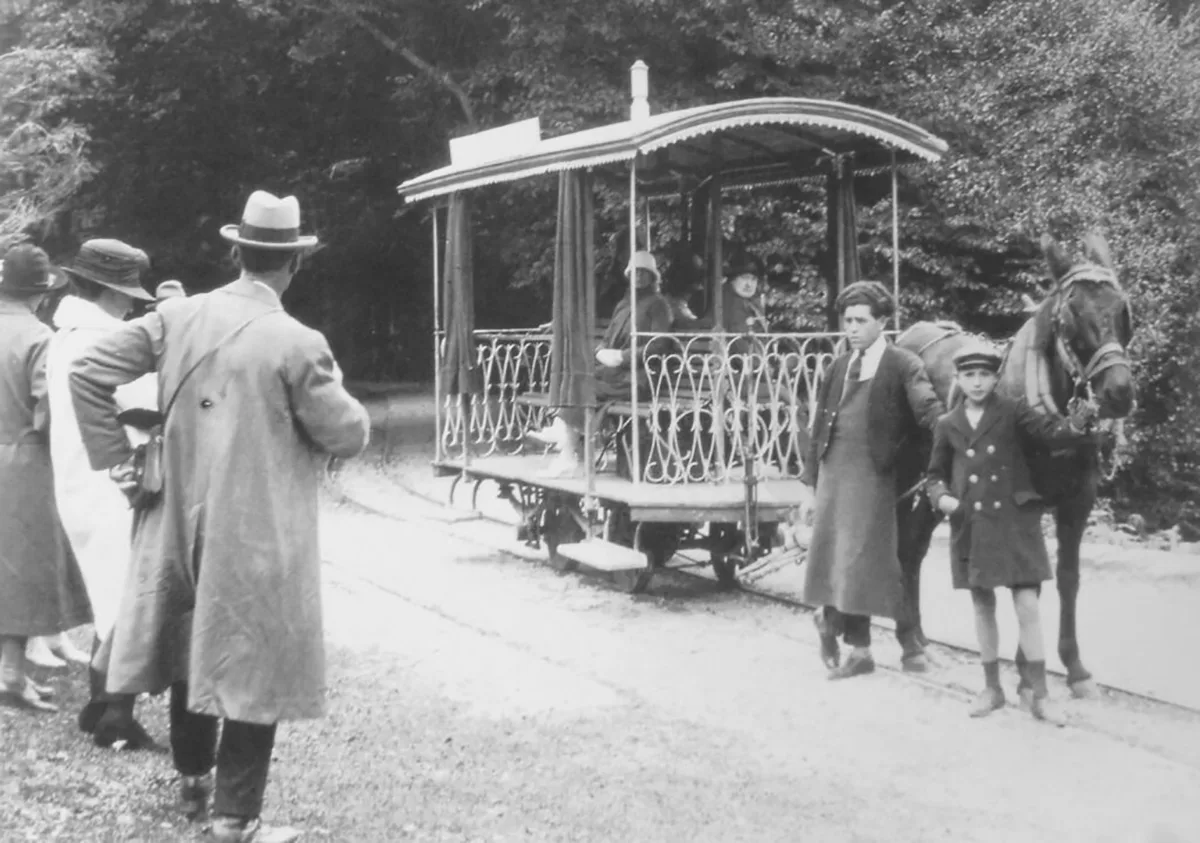
The Bellavista Hotel Tram, photographed in 1925.
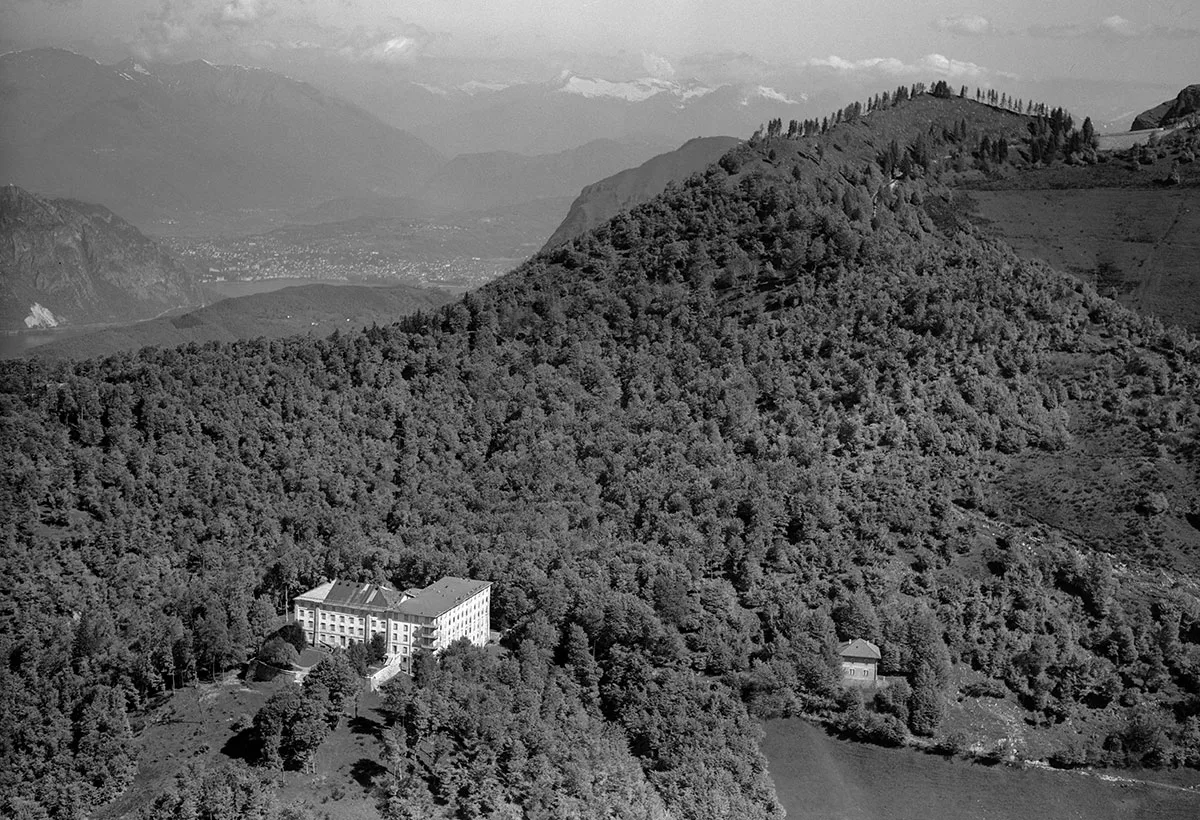
Aerial view of the Bellavista Hotel on Monte Generoso.
The ‘Tramway Bellavista’ took guests to the Bellavista Hotel. This establishment offered fantastic views plus many other conveniences. It was especially popular among the affluent and aristocratic classes. Wikimedia / e-pics
The track gauge was just 600 mm and there was no track switch or rail connection with the Monte Generoso railway. The only carriage (with twelve seats) was pulled up the mountain to the station by a horse. On the way down, the carriage simply ran downhill on the gentle gradient while a hotel employee controlled its speed with the handbrake. The horse was either tied to the back of the carriage or returned alone to the stable.
The horse-drawn tram became redundant after Bellavista station was connected to the road network in 1938. The hotel closed in 1974, fell into ruin and was demolished in 2000. The old track route is now a footpath and the building by the station has been converted into a restaurant.

Mürren horse-drawn tram

Tourism in Mürren, the mountain village in the Bernese Oberland on the west side of Lauterbrunnen valley, situated on a plateau opposite the three peaks of the Jungfrau, Mönch and Eiger, began in earnest with the construction of the Grand Hotel and spa and experienced its first tourism boom at the end of the 1870s. The Mürren railway opened in 1891 as a funicular with a maximum 60% gradient running from Lauterbrunnen to Grütschalp mountain station. Visitors to the spa hotel and tourists then took the just over four-kilometre long narrow gauge railway to Mürren.
Visitors took the funicular to Grütschalp station, then the narrow gauge railway. The final leg of the journey to the hotel was by horse-drawn carriage.
Visitors took the funicular to Grütschalp station, then the narrow gauge railway. The final leg of the journey to the hotel was by horse-drawn carriage. Swiss National Museum
The biggest establishment in Mürren, the Grand Hotel and spa built in 1870, set up a 455-metre long horse-drawn tramway with a 500 mm gauge in 1893 to transport visitors and goods from the station to the hotel. However, the hotel owner Johann Sterchi-Wettach had not thought to apply for a licence. He did file an application subsequently and it was granted on 13 April 1894. The tramway became officially operational on 10 July 1894. It had three vehicles, two goods vehicles and a passenger car built in Paris with eight seats on two longitudinal back-to-back benches. The carriage was designed for the summer weather as it didn’t run in winter and it had a roof and curtains on both sides as protection from the elements.
The hotel tram ran three to five times a day during the summer season. Photo taken in the late 19th century.
The hotel tram ran three to five times a day during the summer season. Photo taken in the late 19th century. e-pics
The tram service stopped transporting people in 1930 but was still used for goods transport up to 1937. The tracks remained in the road for a while after the route ceased operating. The Grand Hotel and spa then closed its doors in 1945 as it had fallen into disrepair and was in need of renovation. The licence for the horse-drawn tramway expired in the same year. The hotel buildings were demolished in the 1950s but the tracks stayed in the streets of Mürren until around 1965 when they were finally removed during roadworks.

Electric tram to Riffelalp

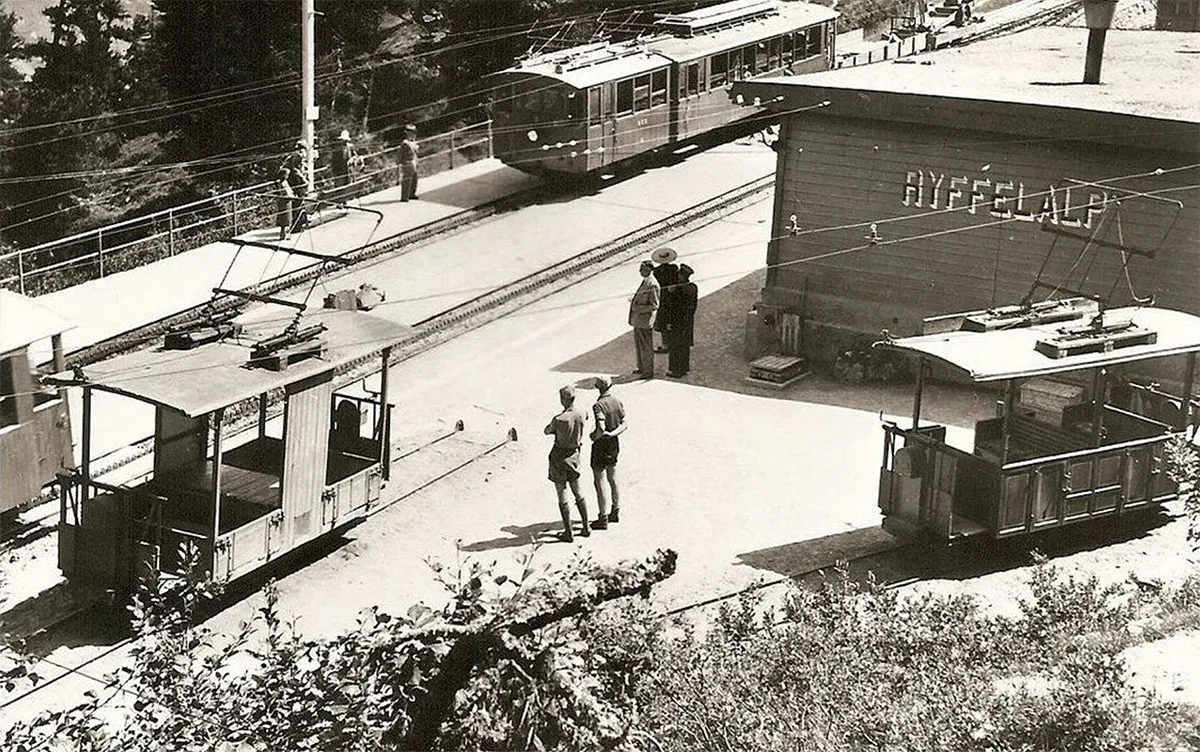
Hotel pioneer Alexander Seiler built the 150-bed Grandhotel Riffelalp from 1874 to 1884 on the Riffelalp near the railway line from Zermatt to Gornergrat. The hotel was extended to 200 beds in 1890 and then to 280 beds some years later when it absorbed two annexes. To link the Gornergrat railway with the hotel, the Riffelalp tram opened on 13 July 1899, probably Europe’s shortest and highest electric tramway. It was 469 metres long with a gauge of 800 mm. The two carriages (one for people and one for goods) were powered by electricity.
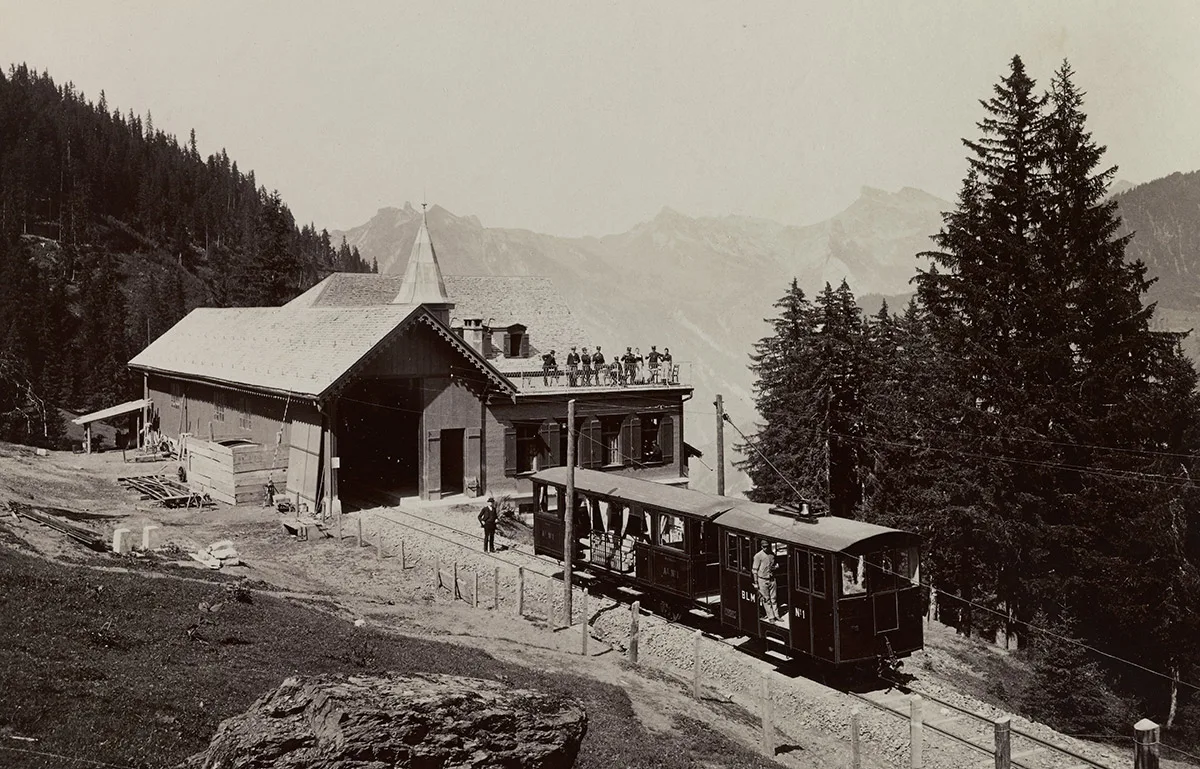
The Gornergrat railway (in the background) transported visitors to Riffelalp. They then changed to the waiting trams.
The Gornergrat railway (in the background) transported visitors to Riffelalp. They then changed to the waiting trams. Gornergrat railway, Zermatt
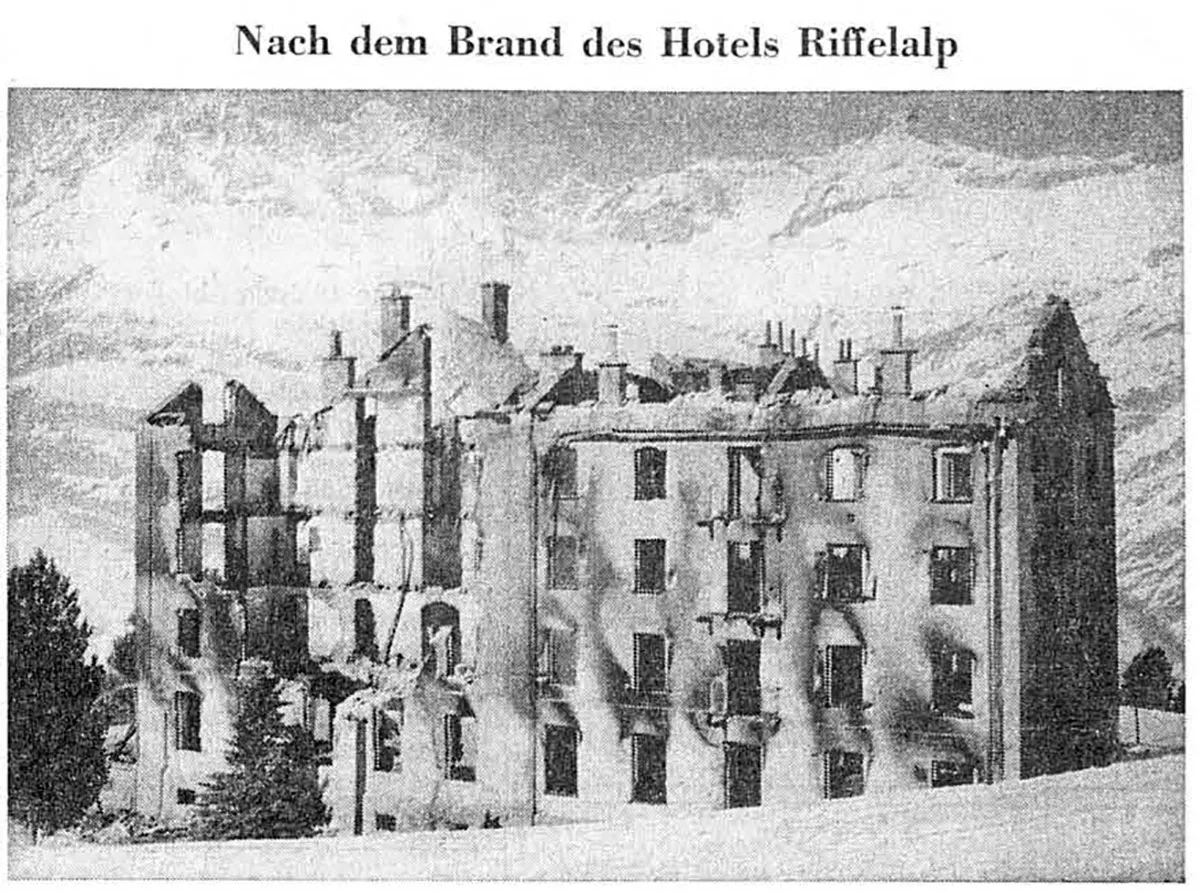
The management of Hotel Riffelalp recognised the tourist potential of the winter season in the 1950s and decided they wanted to keep the hotel open for business in the winter. It was while they were fully engaged in completing the winter installations that a fire ravaged the premises in mid-February 1961. It entirely destroyed the main building and led to the temporary decommissioning of the Riffelalp tram which, although it wasn’t damaged, had lost its destination.
Image of the ruins in NZZ newspaper on 17 February 1961.
Image of the ruins in NZZ newspaper on 17 February 1961. e-newspaperarchives
Construction on a new hotel finally started in 1998, which gave the tram a reason to start running again. The tracks had to be relaid as they had remained unused for so long. On 15 June 2001, it was finally ready. The track width was maintained and the length was extended to 675 metres and equipped with a turning loop. The revamped shuttle service was equipped with three rail vehicles, the two restored motor vehicles for transporting passengers plus the addition of a trailer for goods and luggage. It was battery powered with a three-phase current. The overhead cable could not be rebuilt due to legal requirements that had been passed while the tram was decommissioned.
A trip on the new Riffelalp tram. YouTube

The Dolder tram

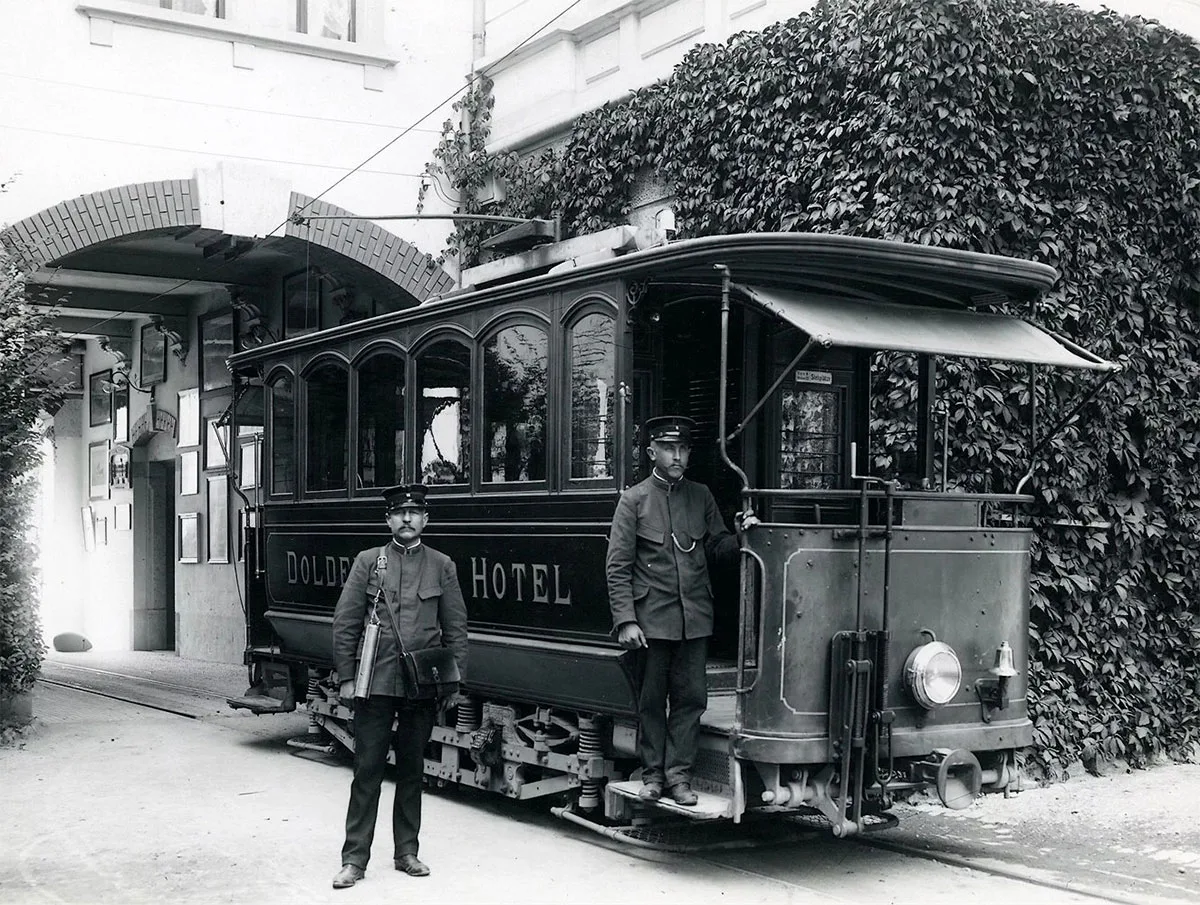
The Grandhotel Dolder located high above Zurich city originally opened as the Dolder Grand Hotel & Curhaus in 1899. It had 220 beds and a telephone, telegraph machine and shared bathrooms. In 1895, just four years earlier, the ‘Dolderbahn’ funicular (which was converted to a rack railway in 1973) connected Adlisberg to Zurich. The funicular quickly became very popular with hotel guests and the general public. The hotel had its own tram shuttle to transport people from ‘Bergstation Dolderbahn’ to the hotel located more than half a kilometre away. On 5 July 1899, the tram became operational as an electrically powered vehicle with a metre gauge and a track length of 637 metres. The track ran along Kurhausstrasse to the hotel.
The Dolder tram railcar with two employees. Photo taken in 1906.
The Dolder tram railcar with two employees. Photo taken in 1906. Wikimedia / Arthur Meyer Collection
The tram had one two-axle Ce 2/2 railcar. It was structurally identical to the carriages of ‘Städtische Strassenbahn Zürich’ (Zurich transport company), which was also responsible for the maintenance work on the Dolder railcar and provided a replacement vehicle when the work lasted longer than usual. However, the single track was not connected to the rest of Zurich city tram network.
This special tram with its single red motor vehicle with no number, only ran during the season from April to October until 1914. The route was shortened to the hotel terrace when the establishment was renovated in 1924/1925. On 31 December 1930, the tram was replaced by the hotel bus service.

Aigle: from platform to hotel bed

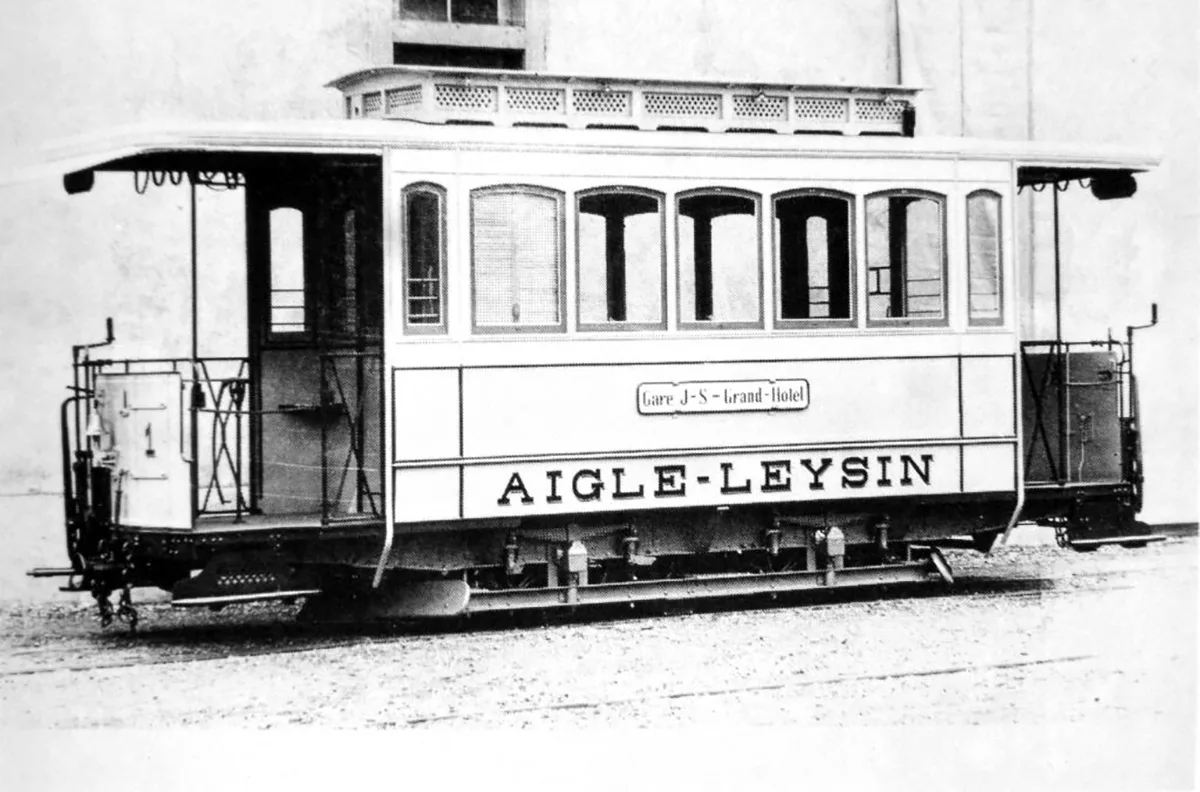
The most recent hotel tram shuttle (apart from the revived Riffelalp tram) ran from the former Aigle station of Jura Simplon Railways (Aigle CFF train station from 1902) in the canton of Vaud to the Grand Hôtel des Bains d’Aigle. The hotel itself opened in 1872, but the 900-metre line serving it only began operating on 5 May 1900. It formed part of the metre-gauge street tramway between Aigle station and the Aigle depot of the Aigle–Leysin railway. Locals simply called this street section the Tram Aigle.
The shuttle to the hotel ran from 1900 to 1932. When visitors stayed away during the Great Depression, the hotel closed in 1934 and was used to accommodate refugees and troops during the Second World War. The hotel was demolished in 1947, just two years after the tram track had been dismantled.
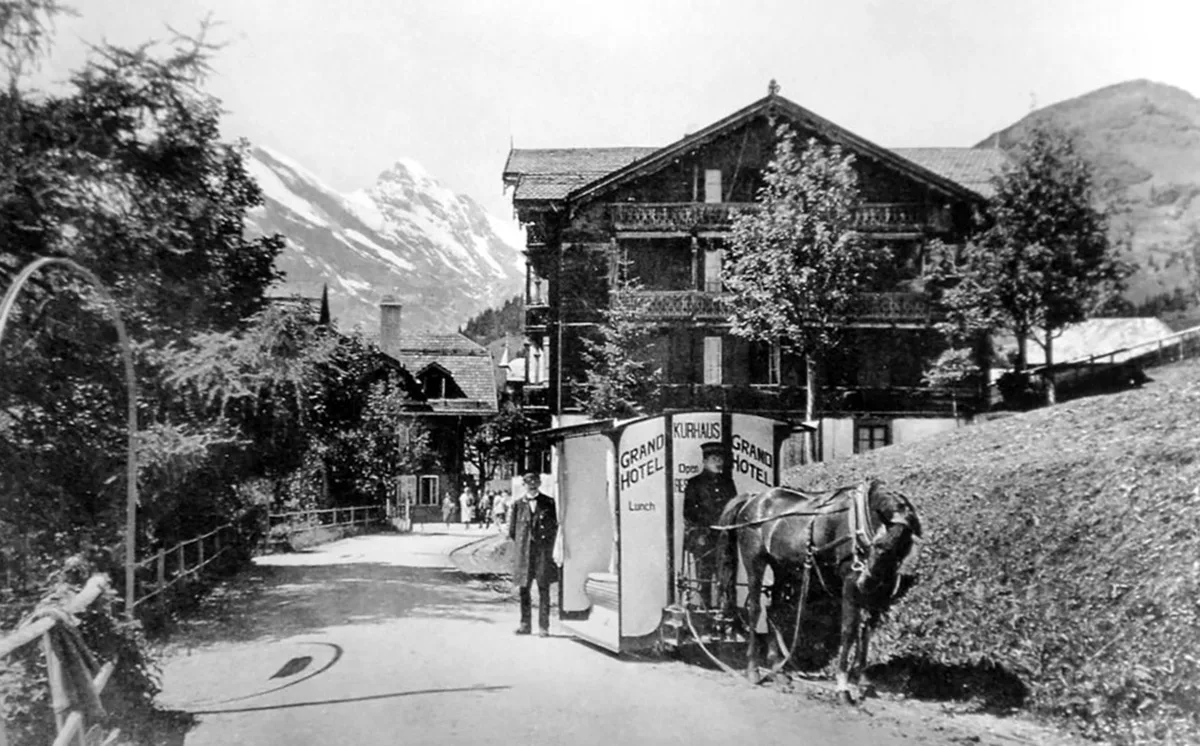
The Aigle hotel tram ran from 1900 to 1932 and transported visitors straight from the station to the Grand Hotel.
The Aigle hotel tram ran from 1900 to 1932 and transported visitors straight from the station to the Grand Hotel. Wikimedia
It’s hard to imagine now that trams once ran practically to the hotel entrance. But they did, and it was something of a sensation at the time. British writer E.W. Hornung commented on how unusual this form of arrival was when he described the Riffelalp tram as a “tiny train” in 1903, which transported visitors and their luggage straight to the hotel door. The hotel trams were symbols of progress and heralded a new age of tourism.

Further posts