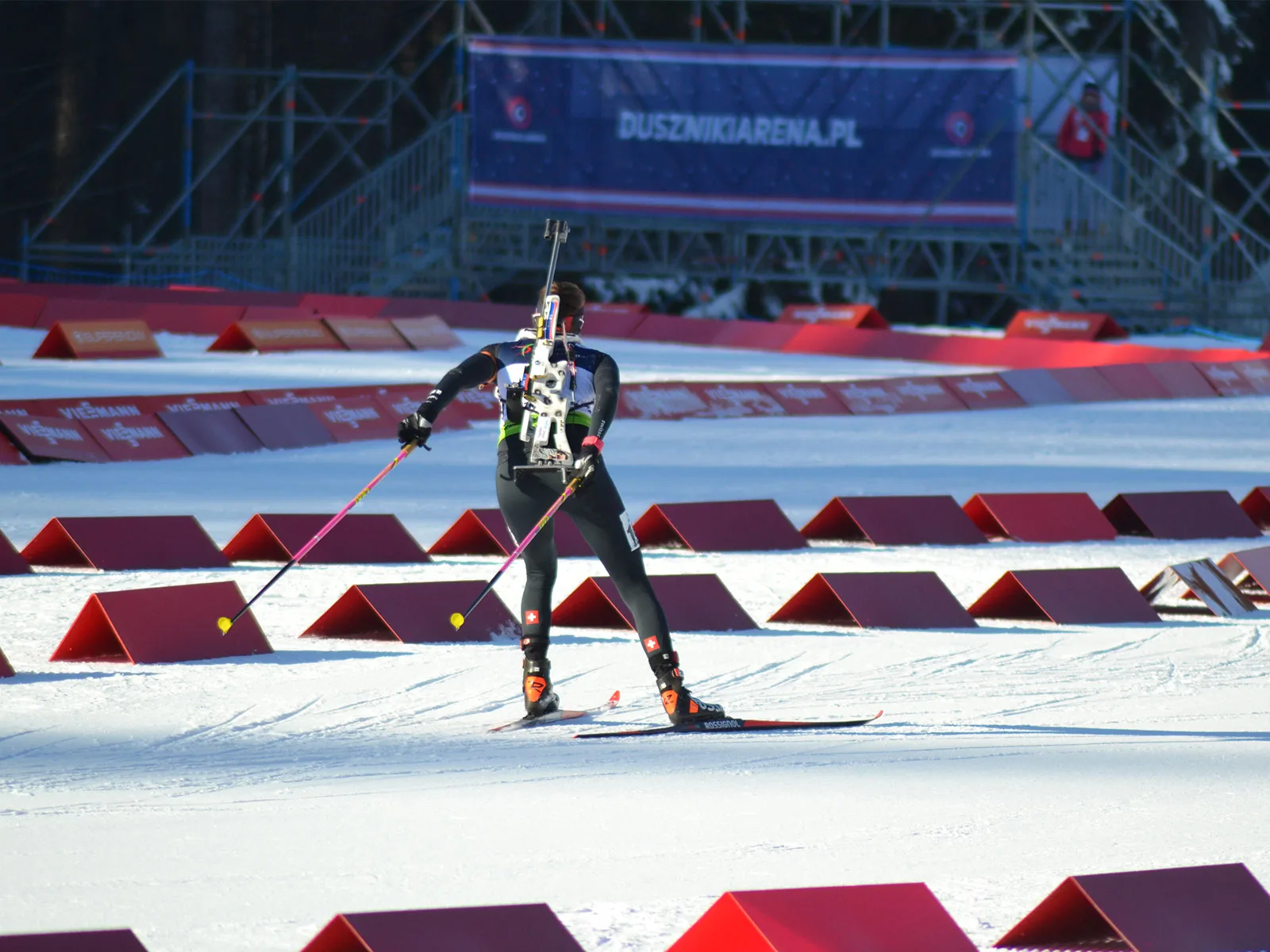
Aita Gasparin from Graubünden has been on the Swiss national biathlon squad since 2011.
Aita Gasparin from Graubünden has been on the Swiss national biathlon squad since 2011. Wikimedia

Biathlon in Switzerland: a tale of difficult beginnings and missed opportunities

Biathlon sounds like a sport tailormade for Switzerland. Shooting at targets while on cross-country skis fits perfectly with the definition of the country’s self-image as a nation of skiers ready to rise in defence of their land. However, it has never really taken off in Switzerland, unlike in Germany or Scandinavia. Why is that?

Michael Jucker

Michael Jucker

Michael Jucker is a sports historian, head of Swiss Sports History and co-director of the FCZ Museum.

The men’s and women’s biathlon is currently under way at the Winter Olympics. It is a sport that still struggles for recognition in Switzerland, despite the popularity and long tradition of winter and shooting sports in the country. The history of biathlon in Switzerland is a tale of false starts and misunderstandings not seen elsewhere: the sport has had to jockey for position with other disciplines, which are similar but based on another tradition.
Biathlon featured at the Olympics for the first time in 1960 in Squaw Valley. Switzerland, a nation of skiers and shooters, was notable by its absence from the event, which sounds ridiculous now and received widespread criticism in the media, as Switzerland already had everything it needed to promote the sport: “There is nothing out of the ordinary about a competition involving skiing and shooting for us – after all, Switzerland is the land of ski patrols!”, was how Der Bund newspaper summed up the situation on 27 March 1960.
Sweden’s Klas Lestander won the first Olympic gold for the biathlon in 1960. YouTube
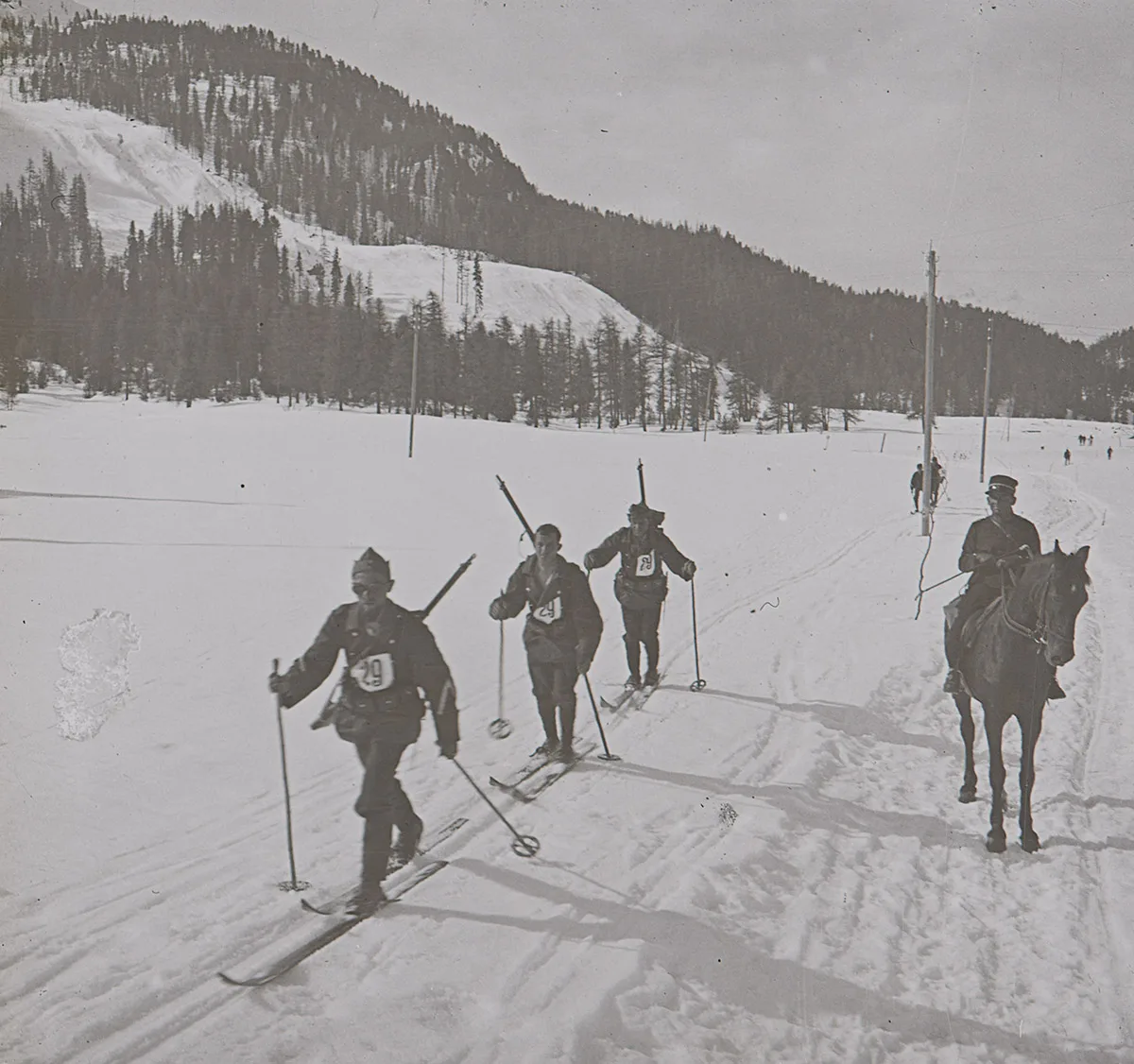
The ski patrol referred to in the newspaper article was a Swiss tradition going back almost 60 years comprising a skiing and shooting competition with heavy calibers. Back in the late 19th century, the Gotthard soldiers in the Andermatt barracks were equipped with skis and competitions were held there from 1902. Seven years later, the competitions were officially advertised as military ski patrols for groups of soldiers. The expansion of the Gotthard fortification up to 1920 added substance to the image of the soldier on skis and ready for action at the mountain redoubt.
Ski patrol competition in Engadin in 1916.
Ski patrol competition in Engadin in 1916. Swiss National Museum
However, the patrols failed to evolve into an elite sporting event because Swiss Ski (or the Swiss Ski Association as it was known then) withheld recognition from military sports disciplines from 1936, which obliged the armed forces to hold their own championships. These took place in Andermatt. Swiss ski patrollers never failed to deliver at a national and international level, whether in the World Military Championships (CISM) or at the 1948 Olympics in St. Moritz, where a military patrol was held as a demonstration sport, with Switzerland coming in first ahead of Finland and Sweden.
The demilitarisation of Olympic sport took place later on, when the International Olympic Committee (IOC) distanced itself from military events and removed ski patrols from its programme. The Swiss media was therefore surprised to see the biathlon brought in as an Olympic event in Squaw Valley. The media and many in the armed forces understandably interpreted this as a resumption of the military competition. However, theirs was not the sole interpretation, and the sport did not have the same military connotations outside Switzerland. The Swiss saw the event as being based on their military ski patrols around the National Redoubt (defensive mountain fortifications). However, the IOC and especially the IBU (International Biathlon Union) founded in 1993 actively promoted another narrative. They saw the origins of the biathlon in Stone Age hunting, drawing on Norwegian cave paintings. Of course, this picture was not entirely coherent either: the international associations overlooked the military links of the Scandinavian and Russian ski regiments.
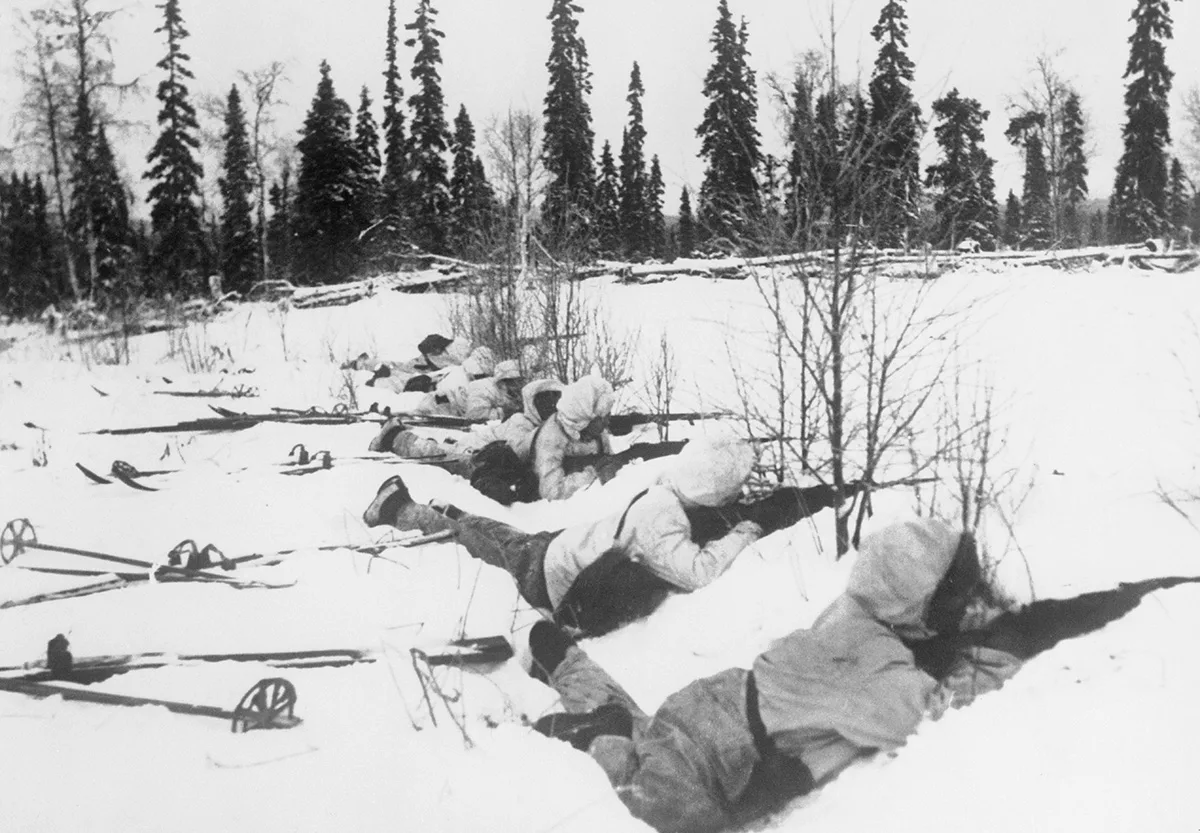
A Finnish ski patrol in the 1940 winter war against the Soviet Union.
A Finnish ski patrol in the 1940 winter war against the Soviet Union. Wikimedia
Nonetheless, the Swiss armed forces were not deterred and just a few weeks after the Squaw Valley Games in which Switzerland failed to make its mark, they organised biathlon competitions in Sörenberg (canton of Lucerne). However, the idea was not to establish a new discipline but to test recruits to determine whether they were fit to serve in the Swiss army. So, the military aspect was central, meaning that only members of the armed forces were eligible. Women were therefore obviously excluded and the results were not great. The exhausted soldiers rarely hit the small targets the size of a 5-franc coin, as they were used to much bigger targets on their own patrols. The Swiss biathletes accordingly focused on their shooting training. Still it was not enough to notch up any victories at the CISM World Championships in Andermatt in 1961 (where biathlon was an event).
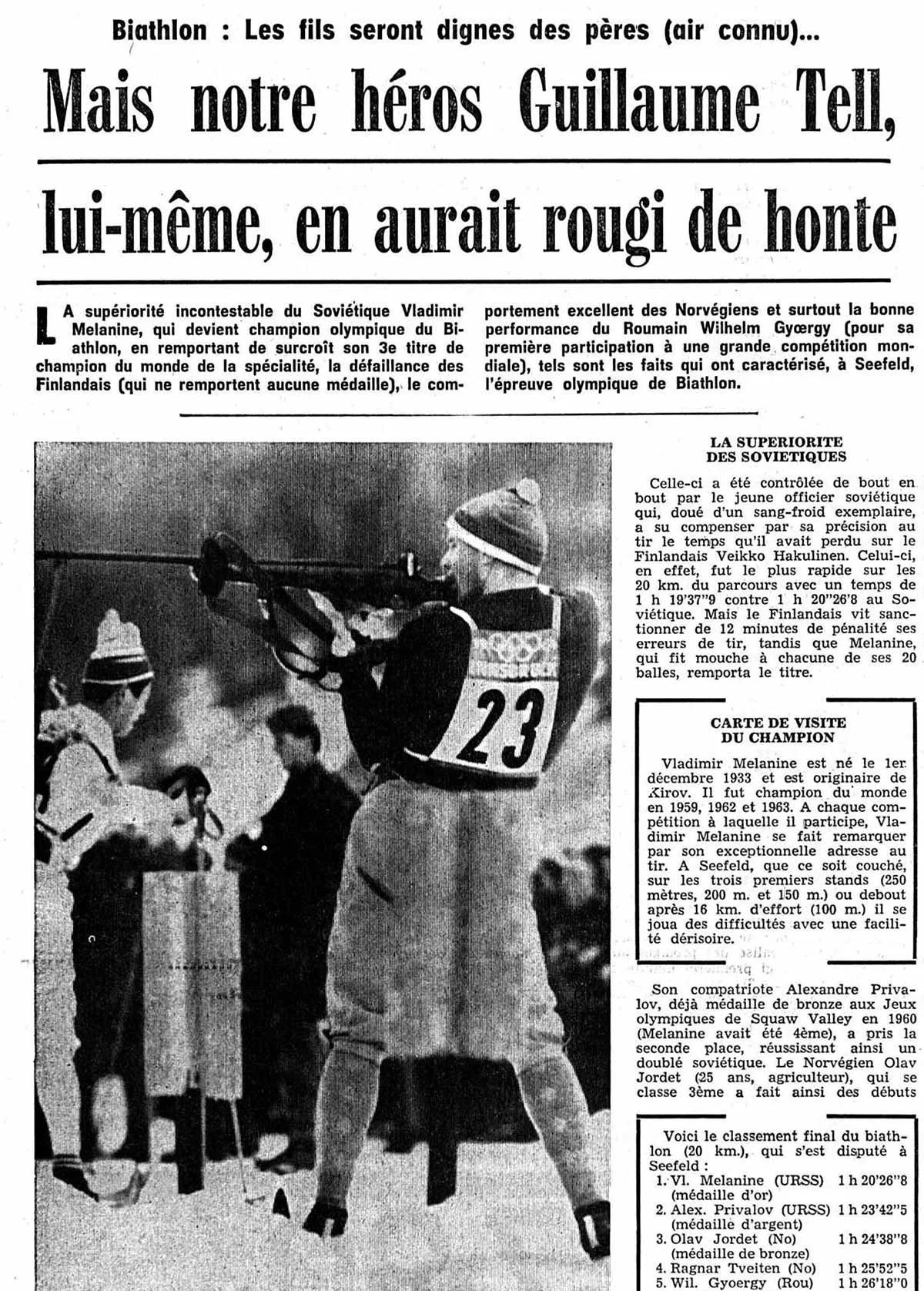
This did not help the country’s self-image as a skiing and shooting nation. There was no change  during the ensuing years either. Valais newspaper Nouvelliste du Rhône summed it up as follows: “Biathlon: the sons live up to the legacy of their fathers (familiar theme)… But our hero William Tell,  would have blushed in shame.” In other words, William Tell would have been ashamed of the country’s sporting prowess, or lack thereof. Switzerland’s sporting identity crisis came to a head in 1964 when the country failed to medal at the Innsbruck games. So, was the biathlon with its demands for endurance and sharpshooting possibly unsuited to the sons of William Tell?
Even William Tell himself would have blushed in shame. Article in Valais newspaper Nouvelliste du Rhône in February 1964.
Even William Tell himself would have blushed in shame. Article in Valais newspaper Nouvelliste du Rhône in February 1964. e-newspaperarchives
The shame of the Innsbruck games galvanised policymakers and sporting associations, leading to calls for change in sports funding policy. In answering a question by Bern National Councillor Erich Weisskopf (FDP), who wanted more backing for the biathlon at a national level, the national government said the following in March 1964: “The biathlon, contrary to the assertion by the questioner, is not a military competition but a civilian sport comprising cross-country skiing and shooting.” State support was thus not an option. The Federal Council feared that the interpretation of the biathlon as a military sporting discipline could disrupt backing for the traditional armed forces winter sports.

Promotion of sport for defence purposes
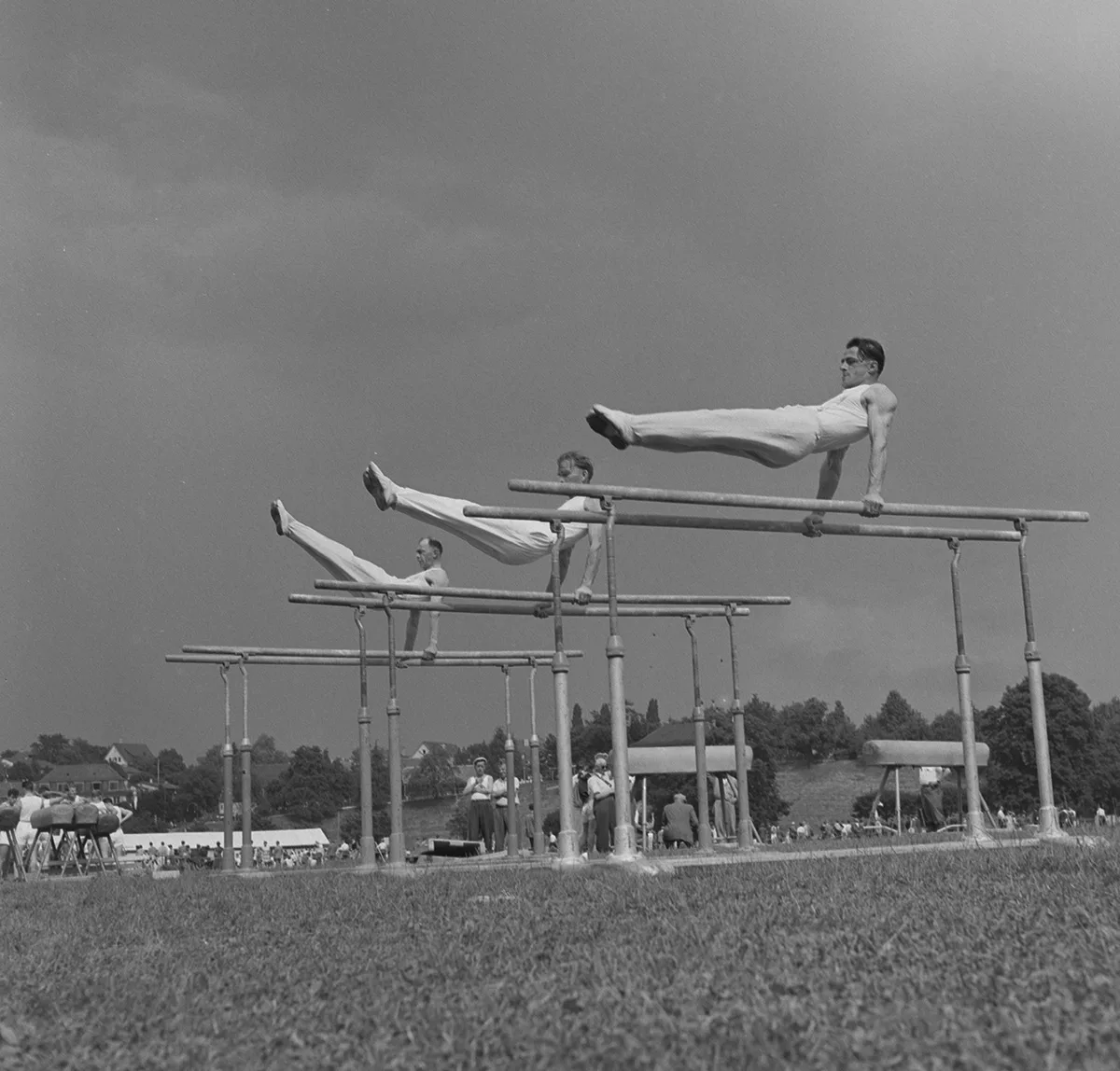
The main reason for withholding funding, however, was because the Confederation only supported sports seen as relevant in training soldiers to defend the nation. The Federal Council did not see the biathlon as having any military relevance, considering it instead as part of the growing international popularity of traditionally military winter sports. However, other sports like swimming or apparatus gymnastics received financial backing for years and they seemed a lot more detached from military skills than biathlon. In 1964, the national government thus let an opportunity slip. While the biathlon was already receiving state support in Scandinavia, Germany and other countries like France, it took a long time before Switzerland, the country of skiing and shooting, followed their lead.
Apparatus gymnastics like this event at Sonvilier in 1955 received financial backing from the federal government. Biathlon did not.
Apparatus gymnastics like this event at Sonvilier in 1955 received financial backing from the federal government. Biathlon did not. Swiss National Museum / ASL

It was not until the 1995 junior World Championships in Realp (canton of Uri) that biathlon received a much-needed shot in the arm. The country’s first biathlon track was set up in the Uri mountains. As these world championships had originally been scheduled for Lenk (canton of Bern), the infrastructure was not initially designed to meet the complex training requirements of the athletes; it was more of a short-term temporary measure than a properly designed and adequately sized facility. The building permit had only been granted the previous summer. Trees were felled to make way for the facility and WWF Uri intervened, turning the project into something of a political hot potato in the local area. The facilities ended up being built before final approval had been granted.
The Realp facility marked a watershed in the long-term evolution of biathlon in Switzerland. It was ideally located in the vicinity of the new Andermatt army sports centre and well protected from the Föhn mountain wind. The temporary facility was replaced by a more modern track in August 2002, which was also suitable for summertime training. The project was extremely important for the Urseren valley as the army kept downsizing its presence there, which was affecting jobs in the area.
The new facility plus the founding of the Federal Office of Sport in Magglingen in 1998, and the new Sport Promotion Act of 2011, which mentioned elite sports promotion for the first time, created the optimum conditions to prevent a repeat of the Squaw Valley and Innsbruck debacles. Switzerland had initial successes with a third-place finish for Matthias Simmen from Uri at the 2008 Summer World Championships and there were more podium finishes between 2005 and 2011. The Gasparin sisters, Amy Baserga, Lena Haecki-Gross, Benjamin Weger and Niklas Hartweg also achieved excellent rankings as well as winning medals after the turn of the millennium. Selina Gasparin even won silver in the individual event at the 2014 Sochi winter games.
Profile of Matthias Simmen from ‘Sportpanorama’ from 9 January 2005 (in German). SRF
In the meantime, promotion of the sport extended to youth level, notably due to Swiss Ski recognising the Swiss Biathlon Association, which had experienced hard times and financial difficulties. The armed forces also began indirectly supporting biathlon, for example by training military personnel. This provided an excellent opportunity, especially for women, to establish themselves in elite sport.
Biathlon definitely has scope to progress further as an elite sport in Switzerland. A nation of skiers and sharp shooters, conditions in Switzerland have always been conducive to biathlon excellence. The narrative of soldiers on skis helped embed the biathlon in Switzerland’s national identity. At the same time this image and its connection to the country’s National Redoubt proved a hindrance to developing biathlon into an elite sport. Army officers and the Federal Council did not see biathlon as benefiting the country’s defensive capability. As a result, the Swiss failed to move with the times and stuck with their military sports and ski patrols instead. It was only when the biathlon track was set up in Realp, which was later developed into a premier national sports centre, elite sports promotion was introduced (which happened late by international comparison) and, more recently, the biathlon World Cup-approved arena in Lenzerheide was completed that real progress was made. In the meantime, this exciting and demanding sport has attracted a broad public, private donors and powerful sponsors, which augurs well for future biathlon medal hunters.

Swiss Sports History

This text was produced in collaboration with Swiss Sports History, the portal for the history of sports in Switzerland. The portal focuses on education in schools and information for the media, researchers and the general public. Find out more at sportshistory.ch
Further posts