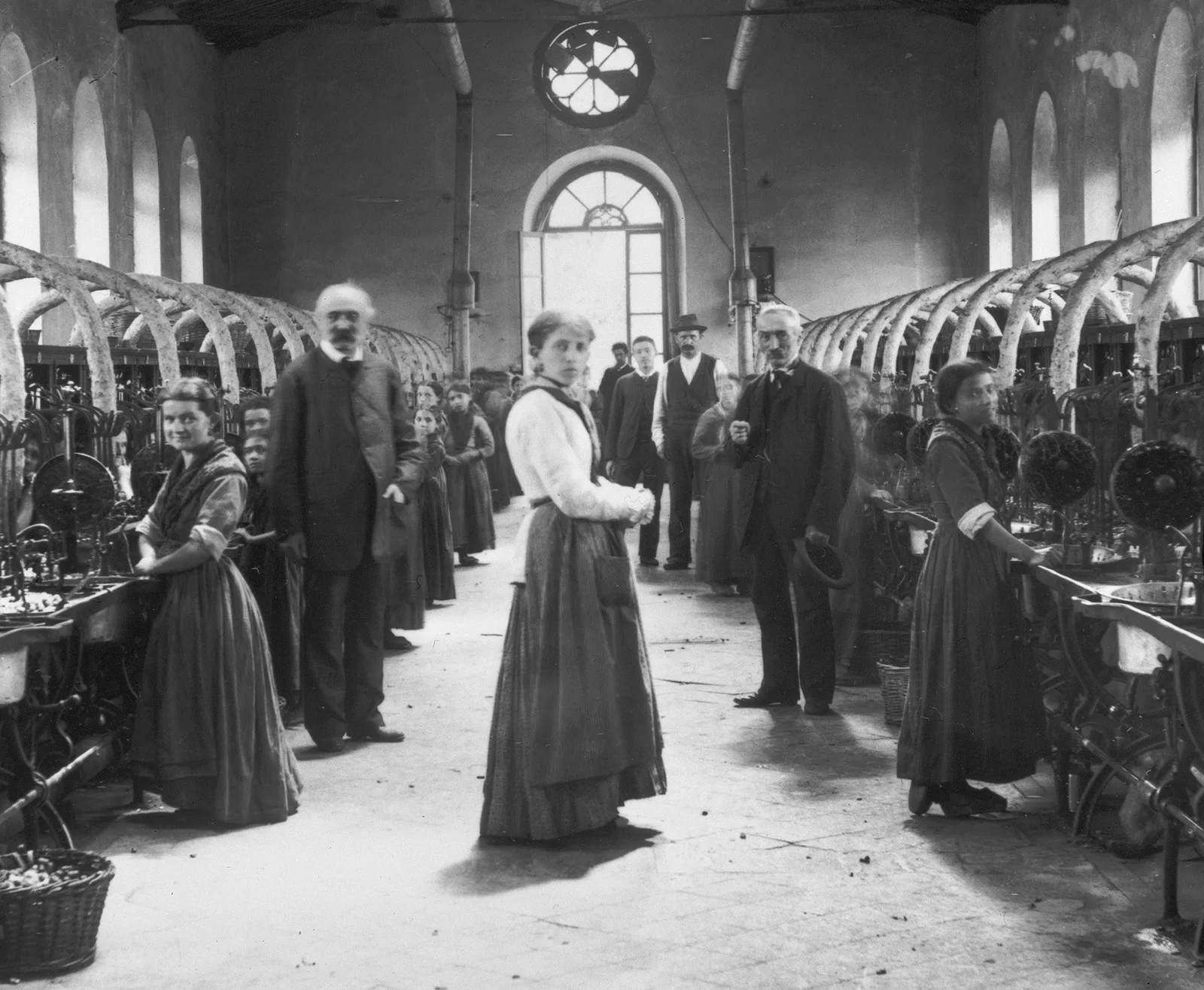
Children at work in a silk-spinning mill. Photo by Rudolf Zinggeler-Danioth, circa 1890-1936.
Children working in a silk spinning mill. Photo by Rudolf Zinggeler-Danioth, circa 1890-1936. Swiss National Museum

When children toiled in factories

A strange alliance of capitalism and Catholicism allowed children to be exploited on a massive scale – not that long ago, but in the 19th century, in the heart of Switzerland. Up to 16-hour working days were completely normal.

Michael van Orsouw

Michael van Orsouw

Michael van Orsouw has a PhD in history and is a performance poet and author. He regularly publishes historical books.

The modern historian would only too readily tell the story of 11-year-old factory child Maria Gwerder who worked up to 16 hours a day at the spinning mill in Neuägeri. Or recount the life of 12-year-old Anton Bossard, who, after a long day’s work in the factory, then had to mop the corridors, peel potatoes and dig the garden of the workhouse.
But the source material on child labour from that time is so scant that while these children are invented, their stories are definitely not. This is because the children themselves did not have the time or the energy to write about their extremely hard lives. Even so, there are reports about daily life in the workhouses for children. Nonetheless a certain amount of caution is needed regarding these sources as the reports were all written by men who were directly involved and who attempted to justify their actions by glossing over the details.
These institutions were a pioneering achievement of Swiss economic history, albeit a highly dubious one. In 1855, Switzerland’s first child labour institution – the ‘Erziehungs- und Arbeitsanstalt am Gubel’ – was set up in the canton of Zug. It housed up to 100 children aged between 12 and 18 who worked in the nearby spinning mill in Neuägeri – half during the day and the other half at night. Sister Luzia Hemmi and three fellow nuns from the Sisters of Holy Cross Menzingen religious congregation were responsible for daily life and looking after the children.
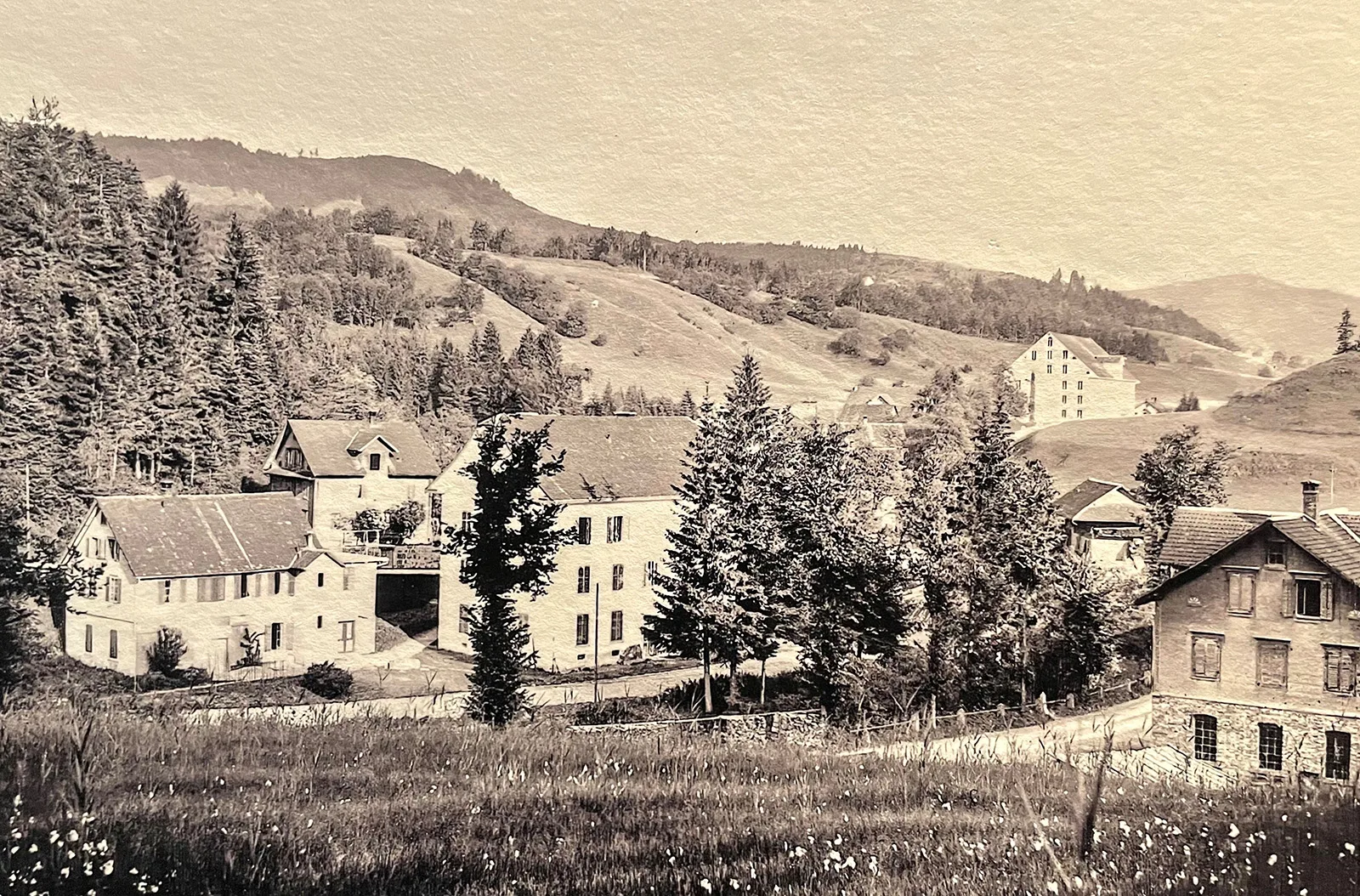
‘Erziehungs- und Arbeitsanstalt am Gubel’ education and labour institution (centre) in Neuägeri, with the spinning mill in the background. The children lived in the building behind the tree. 1900–1913.
‘Erziehungs- und Arbeitsanstalt am Gubel’ education and labour institution (centre) in Neuägeri, with the spinning mill in the background. The children lived in the building behind the tree. 1900–1913. Staatsarchiv Zug

A different kind of alliance

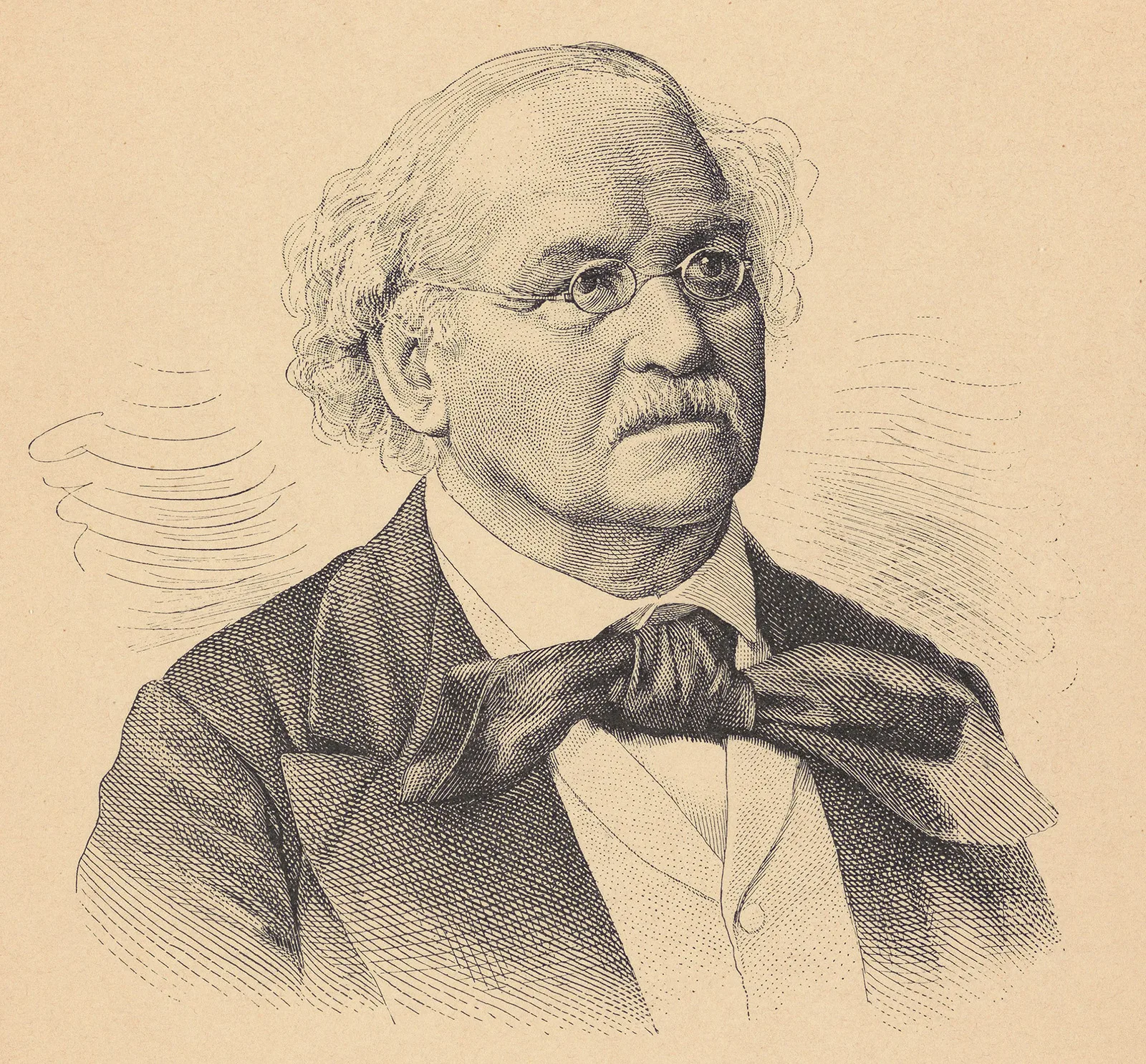
The model was based on a canny alliance of Catholicism and capitalism. Its initiator was Capuchin friar Theodosius Florentini (1808–1865). This restless social reformer recognised how factory work alienated people. Instead of becoming an opponent of large-scale industry, Father Theodosius sought a third way: one that aimed to combine Christian charity with profitable business. His solution was to make the factories into monasteries. His idea was that people should not only slave away in the production halls, but also pray, according to the biblical motto of ‘ora et labora’ or ‘to work is to pray’. The Sisters of the Holy Cross Menzingen had been established on Florentini’s instigation, and the director of the Erziehungs- und Arbeitsanstalt am Gubel was Lukas Businger, one of his disciples. And so it all came together as the textile industrialists were more than willing to participate.
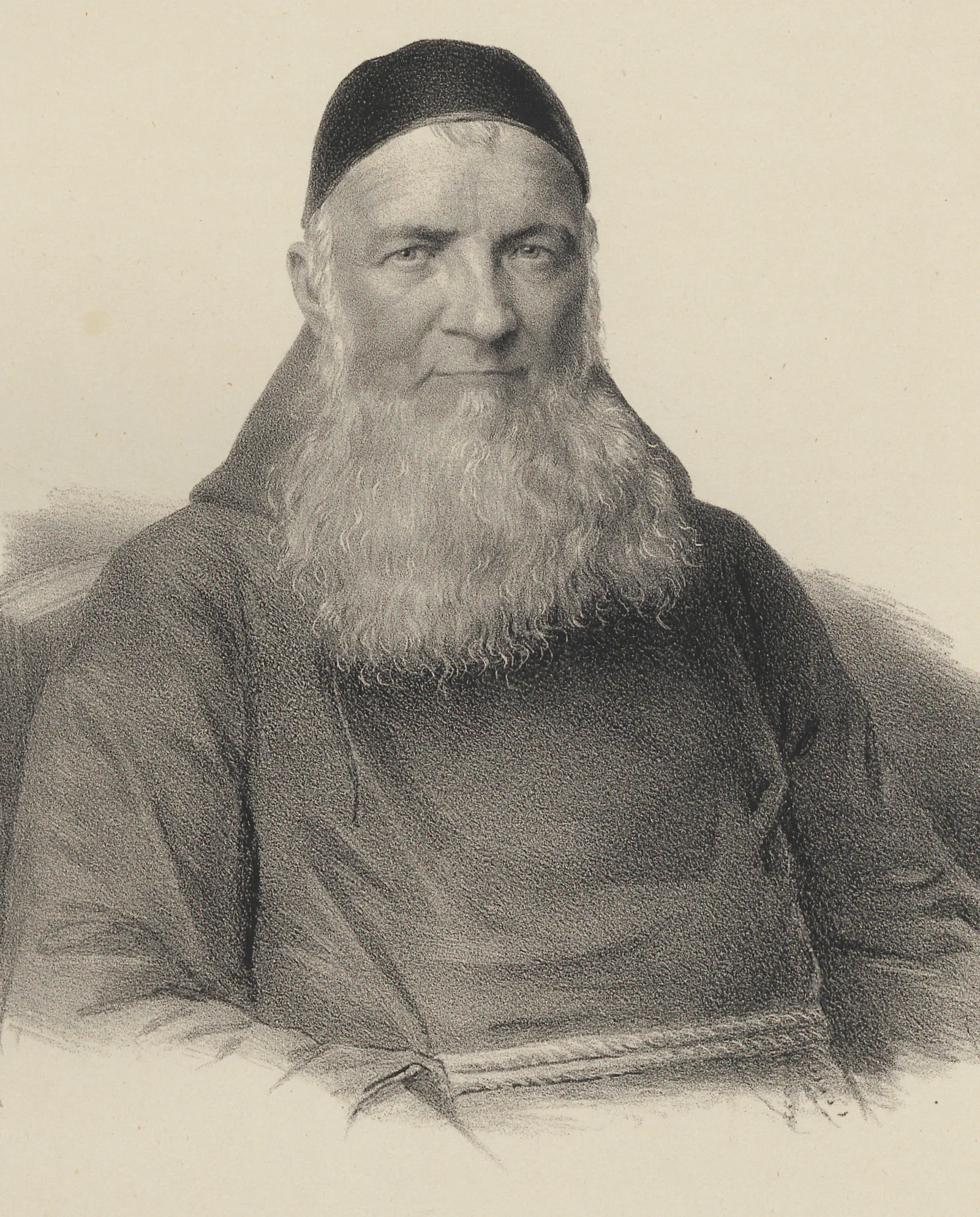
Capuchin friar Theodosius Florentini was the mastermind behind the child work institutions. Lithograph, 1863.
Capuchin friar Theodosius Florentini was the mastermind behind the child work institutions. Lithograph, 1863. ETH Library Zurich
Children were highly sought after in the factories: they were put to work in between the machinery as nimble, inexpensive labourers and often worked in extremely dangerous conditions as winders, doffers and sweepers, tying threads, replacing full spindles, cleaning machines and clearing up rubbish. Because of their small size, they mainly carried out work underneath, in between and inside the machines. According to the embellished accounts, many of the children had “mental and in some cases also physical afflictions” and received a daily wage of 55 to 120 centimes. The institution took 65 centimes from this to cover board and lodging. The hiring fee of ten francs was also deducted from their pay, as were the costs of clothing, so the children must have been pleased if there was anything left at all.
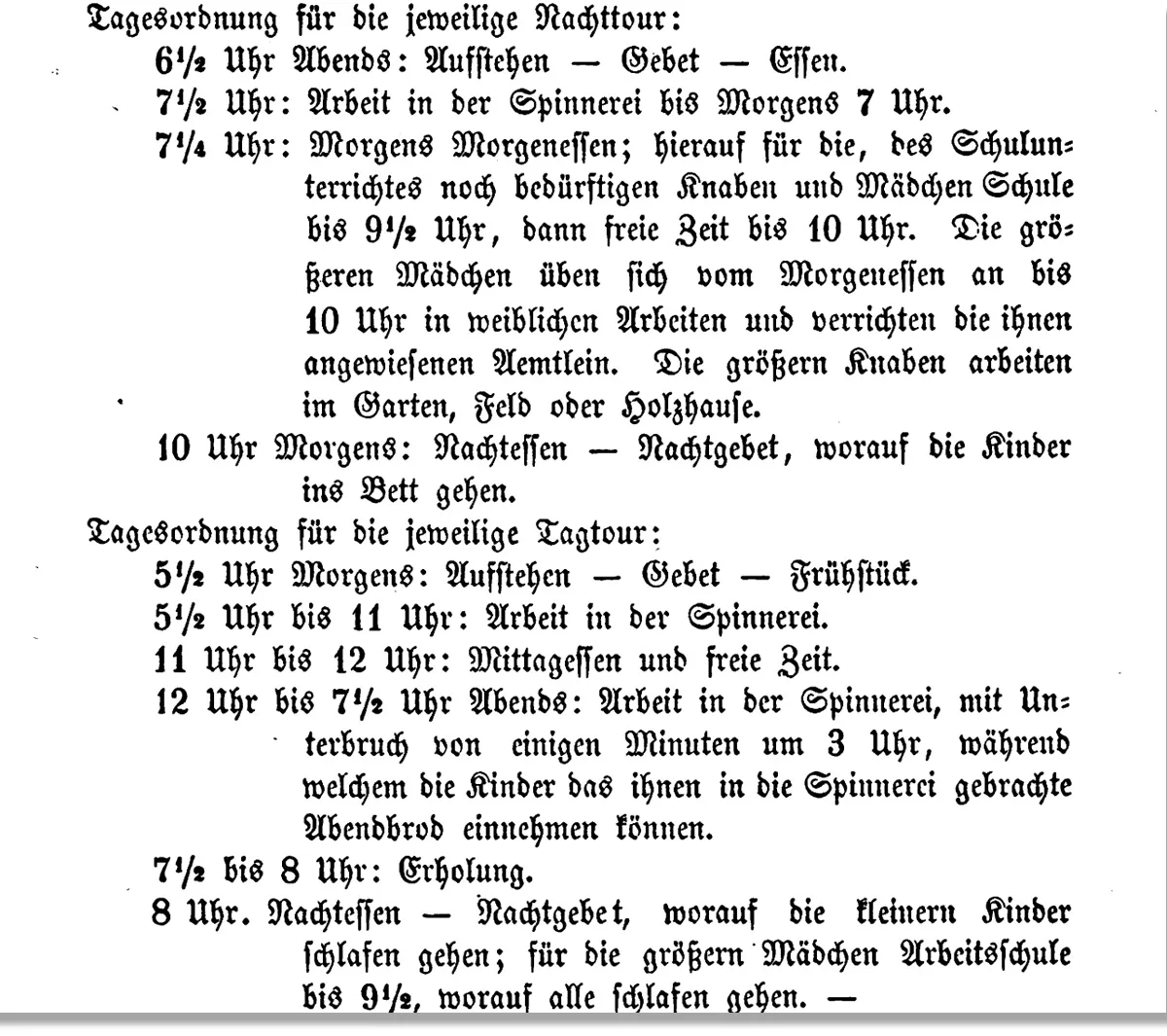
Daily schedule from a report by the first institution director, Lukas Businger, 1863
Daily schedule from a report by the first institution director, Lukas Businger, 1863. Staatsarchiv Zug
Father Theodosius wanted the factory to mutate into a monastery. As that was not possible, a packed programme was drawn up for the children’s scarce free time, which was not really free time at all: they actively helped out in the workhouse, attended mass or had to endure morally edifying instruction. That they were inattentive during this, or even fell asleep, did not escape the notice of the men writing the reports, who lambasted it as a disgrace. Instead, the reports highlighted how the children had escaped deplorable conditions in their families and how the order of the factory and work institution had given them structure and stability, and that their treatment was “humane and truly Christian”. Director Businger was even granted citizenship of the canton in recognition of his beneficent activity. The report also praised the fact that the children studied drama and performed plays. It failed to mention that the plays they performed were entitled ‘The slave girl’ and ‘The miser’, but the story is riddled with irony, especially as the children were kept like slaves by industrialist misers.
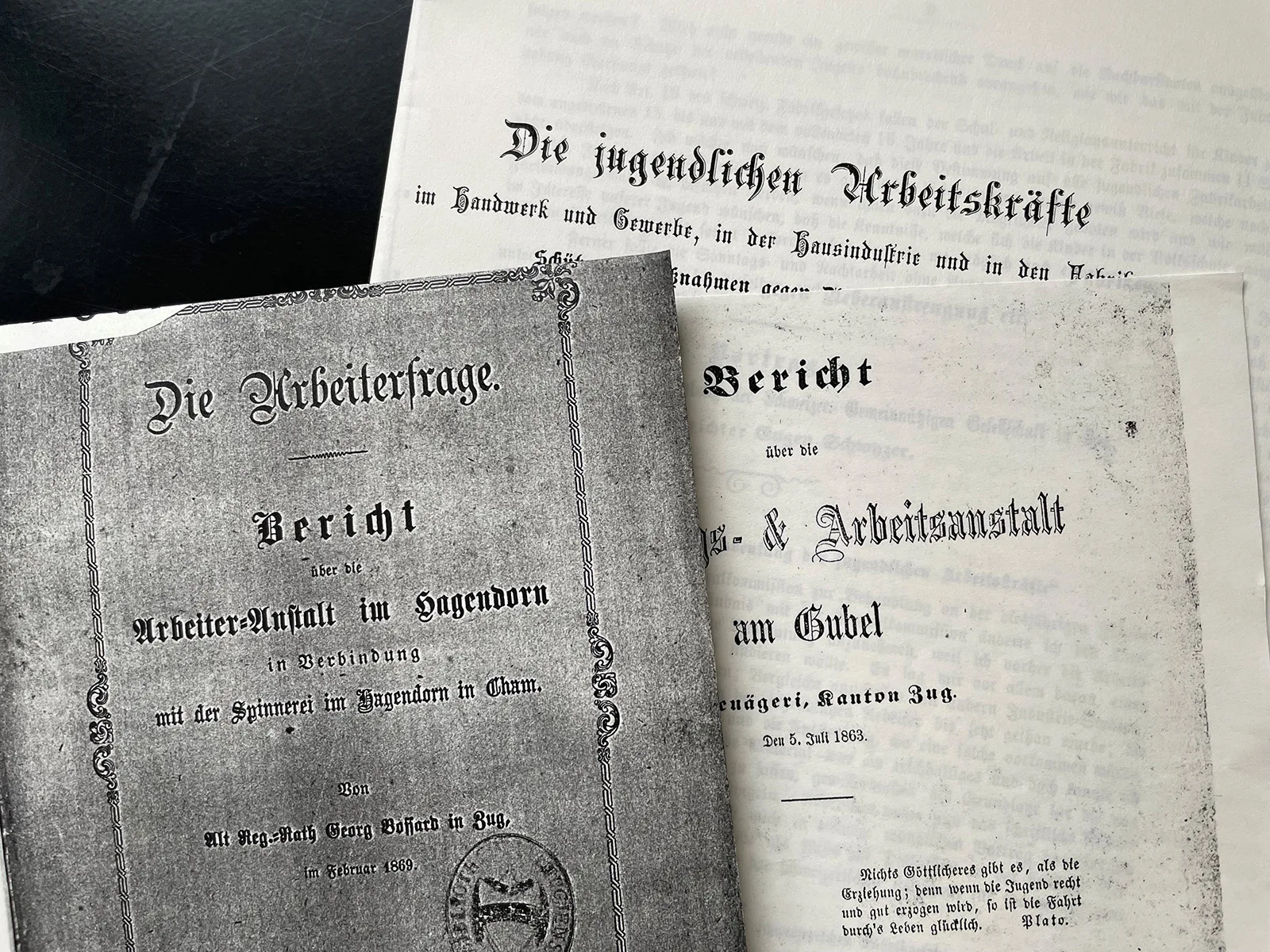
Three of the expert opinions – written by inspectors who were all biased.
Three of the expert opinions – written by inspectors who were all biased. Michael van Orsouw
From today’s perspective, it’s hardly surprising that not everyone bought into this self-congratulation. Criticism repeatedly flared up. For example, a doctor from Zug named Ferdinand Kaiser, who was a Liberal and fellow party member of the factory owners in Ägerital, spoke out in the cantonal parliament in April 1863 to criticise the child workhouse and in particular, the fact that the children were forced to work nights. He said that the children were made to work “eight nights back to back” and that this made “normal physical and mental development practically impossible”. Doctor Kaiser called for an investigation into the conditions and some sort of child protection law, which, interestingly, the council endorsed.
Although a liberal, Ferdinand Kaiser, a doctor from Zug, was a critic of the child labour institutions.
Although a liberal, Ferdinand Kaiser, a doctor from Zug, was a critic of the child labour institutions. Bibliothek Zug
The reports written by the people running the factories only appeared after their closure. During the nine years of its existence, 488 children were accommodated at Erziehungs- und Arbeitsanstalt am Gubel workhouse, 158 of whom came from the canton of Zug and 330 from other cantons. Yet the pressure on the institution endured, leading those in charge to decide to end the pioneering project of a factory children’s home at the end of 1863.

A return to capitalism and Catholicism

To ensure that the children didn’t end up on the streets, the established alliance of capitalism and Catholicism came up with a follow-up solution, less than 20 kilometres away. In early 1864 the nuns were able to travel with the children to Cham, where they were accommodated in the ‘Arbeitsanstalt Hagendorn’ workhouse. The parish priest Franz Michael Stadlin became the chair of the ‘benevolent society’, while Sister Klara Schibli from Menzingen was head of the institution and in charge of operations. The children – of whom by then there were between 70 and 80 – worked in the neighbouring weaving and spinning mill in Hagendorn. The factory children were kept there like they had been in Ägeri, and they made up around a quarter of the workforce. Even so, the wages were better and, according to the local paper, the factory owners promised “further support to the extent that circumstances allow”.
Another expert opinion noted the children’s working conditions:

Day after day in enclosed spaces, often at excessively high temperatures, where the air is polluted by human exhalation and perspiration, but also the materials used in industry.
But even then, no changes were to be expected. Because the inspector believed in the work of the ‘noble sisters’: “The sacred vow to do everything for the glory of God encompasses their entire being and activity, and provides an incomparably more reliable guarantee than the watchful eye of a so-called inspector.”
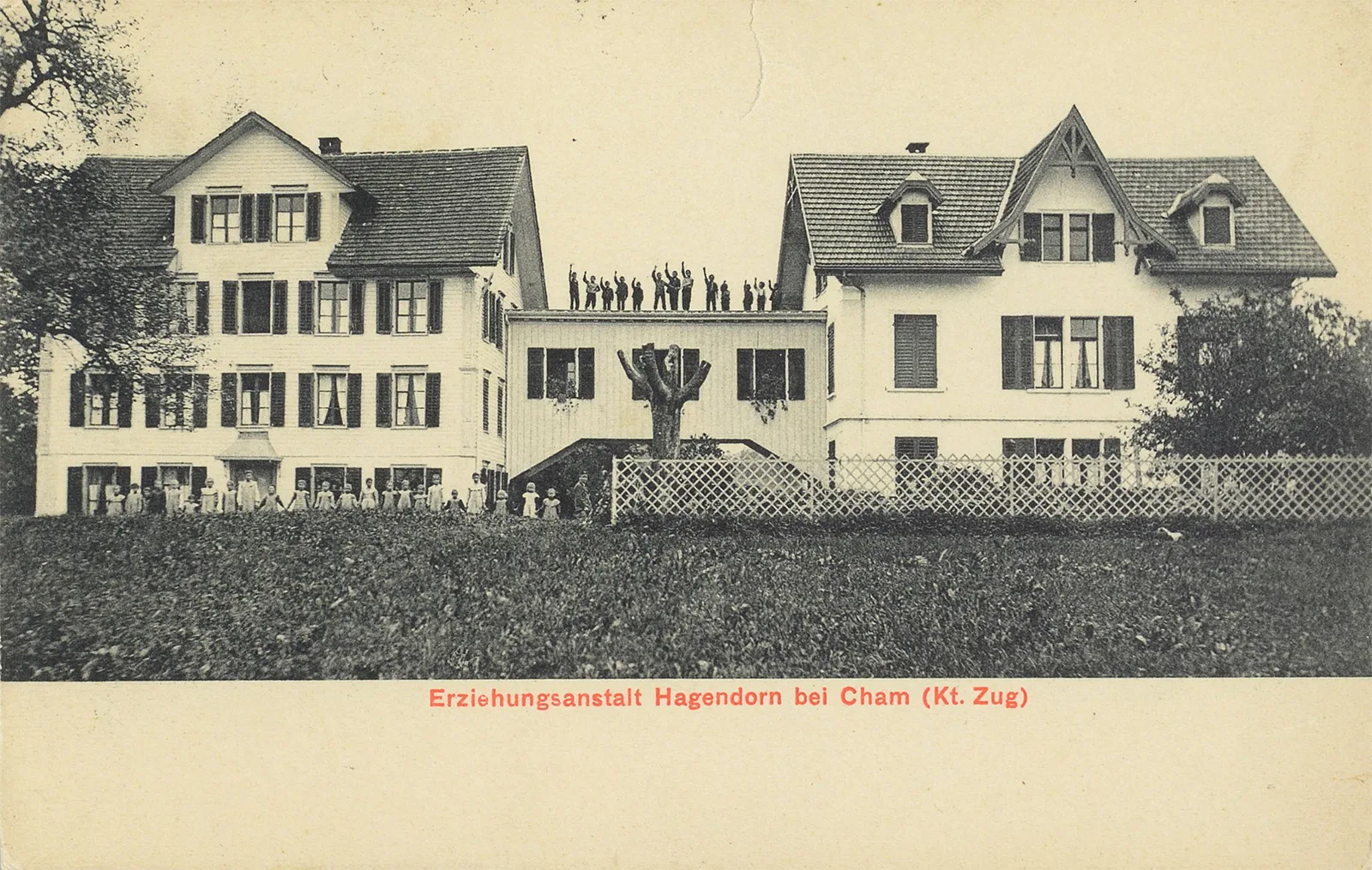
Children at the education institution in Hagendorn: the building on the left was once the home for factory children. Postcard from 1911.
Children at the education institution in Hagendorn: the building on the left was once the home for factory children. Postcard from 1911. Bibliothek Zug
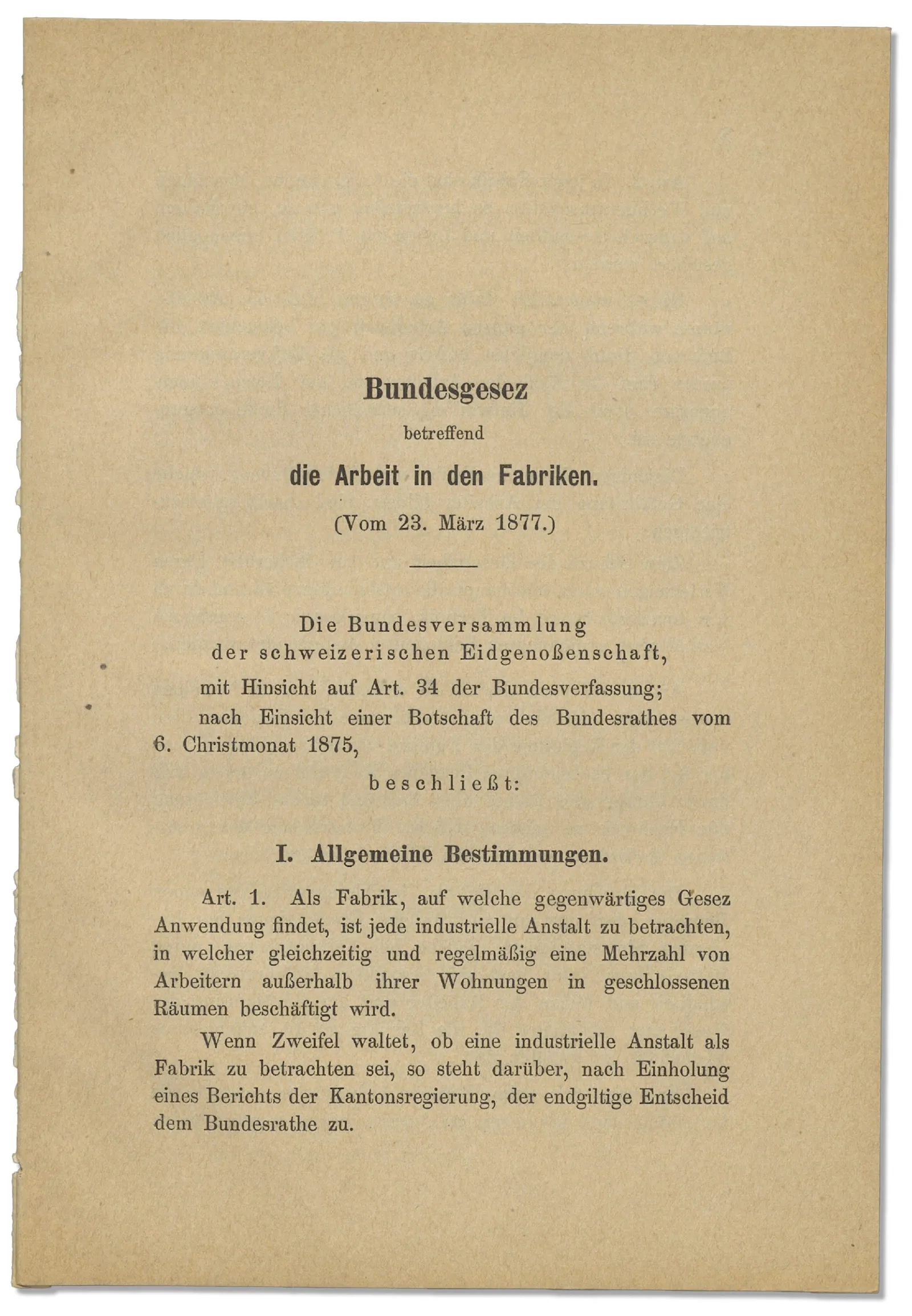
It’s therefore no surprise that the protection laws for children once called for by Dr Kaiser were no longer on the agenda, especially as the Factory Act was in the pipeline at federal level and was to include clauses on child protection. However, the corresponding law didn’t enter into force until 1877. It prohibited children under 14 from working and limited daily working time to 11 hours. Nonetheless, the home for factory children in Cham remained.
The 1877 Factory Act brought in nationwide regulation for factory work for the first time and banned children under the age of 14 from working in factories.
The 1877 Factory Act regulated factory work at national level for the first time and banned work for children under 14. Swiss Federal Archives
On 19 August 1888, the weaving and spinning mill in Hagendorn was burned to the ground. The factory owners received large sums from the insurance and rejected the idea of rebuilding. This left 370 people unemployed overnight, including the 80 or so children from the Hagendorn institution.
Unfortunately, there are no accounts about whether the children were pleased to see the end of the textile factory and their children’s home. The factory children’s institution subsequently became an orphanage after it was bought by Carl Vogel-von Meiss, the owner of the paper factory in Cham. He resisted the temptation to put the children to work. And that marked the end of the capitalist-Catholic alliance. It is worth noting how the workhouse was assessed in the catholic-conservative Zuger Nachrichten newspaper: “Where capitalism once pursued its selfish ways, Christian charity has built itself a temple — and indeed a temple of truly fresh and joyful life.”
Whether and how life there was fresh and joyful is another story, however.

Further posts