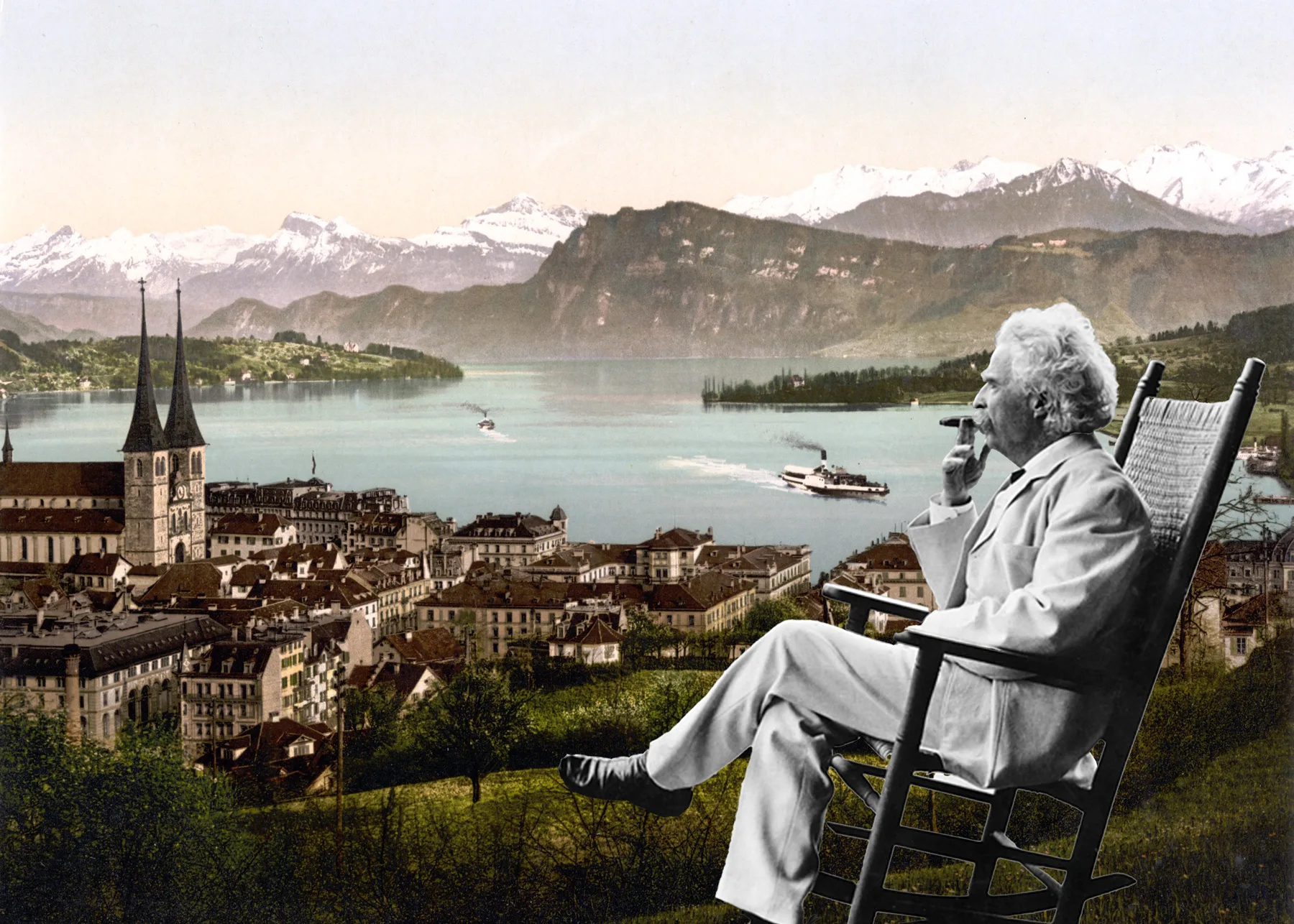
Mark Twain zog es immer wieder in die Schweiz – besonders Luzern und die malerische Umgebung hatten es ihm angetan.
Mark Twain travelled extensively through Switzerland, particularly enjoying Lucerne and the surrounding area. Bilder: Wikimedia

Mark Twain in Switzerland

Mark Twain (1835-1910) remains the most-celebrated humorist in the canon of American literature. The well-traveled and curious Twain made two personal trips to Switzerland, recording some of the happiest and most-solemn days of his life in and around the environs of Lake Lucerne.

James Blake Wiener

James Blake Wiener

James Blake Wiener is a world historian, Co-Founder of World History Encyclopedia, writer, and PR specialist, who has taught as a professor in Europe and North America.

Mark Twain was born Samuel Langhorne Clemens in the small village of Florida, Missouri, but raised in the riverside town of Hannibal, Missouri. After an idyllic childhood spent playing along the embankments of the Mississippi River, Clemens’ life took a peripatetic turn as he worked as a typesetter in a printshop, apprenticed under a steamboat captain, served briefly in the Confederate army, and prospected for gold in Nevada. While Clemens did not strike it rich in terms of gold, his humor and unusual life experiences led him to a career in journalism between 1862 and 1871. He was a free spirit with a penchant for witty conversation and innocuous gossip. Indicative of his colorful personality and desire to provoke thought, Clemens adopted "Mark Twain" as a cheeky pseudonym. The term refers to a steamboat leadman's exclamation to indicate a water depth of two fathoms (3.7 metres), "Mark twain!"
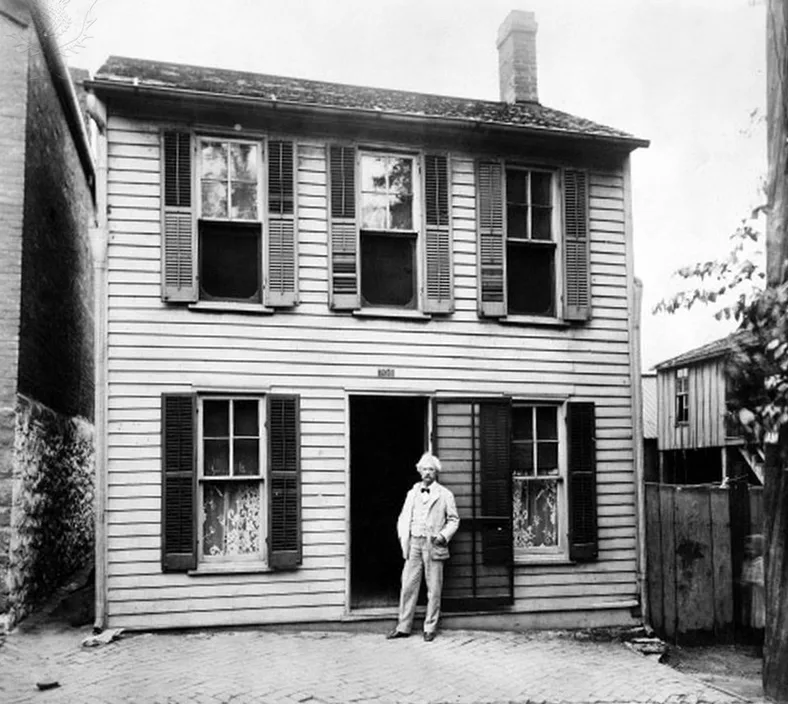
Mark Twain vor seinem Elternhaus, fotografiert im Jahr 1902.
Mark Twain photographed at his childhood home in 1902. Britannica Imagequest, The Granger Collection
While Swiss and American readers remember Twain primarily for his novels and reminiscences that evoked life along the Antebellum Mississippi River – The Adventures of Tom Sawyer (1876), Life on the Mississippi (1883), and Adventures of Huckleberry Finn (1884) – Twain was better known as a comedic lecturer in his lifetime. His public speaking tours around the United States were so financially lucrative and popular that they enabled Twain to travel the world. In 1867, Twain received funding from the New-York Tribune and The Alta California to undertake a special tour of Mediterranean Europe, Tsarist Russia and the Holy Land. Upon his return to the U.S., Twain would compile his travel diaries into a book entitled The Innocents Abroad, which was published in 1869. Twain’s satirical travelogue lampooned loud, naive, and clueless American tourists as they explored Europe and the Middle East. The title proved so popular that it sold over 5,000 editions in its first month of publication, and thereafter sold more than 31,000 copies within a year. The Innocents Abroad catapulted Twain into international prominence.
The stories about Tom Sawyer and Huckleberry Finn have been adapted for film many times, for example in 2014. Youtube
Following the acclaim of The Adventures of Tom Sawyer, Twain desired to return to Europe to gather fodder for another travelogue. Eager to explore Switzerland after previously touring Germany, Twain crossed the Swiss border in August 1878 with his friend Reverend Joseph Twichell. The two spent several weeks exploring the breadth of the country, from Schaffhausen to Lucerne, Interlaken to Zermatt, concluding with a grand arc through the Romandy from Martigny to Lausanne and finally Geneva. Switzerland captivated Mark Twain with its breathtaking alpine scenery, lush meadows, pristine lakes, and enchanting, well-kept cities and towns. He also found peace and tranquility in the country's orderliness. In particular, Twain admired the landscapes and cityscapes of central Switzerland. Twain found Lucerne an especially fascinating city, as it was then in the midst of a commercial and economic boom thanks to the rise of international tourism. When reading Twain’s description of Lucerne in 1878, one encounters text that is at once chatty and colloquial, but still reverential. Moreover, the city he describes looks very much like the one still in existence today:

"Lucerne is a charming place. It begins at the water’s edge, with a fringe of hotels, and scrambles up and spreads itself over two or three sharp hills in a crowded, disorderly, but picturesque way, offering to the eye a heaped-up confusion of red roofs, quaint gables, dormer windows, toothpick steeples, with here and there a bit of ancient embattled wall bending itself over the ridges, worm-fashion, and here and there an old square tower of heavy masonry."
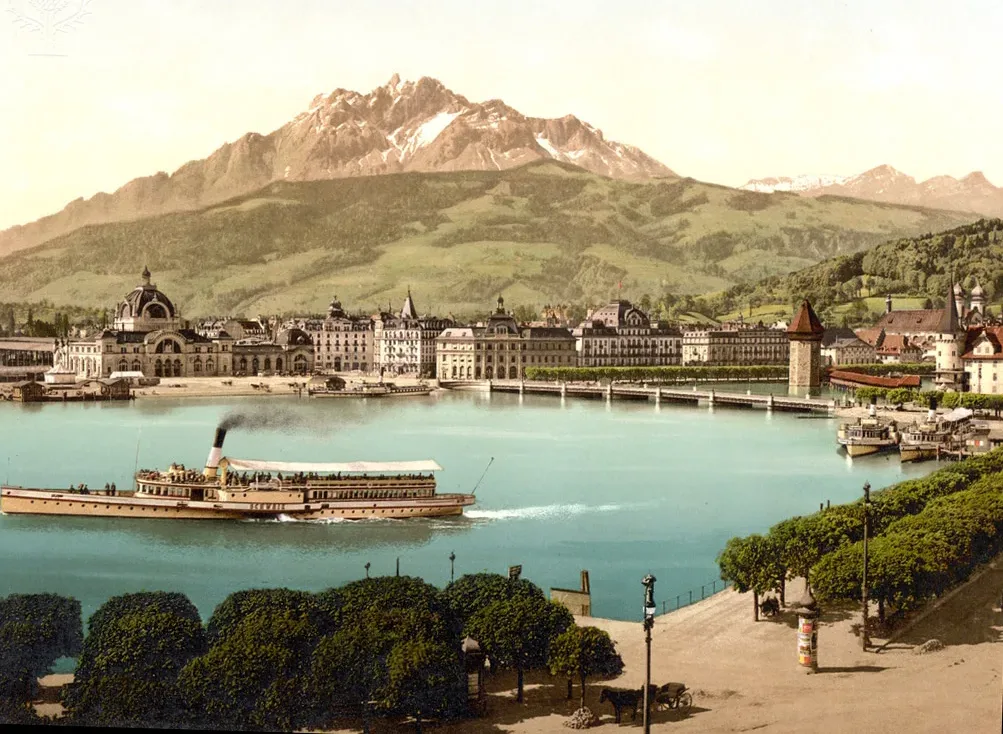
Blick auf Luzern und den Pilatus, 19. Jahrhundert.
View of Lucerne and Mount Pilatus, 19th century. Britannica Imagequest, Universal History Archive
Twain spent his time leisurely admiring the Lucerne’s Lion Monument, walking back-and-forth through the wooden and cheerful Kappelbrücke, and enjoying coffees at the Hotel Schweizerhof. However, as Twain was a great outdoorsman, he wished to experience all the Alps had to offer as well. Although Twain’s claim that he needed three days to scale the 1,800 metre Mount Rigi is in all probability complete hyperbole, there can be no doubt that Twain seized the majesty of an alpine sunset to perfection:

"The great cloud-barred disk of the sun stood just above a limitless expanse of tossing white-caps – so to speak – a billowy chaos of massy mountain domes and peaks draped in imperishable snow, and flooded with an opaline glory of changing and dissolving splendors, while through rifts in a black cloud-bank above the sun, radiating lances of diamond dust shot to the zenith. The cloven valleys of the lower world swam in a tinted mist which veiled the ruggedness of their crags and ribs and ragged forests, and turned all the forbidding region into a soft and rich and sensuous paradise."
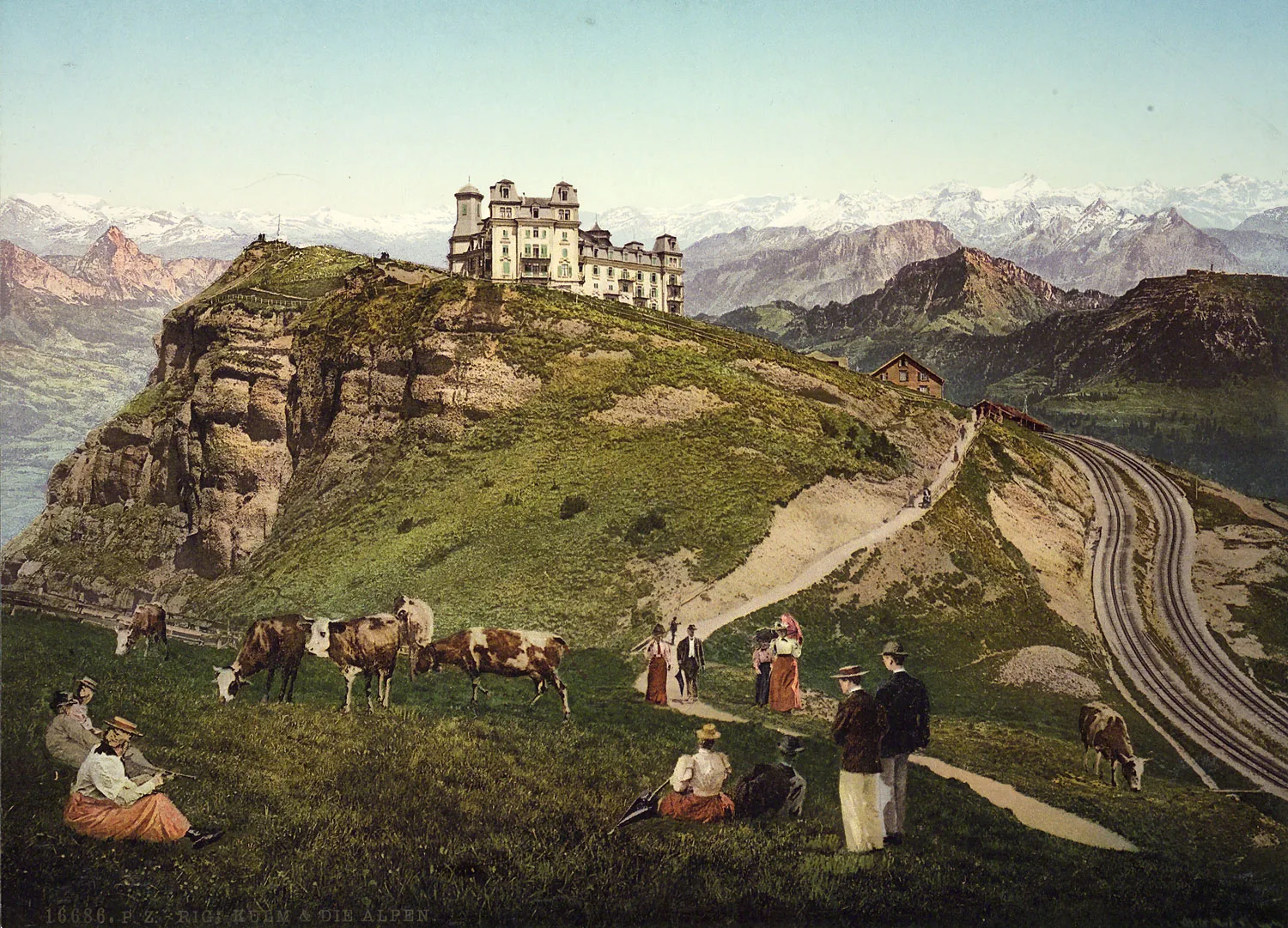
Darstellung der Rigi, um 1900.
Illustration of the Rigi, around 1900. e-pics
A Tramp Abroad (1880) – Twain’s vaunted collection of remembrances from his excursions through Germany, Switzerland and Italy – was an immediate success following its publication and is arguably his best-written travelogue. It was and has remained popular throughout Europe, in part, because of his elaborate descriptions of Switzerland's manmade and natural attractions. Readers have found great pleasure in Twain’s tonality too – lucid and often critical, but tinged with kindness and pleasure in the observation of everyday realities.

Twain’s literary career reached its apogee with the publication of Adventures of Huckleberry Finn. His innovative use of a natural, first-person narrative reshaped the relationship between form, expression, and content in American fiction. However, literary tastes were changing, and Twain struggled to find his footing and voice in Gilded Age America. Twain’s difficulties were compounded by mounting misfortunes. The Panic of 1893 left Twain with a debt of 100,000 USD, equivalent to approximately 3,7 million USD in 2025. In 1896, Twain suffered another devastating blow when his beloved, eldest daughter, Susan, died of meningitis. These hardships left him embittered and disillusioned in his later years.

The Panic of 1893

The Panic of 1893 was the most-severe economic crisis in U.S. history until the Great Depression of 1929. After news of a stock market collapse, Americans rushed to withdraw their savings, triggering widespread bank runs. By the end of the year, more than 600 banks and 16,000 businesses had failed. Unemployment reached an estimated 20% in the first year of the crisis, which dragged on until 1897. The U.S. economy did not fully recover until 1901.
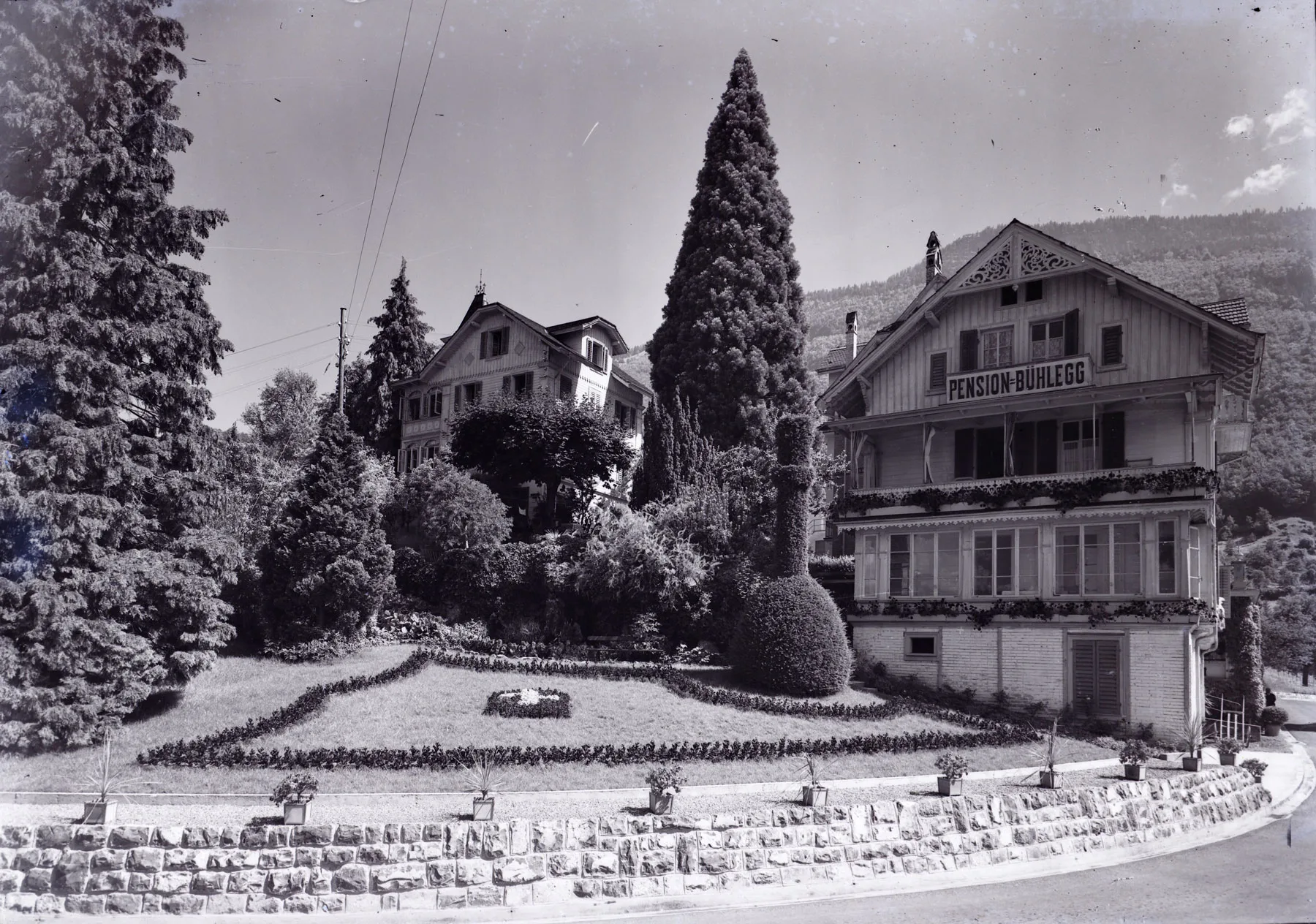
Twain returned to Switzerland in July 1897 with his wife and two daughters. After the loss of Susan, he and his family sought a place where they could find solitude during the summer season, following an extended stay in London. After reviewing their options, the Twains opted to stay in Weggis, renting the annex "Schlössli" (little castle) of a simple guest house called Pension Bühlegg, in addition to an office in Villa Tannen. Due to their diminished financial circumstances, they could not afford to lodge in a grand hotel along the lake.
Blick auf die Pension Bühlegg mit dem Anbau auf der linken Seite, in dem Mark Twain mit seiner Familie wohnte.
View of the Pension Bühlegg, with the annex on the left where Mark Twain lived with his family. Historisches Archiv Weggis
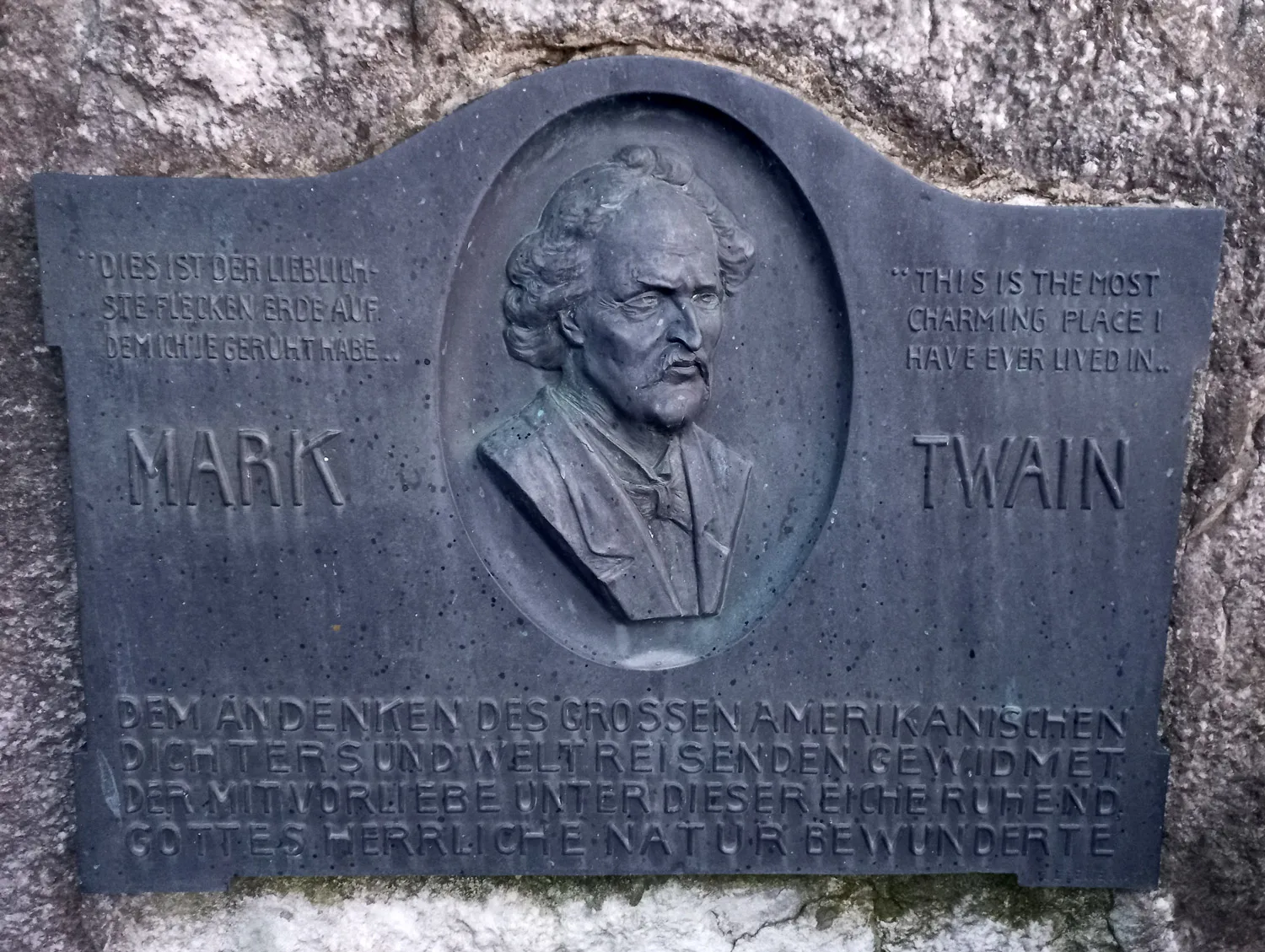
Ein Denkmal in Weggis erinnert an Mark Twains Besuch.
A memorial in Weggis remebers Mark Twain's visit. Wikimedia
For a duration of ten weeks, the family enjoyed the simple pleasures of the Swiss Alps and privately mourned Susan. Twain continued to edit a new work that would eventually become Following the Equator (1897) – a travelogue of his time touring and lecturing throughout the British Empire between 1895-1896. The Twains vacated Weggis for Vienna in September 1897, but Twain, in a personal notebook, leaves us with a final, intimate glimpse of how he saw Weggis and Switzerland:

I believe that this place is the loveliest in the world, and the most satisfactory. The scenery is beyond comparison beautiful… Sunday in heaven is noisy compared to this quietness.

Further posts