Was the Hotel Rigi-First deliberately set on fire? If so, by whom? Illustration by Marco Heer

The curious case of the arsonists and the clairvoyant

In 1948, a former luxury hotel on Mount Rigi was bought at auction by a garage owner from Zurich. Ten days later, it burned to the ground. The subsequent trial for arson and insurance fraud captivated the nation – not least because a clairvoyant played a key role in the investigations.

Adi Kälin

Adi Kälin

Adi Kälin is a historian and freelance journalist.

The case being heard before the Schwyz Cantonal Court of Appeal in December 1948 sparked a media frenzy. Karl Dubs, a garage owner from Zurich, had been sentenced to five years’ penal servitude by the court of first instance on the charge of incitement to arson. Two men had set fire to a hotel on Mount Rigi just a few days after Dubs had bought the property at auction. The NZZ newspaper reported that the appeal proceedings had got under way “in a blaze of photographers’ flashlights” and had “attracted an unusual amount of media attention from outside the region”.

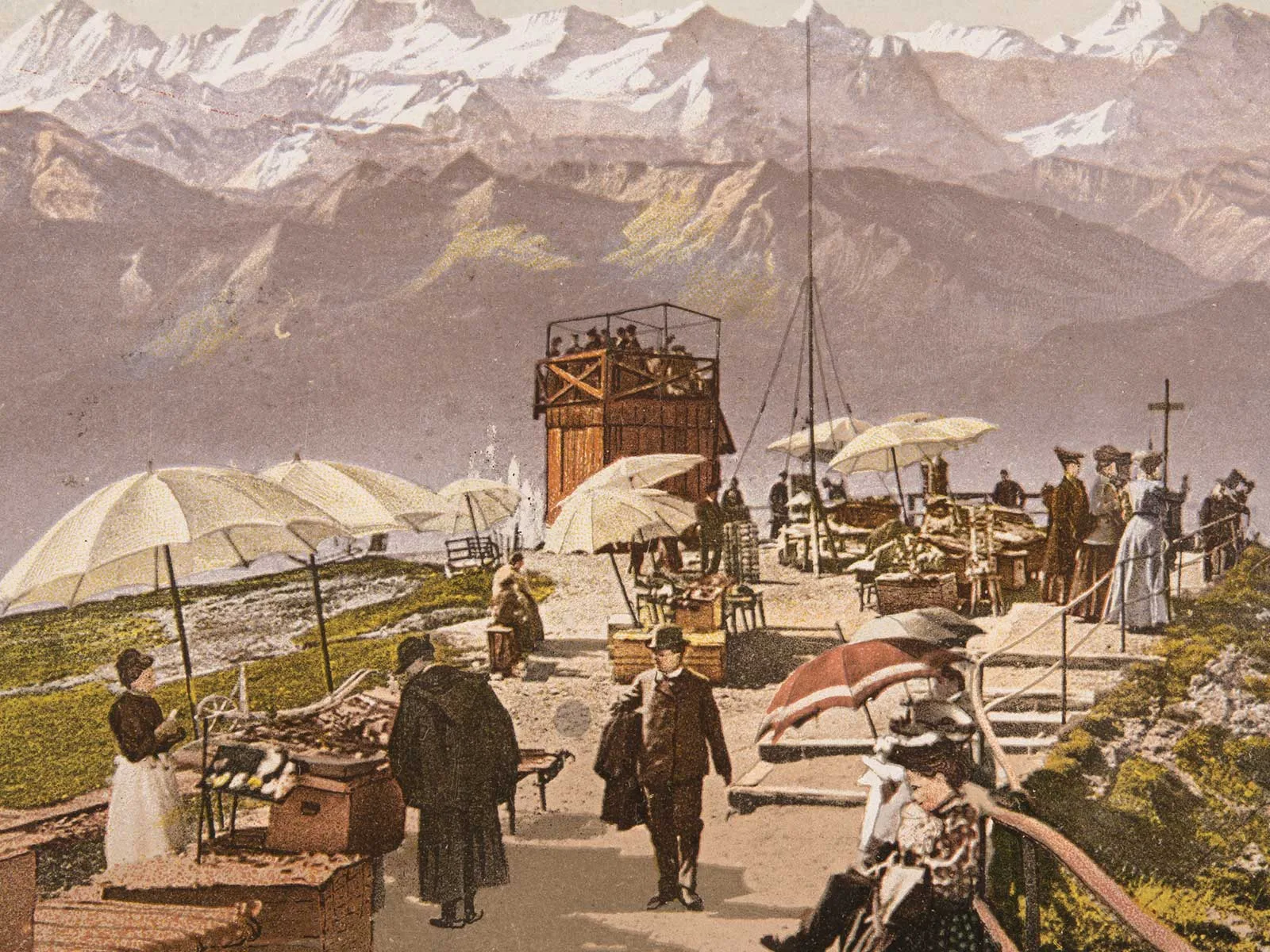
The hotel’s highly colourful history was no doubt one of the reasons for the great interest shown in the story. And the adventurous life of the accused was almost certainly another. The Hotel First had opened in 1875, shortly after the inauguration of the Vitznau-Rigi mountain railway, the first of its kind in Europe. At this time, tourists were literally flocking to the mountain in droves, creating something akin to a gold rush atmosphere. A company named Regina Montium constructed several new railway lines and hotels, including the one at Rigi First, in record time. But, having overstretched its finances, it soon had to file for bankruptcy.
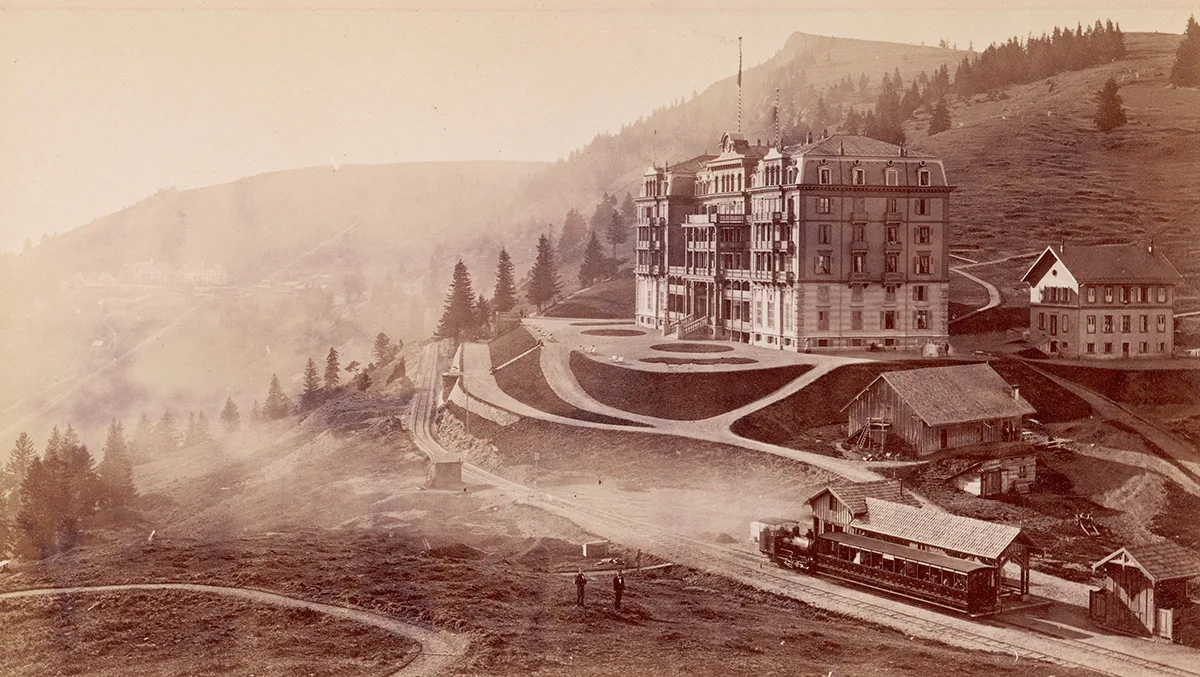
The Hotel First on Mount Rigi, pictured in the 1870s.
The Hotel First on Mount Rigi, pictured in the 1870s. Swiss National Museum
1879 marked the beginning of the grand hotel’s heyday as an establishment catering to the highest standards. The man behind the project was Anton Bon-Nigg, a pioneering Swiss hotelier, whose empire also included Suvretta House in St. Moritz and the Park Hotel in Vitznau. When Bon passed away in 1915, the hotel on Mount Rigi changed ownership several times, but business failed to pick up again after the First World War. In 1948, the by now extremely dilapidated building was put up for auction yet again. The buyer was a certain Karl Dubs from Zurich, a man with a dubious reputation. The selling price was CHF 500,000, the sum insured, however, came to around CHF 1.7 million.
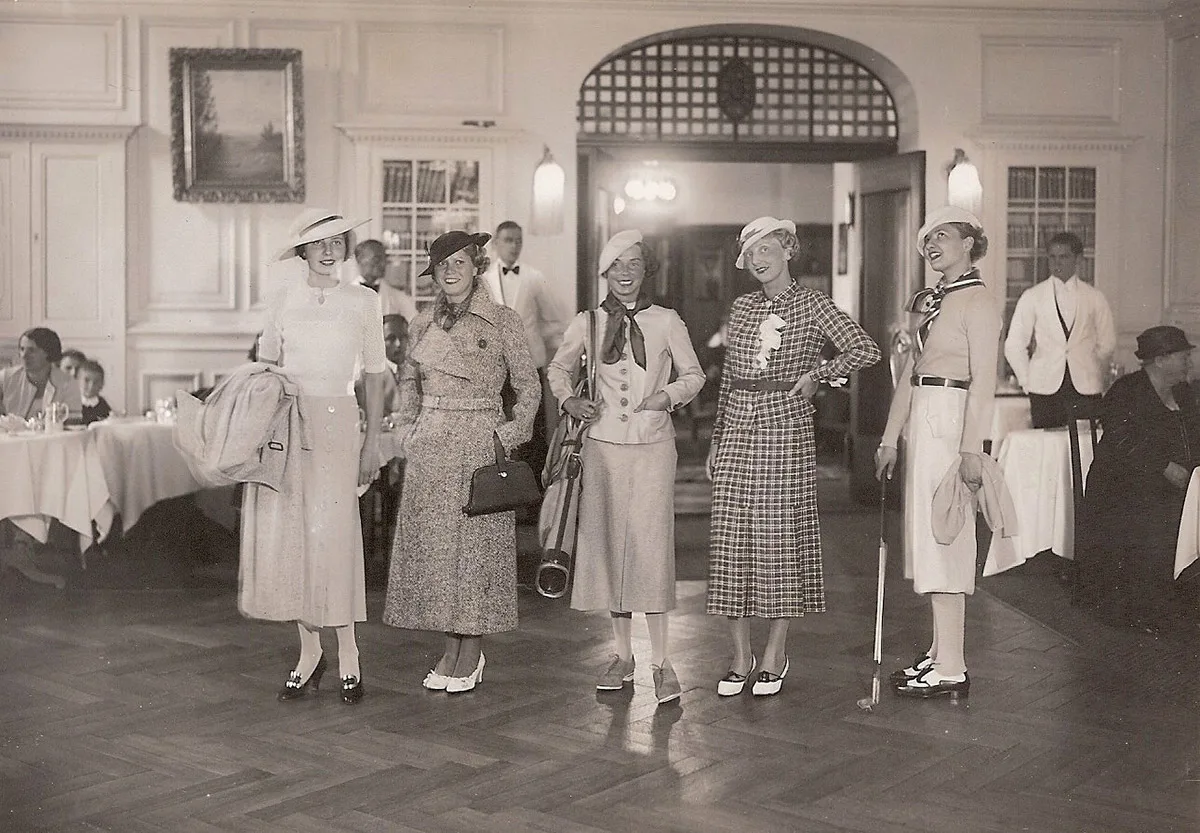
After the First World War, business at the Hotel Rigi-First was failing. Events like this fashion show in the 1930s did little to change that.
After the First World War, business at the Hotel Rigi-First was failing. Events like this fashion show in the 1930s did little to change that. Photo: Regionalmuseum Vitznau
The first trial before the Schwyz Criminal Court revealed certain pieces of information about Dubs. He was originally from Germany, and his real name was Benkert. He had been deported from Switzerland in 1921 after committing numerous offences. But, shortly after that, he had discovered that his real father was Swiss and willing to recognise him as his son. And so, the German Benkert had become a Swiss citizen, with the very Swiss-sounding surname of Dubs. But the change of nationality had done nothing to lessen his criminal tendencies. He had gone on to commit further offences: coercion, rape and document forgery.

The auction had taken place on 15 July 1948. During the night of 25 July, the watchman, who lived in the neighbouring annex, spotted the fire, which was quickly spreading through the empty hotel. When the fire brigade from nearby Kaltbad arrived at the scene 20 minutes later, it was already too late: the hotel, capable of accommodating 160 guests, was fully ablaze. The watchman was keen to try and save some of the valuable silver, but the thickening smoke made any kind of salvage operation impossible. Even so, he claimed to have seen a chianti bottle containing petrol and traces of the fire accelerant on the carpet. However, when later questioned about it in court, the man embroiled himself in a tangle of contradictions.
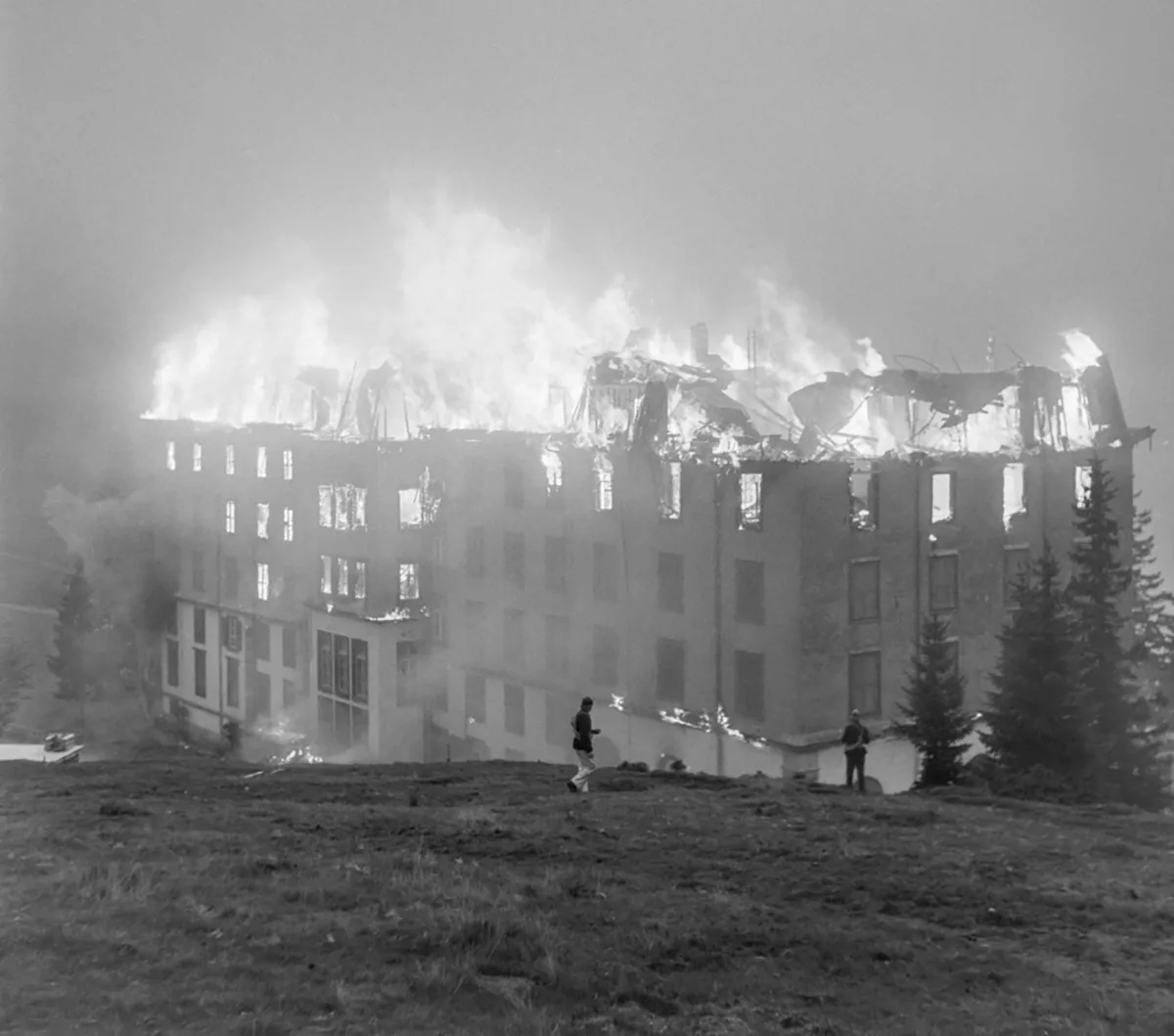
Beyond saving: the large fire at the Hotel Rigi-First in July 1948.
Beyond saving: the large fire at the Hotel Rigi-First in July 1948. Keystone / Photopress-Archiv
It took another two hours for the fire crews from Weggis, Vitznau, Arth and Goldau to arrive by cogwheel railway. All they could then do was attempt to save the annex and the nearby chalet. Naturally, suspicion immediately fell on Karl Dubs – especially as he had several times been heard expressing the hope that the hotel would burn down. It soon became clear that he could not have done the deed himself. However, two men who had been observed at the scene shortly beforehand were presumed to have been acting at the incitement of Dubs.
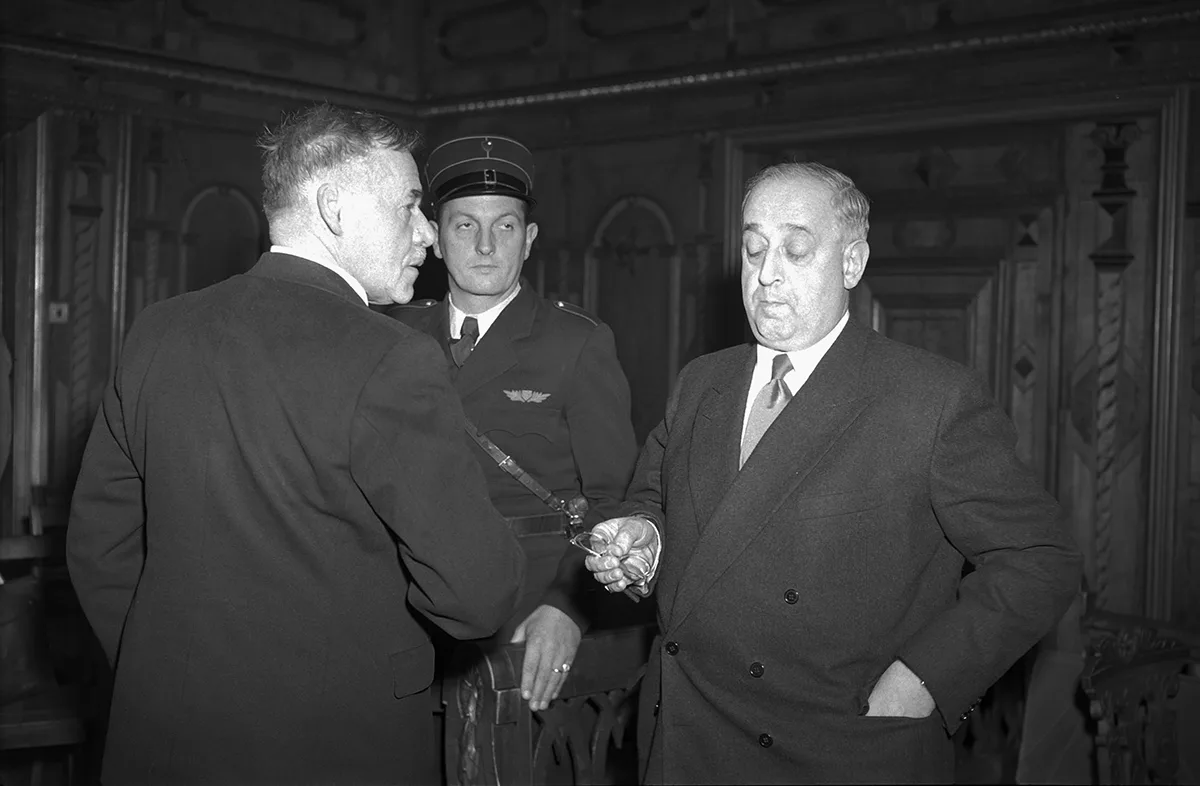
Did Karl Dubs (left), pictured here with his solicitor during the second court proceedings, “commission” the fire in order to collect the insurance money?
Did Karl Dubs (left), pictured here with his solicitor during the second court proceedings, “commission” the fire in order to collect the insurance money? Dukas / RDB
The Zuger Volksblatt newspaper then spread yet another rumour. It claimed that competitors were behind the conflagration at the Hotel First. By all accounts, the head of the Kaltbad fire brigade Alois Dahinden, who also happened to run the Hotel Bellevue, ordered his men not to start extinguishing the fire before he himself arrived at the scene. And he was later said to have “filmed the entire blaze from every angle” instead of involving himself in the fire-fighting and rescue operation. Faced with these accusations, Dahinden justified his actions by stating he had only begun filming once the fire crew from Arth had taken charge of the operation. He threatened anyone daring to assert otherwise with legal action.

The court of first instance convicted Dubs, inter alia, because one witness claimed to have seen him hand over money to two men in Walchwil on Lake Zug – obviously as recompense for starting the fire. The witness had recognised the accused due to his characteristic facial tics and heard the three men conversing in whispers.
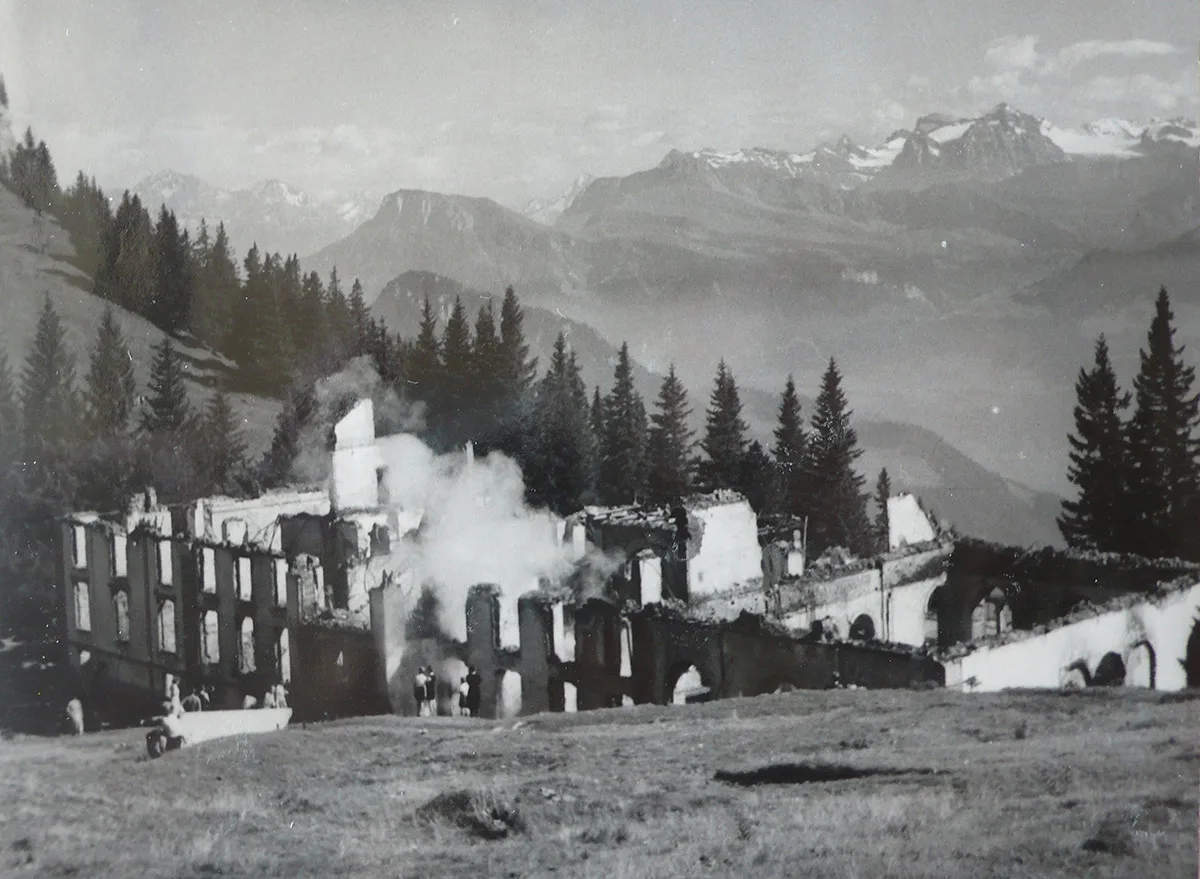
Not much was left of the Hotel First on Mount Rigi following the fire.
Not much was left of the Hotel First on Mount Rigi following the fire. Private collection of Adi Kälin

A clairvoyant for the prosecution

But back to the court of appeal in Schwyz, where the main issue was verifying the credibility of the witness from Walchwil. To everyone’s great surprise, it was revealed that the witness had only been found after a clairvoyant had been consulted. The NZZ published an in-depth report on the sessions with the clairvoyant on 28 December 1949 entitled ‘Unusual investigation methods’.

First séance: the clairvoyant fell into a trance. A photo of Dubs was placed on his stomach. The clairvoyant described the man and his car, saying that he had something to do with the blaze. But the actual fire had been raised by two people, who had been carrying canisters filled with fuel.

Second séance: what had Dubs been doing on 26 July 1948? The clairvoyant hinted at the meeting in Walchwil, seeing visions of a sign bearing the words ‘Prima Fischküche’ (‘excellent fish dishes’). A short man, a farmer, who lived near the railway line was believed to have been in the restaurant at the same time. The police later established that there was only one restaurant with a promotional sign matching the description. A short man had in fact been there on that evening, but he was a local roofer and not a farmer.

This particular individual was eventually tracked down by the police and questioned. Two months after the fire. The fact that the clairvoyant had been brought on board by the very insurance companies that would have to pay out for the fire damage did little to aid the prosecution’s credibility. Its failure to mention the clairvoyant in any of its case files weakened its position even further.
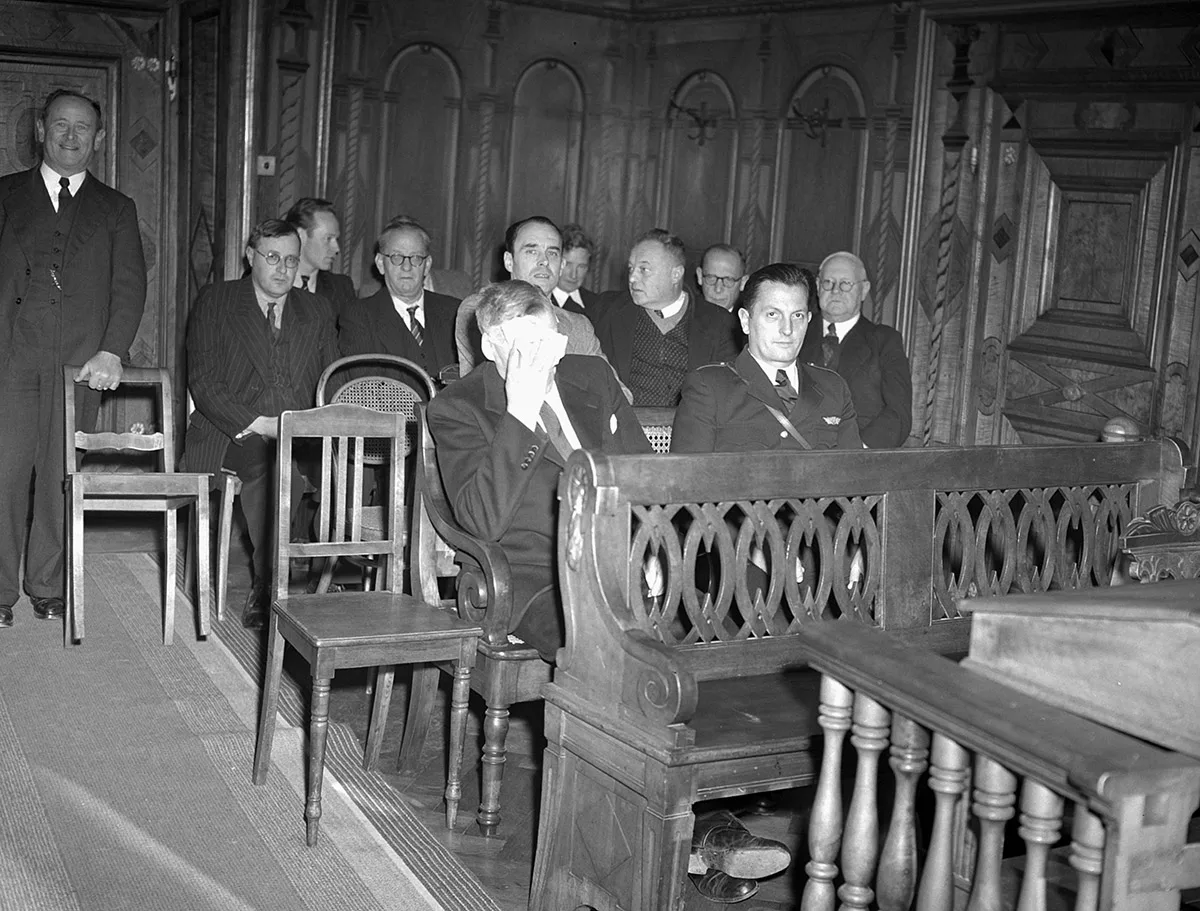
During the trial in Schwyz, Karl Dubs tried to hide his face from the press photographers. This would have been unnecessary, as he was later acquitted due to lack of evidence.
During the trial in Schwyz, Karl Dubs tried to hide his face from the press photographers. This would have been unnecessary, as he was later acquitted due to lack of evidence. Dukas / RDB

Acquitted due to lack of evidence

Proceedings were adjourned and resumed in mid-January 1950. The witness from Walchwil took to the stand for cross-examination: What had it been like the first time he was questioned by the police? Had one of the two policemen perhaps imitated the accused’s facial tics? The witness was no longer sure. Then the chief presiding judge conducted his own experiment. He had a man called into the courtroom and asked the witness whether he knew him. No, said the witness, he had never seen the man before in his life. Asked again, he gave the same answer. But this was none other than the very first policeman who had interviewed him.

Then another man was brought in, escorted by a police officer. The witness identified him as Dubs. But this time it was a person chosen at random, who happened to look a bit like the garage owner from Zurich. Then Karl Dubs himself appeared. Yes, that was quite definitely him, stated the witness. Having discredited the key witness’s testimony in this way, the court had no other option but to rule that there was insufficient evidence for a conviction. The “supernatural” methods adopted by the private prosecutors had ultimately been of no use.
The Rigi-First property was put up for auction again in May 1950. The winning bidder was a fiduciary company from Lucerne. Alois Dahinden, the hotelier and head of the Kaltbad fire service, later turned the annex into the Bärenstube guest house. At the grand opening on 30 January 1958, the film he had shot of the fire at the Hotel First was supposedly shown.

Just three years later yet another hotel on Mount Rigi, the Grand Hotel Kaltbad, was ravaged by fire. There were 180 guests and 60 employees on the premises when disaster struck on 9 February 1961. One of the fire fighters later described the scene to the NZZ newspaper as one of “endless panic”. Countless people at the front of the building were still cowering by their windows while the flames were already bursting through the windows at the back. Many were able to save themselves by jumping out into the deep snow, but the fire claimed the lives of 11 people. Much later, it emerged that this too had been a case of deliberate fire-raising: an apparently frustrated employee had set the hotel’s mattress store alight.
Further posts