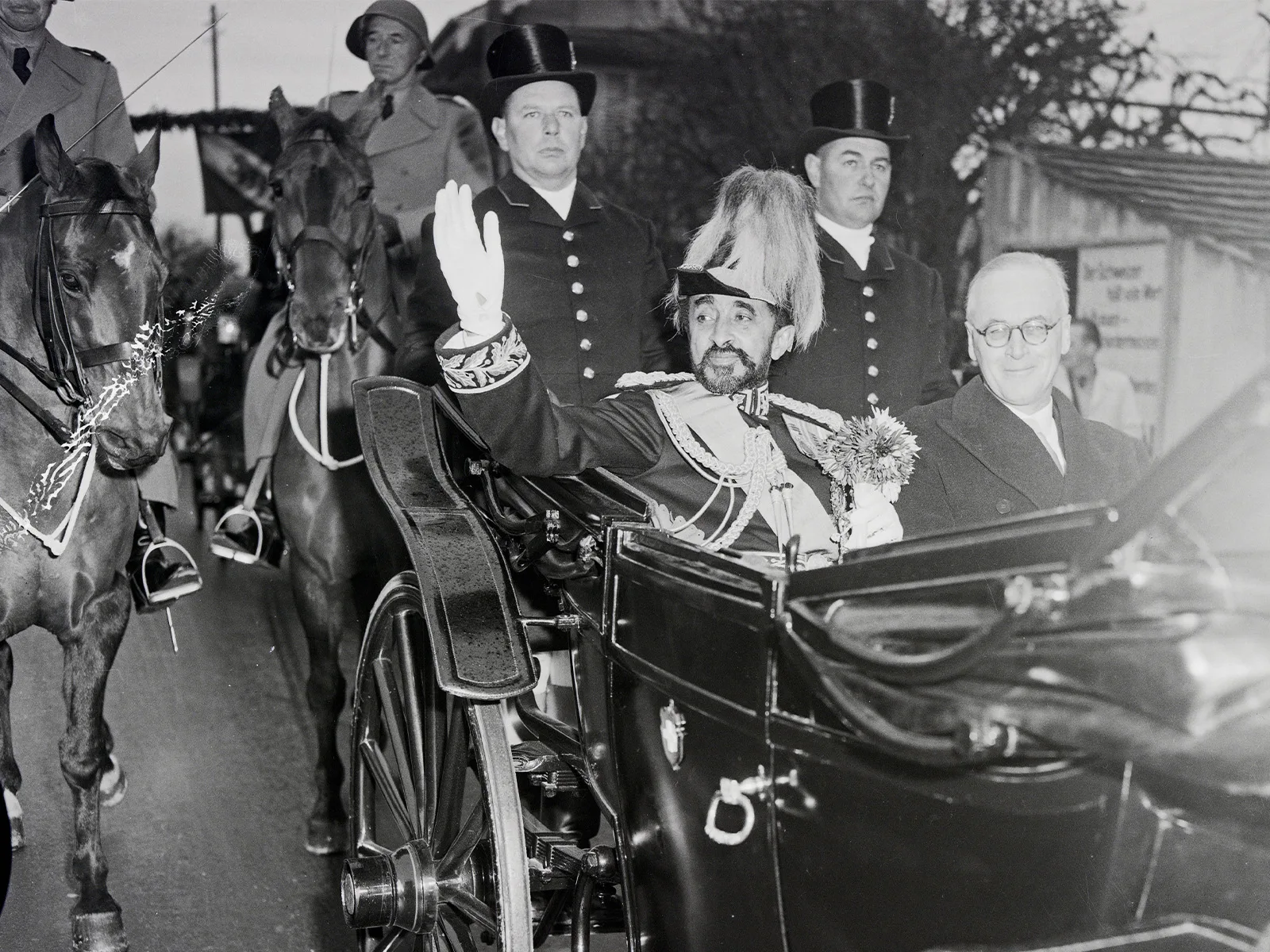
Emperor Haile Selassie and Swiss president Rodolphe Rubattel on their way from Hindelbank station to Jegenstorf Castle in a horse-drawn carriage with a military escort. Photo by Björn Lindroos, 1954.
Emperor Haile Selassie and Swiss president Rodolphe Rubattel on their way from Hindelbank station to Jegenstorf Castle in a horse-drawn carriage with a military escort. Photo by Björn Lindroos, 1954. ETH Library, Zurich

Hosting an emperor – the state visit of Haile Selassie

The 1954 state visit to Switzerland of Haile Selassie (1892–1975), the last Ethiopian emperor, caused quite a stir. Some of his gifts and a belated thank-you letter sparked irritation and gave rise to speculation.

Murielle Schlup

Murielle Schlup

Freelance art historian and cultural scientist

Until the early 1950s, state visits to Switzerland were something of a rarity. When Haile Selassie I arrived at the end of November 1954, he was only the seventh head of state ever to be officially received by the Swiss Confederation and, following on from Kaiser Wilhelm II in 1912, only the second emperor. At a time when the majority of households didn’t own a television set, travel was the preserve of the privileged few and most people’s image of Africa was the same as that pictured in the adventures of popular children’s picture-book character Globi, the fascination with the Negusa Nagast (Amharic for ‘King of Kings’) from a centuries-old empire in far-off Africa knew no bounds.

Once shunned, now fêted

Naturally, the Swiss authorities made every effort to ensure that nothing would go awry during the official visit of the man who was King Solomon’s 225th successor. After all, one of the reasons for the invitation was to make amends for a shameful interlude in the history of official relations between the two parties a little under 20 years previously. After Fascist Italy had invaded Ethiopia in 1935 and waged a brutal war of aggression, the deposed emperor was forced into exile in the United Kingdom in 1936. When he travelled to Switzerland that same year to address the League of Nations in Geneva and make an appeal for international support for his country, Switzerland refused to grant him asylum. On his restoration to the Ethiopian throne following the country’s liberation in 1941, red carpets were happily rolled out for Haile Selassie all over the world during the post-war period. He put Ethiopia on the foreign policy world map and acquired a positive image as an exemplary regent and progressive reformer.

Switzerland in a state of feverish excitement
So, it was hardly surprising that Switzerland should also rediscover its interest in the Ethiopian emperor. And since he had set out on what can only be described as a ‘world tour’ in May 1954, taking in the United States, Canada, Mexico and Europe, the government asked its ambassadors to sound out whether Haile Selassie would be open to stopping off in Switzerland too. On receiving a positive response, the official invitation was sent. Now that the emperor had confirmed he would be coming, the Confederation spared no effort or expense in ensuring that, this time, he would be accorded a grand reception, fitting for an emperor in every way. All of Switzerland, and especially the capital city Bern, was thrown into a state of excitement by the upcoming royal visit. Continuous media coverage began weeks ahead of the actual event, which was scheduled for the end of November.
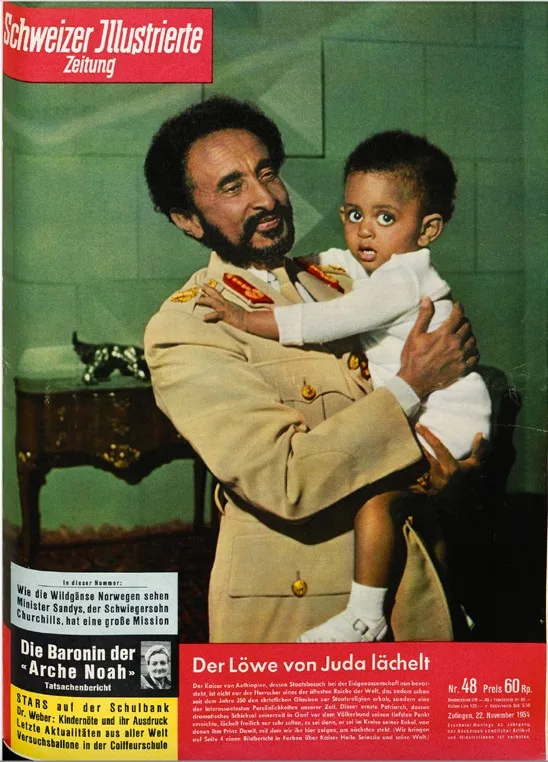
“One of the most interesting people of our time,” was how the ‘Schweizer Illustrierte Zeitung’ of 22 November 1954 captioned its cover story. The photo shows the emperor with his grandson Prince Dawit.
“One of the most interesting people of our time,” was how the Schweizer Illustrierte Zeitung of 22 November 1954 captioned its cover story. The photo shows the emperor with his grandson Prince Dawit. Private ownership
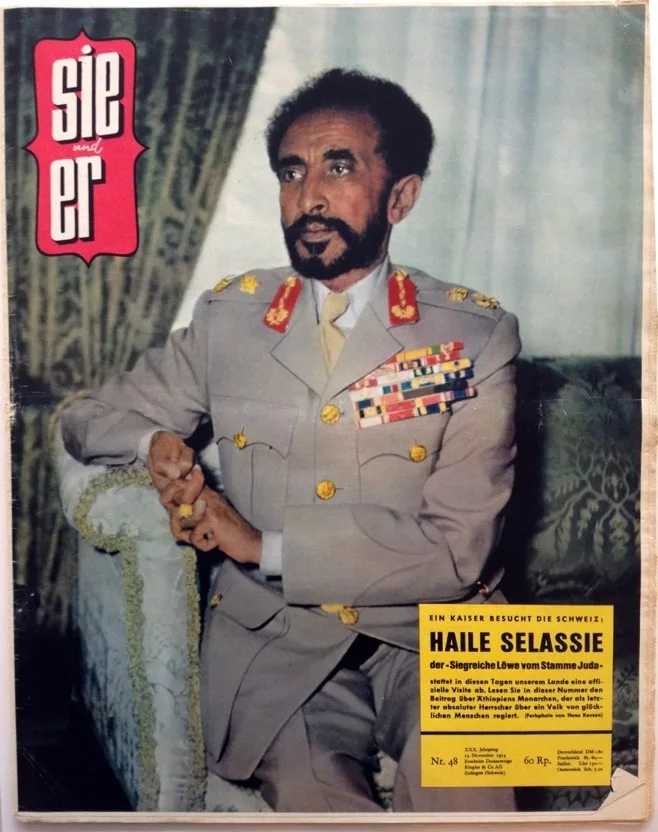
The magazine ‘Sie und Er’ of 25 November 1954 put the state visit on its front cover.
The magazine Sie und Er of 25 November 1954 put the state visit on its front cover. Bern Historical Museum

Accompanied by a 20-strong entourage
Following his official visit to Denmark, Haile Selassie travelled to Switzerland on 25 November 1954 aboard a train provided specially for him by the German Federal Railway. The core of the 20 or so people accompanying him included his son, Prince Makonnen Haile Selassie, Duke of Harrar, his daughter-in law Princess Sara Guizaw, Duchess of Harrar, Tsehafe Taezaz Wolde Giyorgis Wolde Yohannes, “Minister of the Pen and Minister of Justice”, foreign minister Aklilou Habte Wolde, Dejazmach (i.e. Major General) Mesfin Sileshi, Grand Marshal of the Court and Governor-General of the province of Kaffa, plus other “eminent figures of the emperor’s official and private retinue”. The emperor was greeted in Basel with full military honours by Federal Councillor Max Petitpierre and local government representatives during the formal arrival ceremony.
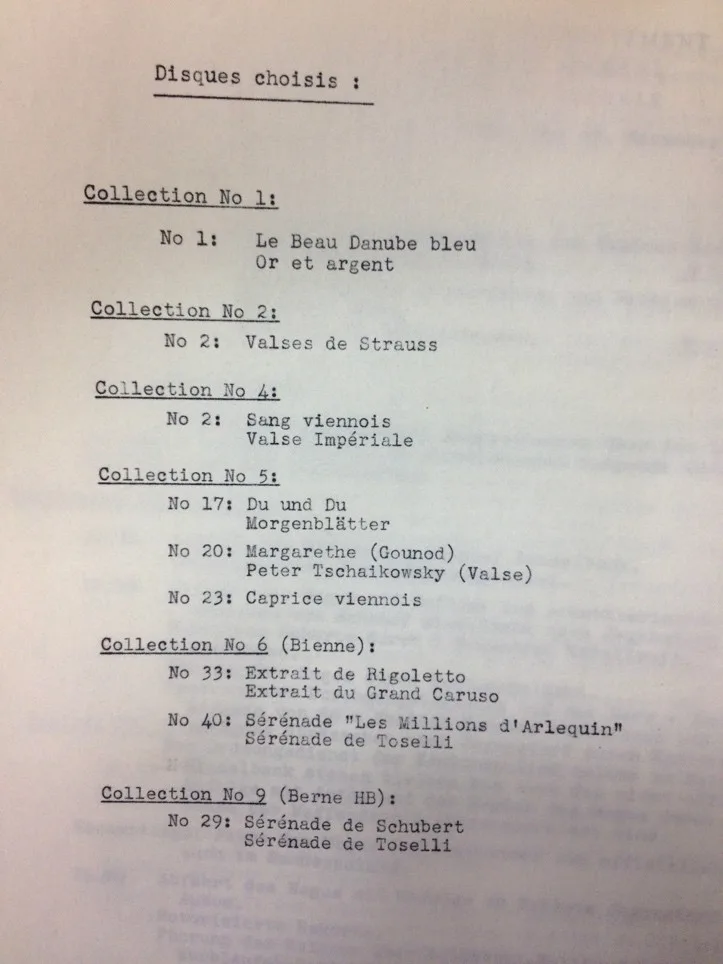
The entourage subsequently made its way to Hindelbank on another specially chartered train: a Swiss double unit known as the ‘Red Arrow’ with a German coach attached to carry the visitors’ 3,000kg of luggage. The emperor would make several trips on the Red Arrow over the following days.
Music selection to be played on the Red Arrow charter train. It was put together by operations managers at the very top of the Swiss Federal Railways.
Music selection to be played on the Red Arrow charter train. It was put together by operations managers at the very top of the Swiss Federal Railways. Swiss Federal Archives
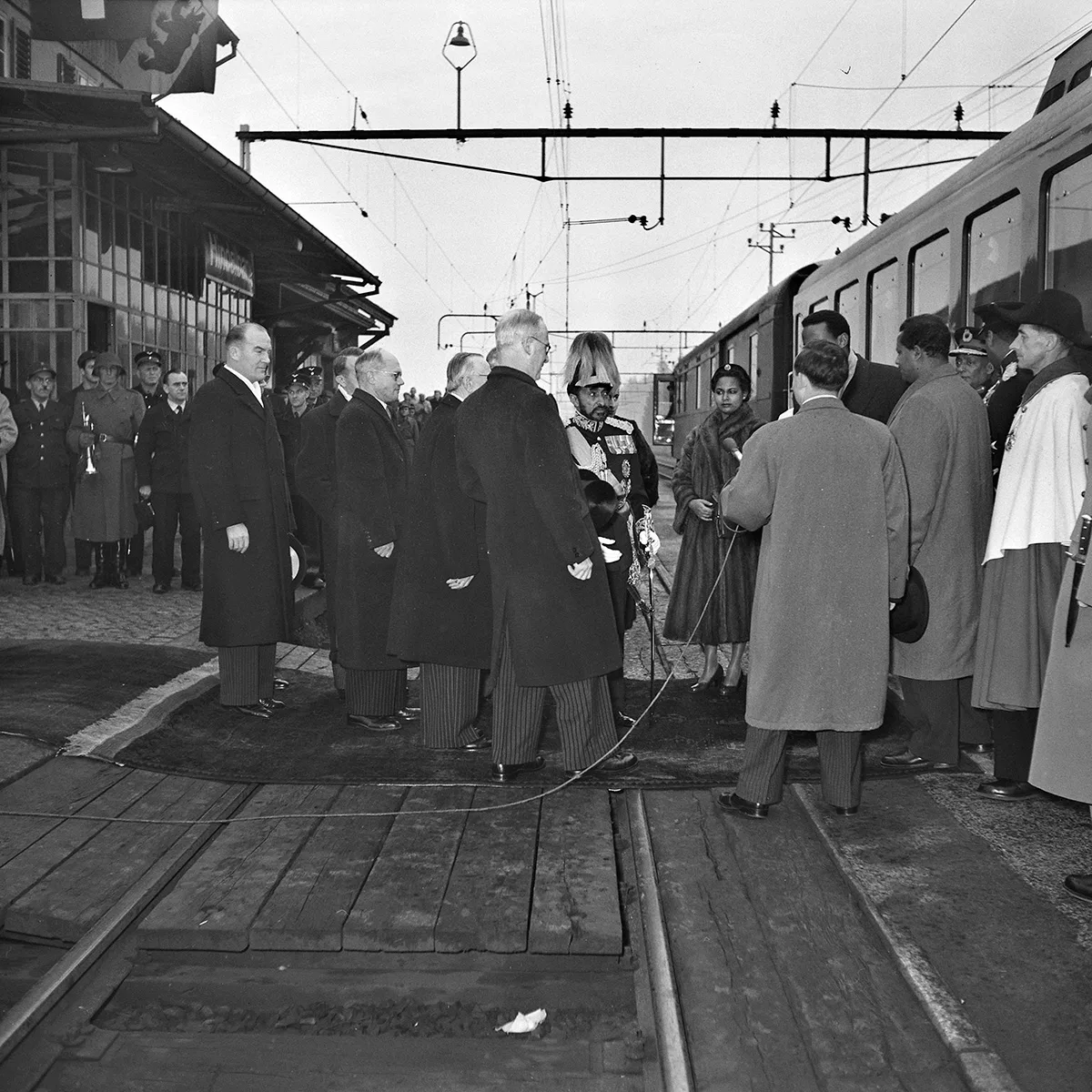
Swiss president Rodolphe Rubattel was waiting at Hindelbank to receive the emperor with great musical fanfare. The two men then continued on to Jegenstorf in an open carriage drawn by a team of four horses.
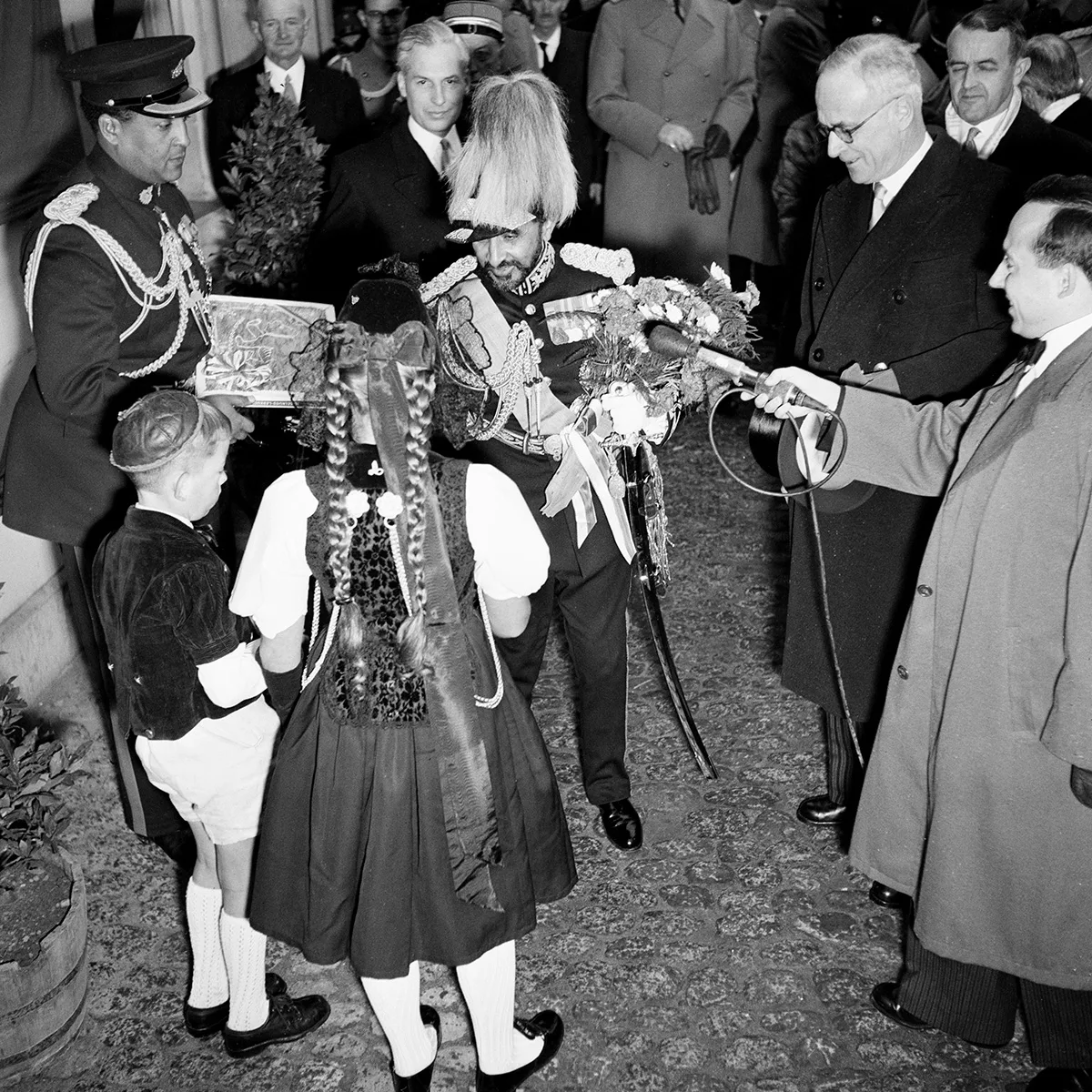
Rodolphe Rubattel, the president of the Swiss Confederation, greets the emperor at Hindelbank station (left).
Rodolphe Rubattel, the president of the Swiss Confederation, greets the emperor at Hindelbank station (left). A girl and boy in traditional costume present the emperor with gingerbread and are gifted coins in return. Swiss National Museum
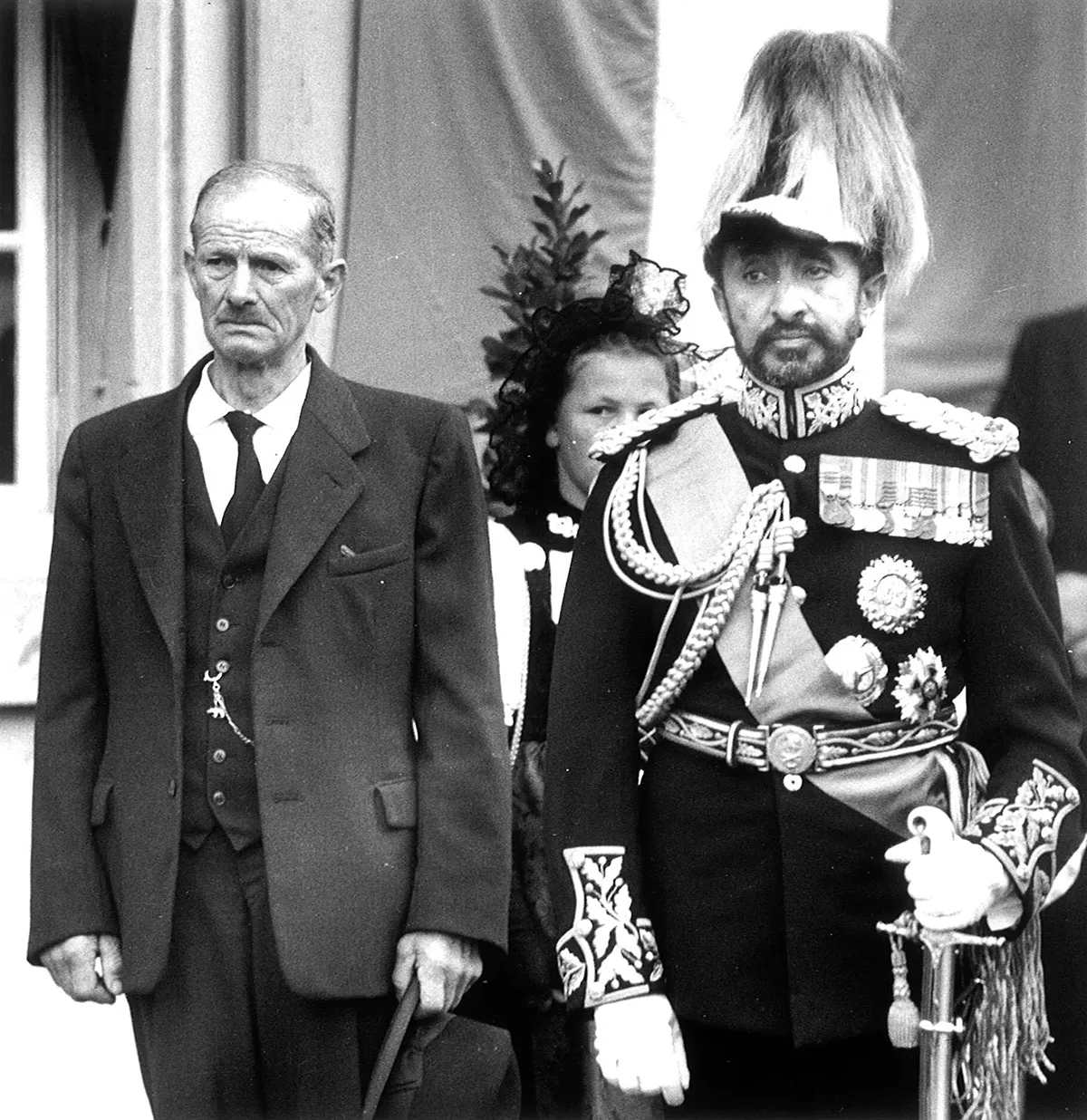
Democratic modesty meets imperial pomp: the mayor of Hindelbank Albert Danz with Emperor Haile Selassie.
Democratic modesty meets imperial pomp: the mayor of Hindelbank Albert Danz with Emperor Haile Selassie. Walter Studer/ Walter and Peter Studer Archives, © Walter Studer / Pipaluk Minder

Residence at Jegenstorf Castle

The castle in Jegenstorf, a farming village just outside the federal capital, had been transformed into a temporary residence for Haile Selassie. This was not the usual form of accommodation for state visitors, but a unique solution tailored entirely to the emperor. The castle was chosen as a residence due to its representative character, but also because it had served well as General Guisan’s command post during the Second World War. Situated close to Bern, Jegenstorf Castle had already proven in 1944/1945 that it was easy to guard and could be kept well-hidden from public view.
The Lohn Estate in Kehrsatz – owned by the Swiss Confederation since 1942 – had previously been used to accommodate visitors during their official stays, including Winston Churchill in 1946. But apart from the fact that the former patrician manor house would not be fitted out adequately for this purpose until 1960, it would simply have been too small to put up the sizeable Ethiopian party. While the emperor and core members of his entourage retired to Jegenstorf Castle in the evenings, the rest of the delegation sojourned at the Bellevue Palace hotel in Bern.
Since 1936, Jegenstorf Castle had housed a museum that was open to the public. So weeks, if not months, were spent on turning it into a residence fit for an emperor. Furniture was brought in from the Lohn Estate, Bern Historical Museum, the Bellevue Palace hotel and the private collections of several families in Bern, while carpets, lamps, chandeliers, silverware, porcelain and glasses were borrowed from specialist retailers.
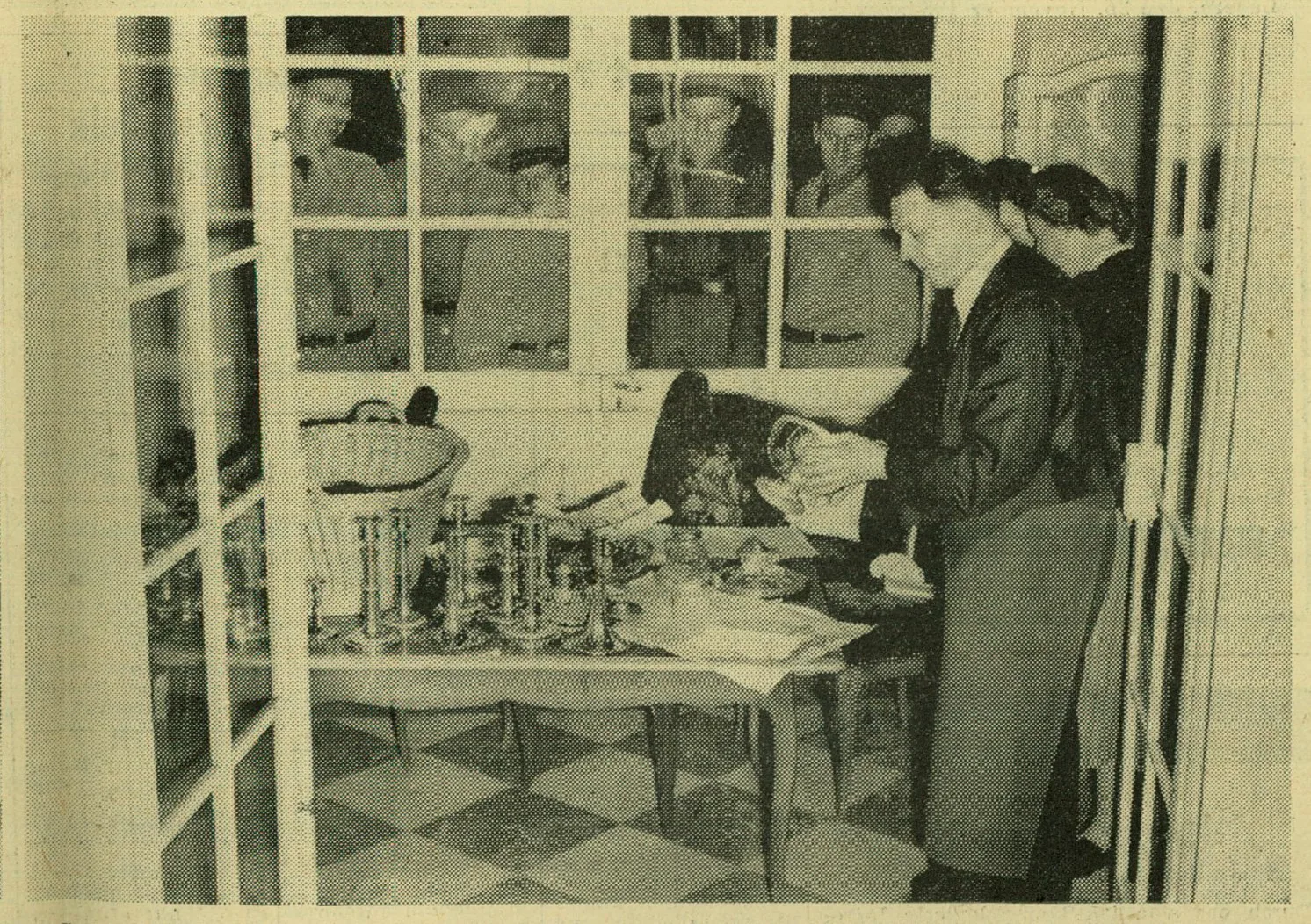
Employees of the Bellevue Palace hotel polish silverware borrowed from the Jezler manufactory under the watchful gaze of military guards at Jegenstorf castle. ‘Luzerner Tagblatt’ newspaper, 27 November 1954.
Employees of the Bellevue Palace hotel polish silverware borrowed from the Jezler manufactory under the watchful gaze of military guards at Jegenstorf castle. Luzerner Tagblatt newspaper, 27 November 1954. zentralgut.ch
The Confederation’s own horticultural unit created arrangements in the Ethiopian national colours of red, green and yellow using the emperor’s favourite flowers ‒ carnations and roses ‒ while Ethiopian flags bedecked the main facade. The central heating was repaired, the fireplaces and tiled stoves made ready for action and the kitchen spruced up. The exchange for the previously installed telephone system, consisting of 18 sets, was housed under the roof. The Bellevue Palace hotel was put in charge of staffing and running the temporary imperial residence, which required one head waiter, a further two waiting staff, two cooks, a governess, a maid and a porter. Forty police officers stood watch over the castle.
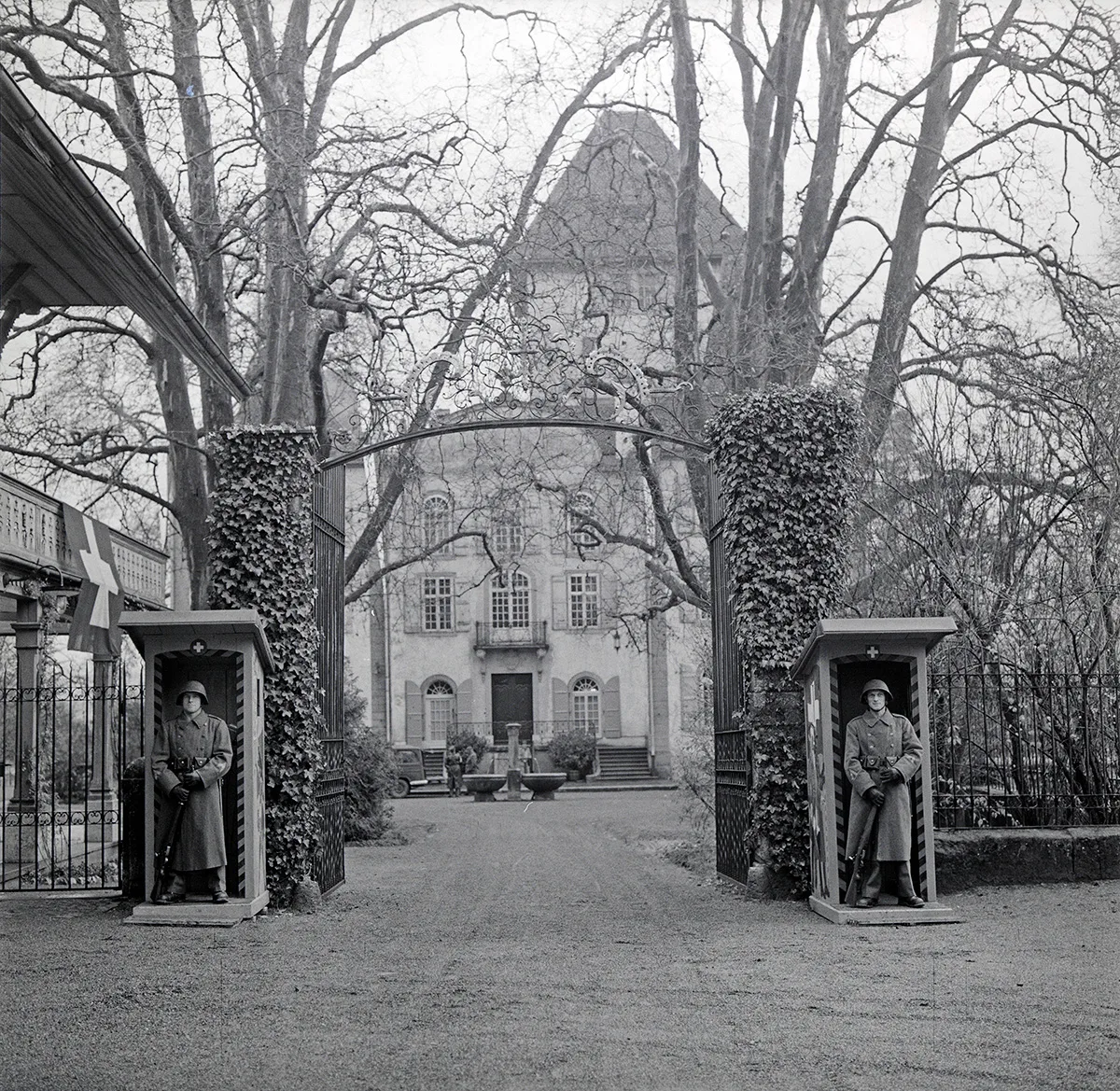
Guards flanking the entrance to the courtyard of Jegenstorf Castle. Policemen were used as well as soldiers. Photo by Björn Lindroos, 1954.
Guards flanking the entrance to the courtyard of Jegenstorf Castle. Policemen were used as well as soldiers. Photo by Björn Lindroos, 1954. ETH Library, Zurich
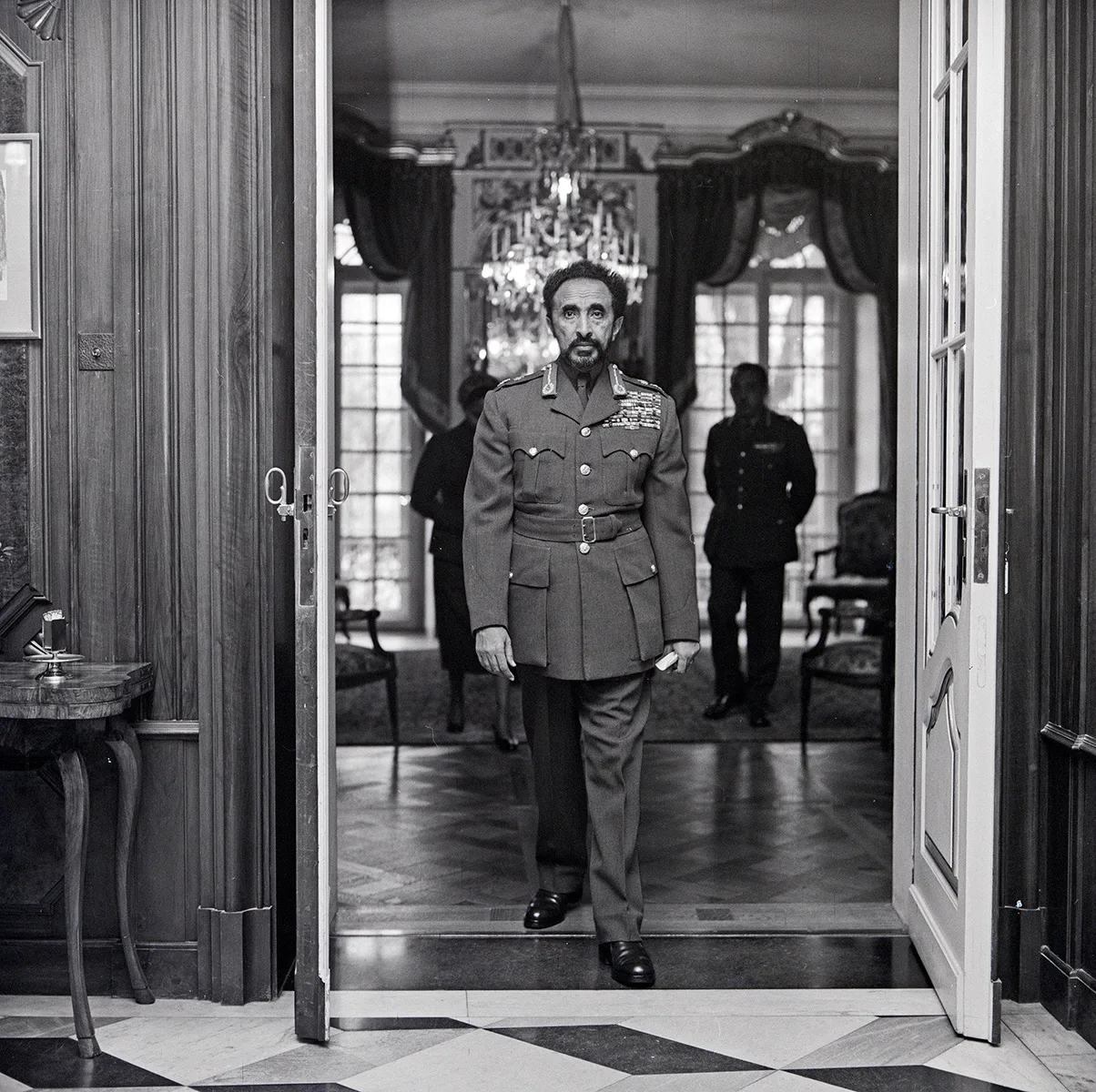
Emperor Haile Selassie striding out of the main salon at Jegenstorf Castle. The photo was taken on 26 November 1954 when the emperor gave an exclusive interview to a journalist and photographer from the ‘Schweizer Illustrierte’ magazine. Photo by Björn Lindroos.
Emperor Haile Selassie striding out of the main salon at Jegenstorf Castle. The photo was taken on 26 November 1954 when the emperor gave an exclusive interview to a journalist and photographer from the Schweizer Illustrierte magazine. Photo by Björn Lindroos. ETH Library, Zurich
To ensure Haile Selassie’s comfort, the Confederation had an additional bathroom installed on the first floor close to the imperial bedchamber – the very room that General Guisan had once used as his office. It cost the taxpayer CHF 18,000, an exorbitant sum of money in those days. Quoted widely in the media, at a time when many homes in the country still didn’t have a bathroom, it gave rise to rumours, the most widespread being that the bathtub must be made of gold – and that the emperor did not even use it once.

Grand entry to Bern watched by 100,000 curious onlookers

Late in the afternoon president Rubattel and the emperor were driven by limousine to Bern, stopping just outside the city gates to once again climb into the horse-drawn carriage before proceeding to the city centre. There, 100,000 curious spectators lined the streets, arcades and squares along the route from Bärengraben to Bundesplatz, the square in front of the parliament building. The offices of the Federal Administration had closed early for the day, and the children waving their Swiss flags had been given the day off school.
Swiss cinema newsreel report about the emperor’s visit. SRF
“The Negus is coming!” and similar calls rang out through the crowd. Everyone wanted to catch a brief glimpse of the ‘King of Kings’. Author Lukas Hartmann, a native of Bern then aged 10, was one of them: “I stood right at the front of the throng of onlookers on the street leading up to the Federal Palace; an endlessly long wait […] and, finally, the magnificently attired Negus, with an unbelievably dark complexion […]. I had, at least for a few seconds, seen an emperor, a real-life emperor! […]. That day, if I could, I would have changed my nationality: to be an Abyssinian seemed to me to be the ultimate thing to aspire to in a world practically devoid of emperors.”

Speeches at one palace, feasting at another
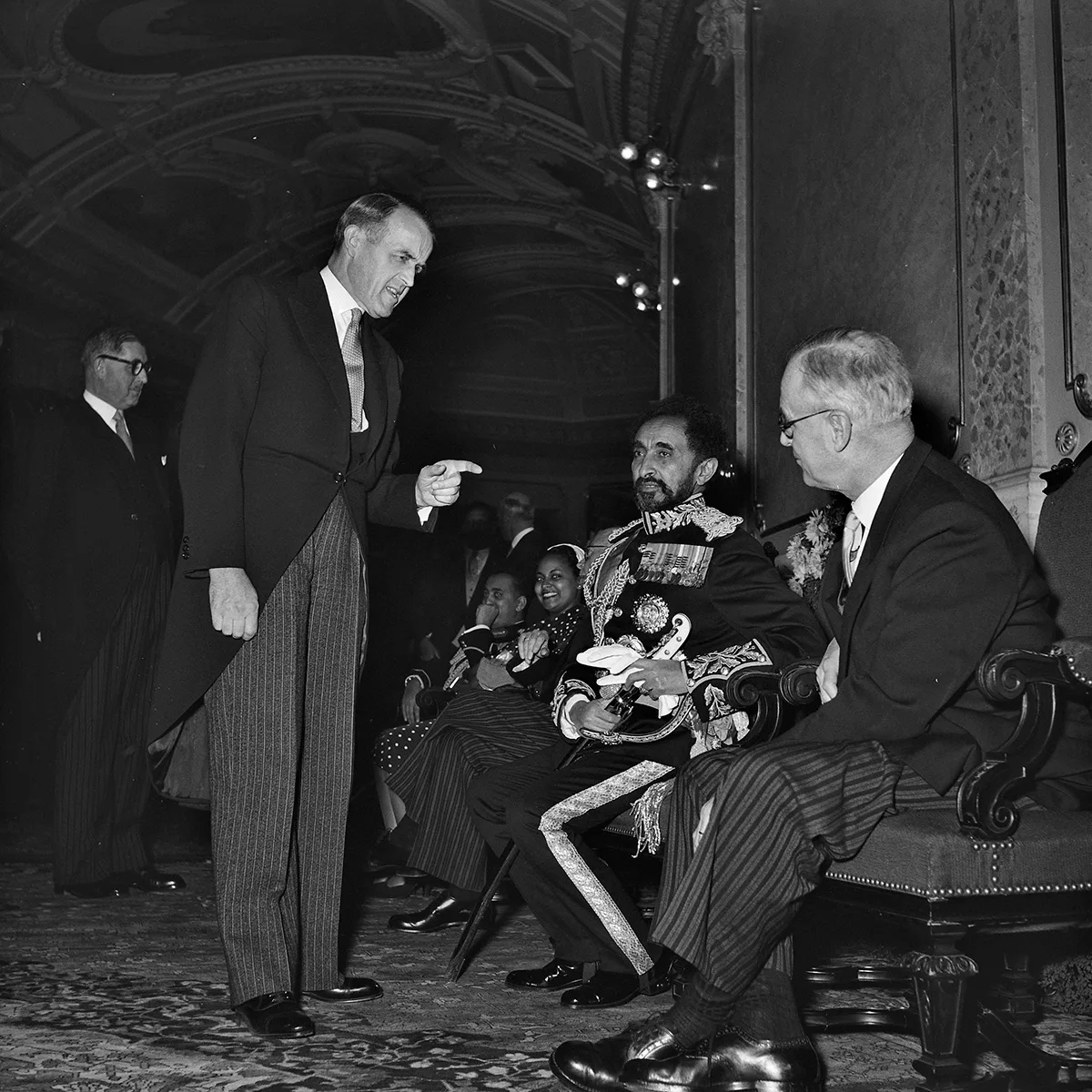
Following the military honours outside the Federal Palace an official reception ceremony took place inside, attended by the entire Swiss Federal Council. Rubattel and Haile Selassie each gave a speech. The president of the Swiss Confederation spoke somewhat verbosely about Ethiopia’s long tradition of Christianity and about the “time-honoured, deep ties” between the two countries: “We are delighted […] to behold the shining symbol of those feelings of high esteem and friendship that have existed for so long between the Ethiopian Empire and the Swiss Confederation. […]. As a matter of fact, we know that Ethiopia has always occupied a special place in the thoughts of our ancestors and that, at the time when Christianity first made its way into our valleys, they already regarded Ethiopia as one of those sacrosanct places of which the Bible speaks. For those believers, the empire over which Your Majesty now reigns basked completely in the light emanating from several hundred years of Christian tradition. […]. The two nations also share similarities in relation to their homeland and devotion to freedom. They are inspired by the same Christian principles and place their hopes and ideals on a foundation of justice and social progress. What is more, both have fought for their independence.”
Haile Selassie I in conversation with Federal Councillor Max Petitpierre (left) and Swiss president Rodolphe Rubattel (right) in the lobby of the Federal Palace.
Haile Selassie I in conversation with Federal Councillor Max Petitpierre (left) and Swiss president Rodolphe Rubattel (right) in the lobby of the Federal Palace. Swiss National Museum
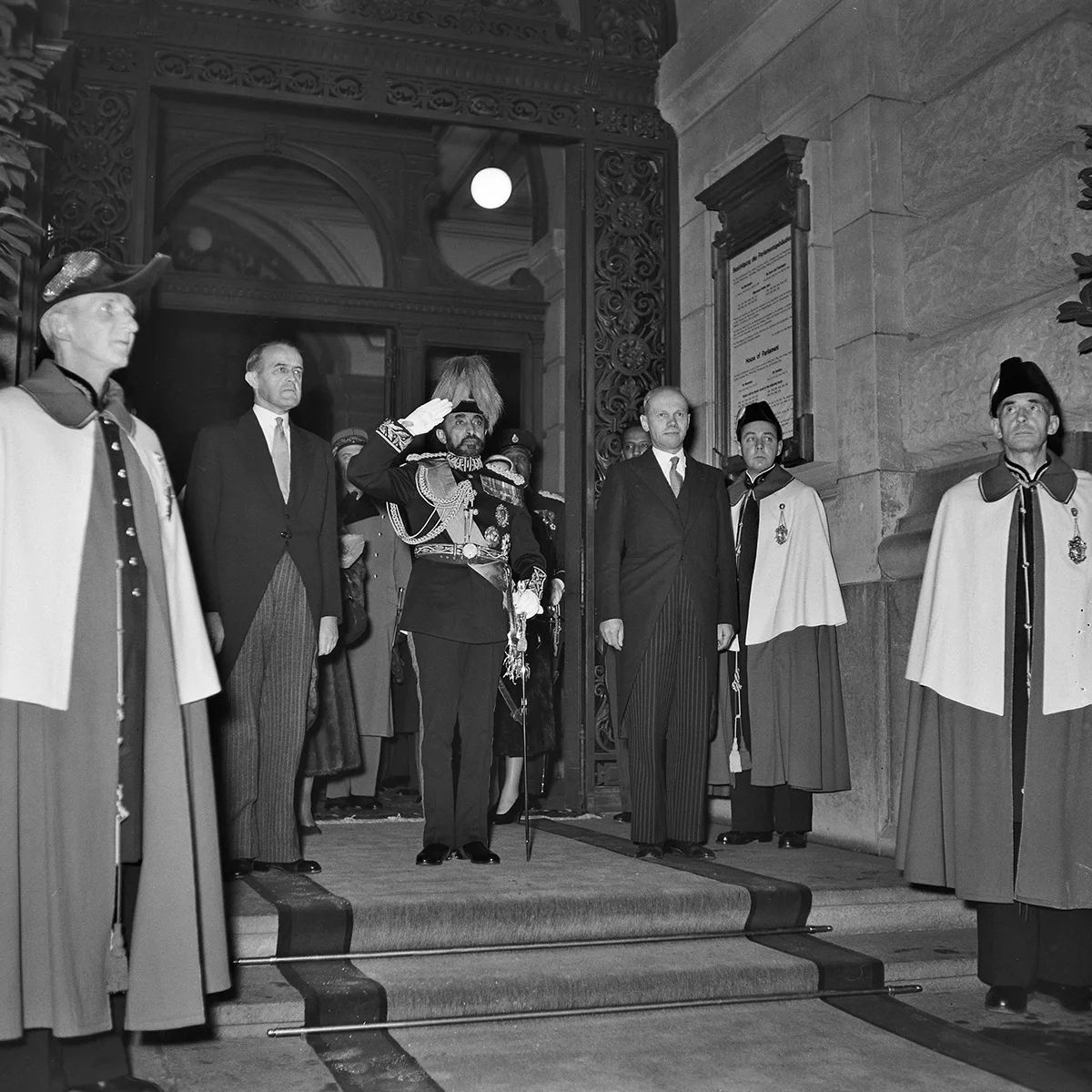
The emperor giving a salute at the entrance to the Federal Palace, with Federal Council Max Petitpierre to his left.
The emperor giving a salute at the entrance to the Federal Palace, with Federal Council Max Petitpierre to his left. Swiss National Museum
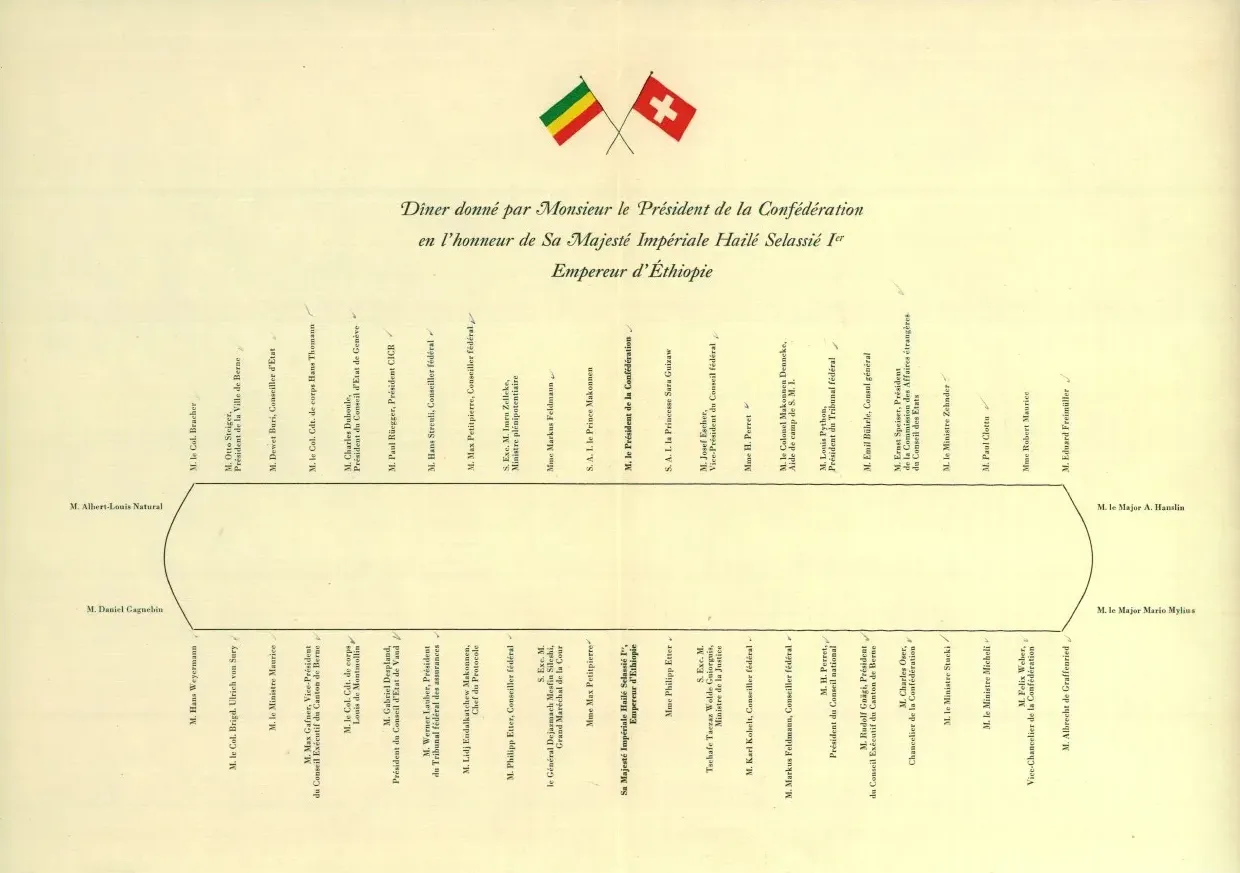
The state banquet hosted by the president of the Swiss Confederation was held later that evening in the Bellevue Palace hotel. While most of those present treated themselves to wine and champagne, the emperor was said to have contented himself with fruit juice.
The seating arrangements for the state banquet at the Bellevue Palace hotel.
The seating arrangements for the state banquet at the Bellevue Palace hotel. Swiss Federal Archives

A busy four-day schedule

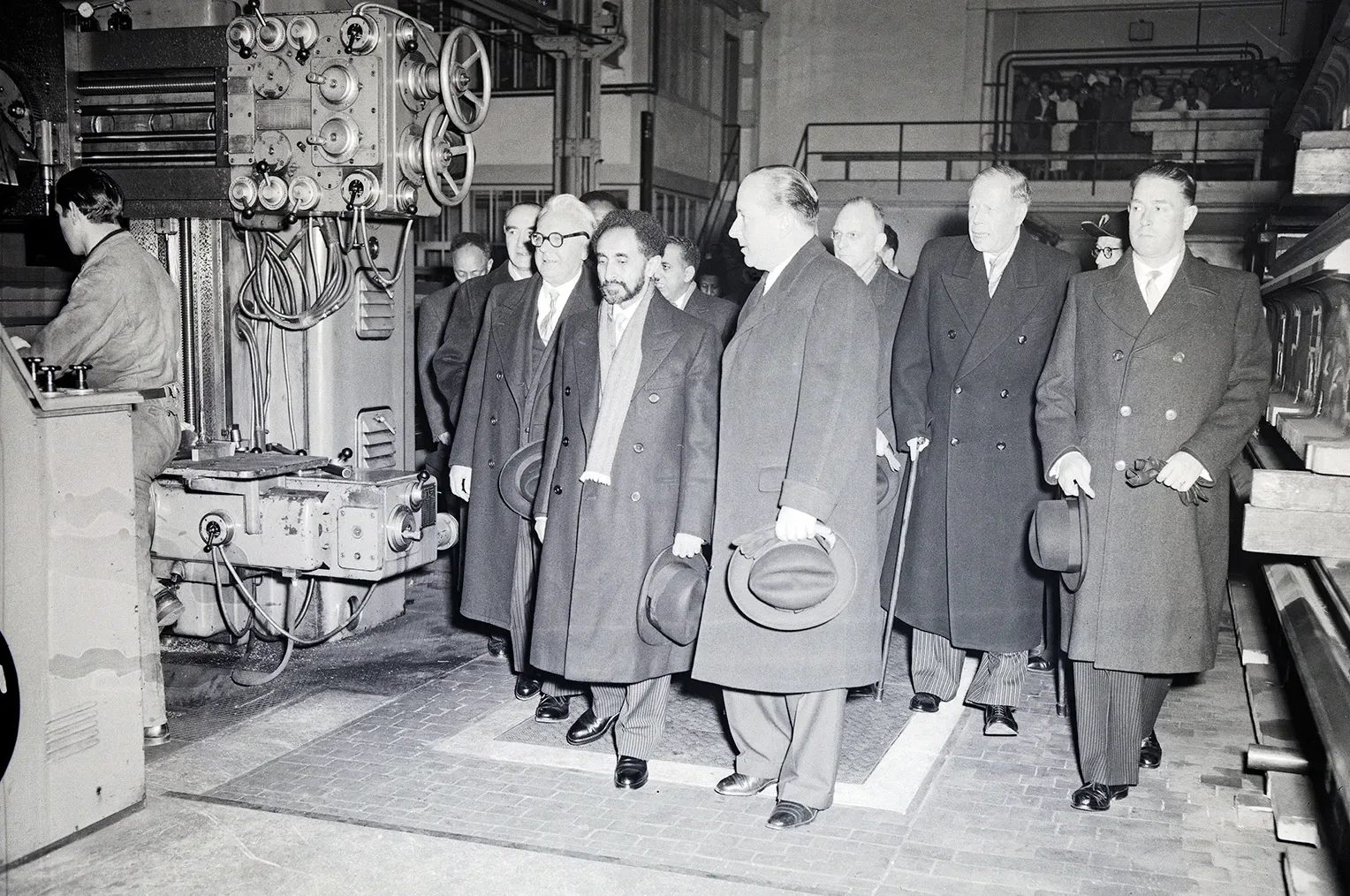
The emperor had a packed programme to get through during his stay from 25 to 28 November 1954. According to Rubattel, this was intended to “acquaint him with certain aspects of our country. At this stage in late autumn, when fog and snow are common, we thought it best not to plan any trips to the mountains.” Instead, the emperor spent his second day in Zurich, accompanied by Federal Councillor Hans Streuli. After being received by the city and cantonal governments, he was shown round the cantonal hospital and the Swiss Federal Institute of Technology (ETH), where he watched experiments being performed in the physics laboratory. He was then guest of honour at an official dinner in the Dolder hotel, followed by a tour of the Oerlikon Bührle & Co. machine tool factory given by Emil Georg Bührle, who had been Ethiopia’s honorary consul general in Switzerland since 1934.
Emil Bührle, seen here with walking stick, showing the Ethiopian emperor around his factory.
Emil Bührle, seen here with walking stick, showing the Ethiopian emperor around his factory. ETH Library, Zurich
The detailed report on the state visit records that “ […] the imperial visitor showed particular interest in the anti-aircraft guns manufactured by Bührle as well as its newly developed rocket launcher, and watched a display of rapid-fire weapons at the firing range”. Ethiopia was one of the many nations to which Bührle sold weapons for decades. Since 1929, it had been gratefully receiving shipments of the factory’s biggest worldwide export hit – the Oerlikon 20mm anti-aircraft cannon. The day finished with a tour of the Brown-Boveri works in Baden following a short visit to Zurich’s Kloten airport.
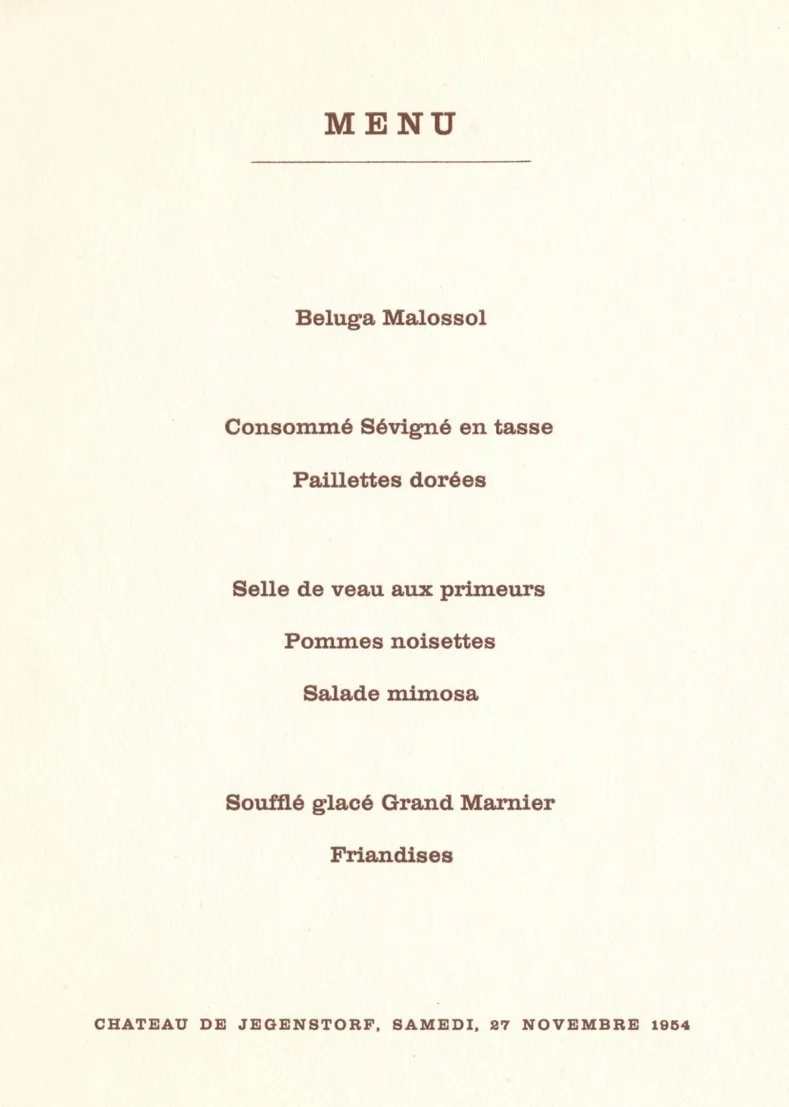
Day three saw Karl Kobelt, another member of the Federal Council, accompany the emperor to the Federal Horse Training Centre, followed by a reception by dignitaries at Bern town hall. The party then made its way to Münchenwiler Castle near Murten, where the emperor was shown round the Volkshochschule Bern’s adult education centre before enjoying lunch. At the military airport in Payerne, Haile Selassie was treated to a demonstration of the Swiss Air Force’s Venom fighter planes in action. In the early evening he returned to the Bellevue Palace hotel for a ‘grande réception’ hosted by the diplomatic corps, with a guest list of 400 people. At the emperor’s invitation, the entire Federal Council dined at Jegenstorf Castle that evening along with their spouses; the catering was again provided by the Bellevue Palace hotel. The emperor then held a reception attended by 250 invitees.
Extract from the dinner menu at Jegenstorf Castle. Champagne (Heidsieck & Co. Dry Monopole brut 1947) and red wine (Château Latour Pauillac M. C. 1934) were also laid on.
Extract from the dinner menu at Jegenstorf Castle. Champagne (Heidsieck & Co. Dry Monopole brut 1947) and red wine (Château Latour Pauillac M. C. 1934) were also laid on. Swiss Federal Archives
On the final day, Federal Councillor Max Petitpierre travelled with the emperor to Geneva. Following a reception and tour of the Museum of Art and History followed by lunch at the Hôtel des Bergues, it was time to visit the headquarters of the International Committee of the Red Cross (ICRC). The final item on the day’s schedule was a visit to the Palace of Nations, the home of the United Nations – the successor organisation to the League of Nations, which had previously failed to come to Haile Selassie and his country’s aid.
Official farewells were said at the border crossing in Buchs, from where Haile Selassie and his entourage continued on to Vienna, the next and final stop on their world tour. After two days in Austria, Haile Selassie made a brief, unofficial reappearance in Switzerland: he spent a few days at the Verenahof, a spa hotel in Baden, before returning home.

The emperor’s gifts

The Federal Administration appeared to be disappointed with the gifts the emperor had brought. One report states that “the Federal Council had to make do with a photograph of the emperor in a silver frame”, while a memo reveals the belief that: “[…] the gift he presented to the Federal Council was far less valuable than those given to the authorities in Zurich, Bern and Geneva”. The conclusion was reached that the emperor’s “stash of trophies was doubtless running low” given that Switzerland and Austria were the final stops on the European leg of his tour. The photograph presented to the Swiss president and the “magnificent rug” accepted by Rudolf Gnägi on behalf of the Bern cantonal government are nowhere to be found today.
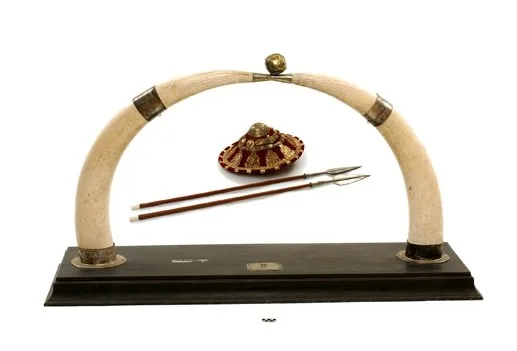
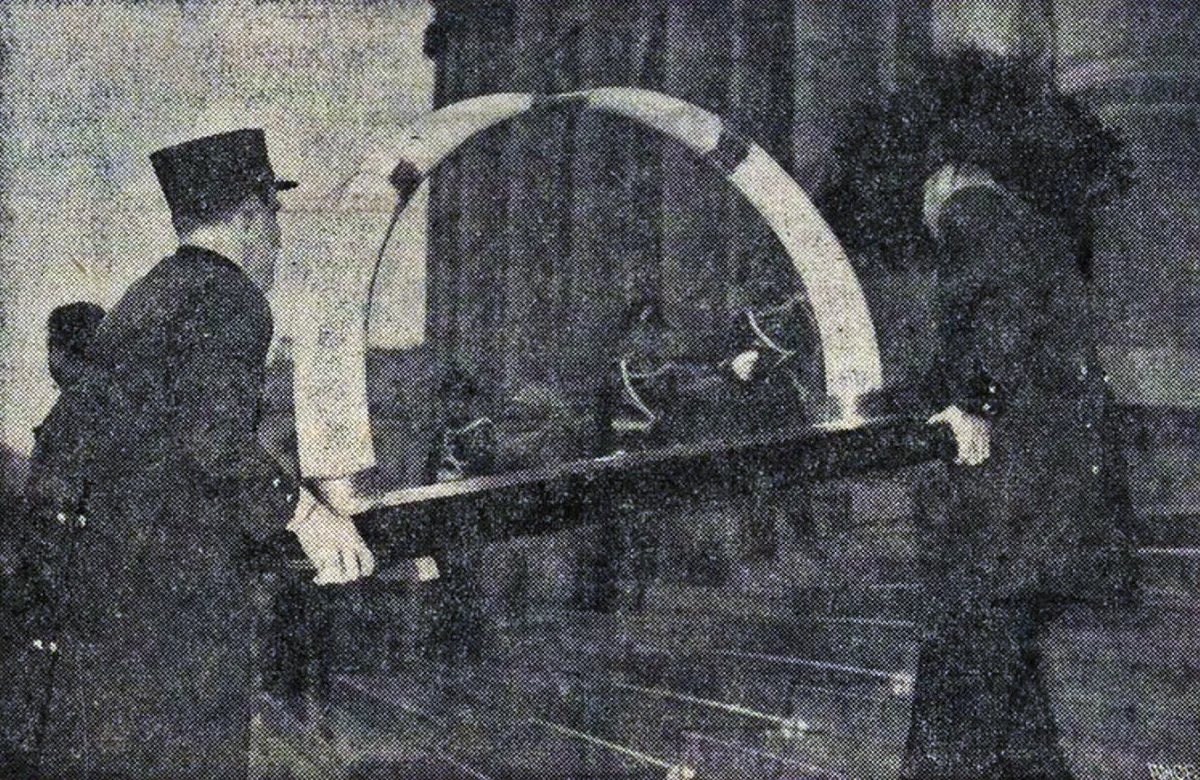
The cities of Zurich and Geneva each received a pair of impressive elephant tusks mounted in silver plus an Ethiopian shield and two spears. These gifts are now part of the collections of the ethnographic museums at the University of Zurich and in Geneva.
Gifted to the City of Geneva: mounted elephant tusks, two Ethiopian spears and a shield.
Gifted to the City of Geneva: mounted elephant tusks, two Ethiopian spears and a shield. Musée d'Ethnographie de Genève
The emperor’s gift being carried into the museum. Photograph from ‘La Tribune de Genève’ newspaper of 29 November 1954.
The emperor’s gift being carried into the museum. Photograph from La Tribune de Genève newspaper of 29 November 1954. e-newspaperarchives.ch
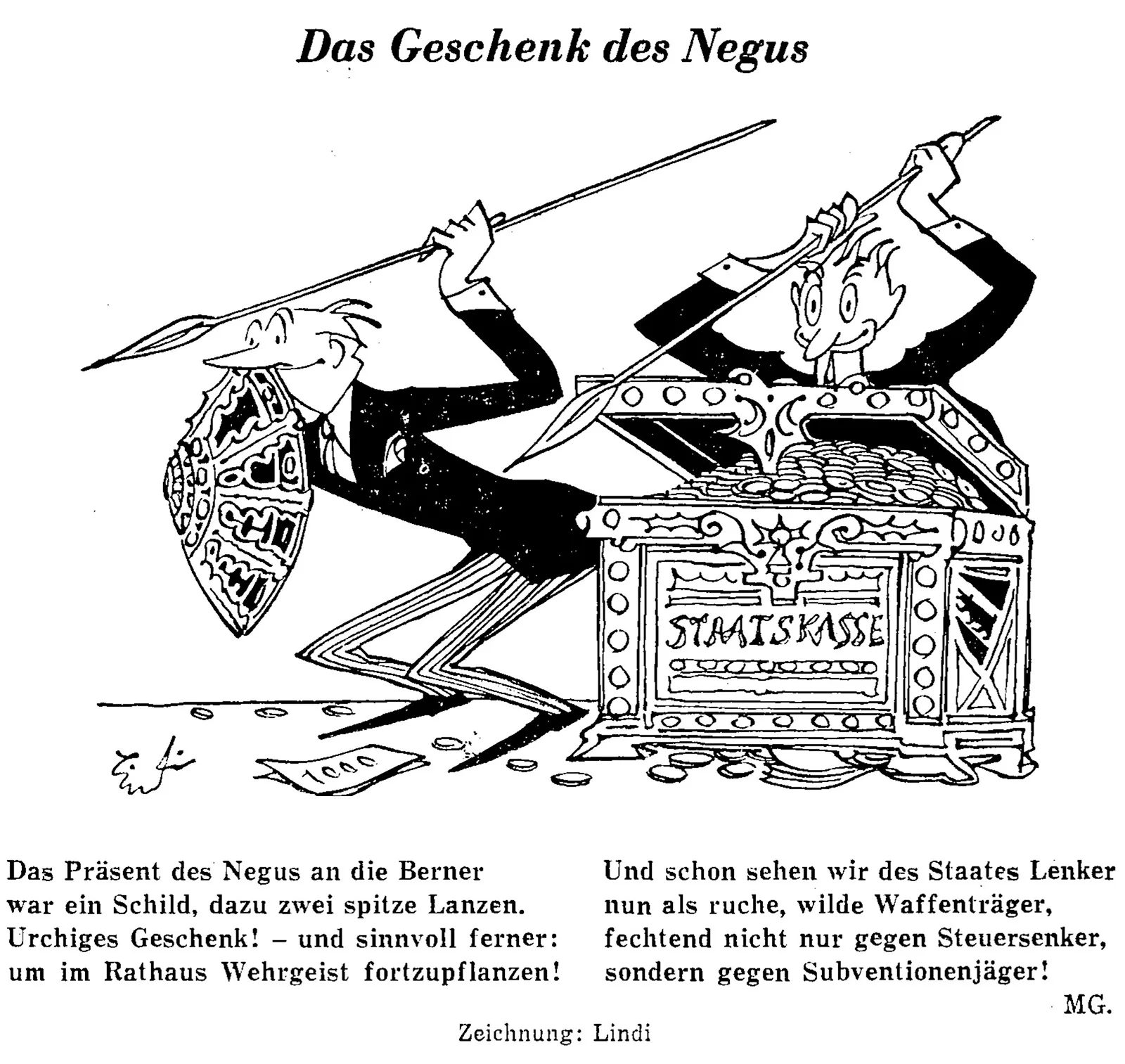
The city of Bern had to make do with a shield and a pair of spears. Irritation at the supposedly ‘provocative’ offering is reflected in some of the documents stored in the Federal Archives. It is conjectured that the gift was made as a “pointed” gibe by the emperor in retaliation for his treatment in 1936 ‒ speculation that tells us more about the giftees than the giver.
An easy target for the press: this caricature by Lindi (Albert Lindegger) on the front page of ‘Der Bund’ newspaper of 5 December 1954 makes fun of the emperor’s gifts to the City of Bern.
An easy target for the press: this caricature by Lindi (Albert Lindegger) on the front page of Der Bund newspaper of 5 December 1954 makes fun of the emperor’s gifts to the City of Bern. e-newspaperarchives.ch
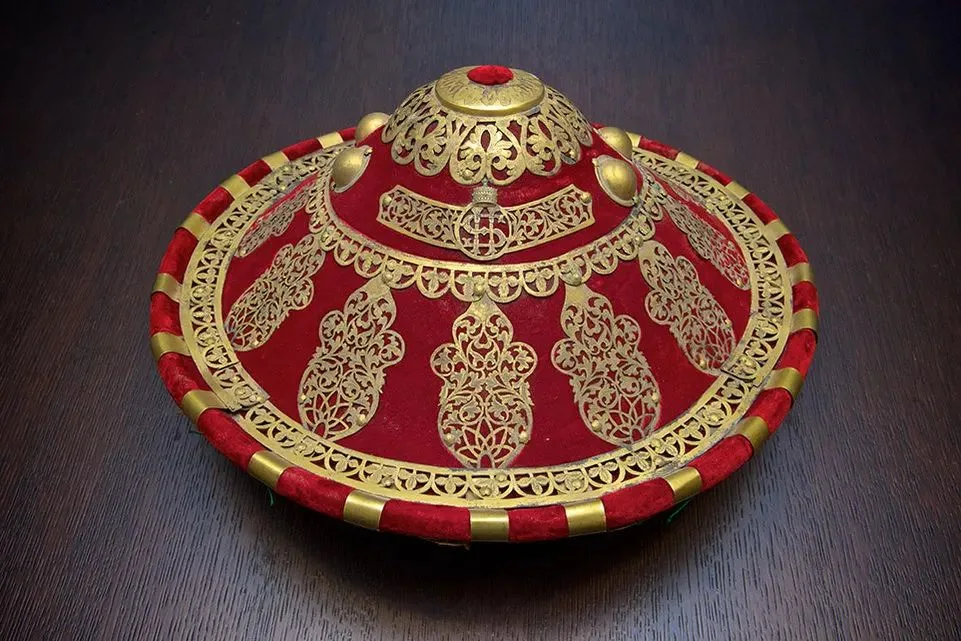
Weapons have always been commonplace as diplomatic gifts (and remain so to this day), partly due to their function as symbols of strength and the willingness to defend oneself. And in Haile Selassie’s case, these were objects of great symbolic value: in Ethiopia shields and spears were sought-after badges of honour, formerly bestowed personally by the Ethiopian emperor on brave warriors and hunters at celebratory feasts. They continued to signify male courage and strength far into the 20th century, despite being supplanted by more modern weapons for hunting and fighting in real life. Furthermore, the silver-tipped spears and the shield each bore the emperor’s monogram.
Covered in red velvet and embellished with brass pierced panels: the Ethiopian ceremonial shield of around 45cm in diameter twice bears the monogram ‘HS’ topped with the imperial crown.
Covered in red velvet and embellished with brass pierced panels: the Ethiopian ceremonial shield of around 45cm in diameter twice bears the monogram ‘HS’ topped with the imperial crown. Stadtarchiv Bern

“Le grand ami” takes his time

On 29 November 1954 the Berner Tagblatt newspaper wrote that “Jegenstorf, the sedate village that was touched by magic from another world without being overawed, is returning to its normal, everyday life.” At the same time, further rumours were spreading throughout the Federal Administration. This time, the issue was whether the emperor might perhaps be dissatisfied with the way his state visit had been organised, given that he had left the country without immediately sending a telegram to the Swiss president thanking him for the hospitality. It was surmised that ignorance of the conventions of international courtesy could not possibly be the reason, as the emperor had sent the Austrian president Theodor Körner a ‘long’ telegram before completing his departure.
And so the hasty conclusion was reached “[…] that he had not forgotten the events of 1936 and that he remembered being refused asylum at the time.” It was even suspected that he had not come to Switzerland to “wipe the slate clean”, but rather to vent his feelings of resentment towards the Federal Council. That was supposedly the reason why he had “deliberately flouted” diplomatic etiquette.
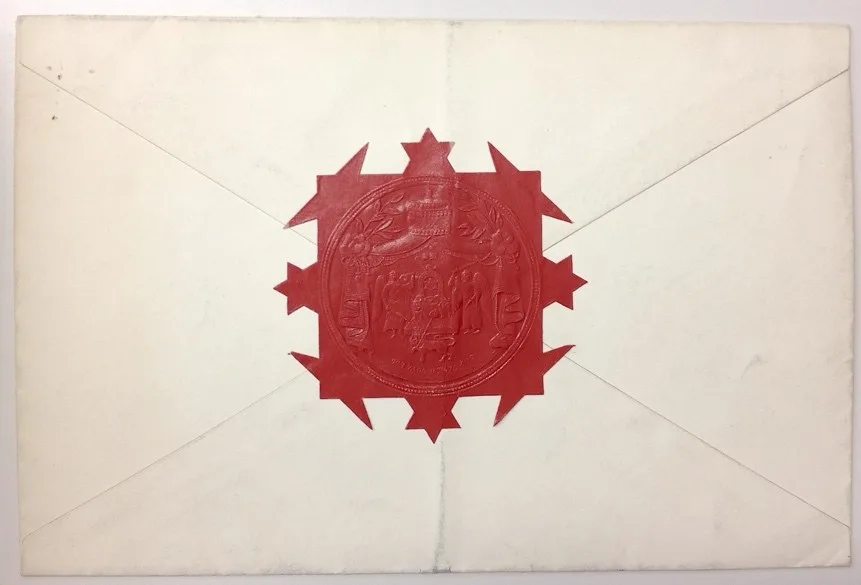
After four months of uncertainty and diplomatic activity involving a great deal of correspondence, the eagerly awaited thank-you letter finally arrived: by normal letter post and addressed to “President of the Swiss Confederation” Philipp Etter – Max Petitpierre was actually Switzerland’s president in 1955, Etter was ‘merely’ the head of the Department of Home Affairs – greeting him in capital letters as “CHER ET GRAND AMI” or “dear and great friend”. The emperor promised to send him “a selection of the finest coffee grown in Our Empire”. Above his signature, written by hand in Amharic script, he described himself as “Le grand ami” (Your great friend). These seemingly agreeable words from the imperial palace in Addis Ababa finally brought a sense of relief to the Federal Administration.
The envelope for the emperor’s thank-you letter. The seal bears the imperial coat of arms depicting the Conquering Lion of the Tribe of Judah on the throne.
The envelope for the emperor’s thank-you letter. The seal bears the imperial coat of arms depicting the Conquering Lion of the Tribe of Judah on the throne. Swiss Federal Archives
The moral of the story? Despite many well-intentioned but mostly ineffective efforts to introduce reforms, the pace of life at the imperial court – and especially of progress and modernisation – remained slow in comparison to the way things were done in Switzerland. The three wristwatches presented to the emperor by the Federal Council as a memento of his visit could do nothing to change that. The promised Ethiopian coffee also took a long time to materialise, only arriving in Switzerland in August 1955. But it was worth the wait: after all, there were 20 sacks full. Although we cannot entirely dismiss the perception that the emperor displayed a “certain froideur” in his dealings with the Swiss government, we can safely assume that Haile Selassie’s feelings towards Switzerland were entirely conciliatory.

The last emperor

Not only was Haile Selassie the last emperor to come to Switzerland on a state visit, he was also the last emperor to rule Ethiopia. By the early 1970s at the latest, it was no longer possible to hide the true nature of the Ethiopian feudal system behind the grand claims of modernisation that had been presented to the outside world for decades. Famine in the countryside and student unrest in Addis Ababa were brought to public attention by the media, culminating in revolts that led to Haile Selassie’s removal from power in 1974 and murder the following year.
 
And so an empire that had lasted for around 3,000 years came to an abrupt end. It was followed seamlessly by the military dictatorship of Mengistu, who established a reign of terror in Ethiopia. At the same time, Haile Selassie, born in 1892 as Ras (literally ‘head’, but equivalent to ‘duke’) Tafari Makonnen, experienced something of a ‘renaissance’, with followers of Rastafari, a global religious movement based on an interpretation of the Old Testament, worshipping him as their returned messiah and God incarnate.
Further posts