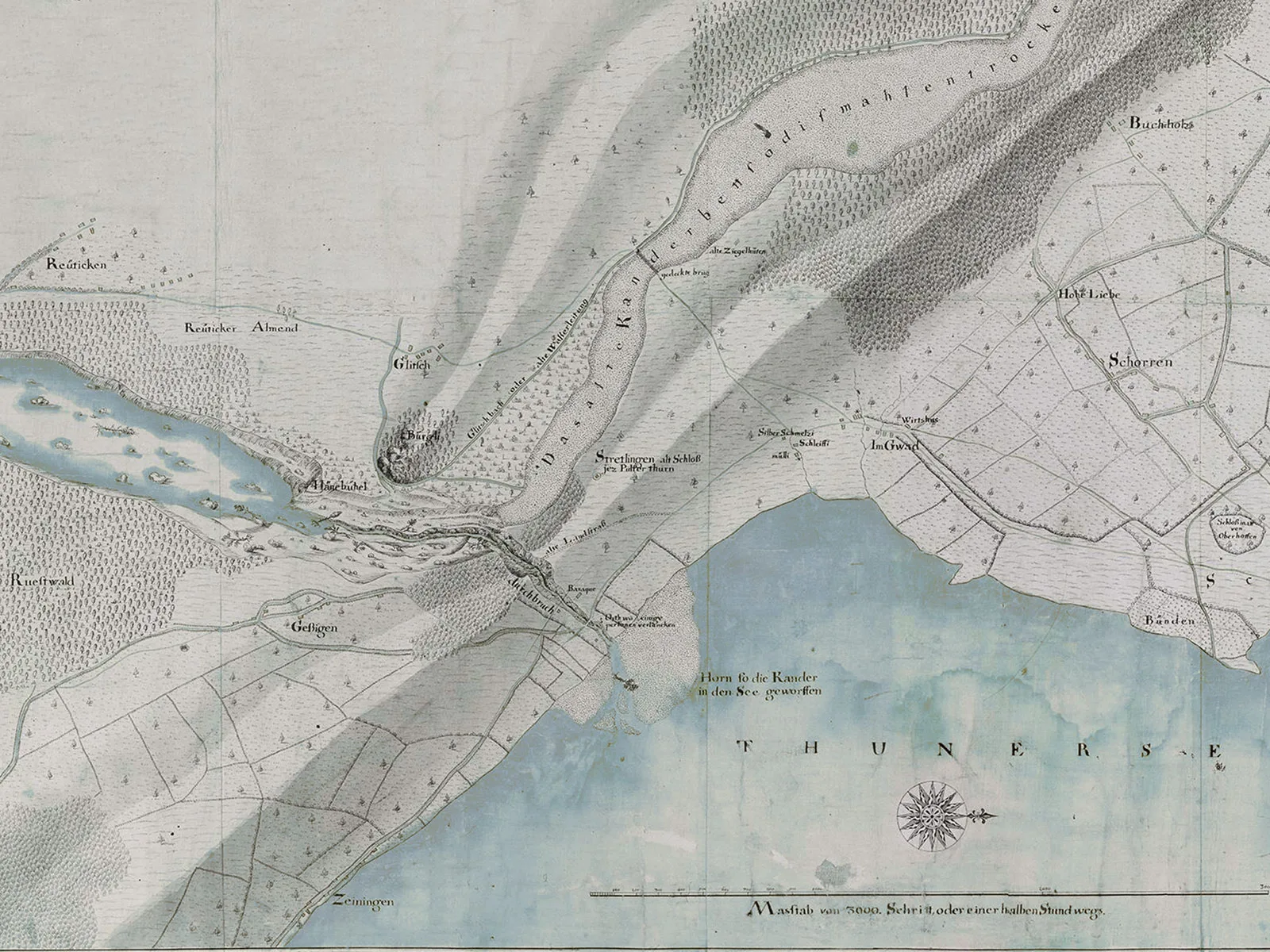
The deviation of the course of the river Kander fundamentally changed the regional landscape. A map from 1716, subsequently amended.
The deviation of the course of the river Kander fundamentally changed the regional landscape. A map from 1716, subsequently amended. Bern State Archive

The Kander river deviation and its aftermath

The stretch of A6 motorway between Thun and Spiez follows the path of a former riverbed and crosses a pioneering project of Swiss water cor-rection dating from the early 18th century. The Kander river deviation had a big impact on the region around the town of Thun and on the man who initiated and managed the project: Samuel Bodmer.

Reto Bleuer

Reto Bleuer

Reto Bleuer is a volunteer at the Archaeological Service of the Canton of Bern.

The Kander is a wild mountain river with an extensive catchment area in the Bernese Oberland. It rises high and fast in heavy rain or when the snow is melting and its irrepressible power sweeps away anything in its path. Before the artificial deviation in the river’s course, the Kander used to flow to the west of the town of Thun through a plain into the Aare. When the Kander burst its banks, the lower course of the river flooded an extensive area, leaving the communes of Allmendingen, Uetendorf and Thierachern exposed to a flooding risk. The debris from the Kander sometimes blocked the Aare, making it also burst its banks and cause flooding damage in Thun.

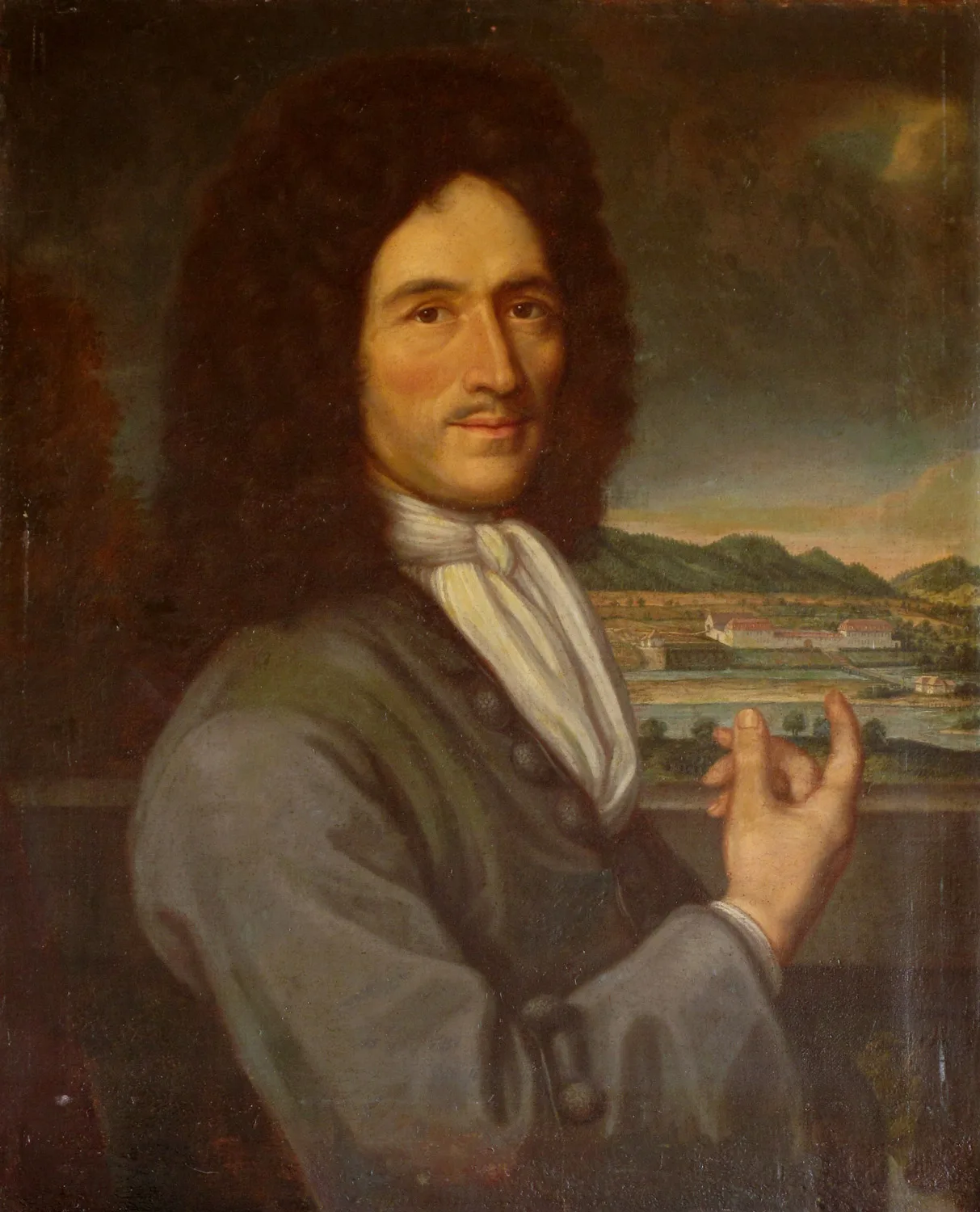
In response, some of the affected communes submitted a proposal to the Bern government in 1698, requesting that the course of the tempestuous river be diverted into Lake Thun. The authorities subsequently set up a committee to review the feasibility of such an undertaking. It proved a long process and it was only following the appointment of the third Kander committee in 1710 that any concrete plans took shape. Respected fortress builder Pietro Morettini worked with the committee as an adviser. However, Samuel Bodmer (1652-1724) led the project. A trained baker, Bodmer also had knowledge of engineering and field measurement from his days as an artillery officer. He owned the estate in Amsoldingen and ran a mill. He had a good view of the havoc occasionally wrought by the Kander from Amsoldingen as it was on slightly higher ground. Having previously done some surveying for the council of Bern, he felt ready to plan and implement the big Kander diversion.

Bodmer proposed digging a 400-metre long channel in the moraine hills running parallel to Lake Thun to divert part of the river near Einigen into Lake Thun. This came to be known as the ‘Kanderdurchstich’ or Kander river deviation. Bodmer also heeded the concerns of Thun municipal council that the Kander would raise the Lake Thun water margin leading to flooding in the city, and he proposed additional measures to increase the lake’s flow rate.
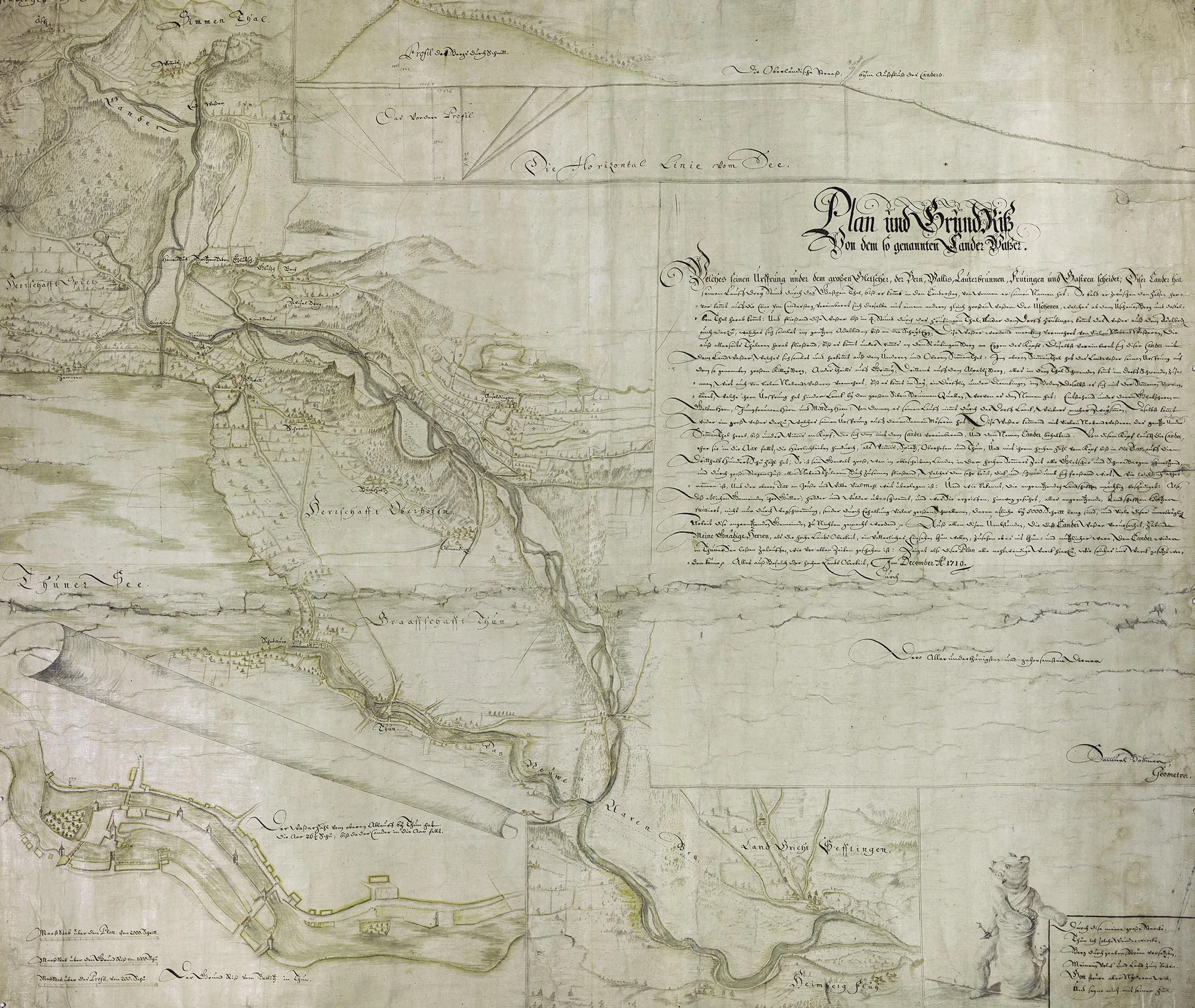
Samuel Bodmer’s plan and sketch for the Kander. The channel can be seen top left, the measures for Thun are on the lower left-hand side.
Samuel Bodmer’s plan and sketch for the Kander. The channel can be seen top left, the measures for Thun are on the lower left-hand side. Bern State Archive
On 11 February 1711, Bern municipal council decided to give the green light to Bodmer’s plan and to appoint Bodmer as project manager. However, no doubt due to cost considerations, they opted to focus on digging the channel and forego the ancillary measures.

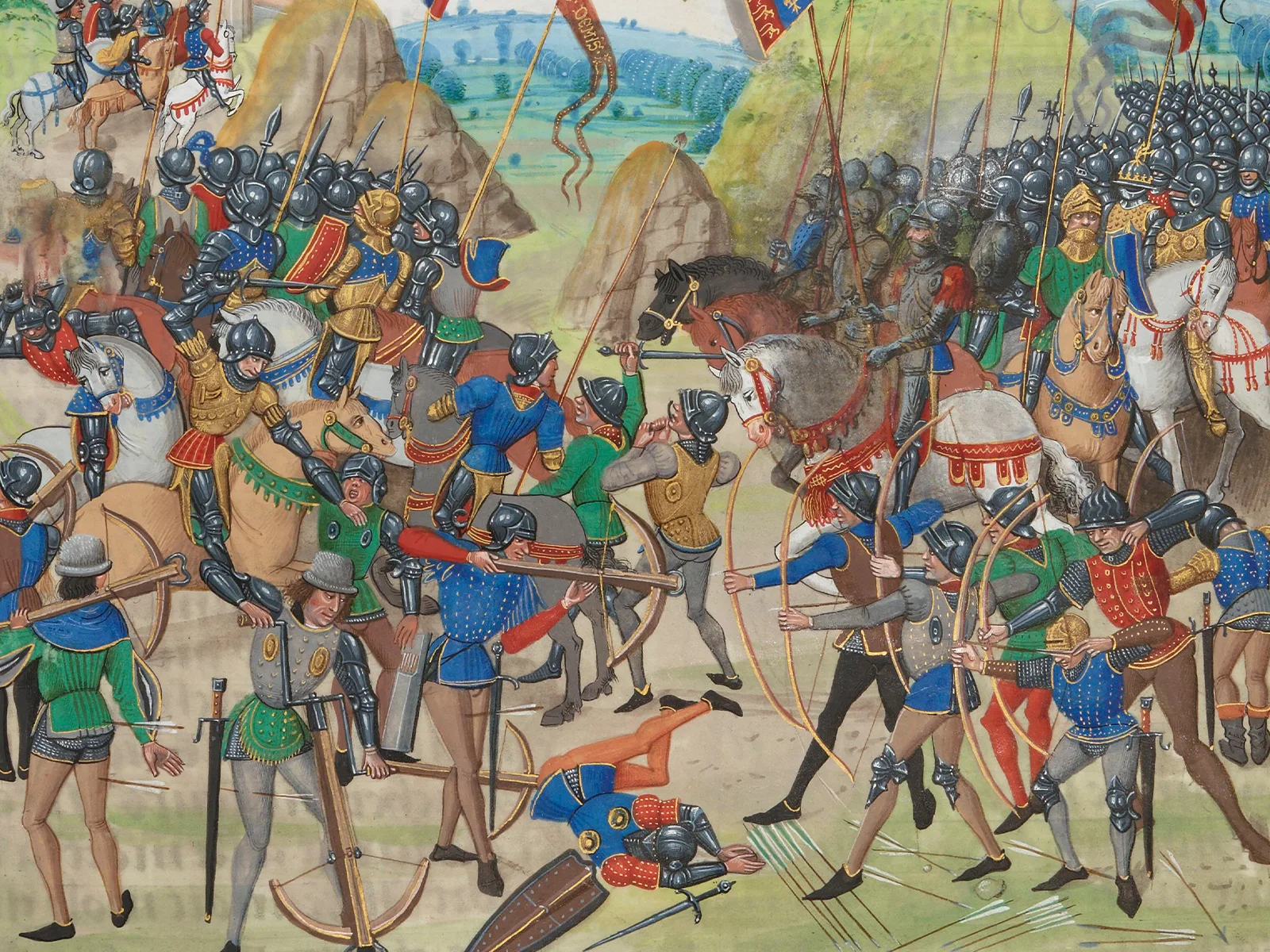
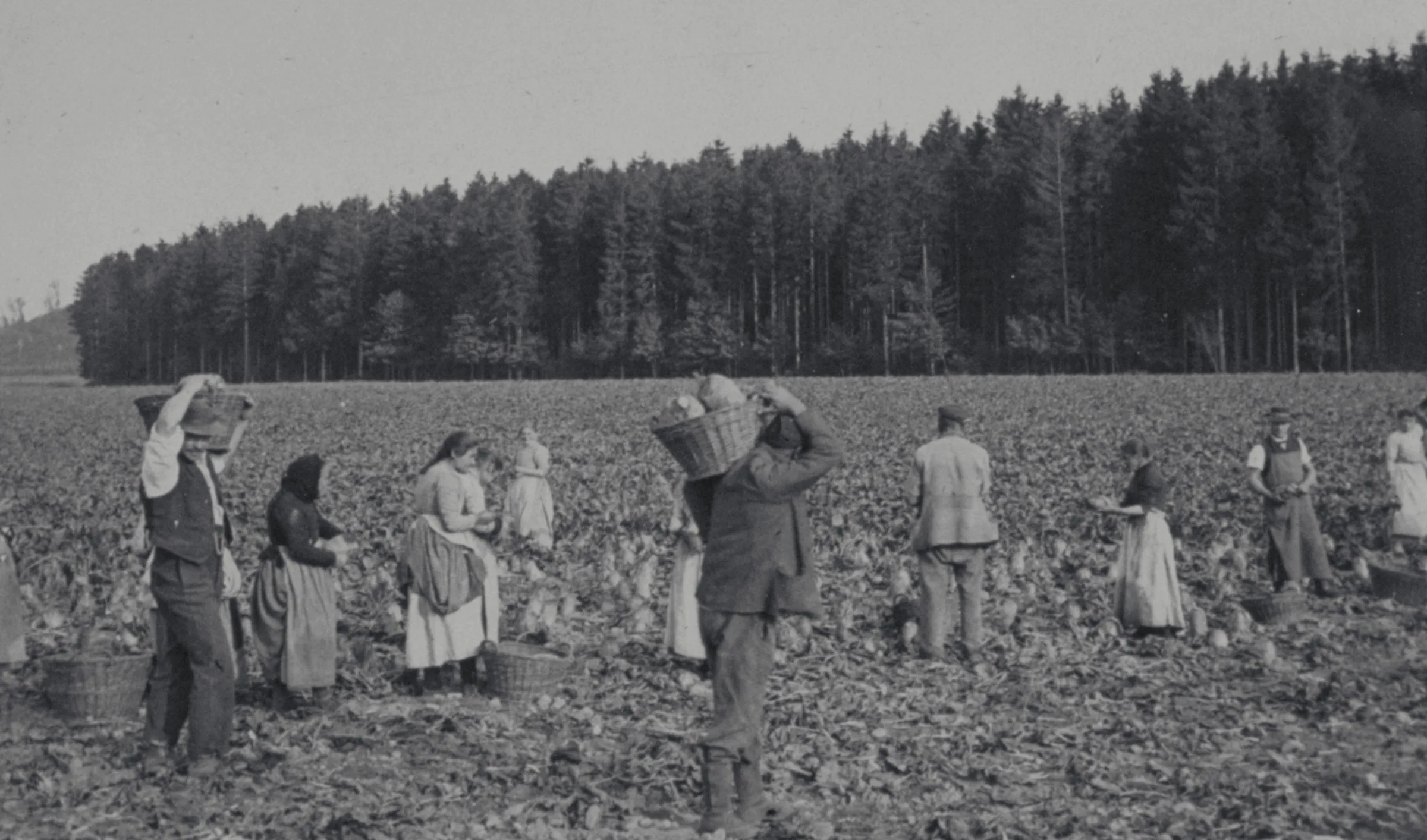
Work began in April 1711. Bodmer started out with a team of 150 workers equipped with shovels, pickaxes and wheelbarrows. They got to work on clearing the hill near Strättligen bit by bit. The construction team comprised a few professionals, many day labourers, some beggars, tramps and prisoners as well as women and children. Although the work was organised with military discipline and lasted from 5am to 7pm every day, progress was slow. The outbreak of the second Villmergen War in spring 1712 interrupted the work for almost a year.
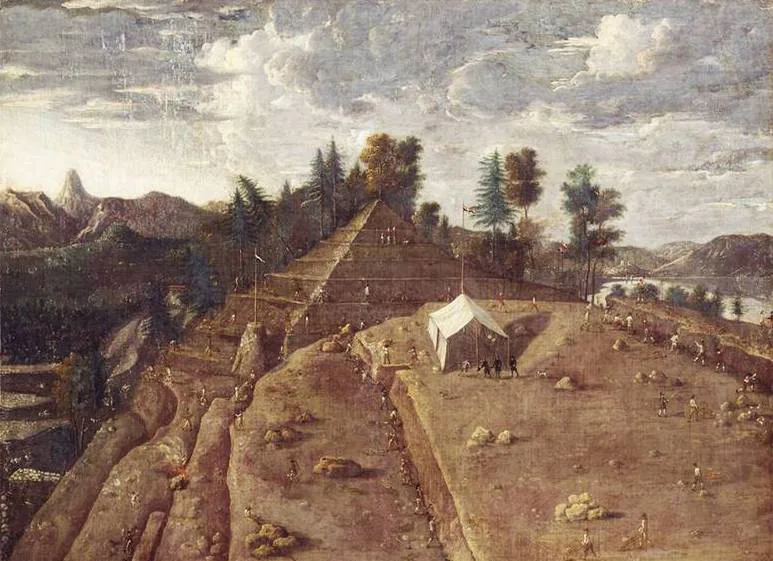
Hard at work on Strättlig hill. Anonymous oil painting.
Hard at work on Strättlig hill. Anonymous oil painting. Wikimedia
The government found the clearing of Strättlig hill to be far too slow. This led to Samuel Jenner, the project’s building surveyor, receiving the go-ahead for his idea of digging a tunnel through the hill in parallel to the excavation work. Bodmer was not put in charge of building the tunnel; that job went to Jenner himself. The 300-metre long tunnel was completed in December 1713 and water from the Kander was channelled through it on a trial basis. In spring 1714, it was decided to make the tunnel the main part of the project and work began on the definitive diversion.
Samuel Jenner won the government over with his idea. The trained stonemason was not just anyone: he had been responsible for the upkeep of the Bern Münster, he had also been ‘Un-terspitalvogt’ (an official position with executive powers) in Bern and had overseen the building of Bad Schinznach.
Samuel Jenner won the government over with his idea. The trained stonemason was not just anyone: he had been responsible for the upkeep of the Bern Münster, he had also been ‘Unterspitalvogt’ (an official position with executive powers) in Bern and had overseen the building of Bad Schinznach. Wikimedia
Events then took a dramatic turn. The geological makeup of the hill and the steep descent to the lake caused the tunnel to keep widening under the pressure of the water flowing through it. This ultimately led to the entire river running through the tunnel and thundering into Lake Thun. On 16 July 1714, a section of the tunnel could no longer withstand the enormous water pressure; it collapsed and swept five people away to their deaths. Just one month later, there was nothing left of the tunnel: the Kander had basically swept it away and eaten its way deep into the hill. So, the Kander gorge, having originally been planned by Bodmer, actually ended up being made by the power of nature.
The Kander flowed straight into Lake Thun from the artificial channel. Swiss National Museum, Animation by Klaas Kaat
The diversion heavily impacted the surrounding region. Although the communes below Lake Thun no longer had to worry about the threat of flooding or the risk of malaria spreading from the dried out marsh land, the diversion also caused the water table to sink markedly. This caused wells and springs to dry up and the mills to stop working. The bridges over the dried out riverbed became superfluous and people were left high and dry - both figuratively and literally. Part of a smaller river, the Glütschbach, was diverted onto the former course of the Kander to alleviate these problems.

The town of Thun was even harder hit by the aftereffects of the Kander diversion. The volume of water flowing into Lake Thun suddenly increased by 60%, which caused many more floods in the area. Bridge foundations and buildings were undermined and, in some cases, destroyed. Extensive construction measures were needed to mitigate the situation: the waterways around Thun were expanded to make another Aare tributary, mills were moved, barriers removed and locks built to regulate the water level. Despite all these measures, the town remained vulnerable to flooding. It was only in 2009 – almost 300 years after the Kander diversion – that an additional outflow was created when a relief tunnel was constructed. It serves as a conduit for water from Lake Thun to flow under the town when necessary, thus mitigating the aftermath of the Kander diversion.
News report on flooding in Thun, 1999. SRF
The dried out marsh areas along the original course of the Kander were used to build Switzerland’s largest military training ground from 1819, which is still a key feature of the town. The Kander project also came in useful during the Second World War when it was included in the defensive line known as the National Redoubt and military structures were built on it.

Another outcome of the diversion was the Kander delta, which quickly formed at the new mouth of the Kander through the accumulated debris and fed into Lake Thun. Today the delta is a protected nature conservation area, which is home to many animal species and types of plant. However, were it not for the gravel mining conducted for over 100 years, which yields about 20,000 cubic metres of gravel a year, the delta would be much larger and would long since have silted up the lower basin of Lake Thun.
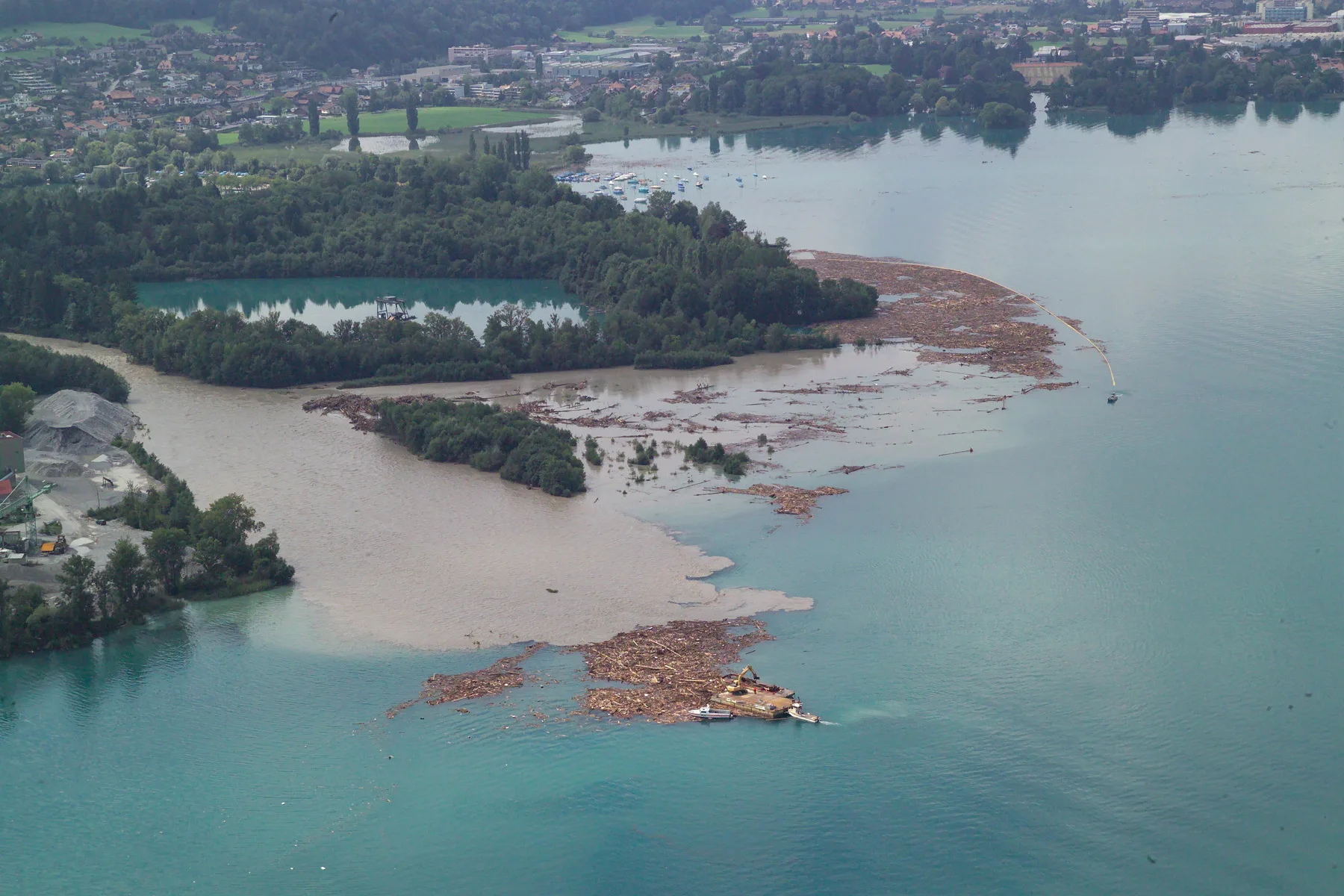
The Kander delta after a storm in 2005.
The Kander delta after a storm in 2005. e-pics
The Kander project ended very badly for Samuel Bodmer. Although he had actually recommended additional measures from the outset, only to be turned down by the authorities, the people of Thun held him solely responsible for the frequent flooding and the damage it caused – Bodmer was hated and even received death threats. By 1717 he saw no alternative but to hastily vacate his property in Amsoldingen and buy Lochbachbad near Burgdorf. It was not until the 300th anniversary of the Kander diversion that Bodmer’s pioneering feat was honoured with the erection of a commemorative stone at the end of the Kander gorge.

Further posts