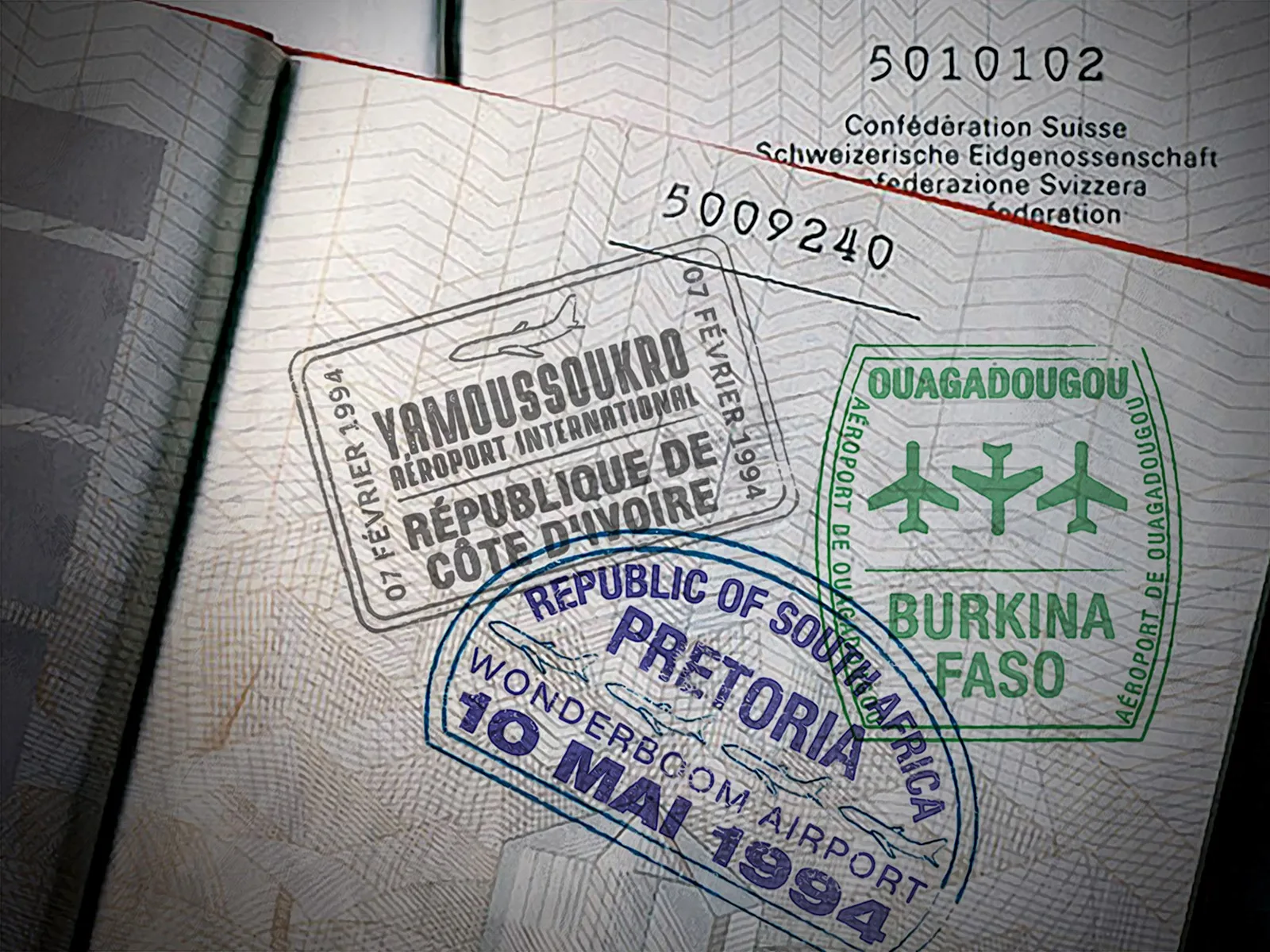
In 1994, the Federal Council maintained close contact with the African continent. Illustration by Marco Heer.

The Federal Council’s ‘Africa year’

In 1994 Federal Councillors and high-ranking officials visited Africa like never before. Their dealings in Côte d’Ivoire, South Africa and Rwanda shine a light on the continent’s varying ties to Switzerland.

Flurina Felix

Flurina Felix

Flurina Felix is a historian who works as an academic researcher at the Diplomatic Documents of Switzerland (Dodis) research centre.
Presidential elections are due to be held in Côte d’Ivoire (or Ivory Coast as it more commonly known in English) at the end of October 2025. One prominent figure hoping to stand as a candidate was Tidjane Thiam. But despite enjoying the official backing of the Ivory Coast Democratic Party, this spring he was ruled ineligible for election due to his dual Ivorian and French nationality. Thiam is not unknown in Switzerland following his stint at the helm of Credit Suisse from 2015 to 2020. During his tenure as CEO, Switzerland’s second-largest bank ran up losses totalling billions and was rocked by scandals. Thiam vacated his villa in Zurich-Herrliberg in 2021 and returned to Ivory Coast to take part in the upcoming elections.
Interview with Tidjane Thiam on leaving Credit Suisse. YouTube / Bloomberg
Thiam comes from an influential Ivorian political family. His great-uncle, Félix Houphouët-Boigny, was Ivory Coast’s first president following independence. As leader of the Democratic Party, he governed the country for 33 years from 1960 until his death in December 1993. ‘Le Vieux’ (The Old Man), as Houphouët-Boigny was affectionately nicknamed by his people, also had a close, albeit discreet, relationship with Switzerland. He owned property in Geneva and is known to have entrusted part of his wealth to Swiss banks. Travelling under the pseudonym Félix Konan, he visited Switzerland one final time in November 1993, shortly before his death, to have treatment at a private clinic above Lake Geneva. Following surgery in Paris, he died on 7 December 1993 in Yamoussoukro, the place of his birth, which he had elevated to the status of Ivory Coast’s political capital some years before.
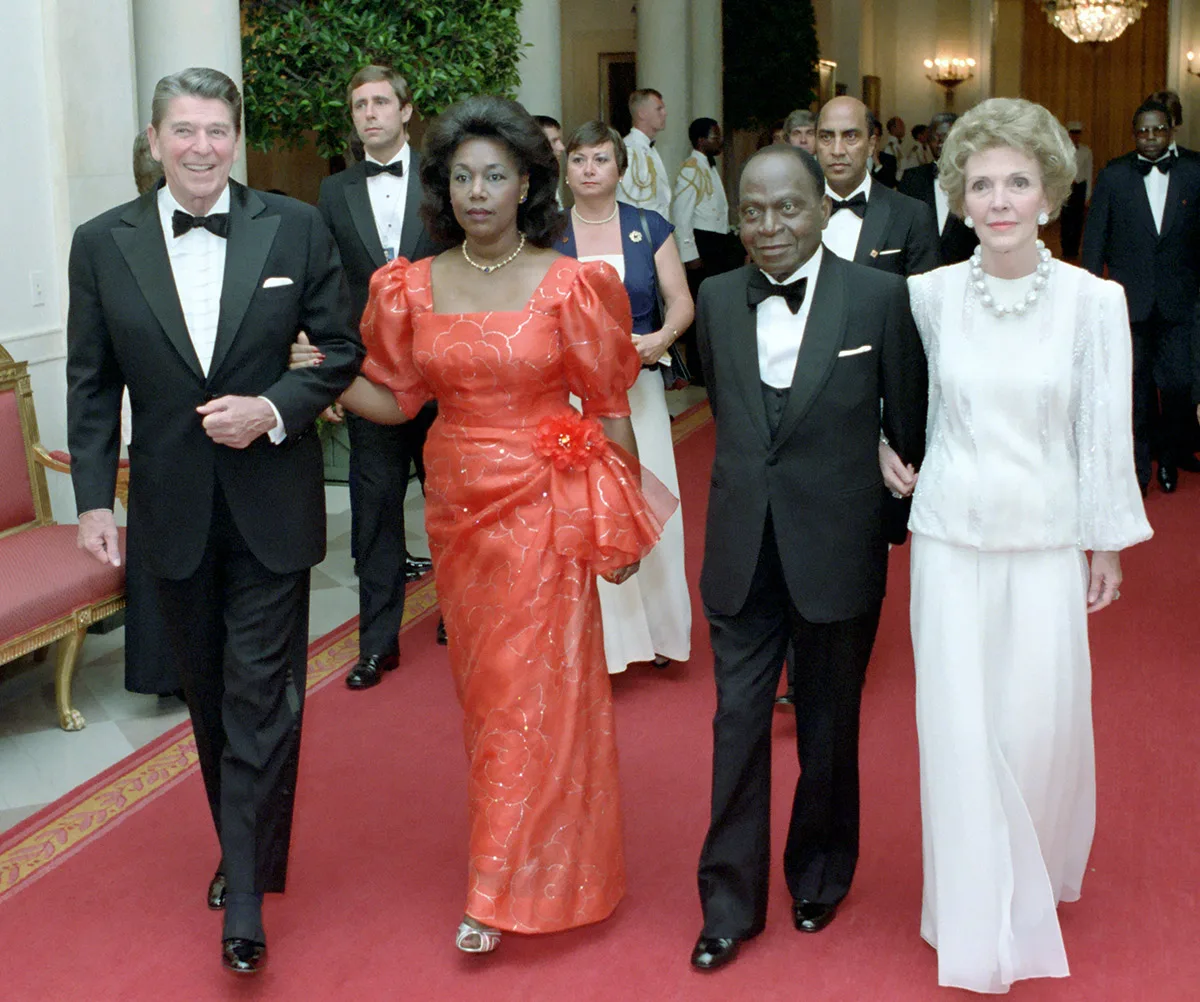
Félix and Marie-Thérèse Houphouët-Boigny were invited to the White House in Washington in June 1983. They are seen here with US president Ronald Reagan and his wife Nancy.
Félix and Marie-Thérèse Houphouët-Boigny were invited to the White House in Washington in June 1983. They are seen here with US president Ronald Reagan and his wife Nancy. Wikimedia
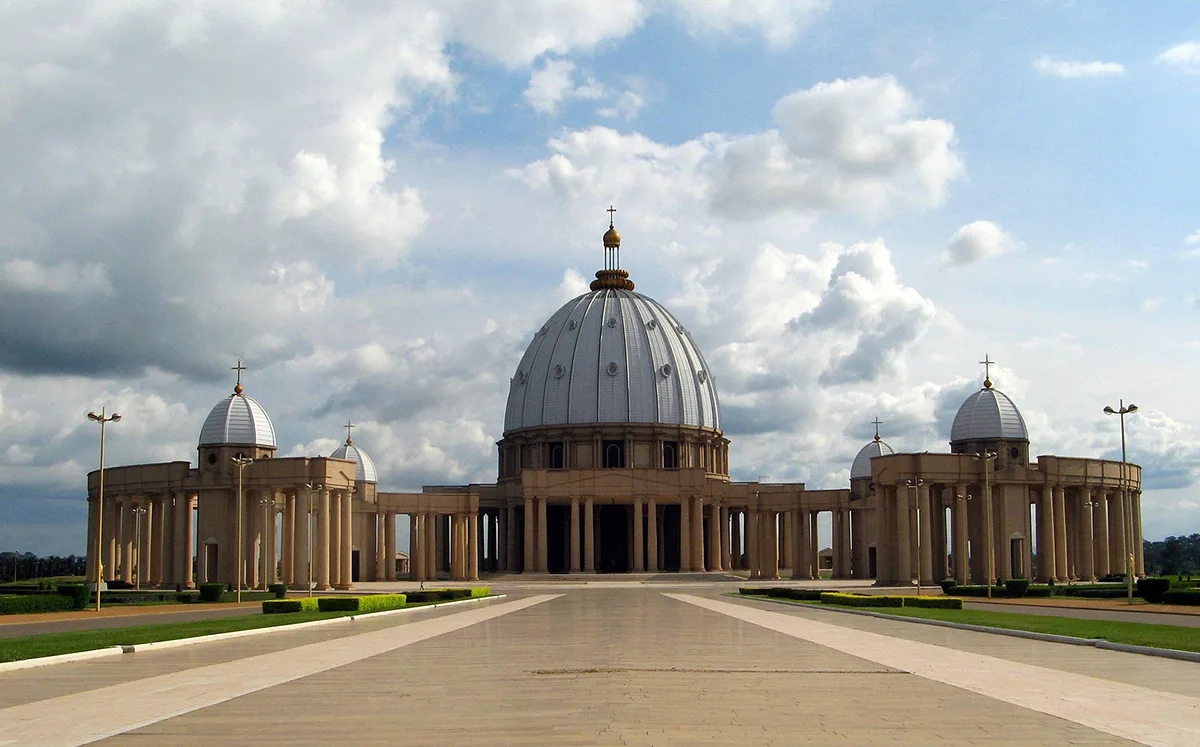
It was there that Houphouët-Boigny commissioned the building of a basilica dedicated to Our Lady of Peace, a colossal structure inspired by St Peter’s in Rome. Reporting on its inauguration in 1990, the Swiss ambassador to Abidjan described the sacred building in Yamoussoukro as surreal and kitschy: “like a film set on a deserted, dusty plot of land on the edge of town, with nearby herds of cattle its only admirers”. The official state funeral of Félix Houphouët-Boigny was held there on 7 February 1994. Switzerland sent a high-ranking delegate to attend the Old Man’s funeral: the then head of the Department of Economic Affairs, Federal Councillor Jean-Pascal Delamuraz. Clearly moved by the occasion, he wrote about the opulent ceremony in a report to his colleagues on the Federal Council, in prose that betrays signs of a literary bent: “The venue: naturally the Basilica of Yamoussoukro, built by the deceased. Monumental, the largest in the world, far from any inhabited areas, but possessing a great interior and exterior harmony […] The ceremony: beautiful, impressive, brilliantly inspired in certain respects, badly managed in others, in terms of organisation: it was actually two hours’ late in starting... And it lasted twice as long as expected!”
The Basilica of Yamoussoukro was inspired by St Peter’s Basilica in Rome.
The Basilica of Yamoussoukro was inspired by St Peter’s Basilica in Rome. Wikimedia / Jcaseru
No other member of the Federal Council had visited Ivory Coast since Pierre Aubert’s legendary trip to West Africa in 1979. In the autumn of 1994 Flavio Cotti, the head of the Federal Department of Foreign Affairs, became the second Federal Councillor to do so that year, making this something of a foreign policy sensation given that relations between Switzerland and Ivory Coast, although good, had been relatively modest up to that point. During his trip, Cotti also visited Burkina Faso and South Africa, where he presided over the Regional Ambassadors’ Conference in Cape Town, an event attended by many Swiss ambassadors to the countries of southern Africa.

The first fully democratic elections to be held in South Africa raised considerable hopes within the Federal Council that the end of apartheid would engender political stabilisation and economic growth in the region as a whole. Swiss president Otto Stich was one of the many international guests to attend the inauguration of Nelson Mandela as South Africa’s head of state on 10 May 1994. Switzerland had maintained close ties with the apartheid regime and treated trade with South Africa as courant normal, assuming a ‘business as usual’ attitude for decades despite international criticism. The country’s transition to democracy allowed the Federal Council to breathe a sigh of relief before going on to successively expand bilateral and economic relations.
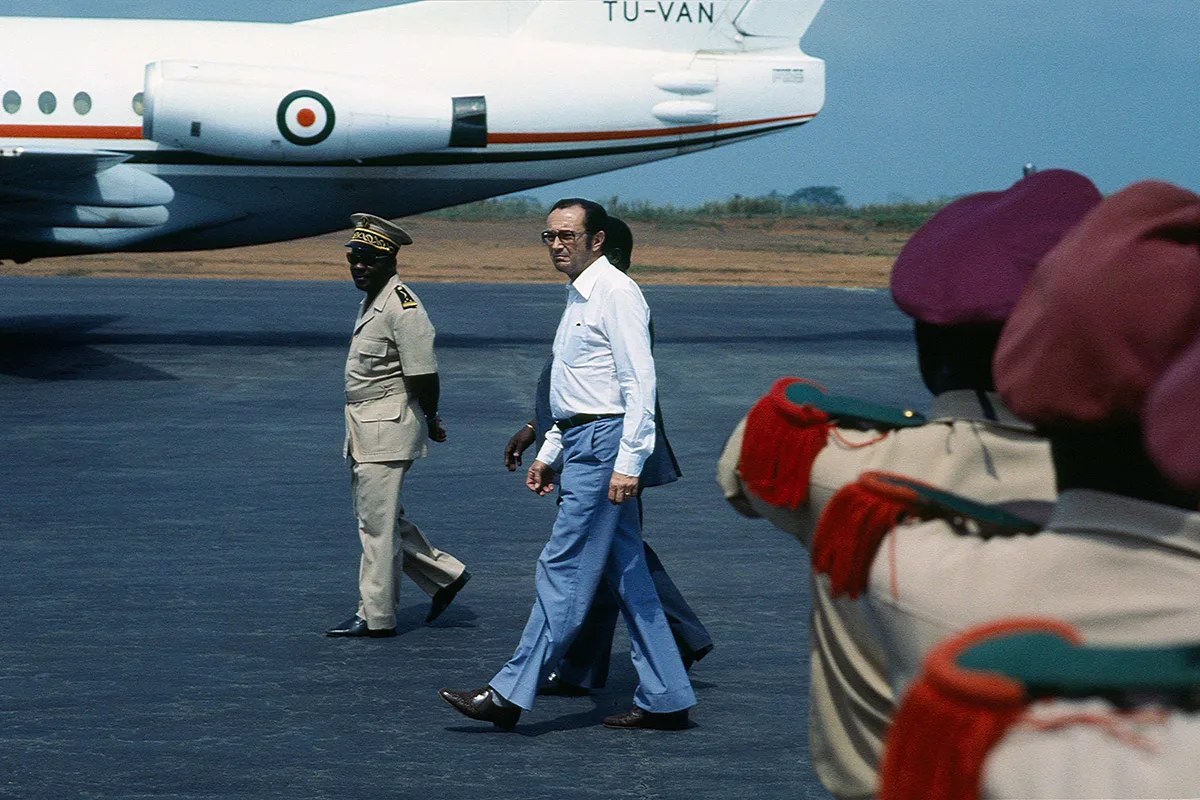
Federal Councillor Pierre Aubert visiting Ivory Coast in 1979.
Federal Councillor Pierre Aubert visiting Ivory Coast in 1979. Reto Hügin © StAAG/RBA13-RC00111-7_122
Africa was also catapulted into the Swiss political consciousness in 1994 by tragic news headlines: the genocide in Rwanda, a priority country for Swiss development cooperation, shocked the government, the administration and the public alike. Federal Councillor Cotti was lost for words. “What little can be said is that the horror of the events taking place in this country following 6 April 1994 has shaken me and the entire Federal Council to the core,” he wrote in a letter to Amnesty International Switzerland. Development cooperation was halted and the money used to deliver humanitarian aid instead.
The visits to the African continent in 1994 by the three Federal Councillors Delamuraz, Cotti and Stich were unusual for the time. In addition, that summer the state secretary for economic affairs Franz Blankart travelled at the head of two mixed economic delegations to the capital cities of Senegal and Ivory Coast, where he took the opportunity to sign bilateral debt relief agreements. Interest in foreign trade with West Africa subsequently grew. According to Blankart: “My trip to Dakar, like the one to Abidjan, was part of an [official government] programme deliberately seeking a closer engagement with Africa”. This reflected the “total and utter conviction” of the Federal Office for Foreign Economic Affairs (as it was then called) that “we must put Africa back to [sic] the map”.

Joint research

This text is the result of a collaboration between the Swiss National Museum and the Diplomatic Documents of Switzerland (Dodis) research centre. The complete documents relating to Pierre Aubert's 1979 trip to West Africa can be found here.
Further posts