Winston Churchill’s visit in the autumn of 1946 kept Switzerland on its toes.
Winston Churchill’s visit in the autumn of 1946 kept Switzerland on its toes. SBB Historic

An improvised train stop for Churchill

In September 1946, a temporary train station was set up in Köniz for the British wartime prime minister’s visit to Bern.

Thomas Krebs

Thomas Krebs

Thomas Krebs is a local historian and runs the Topotheque for the town of Köniz.

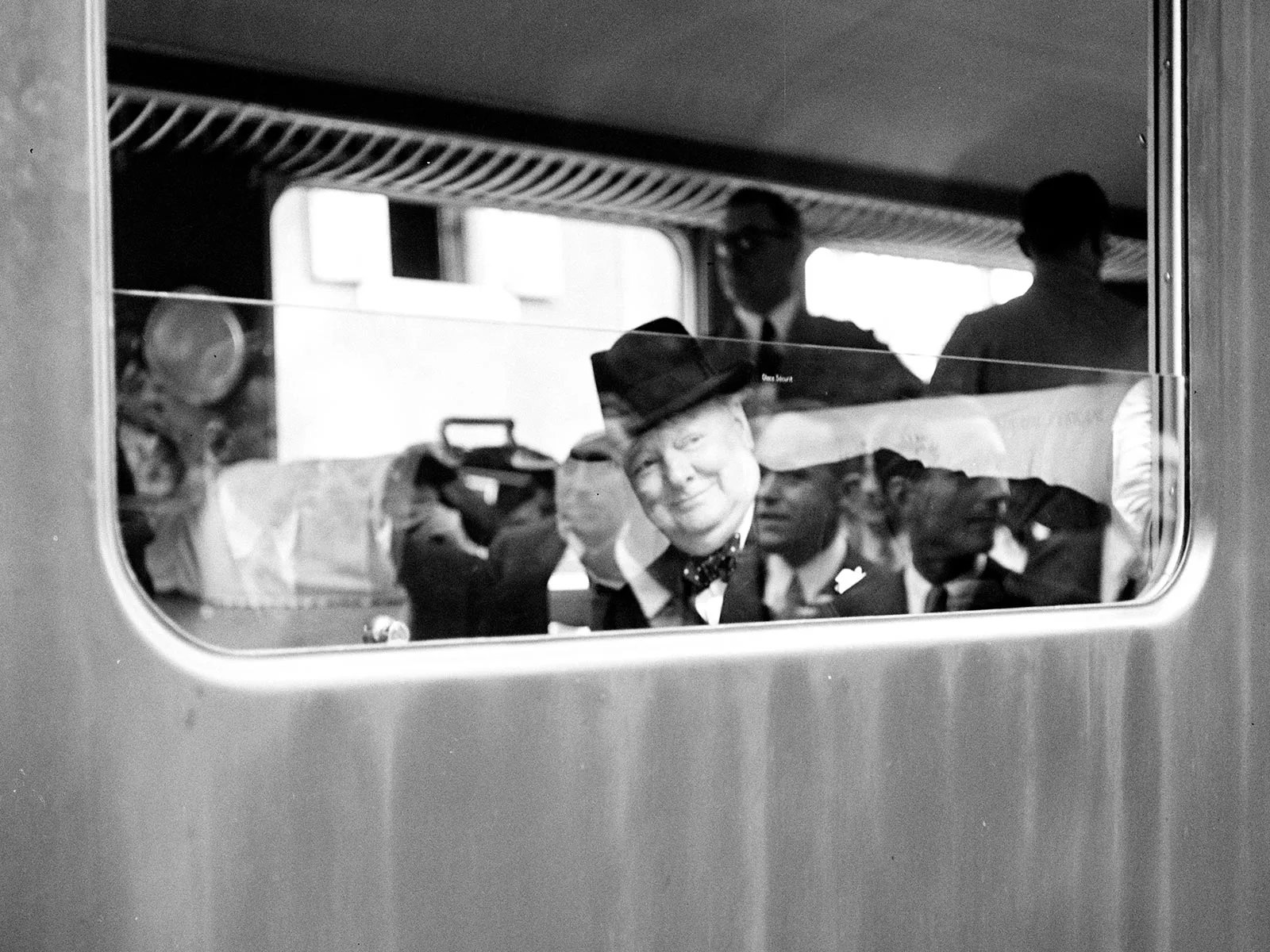
On Monday 16 September 1946, just after 5.30pm, the Roter Doppelpfeil (Double Red Arrow) train carrying Winston Churchill stopped on an open stretch of line near Gurtenbühl, between the stations of Bern-Weissenbühl and Wabern. The train had travelled from Pregny near Geneva in record time without stopping. On reaching the goods station in Bern-Weyermannshaus, it had been diverted onto the Gürbetalbahn line. The instructions issued to the railway left no doubt over the importance of this special journey. Under point 5 they read: “Unobstructed passage must be guaranteed at all costs for train 9051.” The final report, published in 1947, also stated that on instruction from the top management of the Swiss Federal Railways no ticket controls had been carried out on board.

From the Red Arrow train to a four-horse carriage
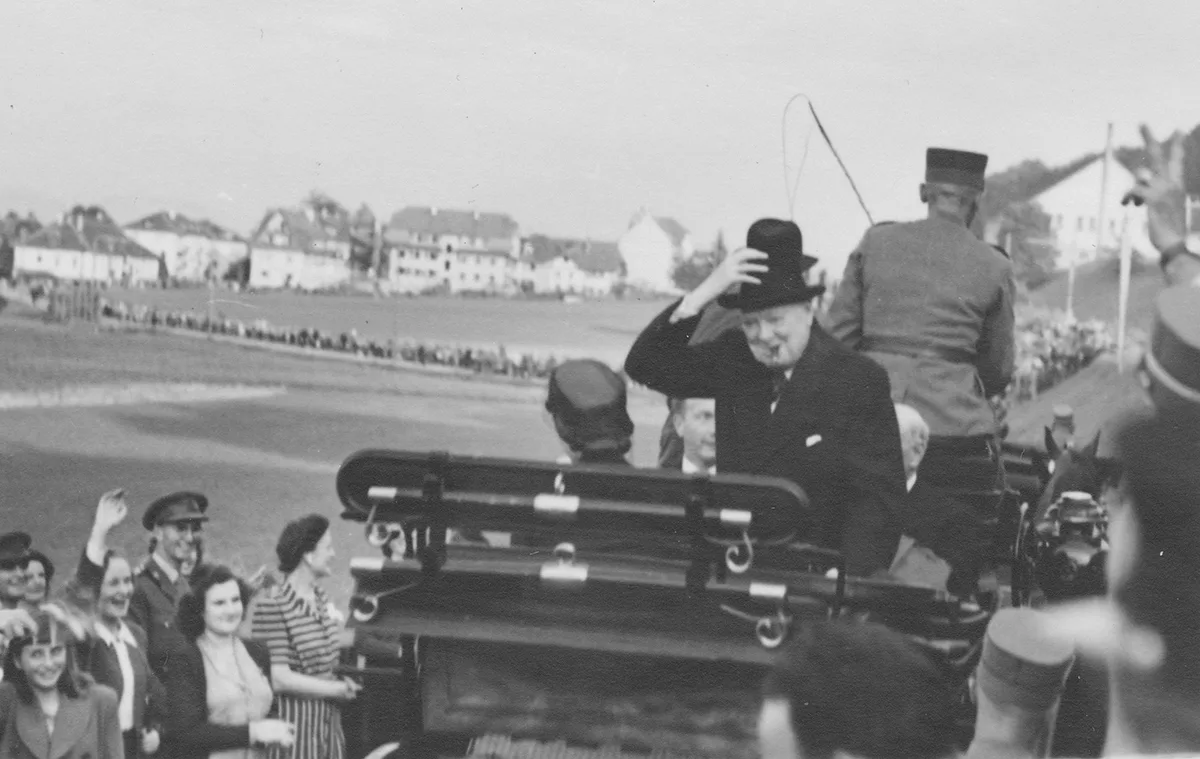
On the onward journey from Weyermannshaus, the train passed through all stations, only stopping after just under six kilometres. There, Churchill and his entourage alighted, covering the last section of the journey – to the Lohn estate in Kehrsatz – in horse-drawn carriages. The estate was used by the Federal Council as a guest house, and the former British Prime Minister (he had had to hand over office to Clement Attlee in July 1945) was the first high-profile guest to stay there. The property had been gifted to the Swiss Confederation by a private donor in 1942.
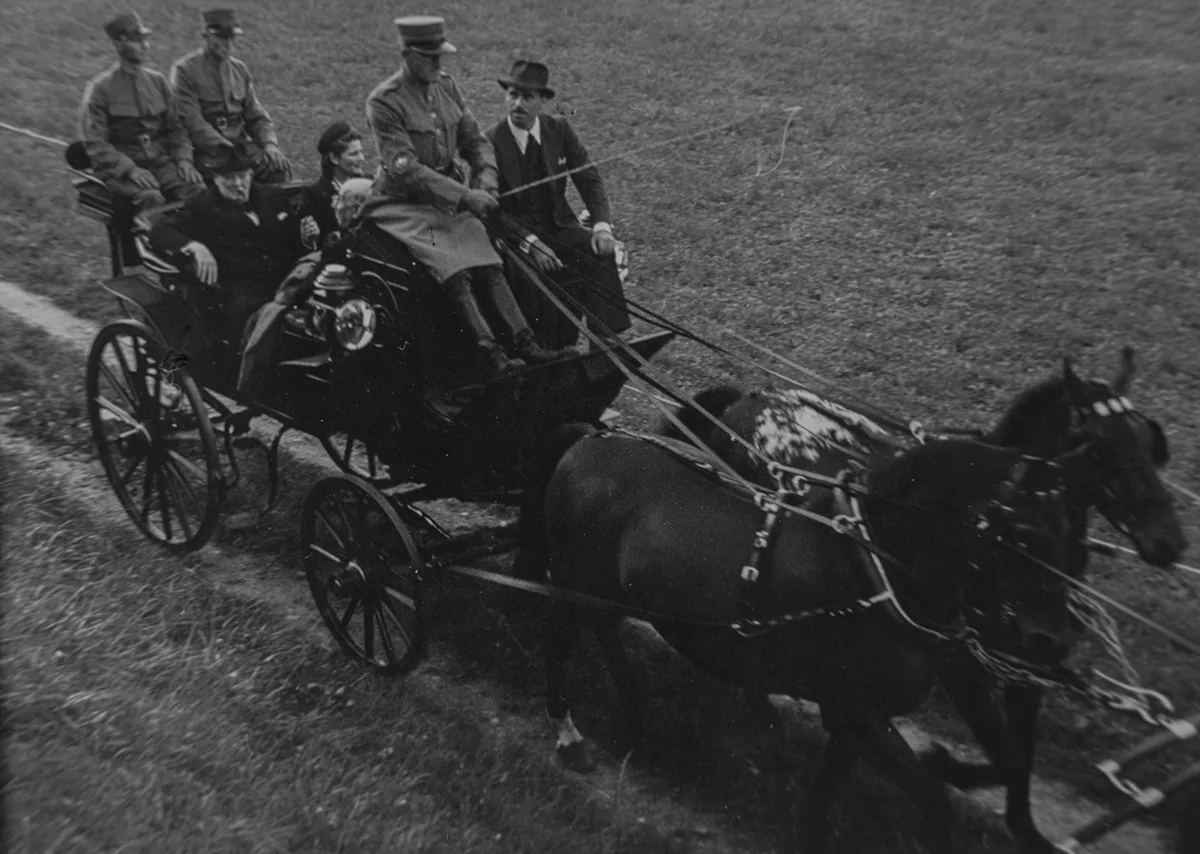
Churchill gets into a carriage near Bern in September 1946.
View inside the carriage taking Churchill to the Lohn country estate in September 1946.
Winston Churchill was transported by horse-drawn carriage from the temporary railway stop to the Lohn country estate in the town of Kehrsatz in the canton of Bern. Topotheque / Topotheque
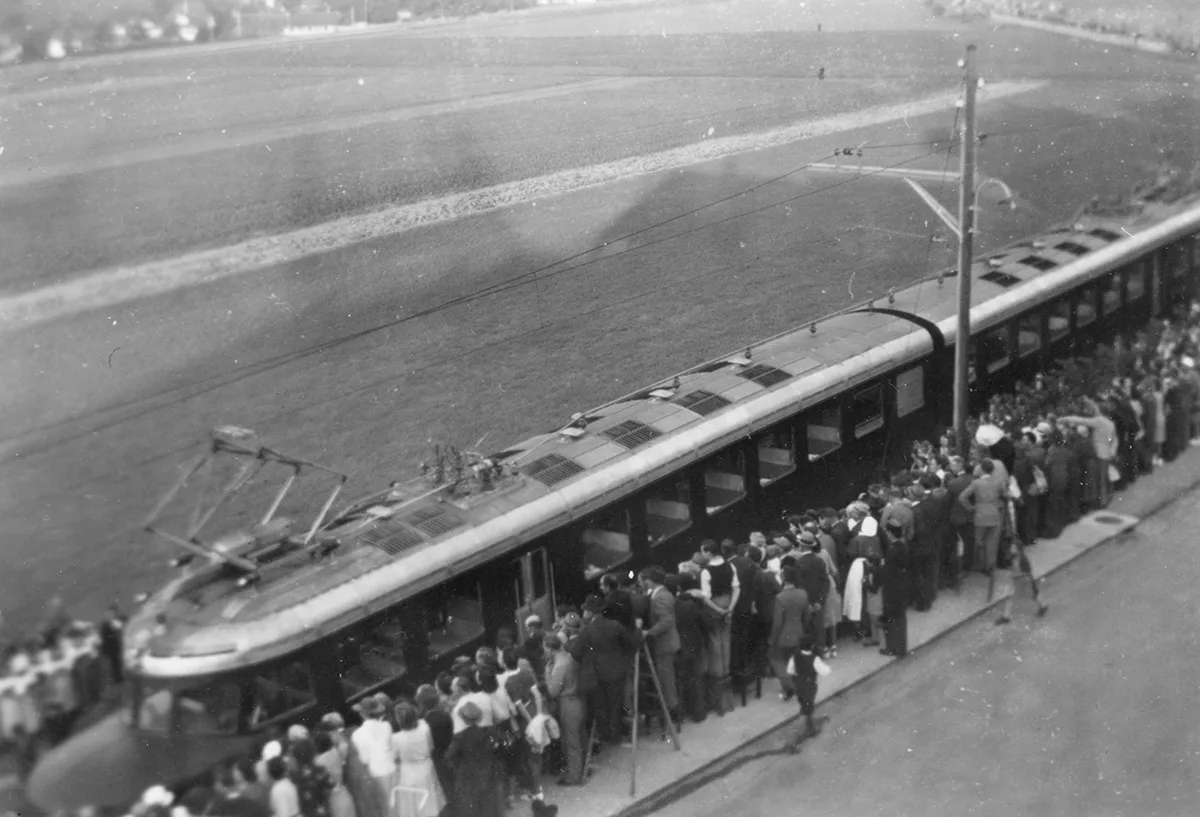
The improvised stop was soon nicknamed ‘Churchill’s Station’, as reported by the newspaper Der Bund, which went on to criticise the fact that no information at all had been released to the public regarding the exact time of Winston Churchill’s arrival in the Greater Bern area. And yet, by 5pm on Monday evening, huge crowds lined Kirchstrasse around the Morillonfeld in Wabern. It was not only the public that was kept in the dark about certain details of the visit, the media was too ‒ unlike the local councils in Köniz, Belp, Kehrsatz and Rubigen, which had been previously notified by the Federal Military Department that the party would alight near Wabern. Nonetheless, a large crowd of onlookers had gathered by the time Churchill arrived.
When Churchill arrived at the temporary stop, the bystanders thronged against the train, trying to catch a glimpse of the British statesman.
When Churchill arrived at the temporary stop, the bystanders thronged against the train, trying to catch a glimpse of the British statesman. Topotheque
The distinguished guest was welcomed by the British envoy, Thomas Maitland Snow, and his wife. According to the Bund newspaper, the members of the British community in Switzerland, who had been granted direct access to the stop to welcome Churchill, were so overcome with joy that they lost their voices and remained silent. The assembled crowd gave Churchill an enthusiastic reception. A traditional folk choir performed a song, the Alphorn was blown, and schoolchildren waved little Union Jacks and Swiss flags. The V for victory sign – made famous by the Briton – was also on display, as the NZZ reported in flowery language: “Naturally, the welcome was dominated by the famous V; already on the field track between the train stop and the country road, it hung above the way, spelled out in leaves and flowers. The people of Bern, both young and old – even three-year-olds perched on their grandfathers’ arms – had been practising the V sign, and Churchill, in the second carriage, responded, smiling and greeting people, without trying to hide the tears in his eyes...”
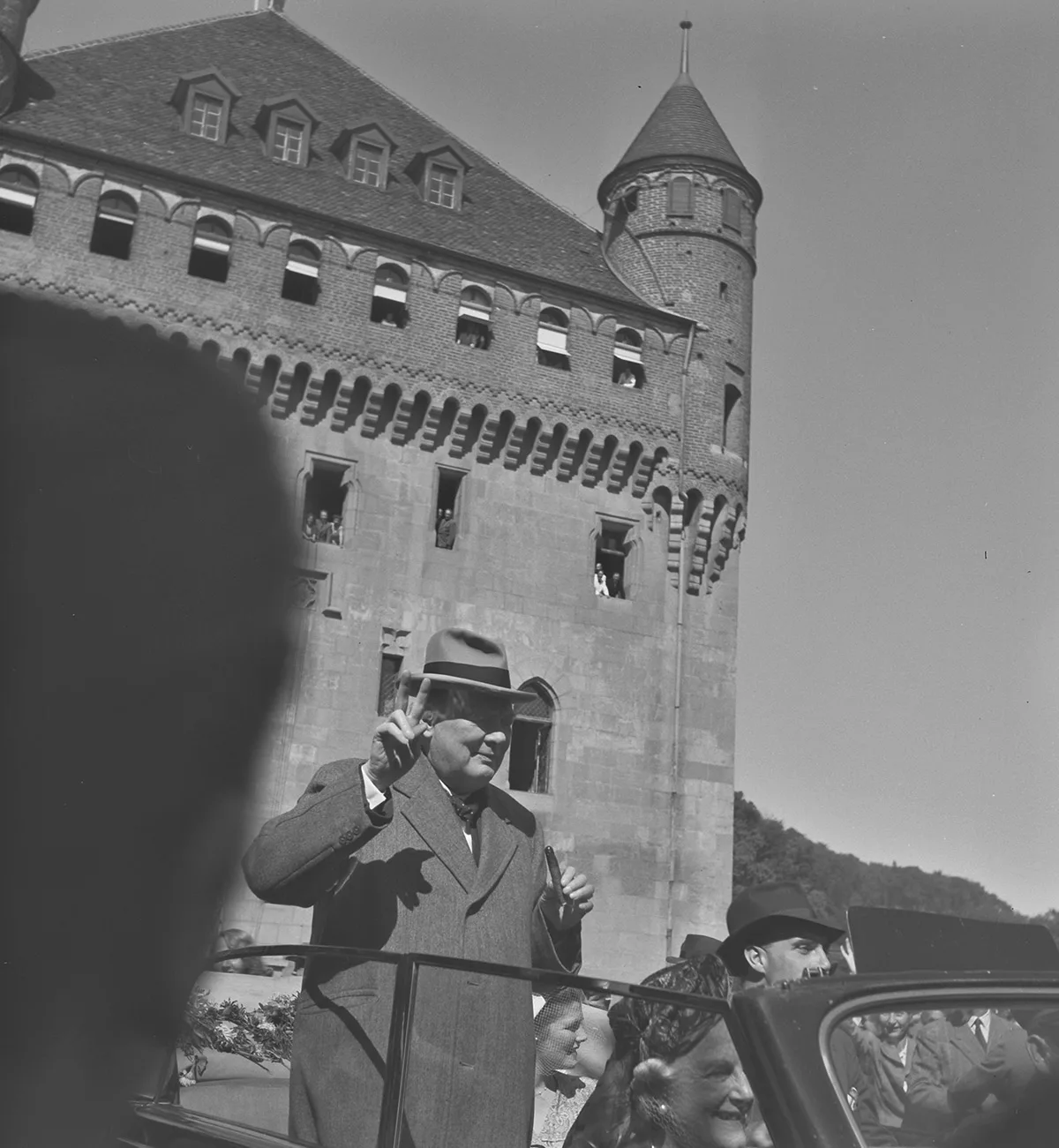
The Briton also flashed his famous V for victory sign during his visit to Switzerland, pictured here in Lausanne. It wasn’t invented by Winston Churchill himself, however, but by a Belgian politician named Victor de Laveleye in January 1941. Intended to symbolise resistance against Nazi Germany, it soon became Churchill’s trade mark.
The Briton also flashed his famous V for victory sign during his visit to Switzerland, pictured here in Lausanne. It wasn’t invented by Winston Churchill himself, however, but by a Belgian politician named Victor de Laveleye in January 1941. Intended to symbolise resistance against Nazi Germany, it soon became Churchill’s trade mark. Swiss National Museum / ASL
The Lohn country estate didn’t have space to accommodate all the foreign guests, only Winston, his wife Clementine and their youngest daughter Mary. Churchill’s private secretary Lettice Marston was put up at a nearby hotel with another staff member. This didn’t go down well with Marston, as she wrote in her diary: “We arrived at 11.30pm and realised that we had to share a room in which there wasn’t even a chest of drawers! And the stench from the toilet was horrendous. We were furious.” She immediately complained to Carl Montag, the Swiss-French painter and art mediator who had been Churchill’s painting teacher since 1915 and who had helped to organise the stay in Switzerland. He responded straight away and arranged accommodation for the women at the luxury Bellevue Hotel in Bern.

Painting by Lake Geneva

The journey to Kehrsatz marked the beginning of the official part of Churchill’s trip to Switzerland. It had been preceded by an over three-week stay at the Villa Choisi on Lake Geneva. The plan had initially been for the Swiss National Tourist Office (now Switzerland Tourism) to invite Churchill. But that had failed for financial reasons. In the end Carl Montag – along with Zurich banker Claus Vogel – managed to put together a consortium of leading figures from Swiss industry and finance to cover the costs of the stay.
Churchill had long had his sights set on Switzerland as a holiday destination. In June 1946, he wrote to British envoy Snow: “I would very much like to travel to Switzerland for a month, and I hear that the public is still keen for me to visit. I would perhaps take a day to make a courtesy call to the government in Bern, or maybe the University of Zurich, but otherwise I would keep a very low profile. Of course, my sole aim is to be able to recuperate and to paint undisturbed.”
The Villa Choisi in the village of Bursinel in the canton of Vaud was eventually chosen. There, Churchill wanted above all to be able to enjoy some peace and quiet and to devote himself to his painting. And that he did, albeit after spending the mornings dealing with correspondence and dictating upcoming speeches from his bed until around 1pm.
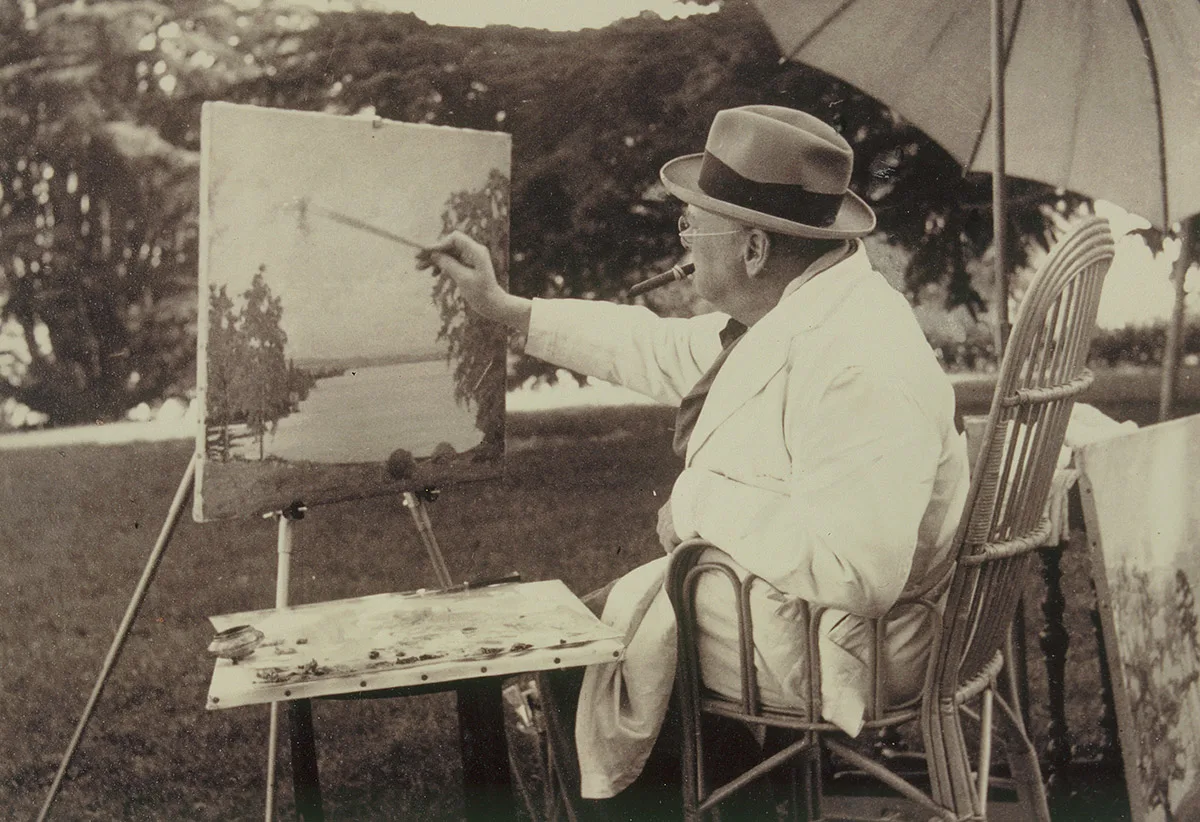
Winston Churchill painting at Bursinel by Lake Geneva, 1946.
During his time in Vaud in September 1946, Winston Churchill mainly concerned himself with all things artistic. Swiss National Museum

Tensions between federal government and canton

It is clear both from the report by Lieutenant Colonel Bracher of the Federal Military Department and from the records of the Bern Cantonal Council that the former British Prime Minister’s visit had sparked tensions between the federal government and the canton. “I cannot start this chapter without mentioning the strained impression that the indecision of Bern’s government left on Churchill”, wrote Bracher to the Federal Council.This was about a row over whether the British dignitary would deliver a speech at his reception in Bern’s City Hall and whether that speech should be broadcast on the radio. According to Bracher “all the toing and froing and umming and ahhing had left Churchill with a rather strained impression.” Yet Winston Churchill was full of praise for his time in Bern, as Bracher also mentioned. Churchill recognised that the schedule had been designed in a way that was not too taxing for him.
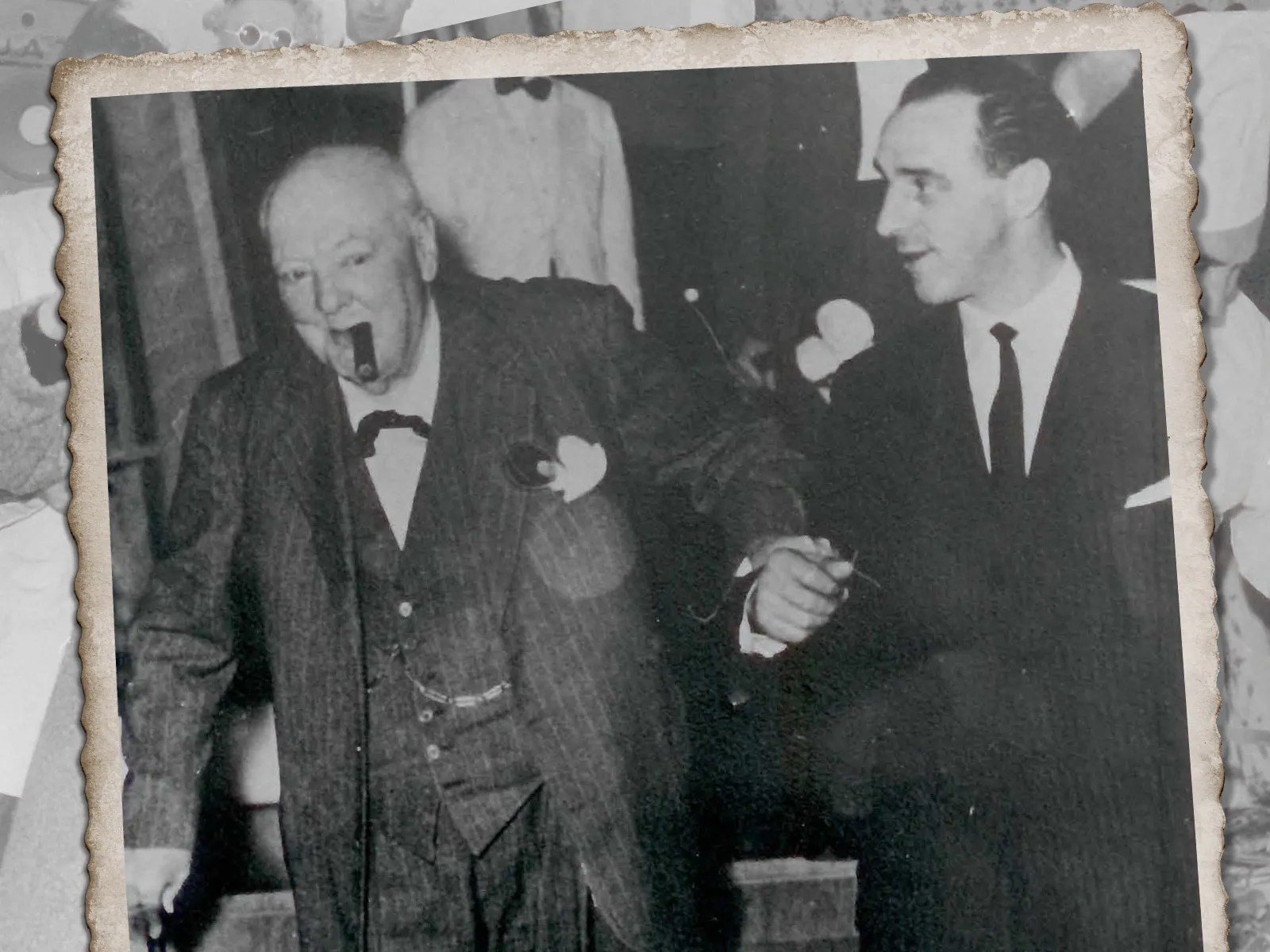
The financial aspect also sparked differences of opinion between the two levels of government. The Bern cantonal authority retrospectively stated that negotiations with the federal authorities to secure a contribution to the costs of the city hall reception had failed. Bern had therefore had to bear the total cost of CHF 5,130 itself. Incidentally, CHF 42 was also spent on procuring cigars for Churchill from the Geissbühler company.
On 18 September Churchill travelled to Zurich, where the following day he delivered his now famous ‘Let Europe Arise!’ speech at the university. He left Switzerland from the airport in Dübendorf on 20 September. And ‘Churchill’s Station’ in Gurtenbühl was soon forgotten.
TV report on Churchill’s legendary Zurich speech of 1946. YouTube / SRF

The Topotheque

The Topotheque is a collaborative online archive of local history. Working together with the public, relevant local material is catalogued, safeguarded and made available online. Its aim is to present local history in a modern way. The Köniz Topotheque has been steadily expanded since 2023 and will in future cover the history of the whole communal area. A historic plaque to commemorate Winston Churchill’s visit is to be inaugurated on 12 September 2026. The 80th anniversary will be celebrated with music, speeches and a drinks reception. Find out more at this link.
Further posts