Coloured street signs to help the French army find its way through Bern. Illustration by Marco Heer.

Bern’s subversive street signs

Street signposting in Switzerland takes the form of white writing on a blue background. But not in Bern’s old town, where the street signs are red, green, yellow, black and white. The City of Bern inherited this bright design from the French military campaign in 1798.

Thomas Weibel

Thomas Weibel

Thomas Weibel is a journalist and professor emeritus of media engineering.
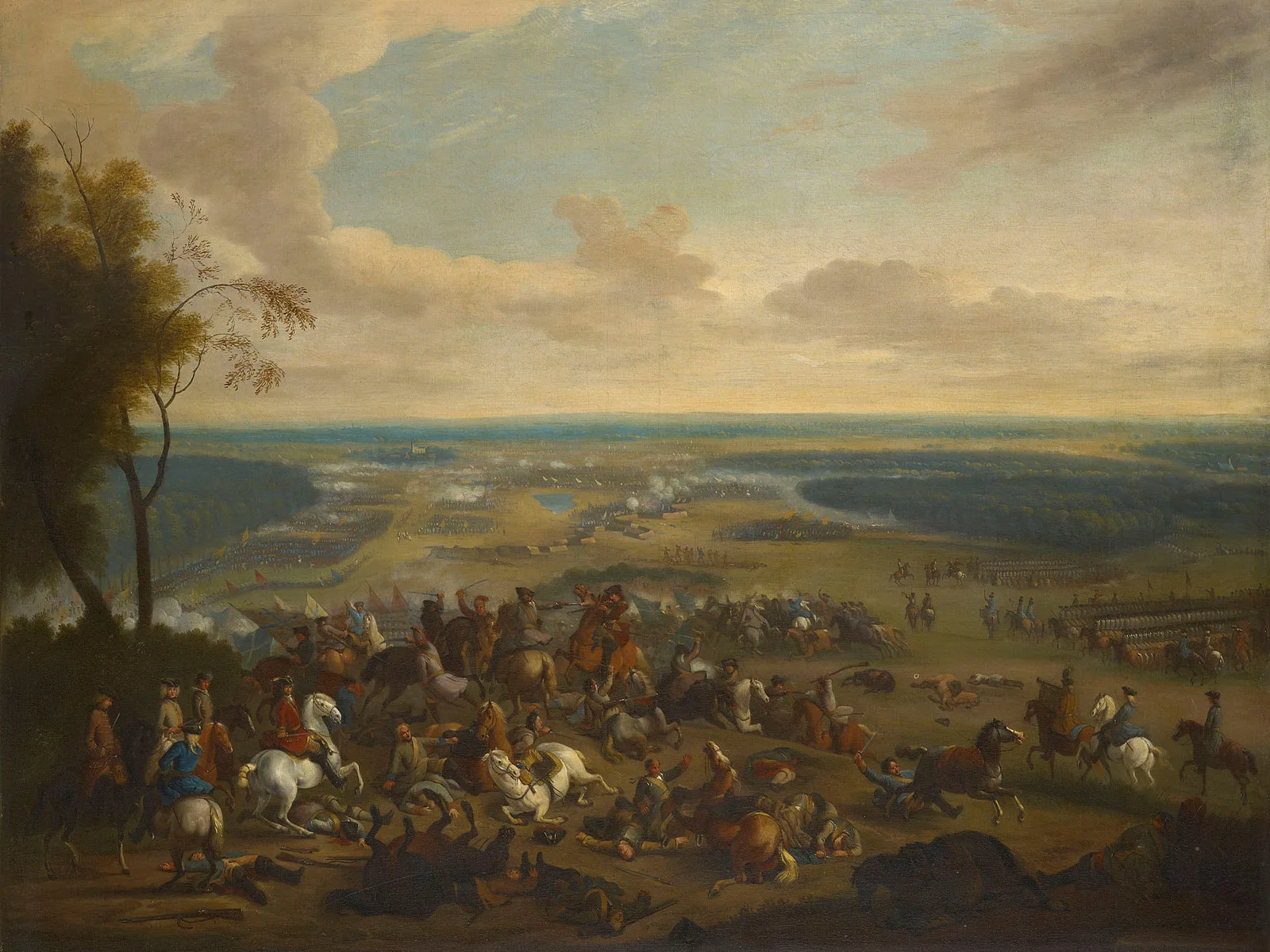
Bern’s 20,000 soldiers ultimately proved no match for the 35,000-strong French army invading from the north. Solothurn had fallen, the government in Bern had capitulated, the 4,100-strong federal auxiliary forces did not mobilise and the few thousand Bernese in Fraubrunnen 16 kilometres away under the command of General Karl Ludwig von Erlach were unable to hold off the invaders. They were routed at the battle of Grauholz, a hilly wooded area to the north of Bern, on 5 March 1798. Following a final skirmish in the Schosshalde area in front of the city gates, the battle was lost. A total of 700 Bernese troops were dead and French forces marched into Bern.
The French march into the city of Bern. Print by Abraham Girardet, animation by Klaas Kaat. Wikimedia / Musée Carnavalet, Paris
Napoleon’s invasion brought rich spoils to the French. The city’s huge treasure, boxes full of gold and silver coins underneath the city hall, was confiscated. Economists estimate its value – taking into account projected returns over subsequent centuries – at over CHF 600 billion in today’s prices. Even the city's heraldic animals, the bears from the bear enclosure in the area currently known as Bollwerk, were taken to Paris as spoils of war.
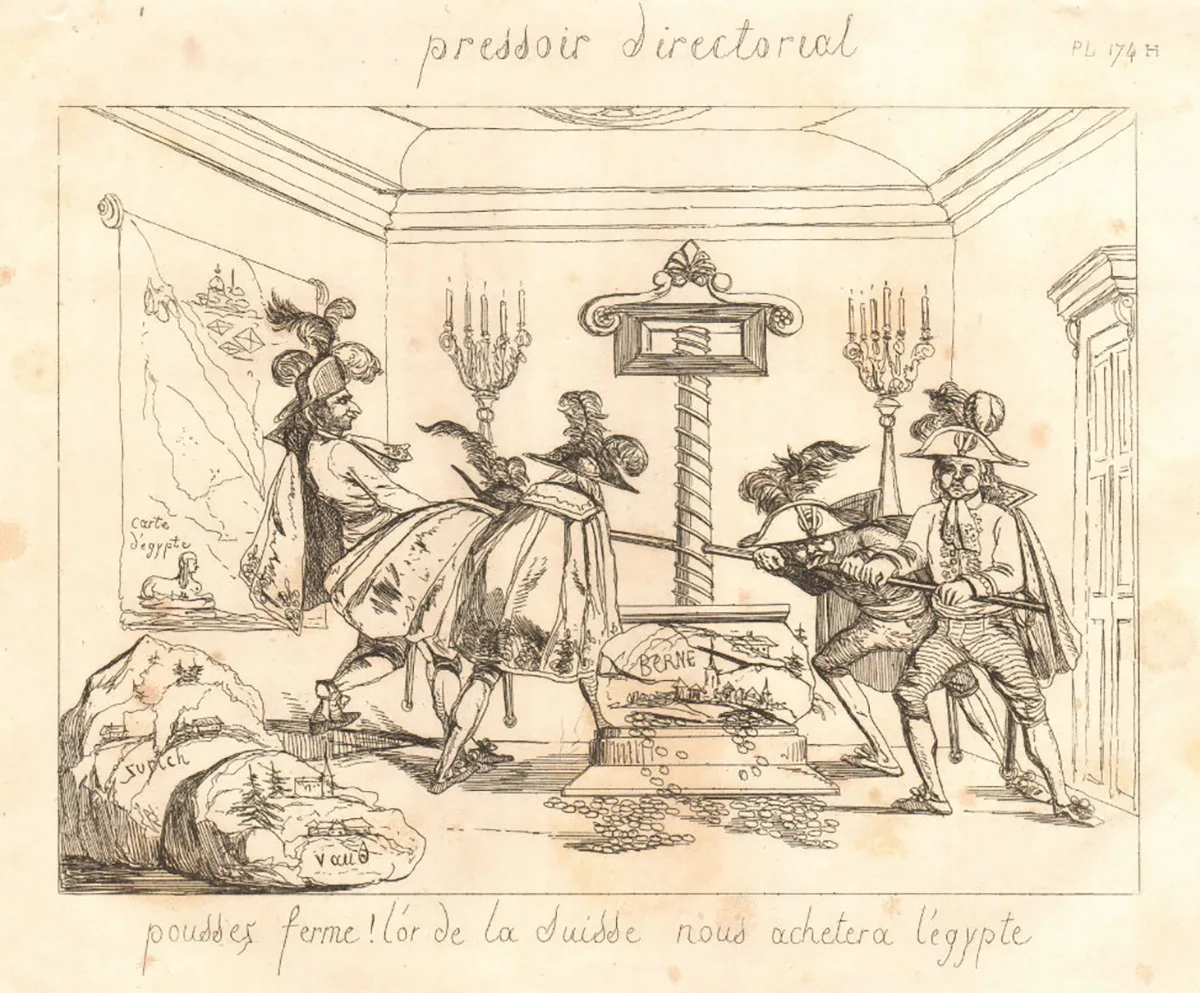
However, the French commander, General Alexis Balthasar Henri Antoine von Schauenburg, still had some problems to contend with. The city and private households were responsible for providing the soldiers with food and board. However, there were murmurs of discontent about the plundering of Bern to finance the French state coffers, which had been severely stretched by Napoleon’s pending Egyptian campaign. Caricatures circulated showing the French overlords bleeding Bern dry. The text pulled no punches: “Poussez ferme! L’or de la Suisse nous achètera l’Égypte!» (Keep squeezing! Swiss gold will bring us Egypt!).
Caricature of the French turning the screws on Bern to secure the funding for Napoleon’s Egyptian campaign.
Caricature of the French turning the screws on Bern to secure the funding for Napoleon’s Egyptian campaign. Wikimedia
The French soldiers also had trouble finding their way around the city. Most of the French troops could not read, so they often didn’t know where they were going. This led to von Schauenburg commissioning Bernese painter Franz Niklaus König to produce coloured road signs for the different parts of town so the soldiers could negotiate the winding streets without having to be able to read the street names.
The ‘Berner Stadtteil I’ district in the inner city comprised five parts: area 1 (Matte and Nydegg), area 2 (Nydegg to Kreuzgasse), area 3 (Kreuzgasse to Zytglogge), area 4 (Zytglogge to Käfigturm) and area 5 (Käfigturm to Hirschengraben). König thought carefully about Schauenburg’s order and finally opted for the colours of the new Helvetic tricolour brought in by the French in 1799: green, red and yellow. The colours of this flag based on the French design were not chosen at random: the French occupiers hoped that the colours would help win over the recalcitrant locals to the ideals of the French revolution, which had happened only  ten years previously. Green was for Vaud, where the Bernese bailiffs had been sworn in in January 1798 following the révolution vaudoise, red and yellow were for the original Swiss cantons of Uri, Schwyz and Unterwalden. König used the same colours as this Helvetic tricolour to colour-code the different parts of the inner city: red (area 5), gold or yellow (4) and green (3), the oldest areas received white (2) and black (1) signs. König reasoned that the French occupiers would like this design.
Franz Niklaus König based his choice of colours for the street signs in Bern on the Helvetic tricolour. Animation by Klaas Kaat. Swiss National Museum / Thomas Weibel / Wikimedia
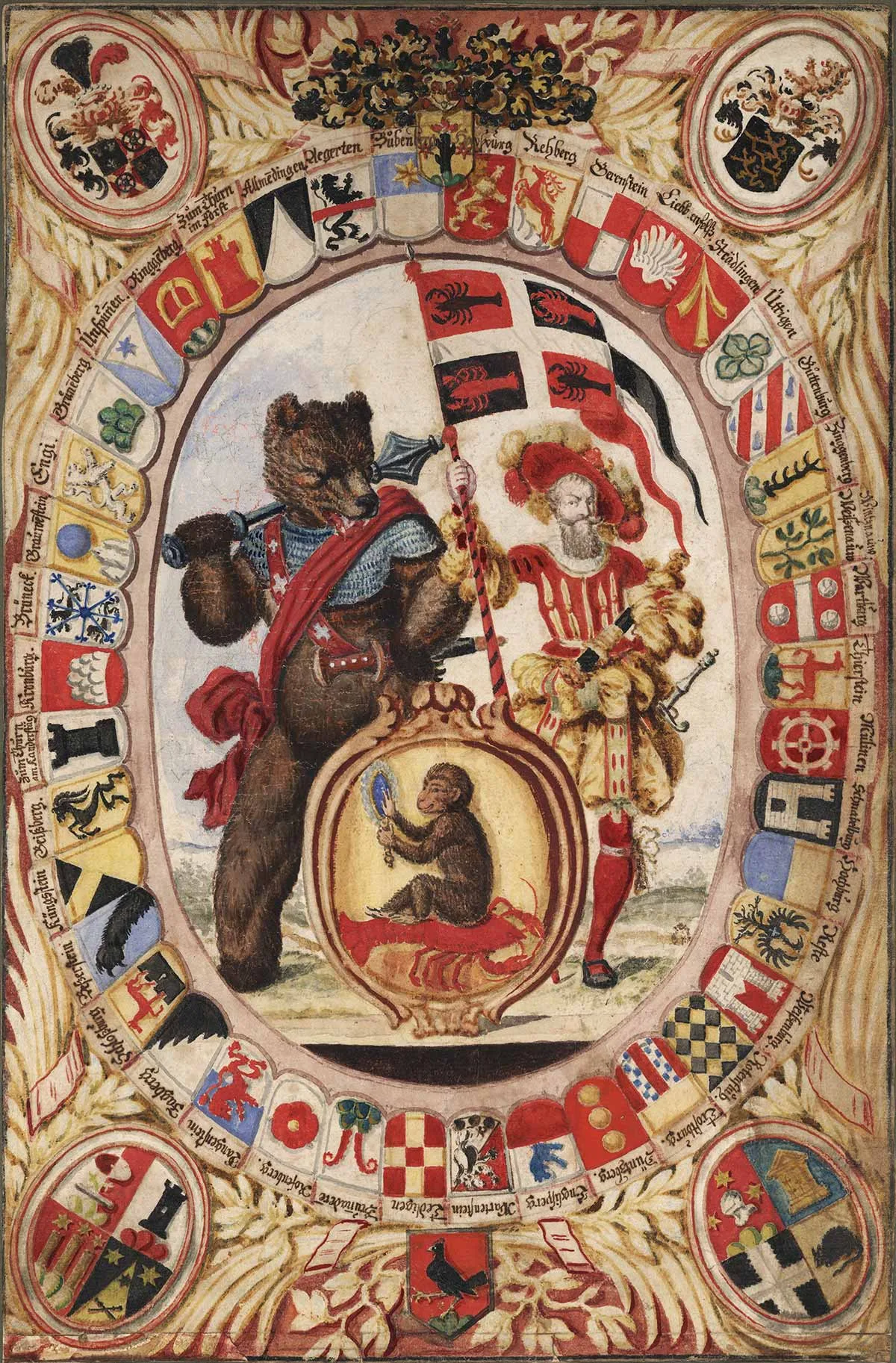
In actual fact, however, these colours were highly subversive. Gold/yellow and red also stood for something else in Bern: they were the colours of the association of young citizens of the City of Bern, known as the ‘Äussere Stand’, which was dissolved one year later. The ‘Äussere Stand’ imitated the city hierarchy with its mayors, councillors, local officials known as ‘Venner’ and bailiffs to prepare the young Bernese for taking up political office. The ‘Äussere Stand’ organised military parades and practised mock combat. The annual procession was held every Easter Monday. The emblem of the ‘Äussere Stand’ displayed an ape riding on a red crab – on a golden surface. And the association’s meeting place, the prestigious Rathaus zum Äusseren Stand building, was fittingly in the yellow quarter.
This deeper meaning went entirely unnoticed by the French. When Napoleon’s rule over Switzerland ended in 1813, however, the people of Bern opted to keep the coloured street signs. It wasn’t cheap: the once subversive enamel signs, numbering about 360, are all produced individually and by hand. They cost between CHF 500 and CHF 750, excluding the mounting. To ensure their longevity they are screwed down in a vandal-proof way – unlike the usual street signs, of which the city of Bern has to replace 100 to 200 every year, the signs dating back to the French invasion are hardly ever stolen.
Emblem of the ‘Äussere Stand’ from Bern, which was founded in the 1680s.
Emblem of the ‘Äussere Stand’ from Bern, which was founded in the 1680s. Burgerbibliothek of Berne

Further posts