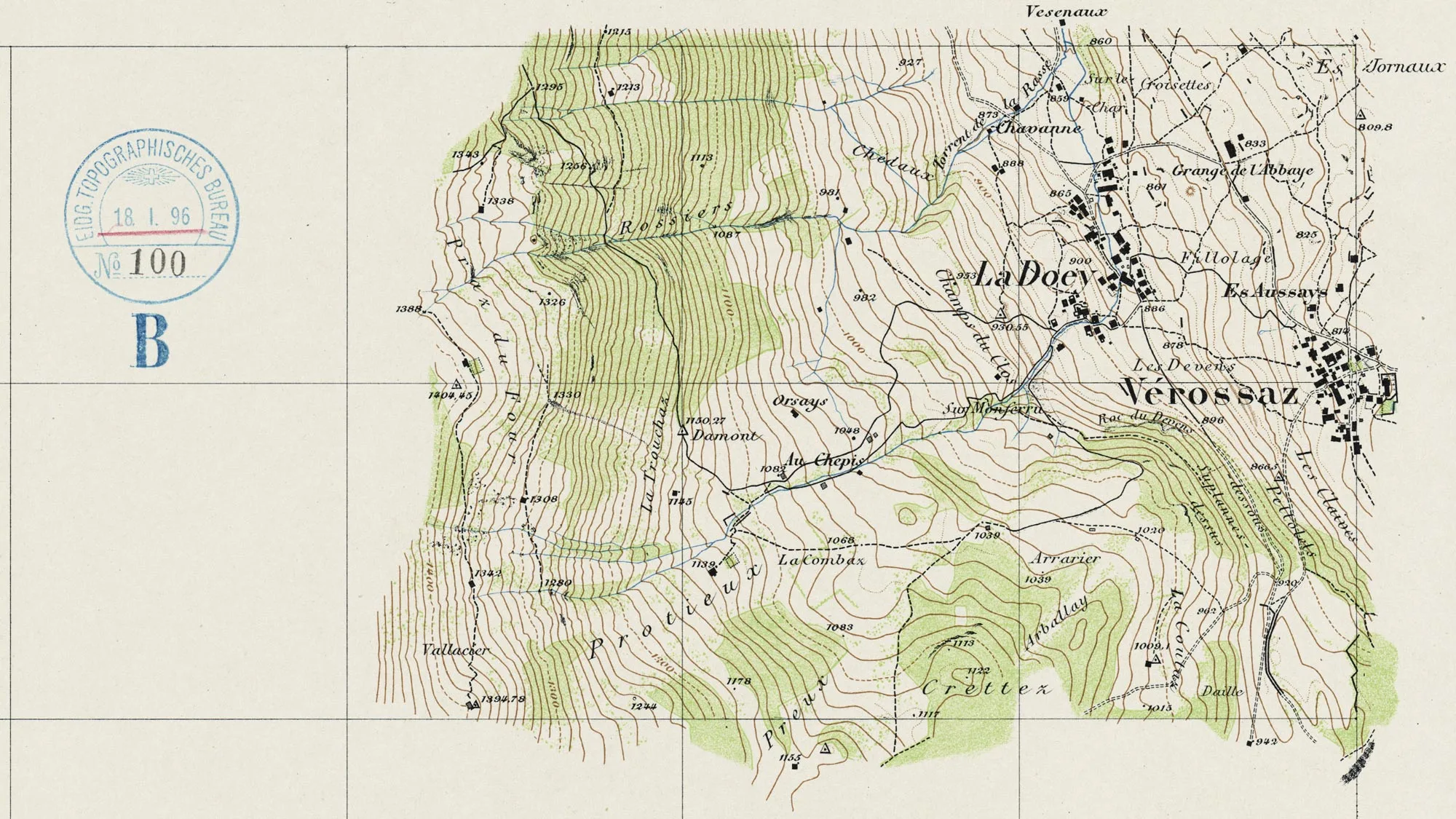
Detail from Sheet 12 ‘St. Tannaire’ of the Saint-Maurice fortification map, 1894.
Detail from Sheet 12 ‘St. Tannaire’ of the Saint-Maurice fortification map, 1894. swisstopo map collection LT FK SMAU 12, 1894

Mapping Switzerland’s fortifications: a mountainous endeavour

Between 1888 and 1952, the Federal Office of Topography produced secret, large-scale maps of Switzerland’s fortified areas. Based on work carried out under the most challenging conditions, these provide a fascinating insight into a hidden mountain world.

Felix Frey

Felix Frey

Felix Frey is a specialist in history at the Federal Office of Topography (swisstopo).

First came the Dufour Map, then the Siegfried Map and finally the famous national maps: this list seems to neatly summarise the official history of charting Switzerland’s topography. However, it fails to mention another remarkable series – the Federal Office of Topography also produced maps of the country’s fortifications between 1888 and 1952.
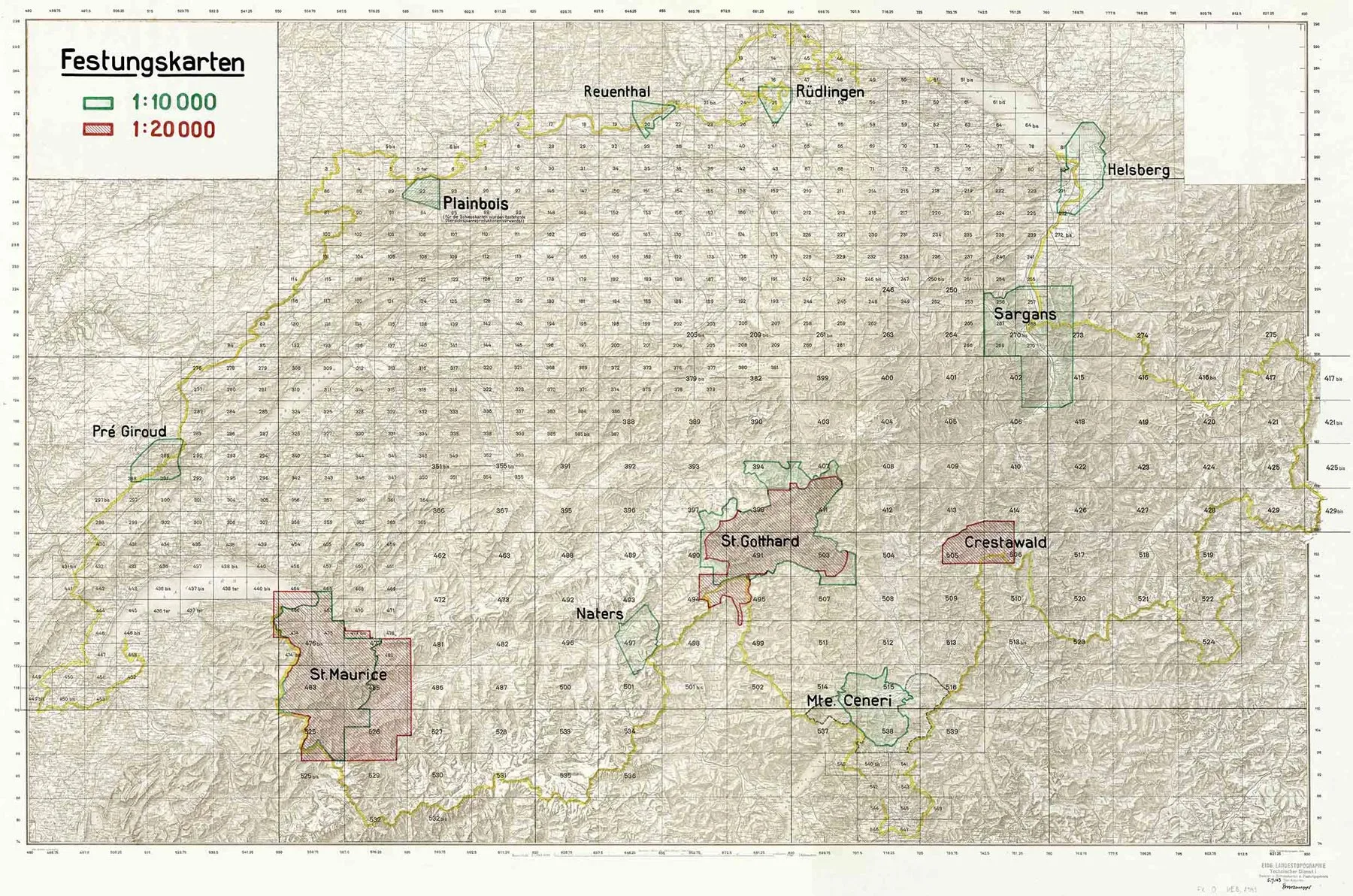
These maps are unique in many ways. They are restricted to defined areas as opposed to covering the whole country. Moreover, the scale of 1:10,000 is much bigger than the Siegfried Map dating from the same time. They were also kept from public view for over 100 years and treated as a state secret before being declassified in 2009.

Fortification maps ‒ why?

As implied by their name and the strict secrecy surrounding them, the fortification maps were used for national defence. They contained details of a series of new fortifications built in the Gotthard area from 1887 and around Saint-Maurice in lower Valais from 1892. Although Switzerland already had extensive defensive installations in place to protect its national border and key alpine passes, they were old and unable to withstand some of the more potent explosives in circulation at the time.
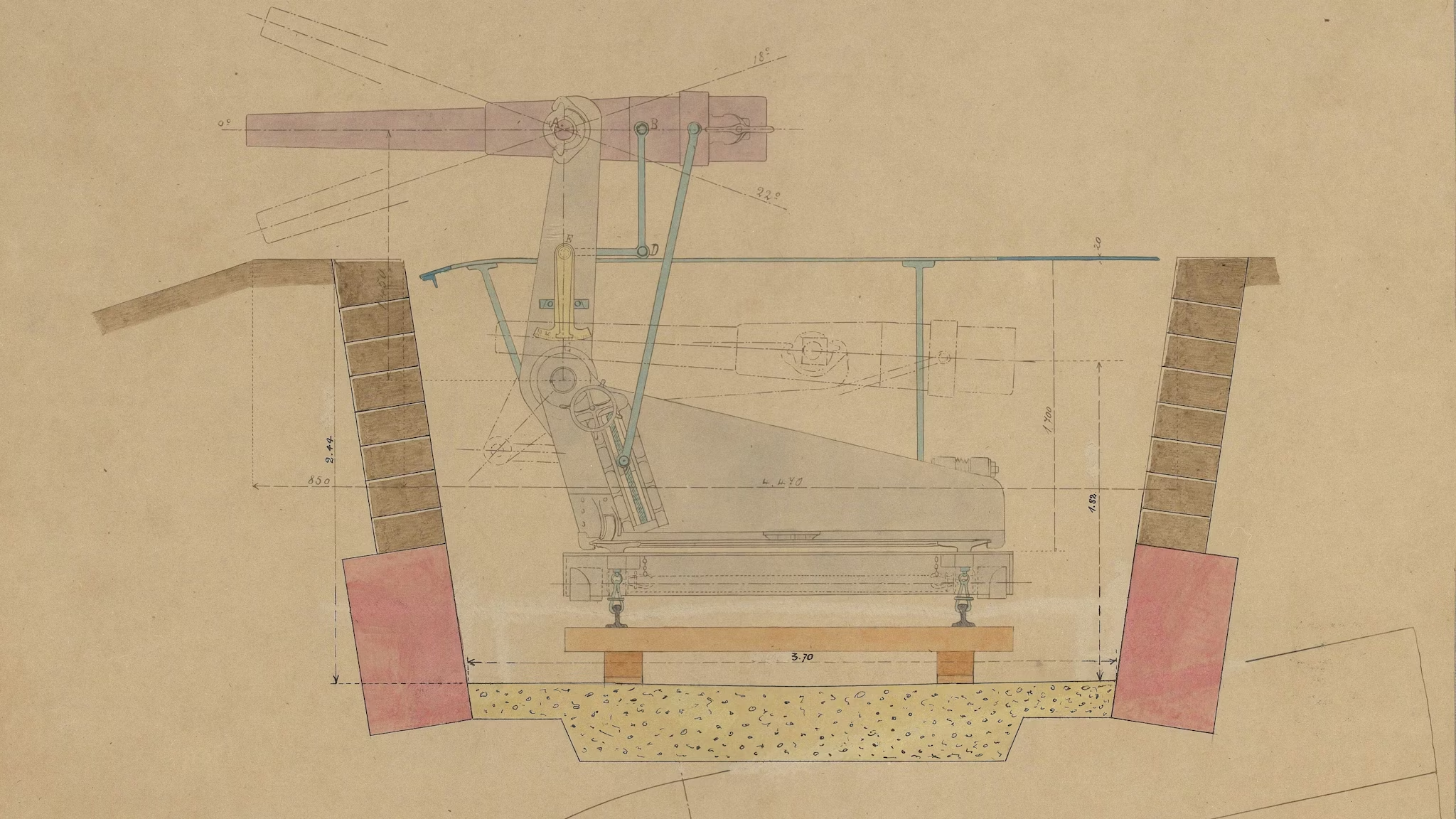
Drawing of a Swiss 12cm fortification cannon, 1893.
Drawing of a Swiss 12cm fortification cannon, 1893. Swiss Federal Archives
The fortifications at the Gotthard and Saint-Maurice were equipped with stationary artillery pieces. Their powerful range was based on the method of indirect fire: gunners often had no direct line of sight to their target several kilometres away because, for example, there was a mountain ridge in the way. Elaborate calculations combining detailed information on the configuration of the terrain with the trajectory of the shot were needed to fire with maximum precision. The fortification maps provided this essential topographical information for the Swiss artillery. The scale of 1:10,000 was extremely detailed by the standards of those days; by comparison, the publicly available Siegfried Map applied a scale of 1:50,000 to the mountain areas.
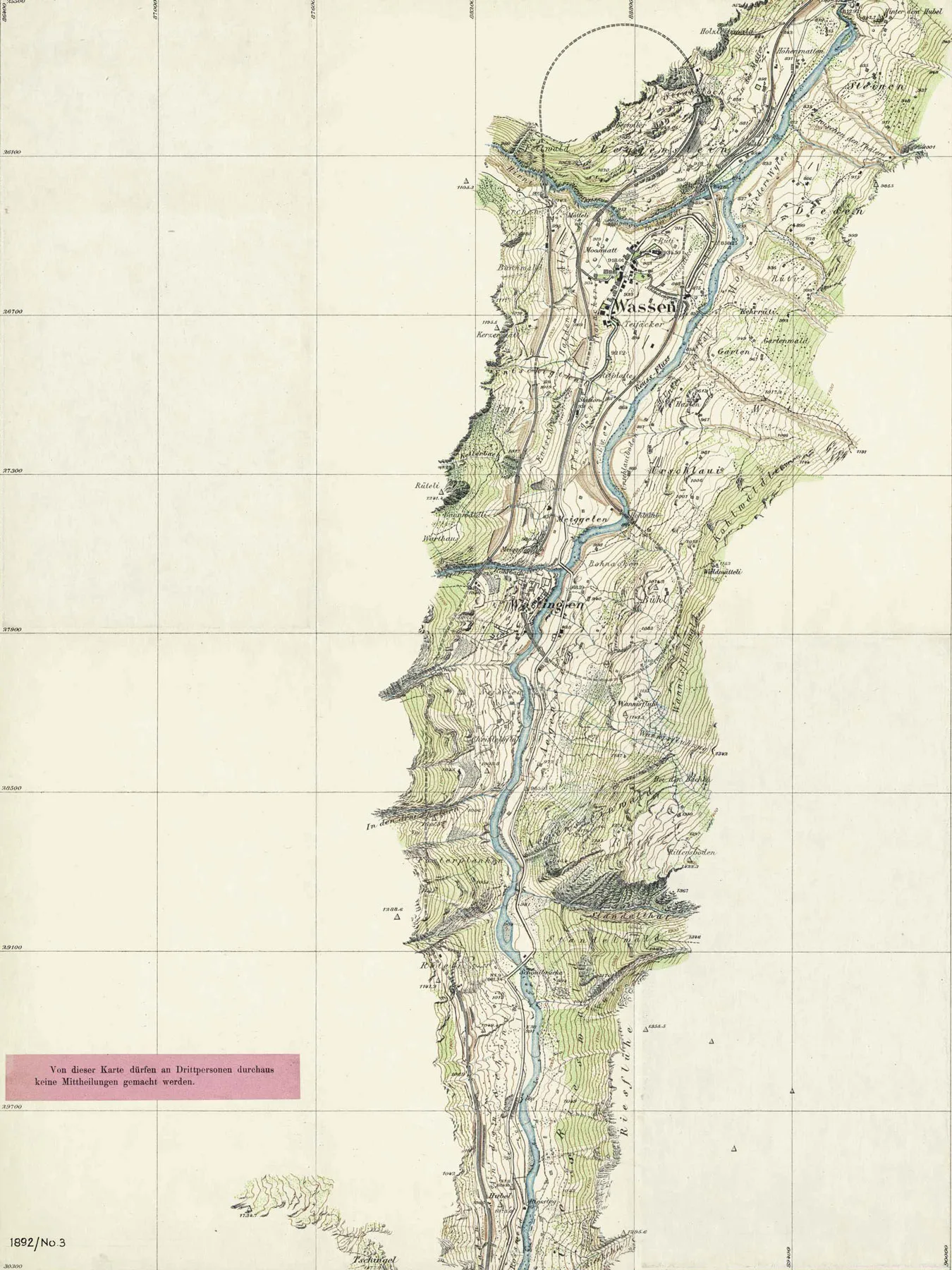
Sheet showing Wassen commune on the fortification map of the Gotthard area in 1892.
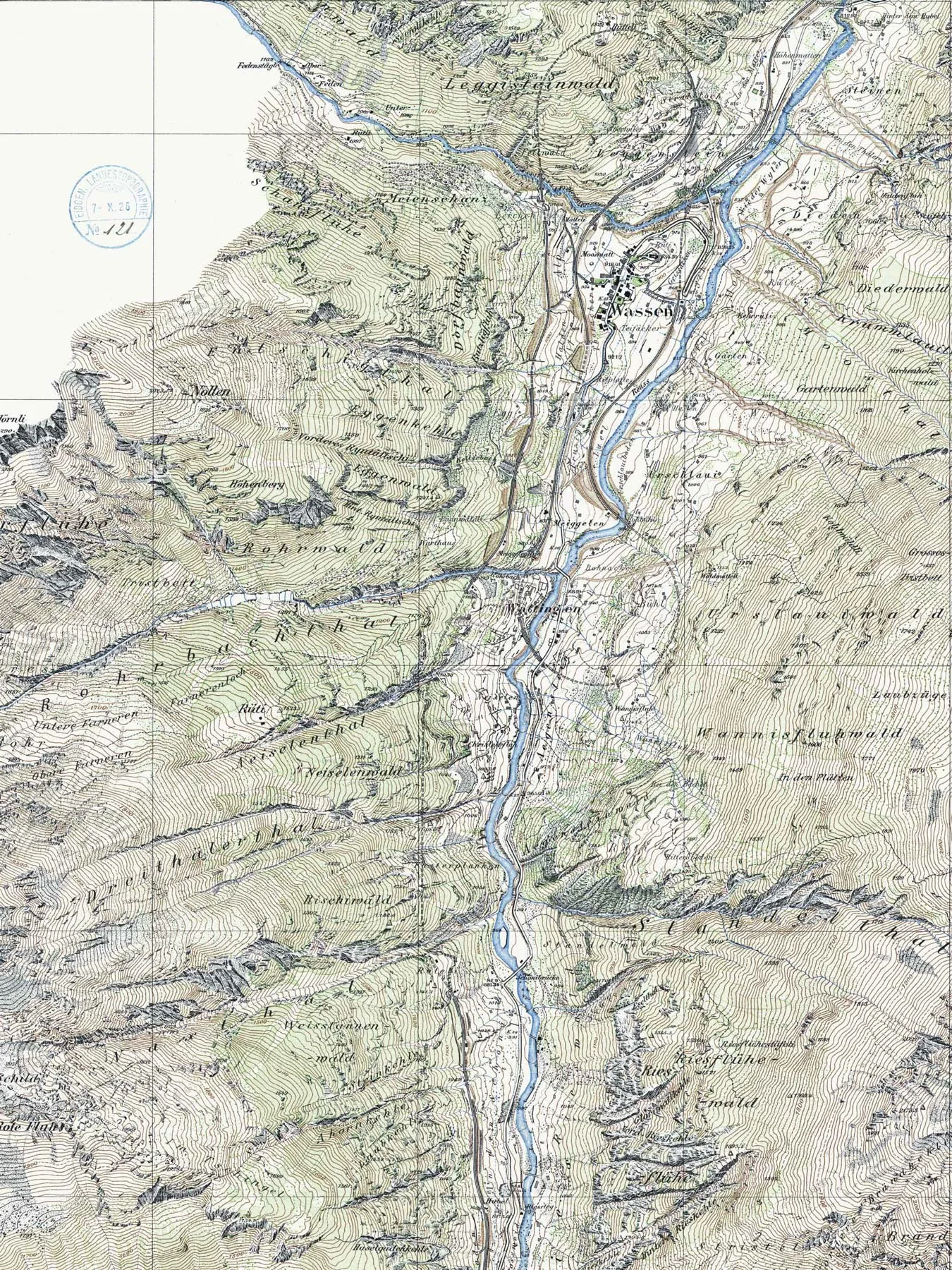
Sheet showing Wassen commune on the fortification map of the Gotthard area in 1921.
Sheet showing Wassen commune on the fortification map of the Gotthard area in 1892 (left) and 1921 (right). Initially it was mainly the strategically important valleys that were mapped before the focus of surveying work shifted to the high mountain terrain swisstopo map collection, LT FK GOT 4, 1892 / swisstopo map collection, LT FK GOT 4, 1921

From fortification maps to firing maps
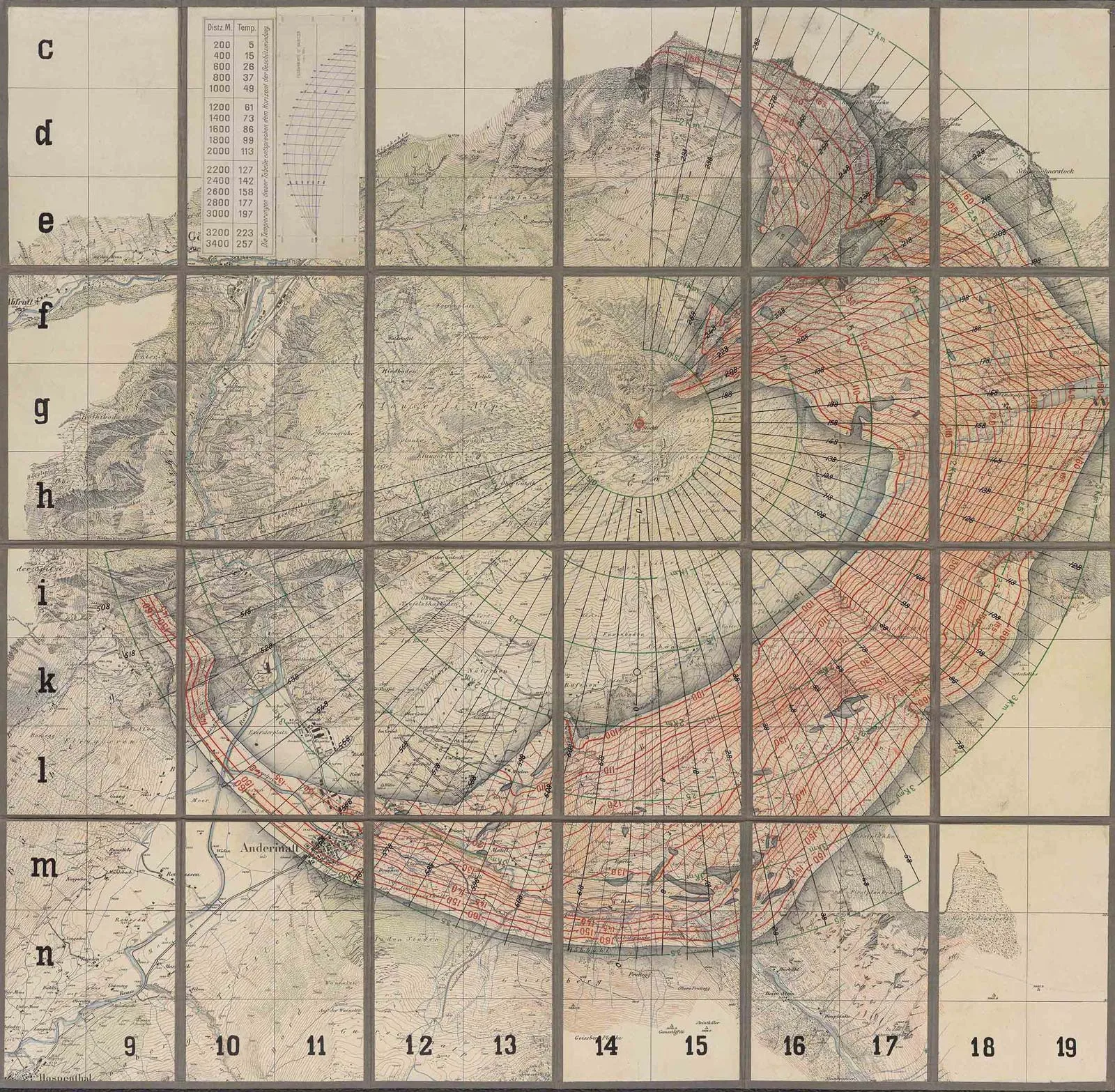
The fortification maps were not sufficient in themselves to meet the artillery’s needs. Instead they were used as a basis for the actual end product, i.e. the firing maps. These were made by a Thun-based specialist unit of the Military Department, before this task was transferred to the Federal Office of Topography in 1935. A separate firing map was produced for each type of weapon, projectile and explosive charge to provide the gunners with detailed information. As topographer Hugo Sturzenegger stressed in 1950, the firing maps were “one of the best ways of increasing the impact of a fortification. The full set [of maps] costs a few thousandths of the price involved  in building a fortification.”
Firing map for a 12cm howitzer at Fort Stöckli in the Gotthard area, ca. 1915. A small red circle in the centre marks the position of the howitzer. The red lines mark the arc of fire.
Firing map for a 12cm howitzer at Fort Stöckli in the Gotthard area, ca. 1915. A small red circle in the centre marks the position of the howitzer. The red lines mark the arc of fire. Swiss Federal Archives

Topographers’ feats of endurance

Extensive surveying had to be completed before a sheet of the fortification map was ready to be printed and further refined into a firing map. Fieldwork in the Gotthard area began in 1889, and the first topographers arrived in Saint-Maurice with their plane tables and alidades in 1892. The focus remained on these two strategically important regions for the next two decades. A third fortification area was charted at Monte Ceneri in the early 1910s.
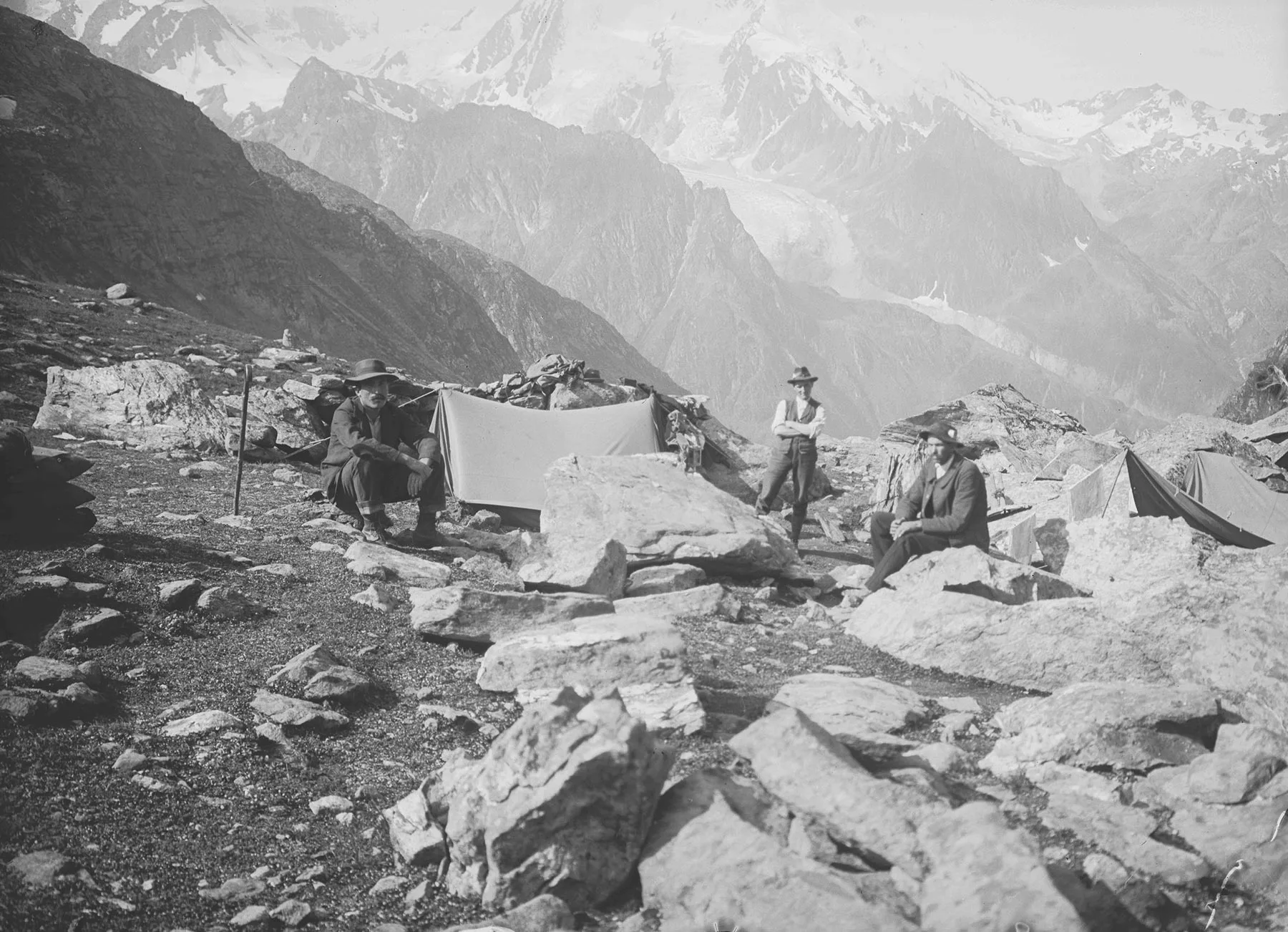
There was only a limited time window during which surveying work could be done in the high mountain areas due to the snowfall and the cold. It was often the end of June before topographers could even start work and then they had to down tools again in the early autumn when the snow started falling. During these months the engineers and their assistants stayed in alpine huts or tents, slept on straw mattresses and lived “in worse conditions at much greater expense” than their colleagues, according to Ernst Leupin, head of the Federal Office of Topography.
An engineer and his assistants bivouacking in the Valais Alps, 1915.
An engineer and his assistants bivouacking in the Valais Alps, 1915. swisstopo image collection, 000-392-466

Photogrammetry: a groundbreaking innovation
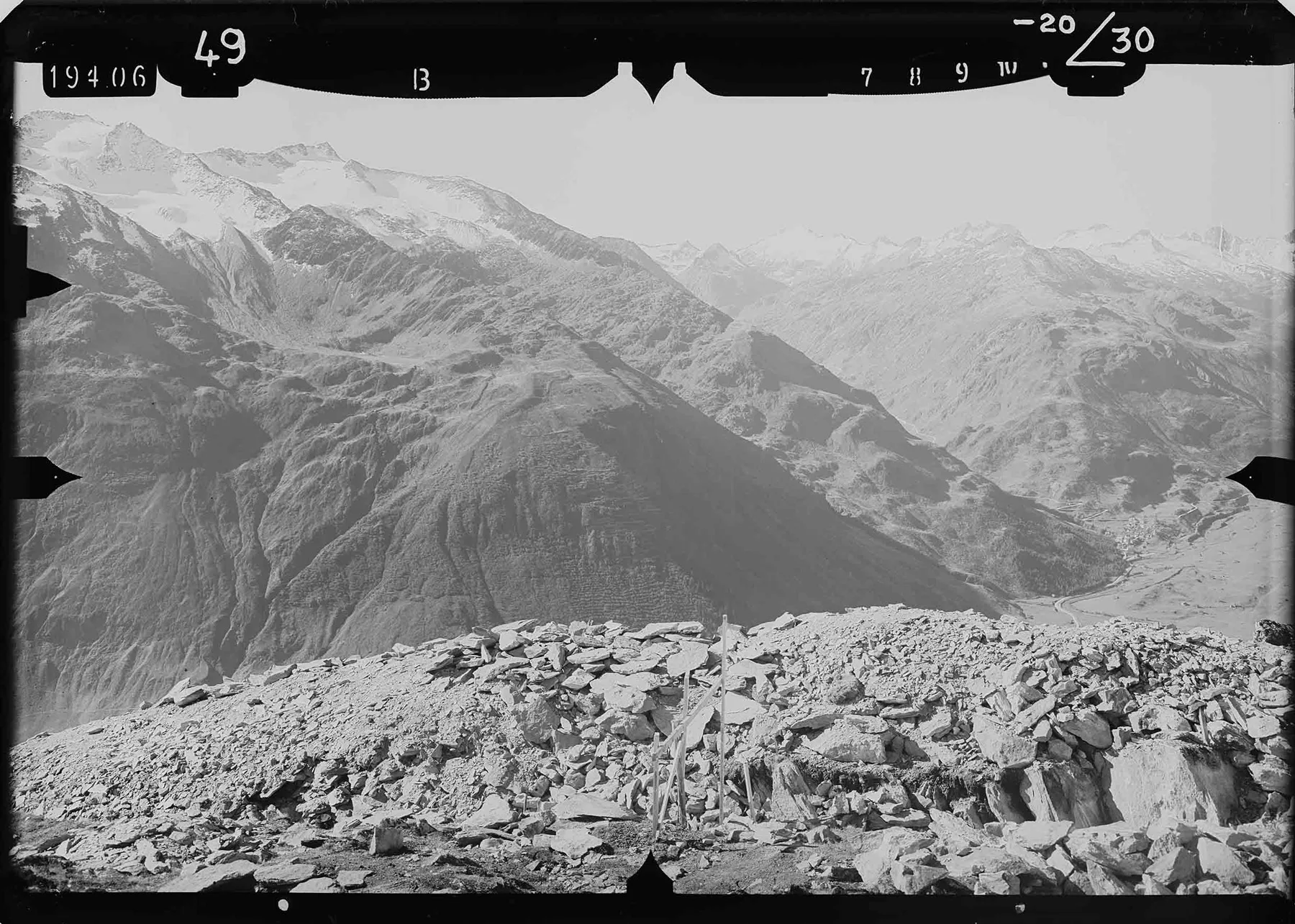
A new technology discovered during the First World War (1914-1918) initiated a sea change in the hard toil of fortification topographers. Instead of roaming the Alps armed with their measuring tables, the survey teams switched to photographic methods from 1915. They prepared stereo pairs of images (overlapping photographs) of the opposite rock face from one side of the valley to model the area in 3D. This enabled the topographers to get more work done during the short time available as they were able to do a lot of the evaluation work in the office as opposed to directly on location.
Terrestrial image of Urseren Valley with Andermatt (far right, centre), 20 September 1915.
Terrestrial image of Urseren Valley with Andermatt (far right, centre), 20 September 1915. swisstopo image collection, 000-164-605

Post-war expansion of the defences

The dangers of the First World War and the new photographic process had greatly increased the area covered by fortification maps. A lot of hard work had gone into producing secret maps of the fortification areas in the Gotthard, Saint-Maurice and Monte Ceneri. However, as Hugo Sturzenegger lamented when looking back on that time, it was after the end of the war that “the practice was brought to an end due to the cost of the war and the general defeatist illusion of ‘permanent peace’.” The survey photographs taken during the war were still evaluated and incorporated into fortification maps during the 1920s, however any new topographical work was suspended.
It was not until the Second World War that a second, comprehensive attempt to expand the fortification maps was initiated. There were eight more fortified areas by then in addition to the previously charted Gotthard, Saint-Maurice and Monte Ceneri. They were all located on the national border and were supposed to add a crucial spatial dimension to the border fortifications. The immense expansion of the areas covered by the fortification maps following the outbreak of the Second World War was only possible due to aerial images and land registry plans. The latter were of a similar scale (1:5,000 or 1:10,000) and could easily be turned into fortification maps.
In 1943 the fortification maps covered 7.5% of Switzerland’s national territory.
In 1943 the fortification maps covered 7.5% of Switzerland’s national territory. swisstopo map collection, FK 0 UEB, 1943

Firing maps: no longer fit for purpose
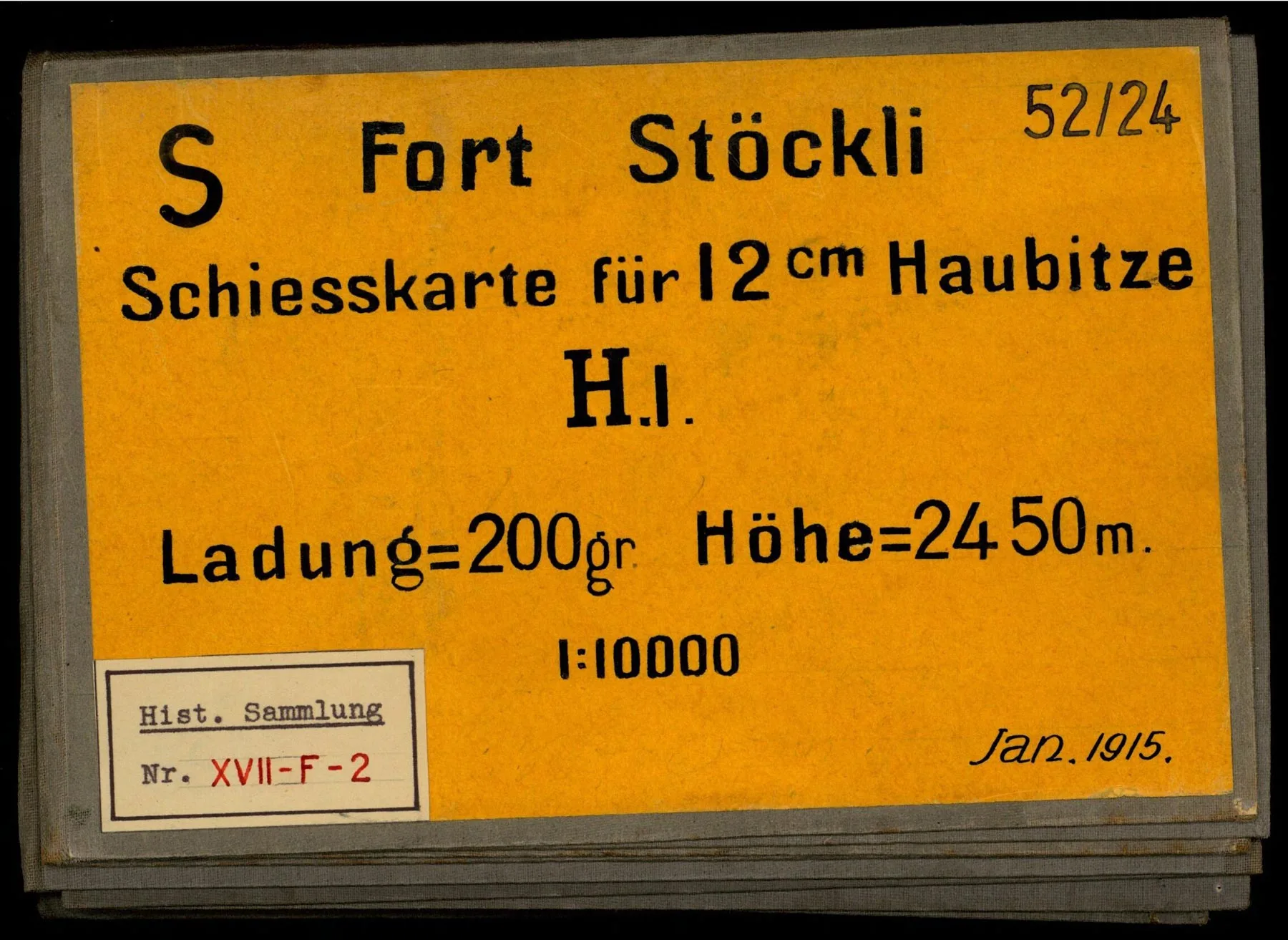
Despite the impressive expansion of the mapped areas, the fortification and firing maps gradually became obsolete during the first half of the 20th century. The variety of projectiles increased markedly during the First World War. The firing mechanisms for a round of ammunition also became more varied. A separate firing map was needed for each make of weapon, taking into account charge quantity and projectile type. The “number of types of firing map required snowballed,” as Hugo Sturzenegger summed up in 1950: in the extreme case of the Gotthard area, which had an unusually large amount of defensive fortifications, a commander had to carry up to 70 firing maps with a combined weight of 25kg. In view of the situation “there was definitely cause to doubt the suitability of such a system in times of war,” commented Sturzenegger.
A separate map for every weapon, charge quantity and projectile type: cover sheet of a firing map for Fort Stöckli in the Gotthard area.
A separate map for every weapon, charge quantity and projectile type: cover sheet of a firing map for Fort Stöckli in the Gotthard area. Swiss Federal Archives
In the early 1930s the Thun-based specialist unit of the Military Department produced simplified firing maps, which lightened the burden. However, the secret military maps faced another stiffer challenge: the artillery pieces in the fortified areas were regularly upgraded as weapons with a greater range were brought in. The fortification maps then had to cover a bigger area to keep pace with the new weaponry, which proved a Herculean task at a scale of 1:10,000. The Director of the Federal Office of Topography Karl Schneider complained in 1940 that three new Panzer towers in the Gotthard were “ready to fire” but the maps were not ready “to exploit these top-of-the-range cannons in the Gotthard fortification.”

Epilogue

The Swiss stopped producing fortification maps in 1952, not solely due to the challenges referred to above. Other large-scale map compilations like that of the land registry had covered more and more of the country by then, and the new series of national maps of Switzerland was detailed enough to, “conduct the necessary calculations to open fire on any terrain,” as Colonel Ludwig Sallenbach commented in 1957.
The fortification maps were no longer of use to the artillery by the 1950s. Nonetheless, the large-scale maps remain a valuable source of information about our mountain regions as they once were. Glacier and forest areas, streams, connecting paths and a lot of other spatial data is recorded with great precision, making them ideal for research and discovery.
The first editions of the Gotthard fortress maps are freely available in high resolution on Wikimedia Commons.
Further posts