The money box was a staple of Swiss banking for decades. Now it is a silent witness to a long bygone era.
The money box was a staple of Swiss banking for decades. Now it is a silent witness to a long bygone era. Swiss National Museum

The demise of the money box

For decades, the financial behaviour of the Swiss was based on filling their Sparkässeli. Those little metal boxes where people kept their savings even shaped society’s relationship with its banks. Today they remain as contemporary witnesses of a bygone era.

Juliane Eberhardt

Juliane Eberhardt

Juliane Eberhardt is a cultural and film scientist and studies at the University of Zurich.

The banks introduced small metal money boxes in the 18th century to encourage saving. The concept of stashing the cash dates back to ancient times when containers for safely storing coins, which came into widespread use from around 600 BCE, were made from clay and bronze. These containers were often buried to keep them out of sight.

Special savings institutions

After the world’s first savings bank was founded in Hamburg in 1778 to encourage broad sections of the population to set money aside for the future, the founding of the Dienstenzinscassa in Bern in 1787 signalled the start of the era of Swiss savings and loan banks. Swiss savings banks kept popping up everywhere over the ensuing years, and the country was soon replete with a dense network of all manner of savings institutions. By 1850, there were already 150 savings and loan banks in operation, catering mostly to small-scale savers.
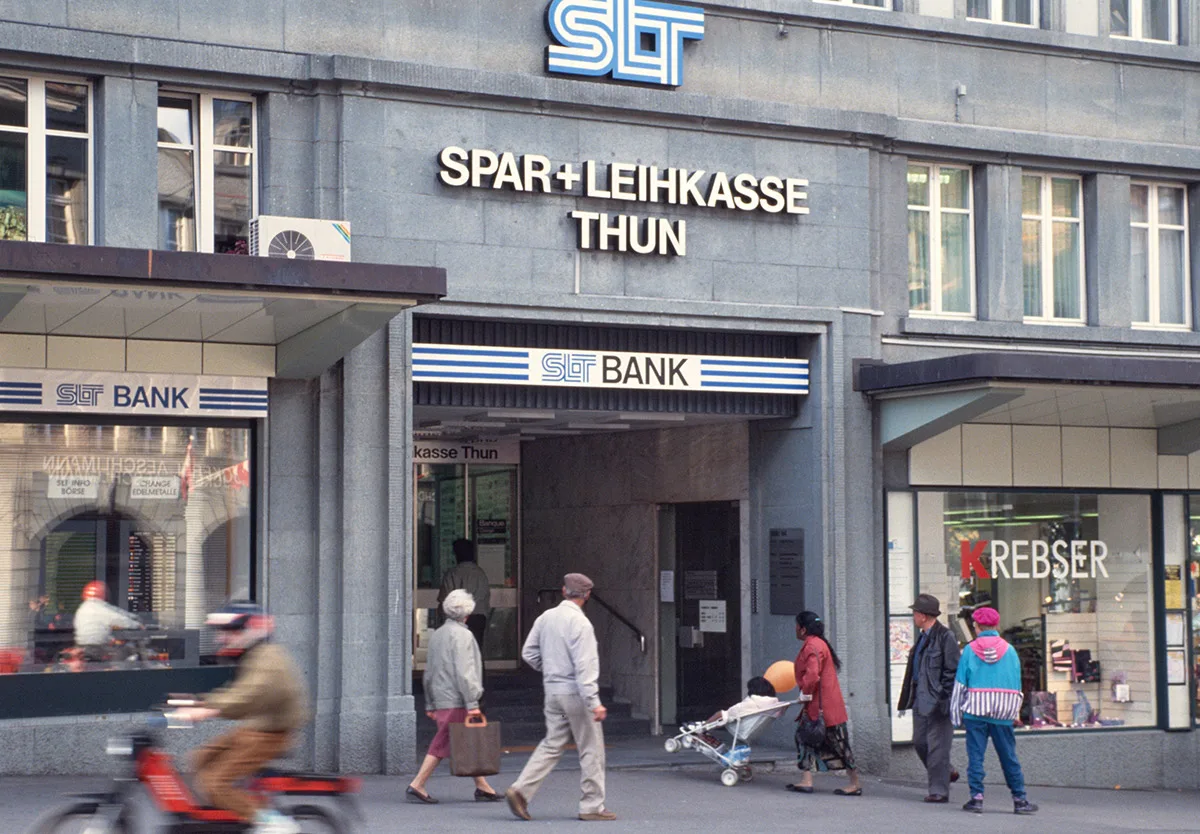
Savings and loan banks became a staple of Swiss towns and cities from the mid-20th century. This one in Thun went bust during a banking crisis in 1991 and was swarmed by customers eager to withdraw their money.
Savings and loan banks became a staple of Swiss towns and cities from the mid-20th century. This one in Thun went bust during a banking crisis in 1991 and was swarmed by customers eager to withdraw their money. Swiss National Museum / ASL
Up until the 1970s, these banks distributed small, mostly oval-shaped, metal money boxes to their customers. They were often given as a promotional gift at birth to foster a saving mentality among children. They also helped banks become a universal presence in family life, with children keeping money boxes in their bedrooms. They served as a constant reminder of the importance of saving and were thus instrumental in teaching generations of children about finance.
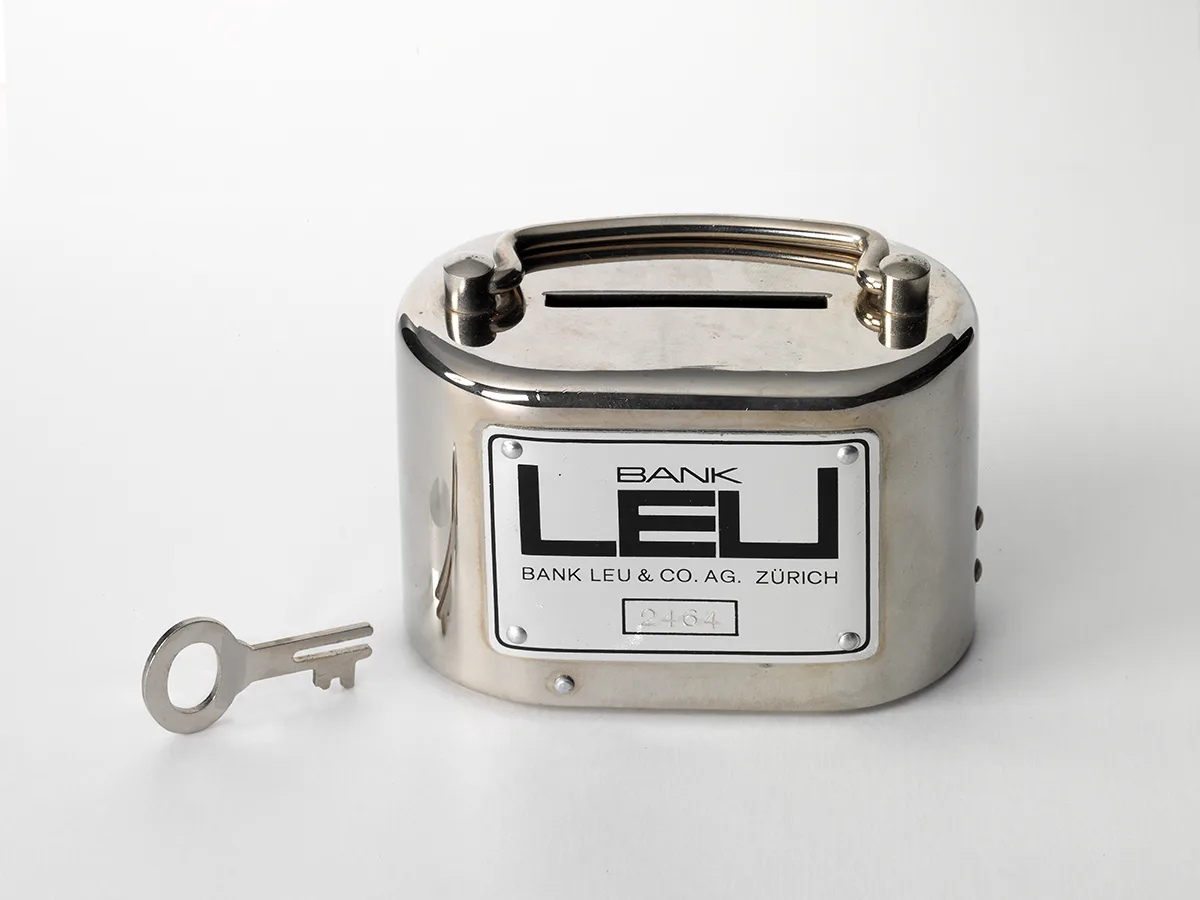
The idea of saving for a rainy day was straightforward: insert money into the box (via the slot) at home. Once full, take it to the bank, have it opened by the teller and the money counted. Deposit that money at lucrative conditions in an account recorded in a personal savings book. Then take the money box home and repeat. This cycle proved invaluable in building customer loyalty as, from the early 20th century, most boxes could not be opened at home, so the money was literally locked in. Only the banks had the master key to open their customers’ personal money boxes. This ensured people would regularly visit the bank.
Bank Leu money box with the key used by bank employees to open it.
Bank Leu money box with the key used by bank employees to open it. Swiss National Museum

A Swiss cultural asset and advertising medium

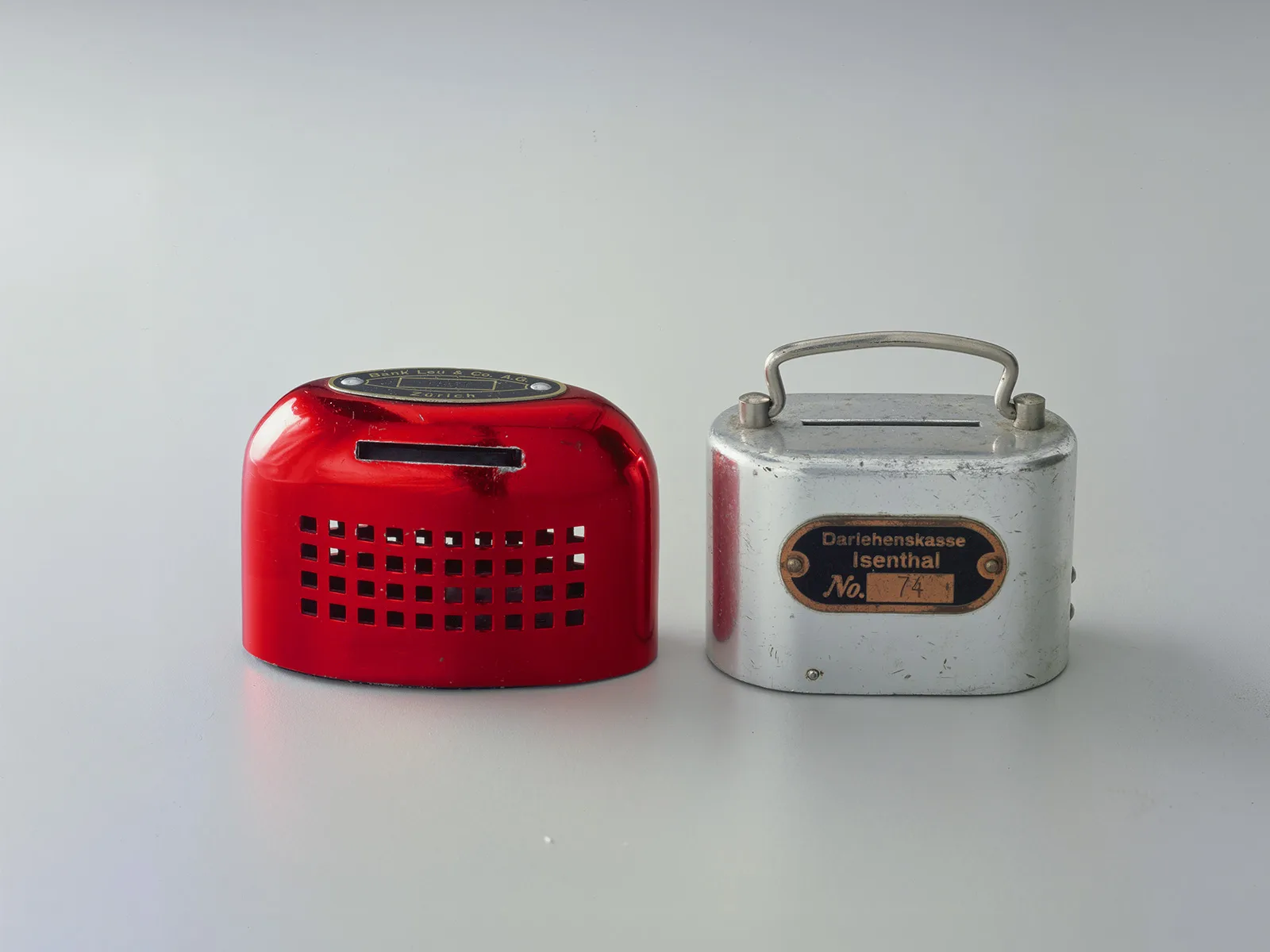
The money boxes all had a fairly standard design: they were mostly oval, approximately ten centimetres long with a slot for coins, a lock at the bottom, a handle on top and a badge riveted onto the side or top. The side invariably displayed the name of the ‘donor bank’ and sometimes included the town or canton, effectively providing a free form of advertising as visitors to people’s homes could see where they banked (assuming, of course, the money box was visible). Sometimes the badge included the bank logo or the coat of arms of the city, commune, village or canton. Each money box also came with its own serial number engraved on it so it could be attributed to a specific customer. There was a simple reason for the uniform appearance of the containers: there were only about ten manufacturers of the metal coin boxes, producing no more than 30 different types.

The Kellenberger money box collection

The special collection of Theres and Werner Kellenberger comprises 868 money boxes, keys and comprehensive documentation. Unimpressed by the plastic coin box offered by their bank in the mid-1990s after opening a savings account for their grand-daughter, the married couple from Bern began collecting metal coin boxes from all over Switzerland.

The project soon turned into a time- and space-consuming hobby. The couple visited banks throughout Switzerland looking for the metal coin boxes that people were no longer using. At home the Kellenbergers photographed the coin boxes with their analogue camera before placing them in a glass cabinet. They also marked each money box they obtained with a point on a map of the country. They wanted to tell the whole story.

In 2004, the collection was included in the Swiss National Museum’s "Technology and traditions" collection as a contribution to the cultural history of saving coins and notes. Twelve of these boxes are on display in the History of Switzerland permanent exhibition at the National Museum Zurich.
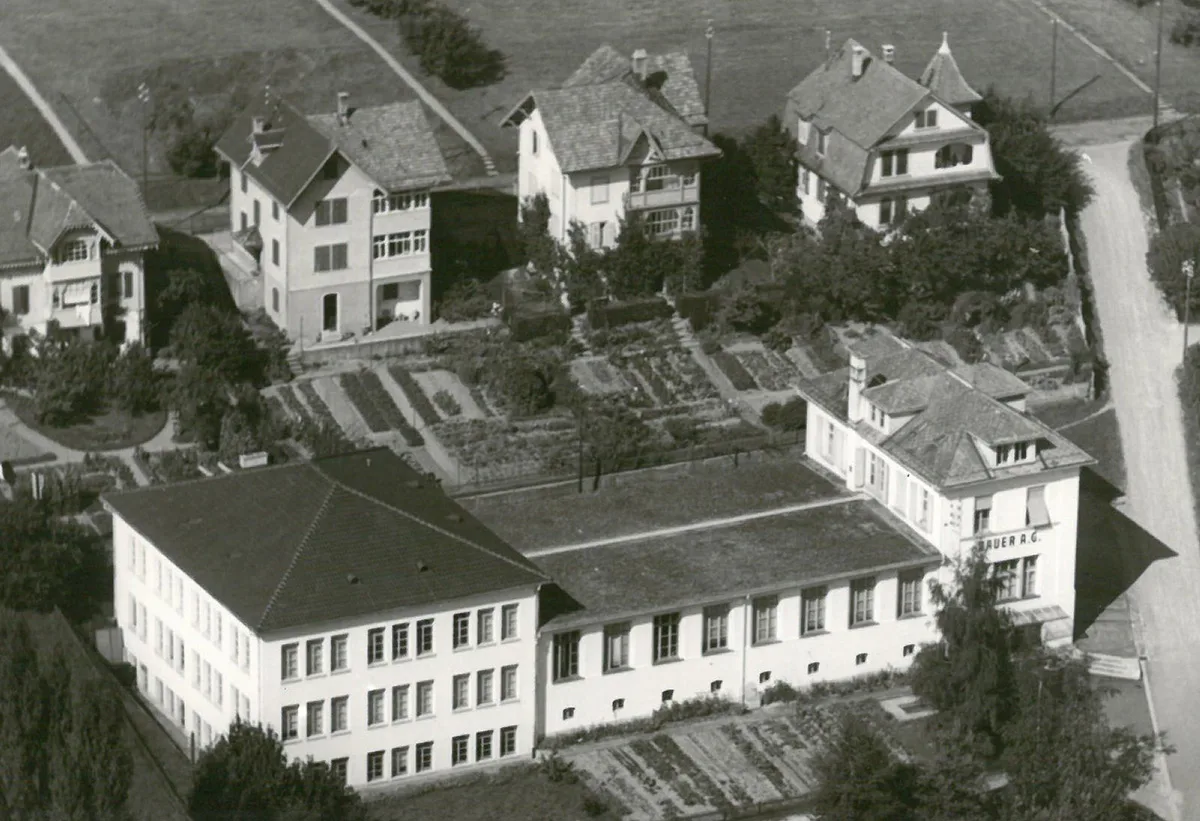
Bauer A.-G. from Zurich had been one of the key suppliers of these boxes to Swiss banks since the 1920s. The company was founded by Franz Bauer in 1862 and passed on to his sons. Over time, the Zurich-based company became a leading manufacturer of vaults and safety installations for banks, with its Wetzikon branch producing up to 50,000 new money boxes a year from the 1930s. They were initially made from iron, then brass and subsequently from aluminium sheet. The company name was also always engraved on the bottom. Following a series of mergers, the company is now known as Dormakaba. It no longer makes coin boxes but still features in everyday life in Switzerland through its invention of the Kaba reversible key.
Aerial shot of the Bauer premises in Wetzikon. It produced about 50,000 money boxes every year for banks all over Switzerland.
Aerial shot of the Bauer premises in Wetzikon. It produced about 50,000 money boxes every year for banks all over Switzerland. wetzipedia / Archiv Ortsgeschichte Wetzikon
The advent of plastic in the 1950s offered an alternative to the metal boxes. The banks then also began supplying a key along with the new plastic boxes.

A reminder of how many banks there used to be

All the different names displayed on the money boxes remind us of how many banks used to operate in Switzerland. Their number was massively reduced by the nationwide wave of banking closures during the noughties, which was driven to a large extent by structural change in the form of more online banking, cost pressures and the fallout from the 2008/2009 financial crisis. Many banks had to give up the independence they had enjoyed for 100 years. This development gained further impetus through the takeover of Credit Suisse by UBS.
The money boxes are a throwback to the days when saving meant accumulating notes and coins, a concept since marginalised by the advent of electronic cash, online banking and financial apps. This change is all pervasive. According to a survey by the Swiss Payment Monitor, just under 24% of the public were still making payments in cash at the end of 2025. Besides, the old idea of keeping cash under the mattress no longer makes sense when that money could be invested, on the stock exchange for example. The practice of saving and managing money in general is moving progressively towards the digital realm.
Nonetheless, Switzerland still seems to have an emotional tie to coins and notes. On 8 March 2026, the electorate voted to have the supply of notes and coins guaranteed by the Confederation and to have this enshrined in the Federal Constitution.

Switzerland, the land of banks

12.06.2026 08.11.2026 / National Museum Zurich
Switzerland is one of the world’s leading financial centres – but how did its close association with banking evolve? The exhibition shows how deeply banking is entrenched in Switzerland’s DNA and traces the development of the banking system by displaying an impressive range of items. Jewish moneylenders, Lombardy merchants and, later, urban exchange offices laid the foundation for the modern financial centre. The exhibition goes beyond merely retracing historical developments; it also invites visitors to engage with the land of banks as it is today.
Further posts