A staunch supporter of the Nazi regime: toolmaker Adolf Walter. Illustration by Marco Heer.

Adolf Walter – national traitor turned liberal industrialist

Adolf Walter fled Switzerland for the Third Reich in 1939, a fugitive from justice. On returning, he was convicted of treason and served a prison sentence. But that did not stop him from setting up in business and living life as a normal citizen.

Rolf Löffler

Rolf Löffler

Rolf Löffler ist Historiker und Sekundarlehrer.

The Federal Criminal Court’s assessment of Adolf Walter was clear: his statements lacked credibility, he did not appear to acknowledge his guilt and he showed no signs of contrition or remorse. Moreover, the judges believed that his crimes had been motivated by a deeply held conviction and that he had joined the traitors of his own free will. The Federal Criminal Court therefore sentenced Walter on 7 May 1948 to two years in prison and stripped him of his civic rights for five years for attacking the independence of the Confederation and other offences. The latter sentence meant that the man from Solothurn was barred from voting in elections and referendums. He was also disqualified from holding public office.

Born in 1914, Walter was one of the 41 men who appeared in court in Zurich in April 1948 on charges of treason. The principal defendant in the major trial ‒ Franz Burri, who had pushed for Switzerland to be annexed into the Third Reich ‒ received 20 years in prison, and many of his co-accused were also given lengthy custodial sentences.
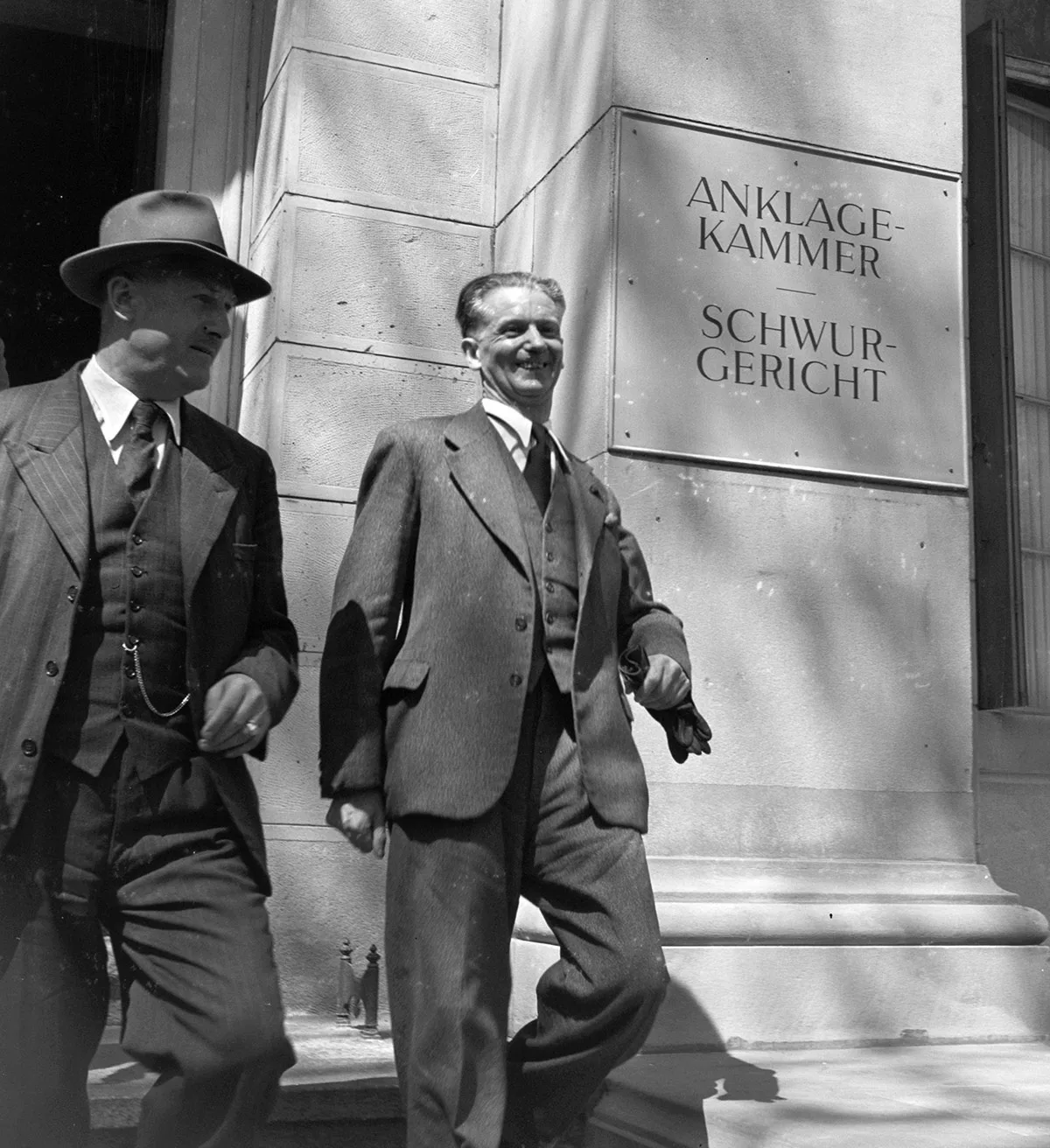
Franz Burri (right) leaving the Zurich court room after an initial hearing on 21 April 1948.
Franz Burri (right) leaving the Zurich court room after an initial hearing on 21 April 1948. Swiss National Museum / ASL
The two years in jail were an additional penalty imposed subsequent to an original conviction. Back in June 1939, the Solothurn-Lebern District Court had sentenced Adolf Walter in absentia to three months’ imprisonment for violating the Ordinance on the Protection of Democracy. Walter, a toolmaker at the armaments factory in Solothurn, had attended meetings of the Bund treuer Eidgenossen nationalsozialistischer Weltanschauung (BTE), a grouping that espoused a National Socialist worldview. He was also given to making vociferous, pro-Nazi statements in pubs, which ended up in brawls on more than one occasion.
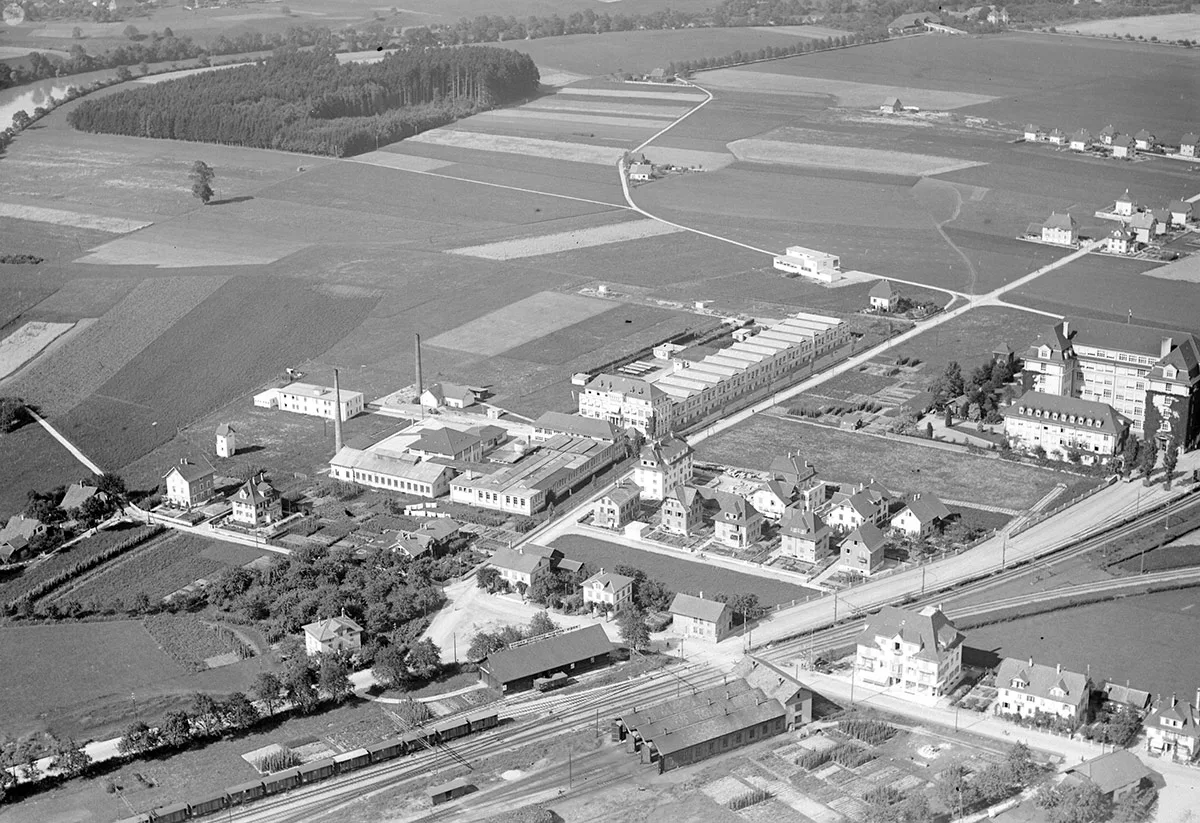
In the 1930s Adolf Walter worked at the armaments factory in Solothurn, seen here in an aerial shot taken in 1930.
In the 1930s Adolf Walter worked at the armaments factory in Solothurn, seen here in an aerial shot taken in 1930. StABS, BALAIR 2502W

Multiple convictions

He avoided the sentence handed down to him in Solothurn by fleeing to Nazi Germany, heading first for Lörrach, then Stuttgart. But this was not to be his last brush with the law in Switzerland: having failed to report for active duty in 1939/40, the military justice authority subsequently sentenced him to a further eight months in prison in July 1946.

The Swiss expat remained in Stuttgart until shortly before the end of the war. He married a local woman, and the couple had a son. Walter worked at a number of tool factories and, according to his own testimony to the court, was a member of an intelligence service run by the German state. However, he refused to reveal any further details. According to one witness who wrote to the Swiss authorities in 1946, Adolf Walter had been providing financial support to the SS. He joined the League of the Swiss in Greater Germany (Bund Schweizer in Grossdeutschland, BSG) in 1940 and was leader of a self-styled ‘fighting squadron’ or paramilitary sports group in Stuttgart. Walter had experience in this area: back in Solothurn he had acted as sporting official for the local BTE chapter, which involved organising its Sunday parades.

Clash with Waffen-SS man Benno Schäppi
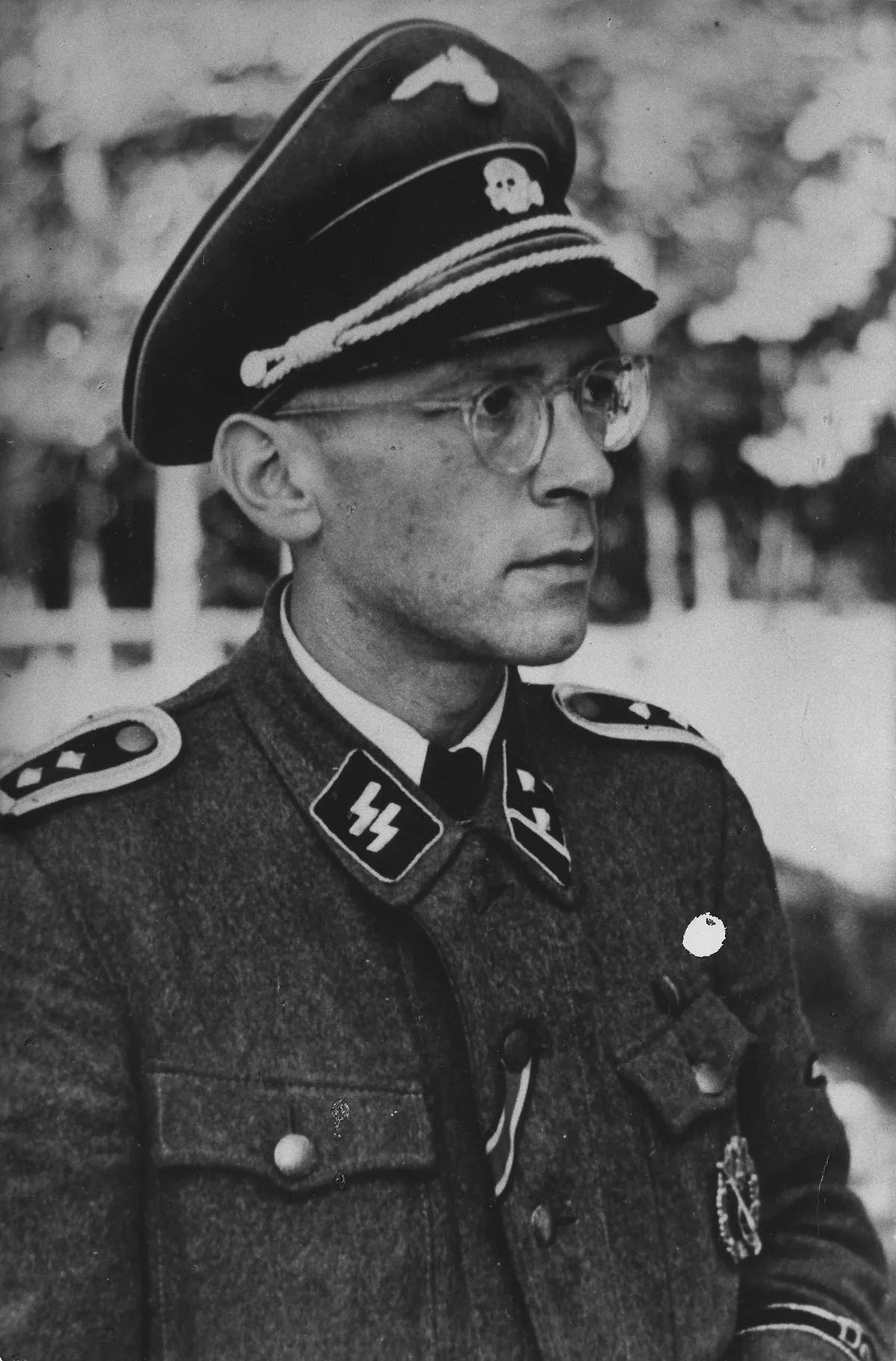
However, things became uncomfortable for Walter in 1942 when he became embroiled in a dispute with Swiss Waffen-SS officer Benno Schäppi and his wife. Differences of opinion on the direction the sports group should take led to insults and acts of violence. Schäppi composed letters to the national leadership of the BSG in which he threatened to “make Walter disappear from the face of the Earth” and to bring the matter before an SS court. An attempt by the BSG to reconcile the two men came to nothing when Walter failed to show up at the meeting. Adolf Walter was drummed out of the BSG in August 1942.
Adolf Walter quarrelled with Benno Schäppi, seen here in SS uniform, about the BSG sports group.
Adolf Walter quarrelled with Benno Schäppi, seen here in SS uniform, about the BSG sports group. Archives of Contemporary History / Estate of Werner Rings / 440
Schäppi subsequently set the secret state police, the Gestapo, on to Walter. He was summoned to the Gestapo offices and interrogated. They even searched his apartment. At the same time, he lost his work permit and his wife fell ill. Returning to Switzerland was not an option as the German authorities refused to give him an exit visa. In September 1943, his dispute with Schäppi was brought to an end by a ruling of the Stuttgart District Court designed to restore peace between the two men, and Adolf Walter’s life became quieter again.

He joined Franz Burri’s Swiss National Socialist League (Nationalsozialistischer Schweizerbund, NSSB) as early as the summer of 1943, becoming head of the organisation’s Stuttgart chapter. He restructured the latter, recruited new members and organised meetings. The Federal Criminal Court would later set down in its judgment that Adolf Walter clearly supported the aims of the NSSB, i.e. the annexation of Switzerland into Hitler’s Reich.

The pro-Nazi Walter brothers
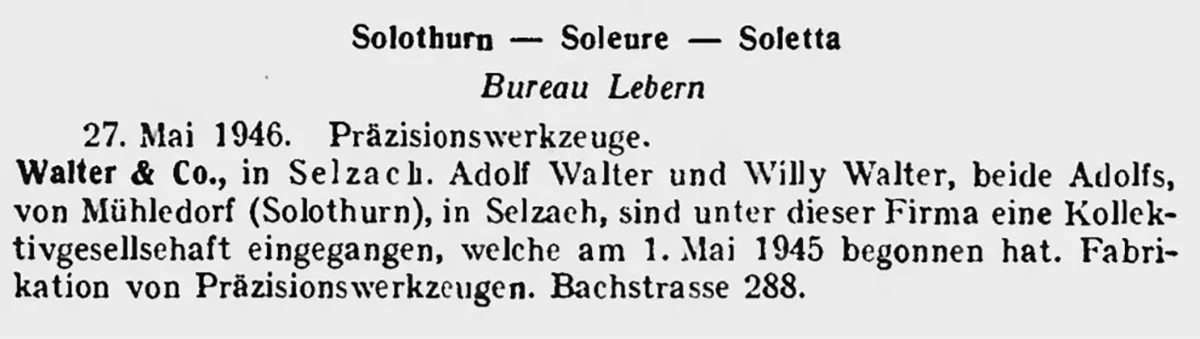
However, Walter did ultimately return to Switzerland with his family – in April 1945, shortly before the collapse of Hitler’s Germany. The clearly indomitable Walter was not the kind of man to be deterred by adverse circumstances and the threat of imprisonment. He began manufacturing precision tools together with his younger brother Willy on 1 May 1945 in Selzach near Solothurn, where they lived. Notice of the establishment of a general partnership named Walter & Co. was published in the Swiss Commercial Gazette on 27 May 1946.
The establishment of Walter & Co. was announced in the Commercial Gazette in May 1946.
The establishment of Walter & Co. was announced in the Commercial Gazette in May 1946. e-periodica
The Walter brothers were clearly supportive of National Socialism: in 1943, an elder brother, Martin, had been sentenced in absentia by the military justice authorities to 15 years in prison and deprived of his citizenship for spying on behalf of Germany. Like Adolf, he had evaded serving his sentence by fleeing to Germany. Willy had been given a four-month suspended prison sentence in the same case for failing in his duties to report.

Adolf and Willy Walter forged ahead regardless, busily setting up their company until the Federal Criminal Court judgment of May 1948 intervened. Adolf then began serving his two years behind bars at the correctional facility in Witzwil in the canton of Bern. The Federal Department of Justice and Police (FDJP) saw fit to release him on parole in August 1949 ‒ for good behaviour and because the prison authorities believed he had changed his attitude to Switzerland.
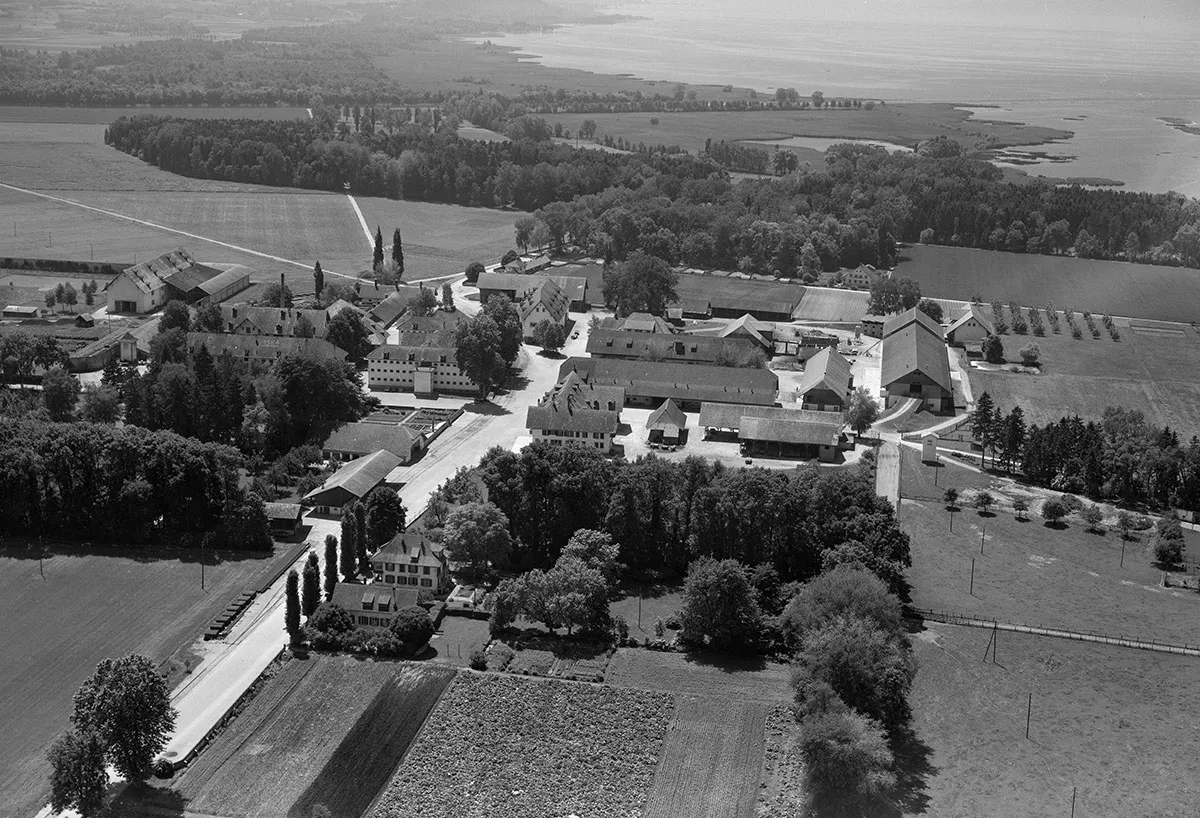
Adolf Walter served his sentence at the Witzwil correctional facility in the canton of Bern. This aerial photo of the prison grounds dates from 1970.
Adolf Walter served his sentence at the Witzwil correctional facility in the canton of Bern. This aerial photo of the prison grounds dates from 1970. e-pics

Head of the company but subject to guardianship

Adolf Walter was placed under guardianship and supervised parole. Consequently, he had no legal capacity to act and was subject to the care and supervision of the agency monitoring his parole. In addition, he continued to forfeit his civic rights – an unusual situation and hindrance for the co-proprietor of a company. Nevertheless, Walter & Co. flourished. By 1951, the tooling and grinding company was employing a staff of 15.

Adolf Walter’s request to be released from guardianship was approved that same year, and the supervision of his parole supervision eventually also came to an end. The Solothurn Police Department responsible for taking the decision described him as “a citizen who lives a quiet, reclusive life, and who is well-liked in the community and by the authorities”.
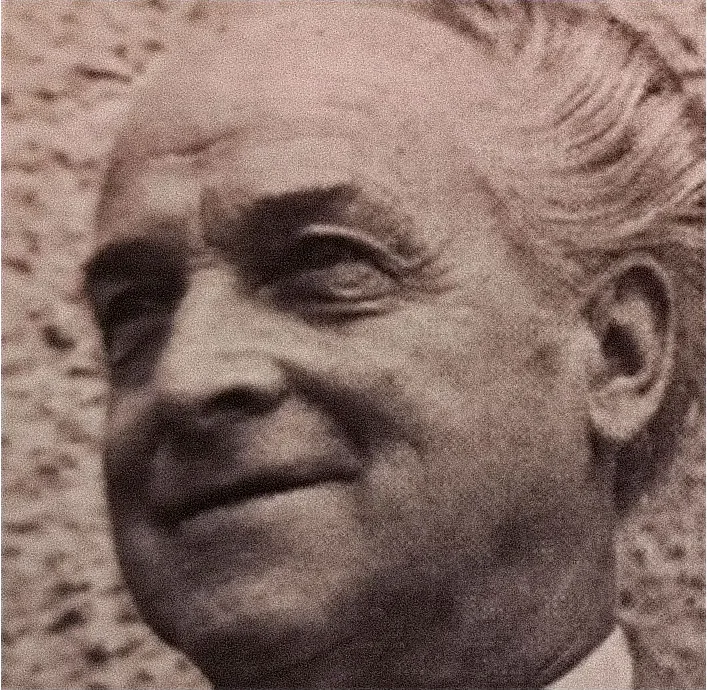
Photograph of Adolf Walter taken in 1972.
Photograph of Adolf Walter taken in 1972. Verein für Ortsgeschichte Selzach/Altreu

From National Socialist to Radical Democrat

As well as successfully running his own company, Adolf Walter dared to venture back into the political arena. When it came to restoring Walter’s civic rights, a letter from the leader of the Free Democratic Party made it clear that this time Walter would be adopting a democratic platform. Party Chairman Widmer notified the FDJP that “as the head of an industrial enterprise” Mr Walter could “be of great service to the FDP Selzach” in the upcoming National Council elections. Adolf Walter’s involvement with the FDP marked a return to his political roots: he had been a member of the Young Liberals for a whole year in 1933/34 before later turning towards the BTE.

The final obstacle to Adolf Walter’s return to civic life was removed in February 1953 when the Federal Criminal Court restored his ability to hold office, vote and stand for election. He could henceforth participate fully in political, economic and social life, with nothing more standing in his way.
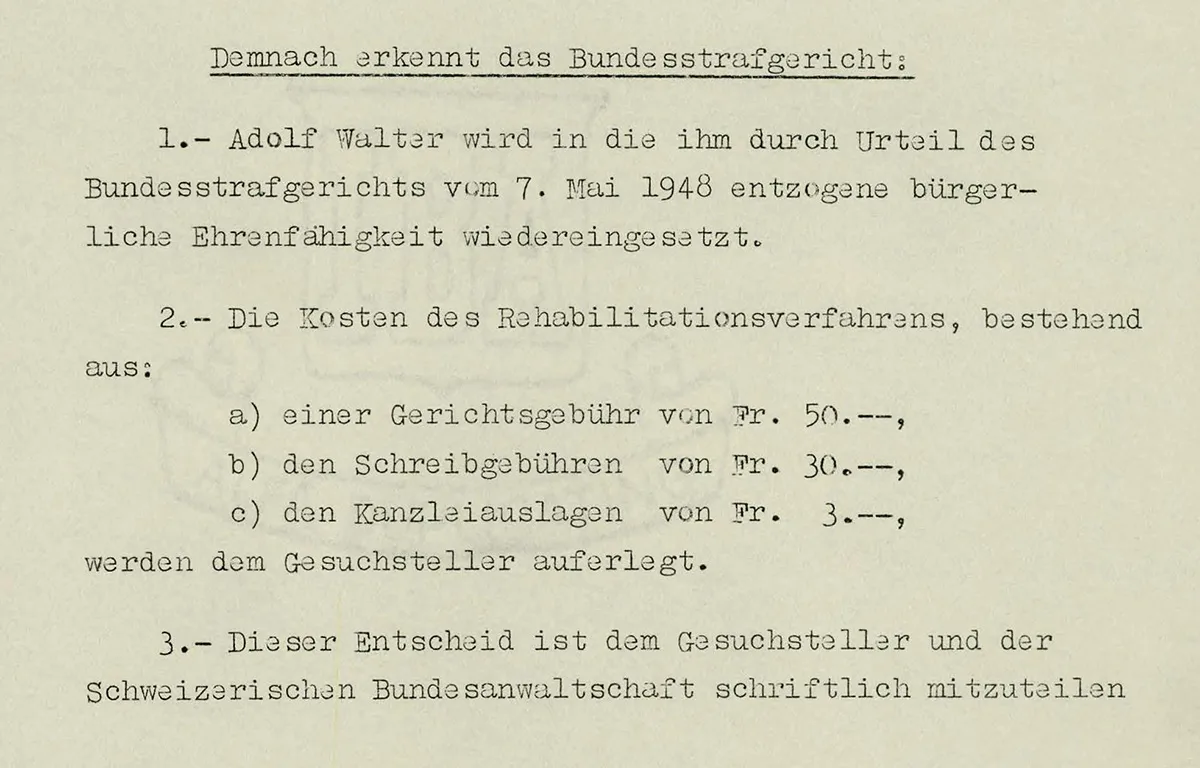
The Federal Criminal Court restored Adolf Walter’s civic rights in 1953.
The Federal Criminal Court restored Adolf Walter’s civic rights in 1953. Swiss Federal Archives
Sports official for a far-right organisation and fugitive from justice, leader of a ‘fighting squadron’, Gestapo suspect and traitor to his country, company boss and FDP member – Adolf Walter’s biography from 1939 to 1953 is testament to an eventful life. Walter’s success as a businessman was no doubt instrumental in smoothing his path following his return, helping to reconcile him with state and society despite his Nazi past and the serious offences he had committed.

His entrepreneurial mindset obviously went hand in hand with a ready ability to adapt to the circumstances in Switzerland and to reembrace the liberal democracy he had rejected and been so hostile towards for many years. The company run by the Walter brothers continued to grow. Adolf Walter died in 1984.
Further posts