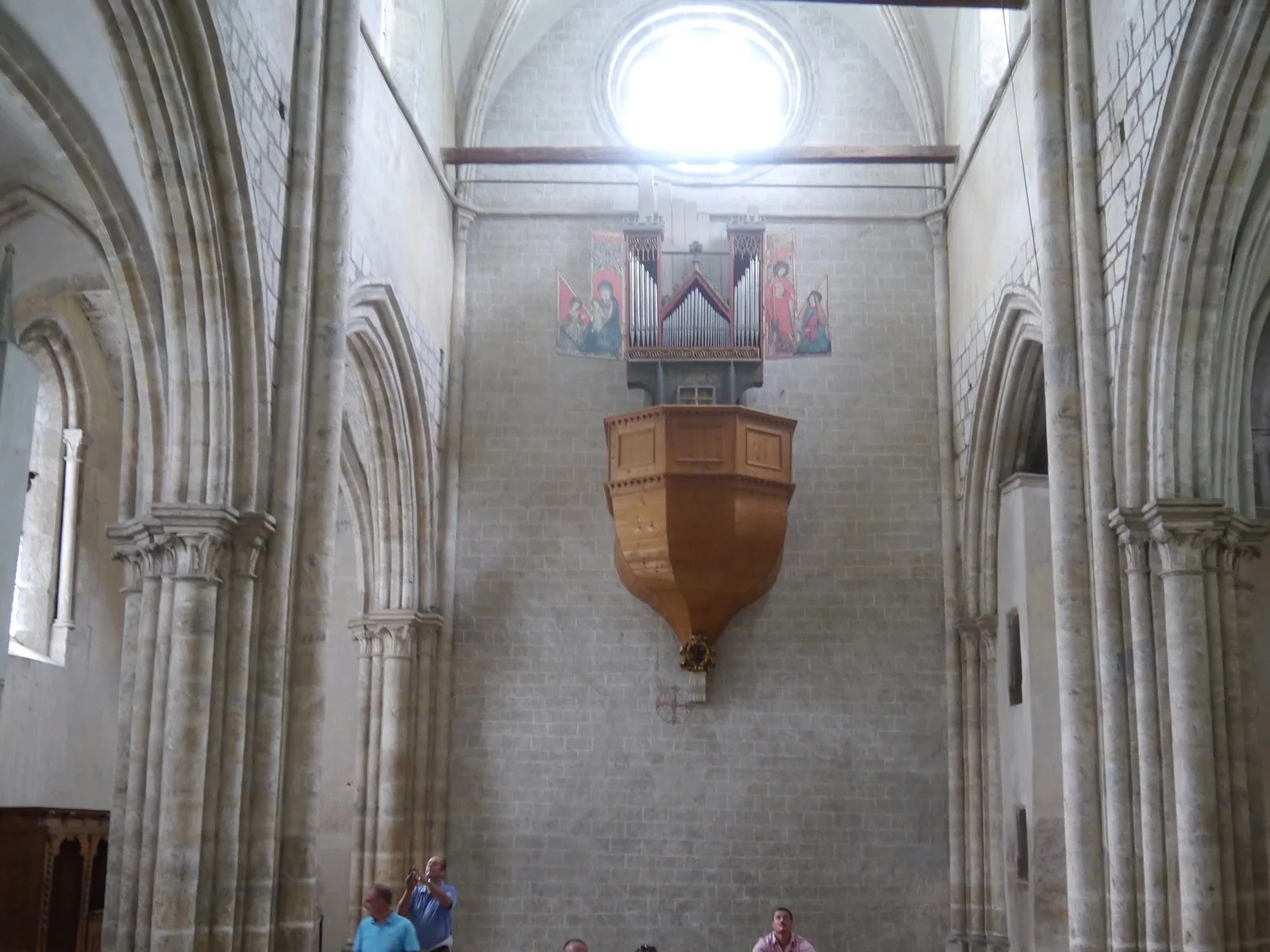
The world’s oldest playable organ 'hangs' on a wall in Sion. Some of its parts date back to the early 15th century. Nonetheless, the Valère organ is still played at concerts.
The world’s oldest playable organ 'hangs' on a wall in Sion. Some of its parts date back to the early 15th century. Nonetheless, the Valère organ is still played at concerts. Wikimedia Commons / Zairon

Switzer​land’s oldest organ through the ages

The swallow’s nest organ high on the west wall of the basilica at Valère castle in Sion is the world’s oldest playable organ and one of the very few, partially at least, preserved instruments from that time. It dates back to about 1435.

Barbara Basting

Barbara Basting

Barbara Basting worked as a cultural editor and currently heads the visual arts division in the City of Zurich’s Culture Department.
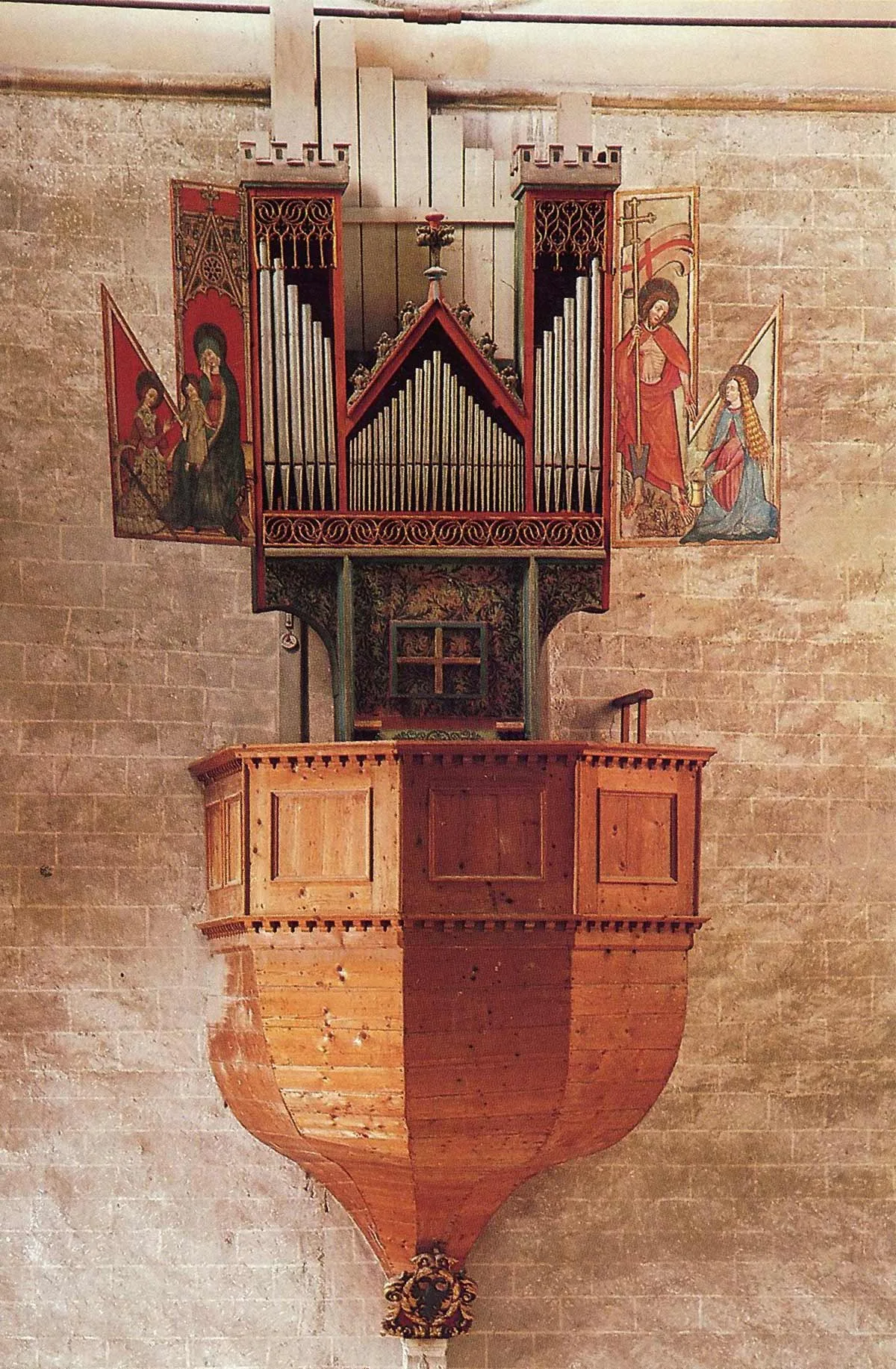
The Valère organ is almost 600 years older than today’s instruments. Organ production has spread far and wide over the intervening centuries. Moreover, organ building technique has evolved in leaps and bounds since then, even if the basic workings of the instrument have remained the same: air flows through pipes when a key is pressed. The sound of the pipes depends on the register used (i.e. the material and design of the pipes made from metal or wood). The Valère organ with its original 135 pipes is a modest instrument compared to the organs in cathedrals and concert halls today, the biggest of which have several thousand pipes.
That is precisely why it is significant in terms of music history. It gives us an idea of how organs sounded in the Middle Ages and early modern era. Organs gradually became established as a sacred instrument in churches during the 15th century. They accompanied the previously predominant singing, even replacing it on occasion. It was a similar instrument to the one in Sion that prompted poet and musician Guillaume de Machaut to describe it for the first time as the “queen of instruments” in 1372. The organ was not a new invention at that time. Monks dedicated themselves to organ building during the Carolingian period from the 9th century after Byzantine Emperor Constantine gifted an organ to King of the Franks Pepin the Short  in 757. This is documented for St. Gallen (writings of Notker the German), Aachen (Palatine Chapel of Charlemagne) or Winchester Cathedral.
The Valère organ of Sion, photographed in 2008.
The Valère organ of Sion, photographed in 2008. Wikimedia
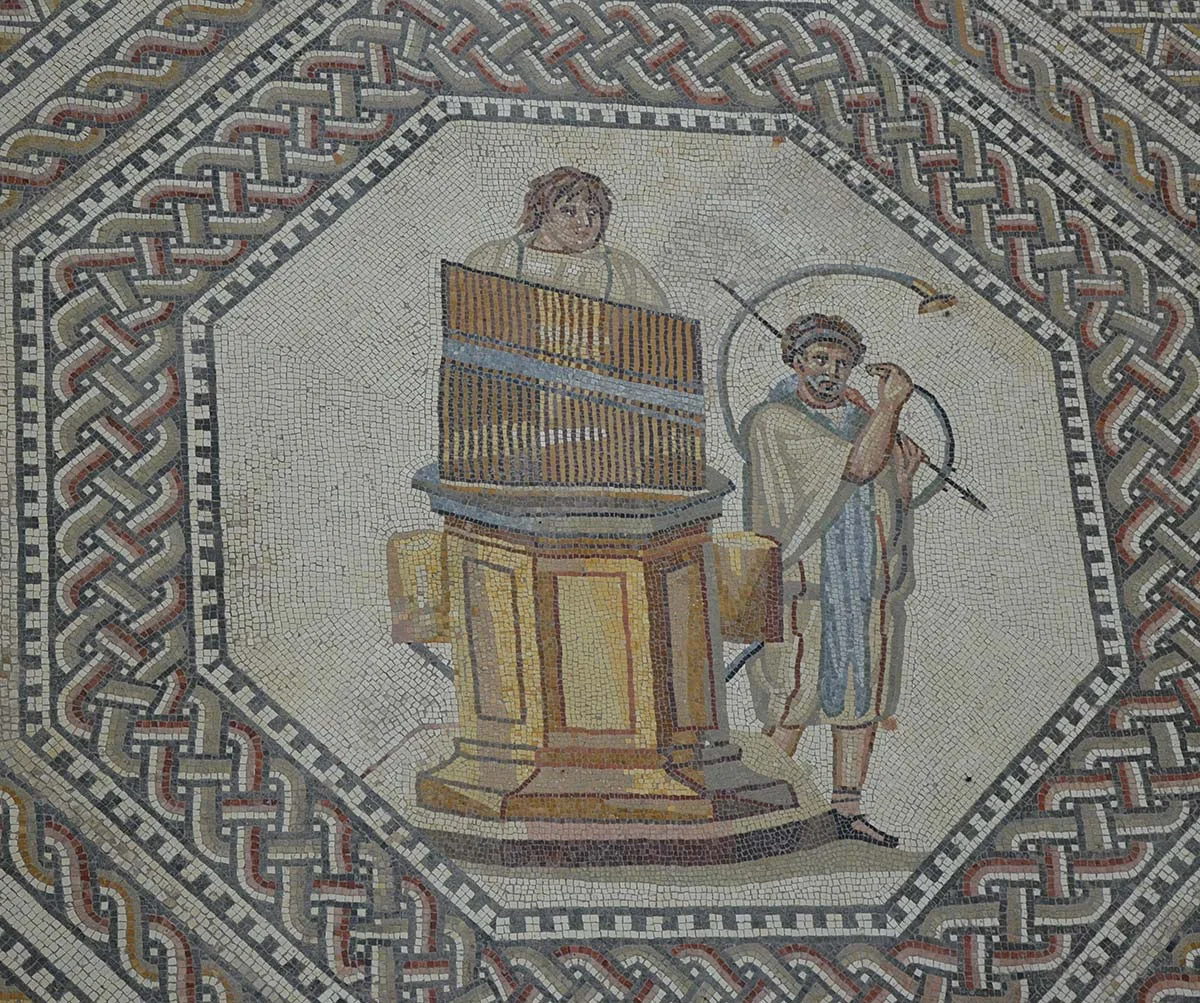
The origins of the organ date back to the third century BCE in Alexandria. Ancient literature contains some accurate descriptions of the organ’s workings. Roman mosaics also contain portrayals of the piped instrument. The first organs were hydraulically powered, i.e. the required wind pressure was created through water. A replica is available for viewing in the Swiss Organ Museum at Roche (Vaud).
These instruments known as hydraulis (water organ) were transportable and featured at festive occasions, music competitions and contests in Roman arenas. Bronze fragments from archaeological excavations in Avenches (Vaud) were identified as connected pieces of a Roman organ in 1996.
Organ music was popular as early as Roman times, as shown by this mosaic from a Roman villa in Nennig.
Organ music was popular as early as Roman times, as shown by this mosaic from a Roman villa in Nennig. Wikimedia / Carole Raddato
A perforated plate, long thought to have been a type of grille, turned out to be part of the base for setting up the pipes on the wind chest, a repository for the pressurised air, which makes the sound emanated by the pipes when a key is pressed. A dedicatory plaque from 228 CE tells us when the organ was made. There are few comparable finds and no instrument from antiquity has been preserved in its entirety. The organ subsequently fell out of favour in late antiquity.

The comeback of the organ in the Middle Ages
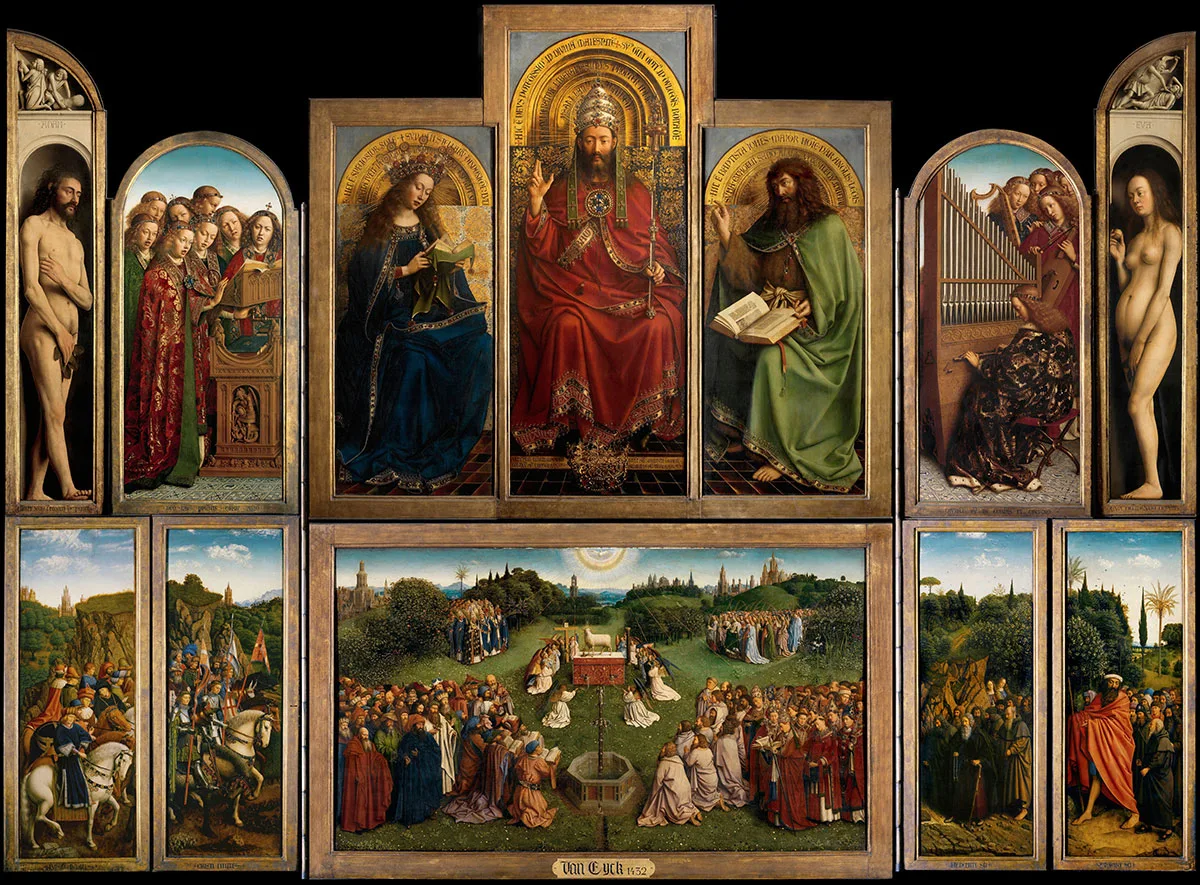
The organ then reappeared in the Middle Ages, although it was no longer hydraulically powered. This can be seen, for example, from all the altarpieces of the time showing organs being carried, known as portative organs. One hand would work the bellows on these instruments and the other hand the keys, which were few in number. Portative organs were played on the altarpieces either by angels or by Saint Cecilia, the patron saint of music. Famous examples of this art, dating from the time of the Valère organ, can be seen on the Ghent Altarpiece by Hubert and Jan van Eyck or on works by Fra Angelico.
Playing of the organ (top right) as an image motif on the Ghent Altarpiece.
Playing of the organ (top right) as an image motif on the Ghent Altarpiece. Wikimedia
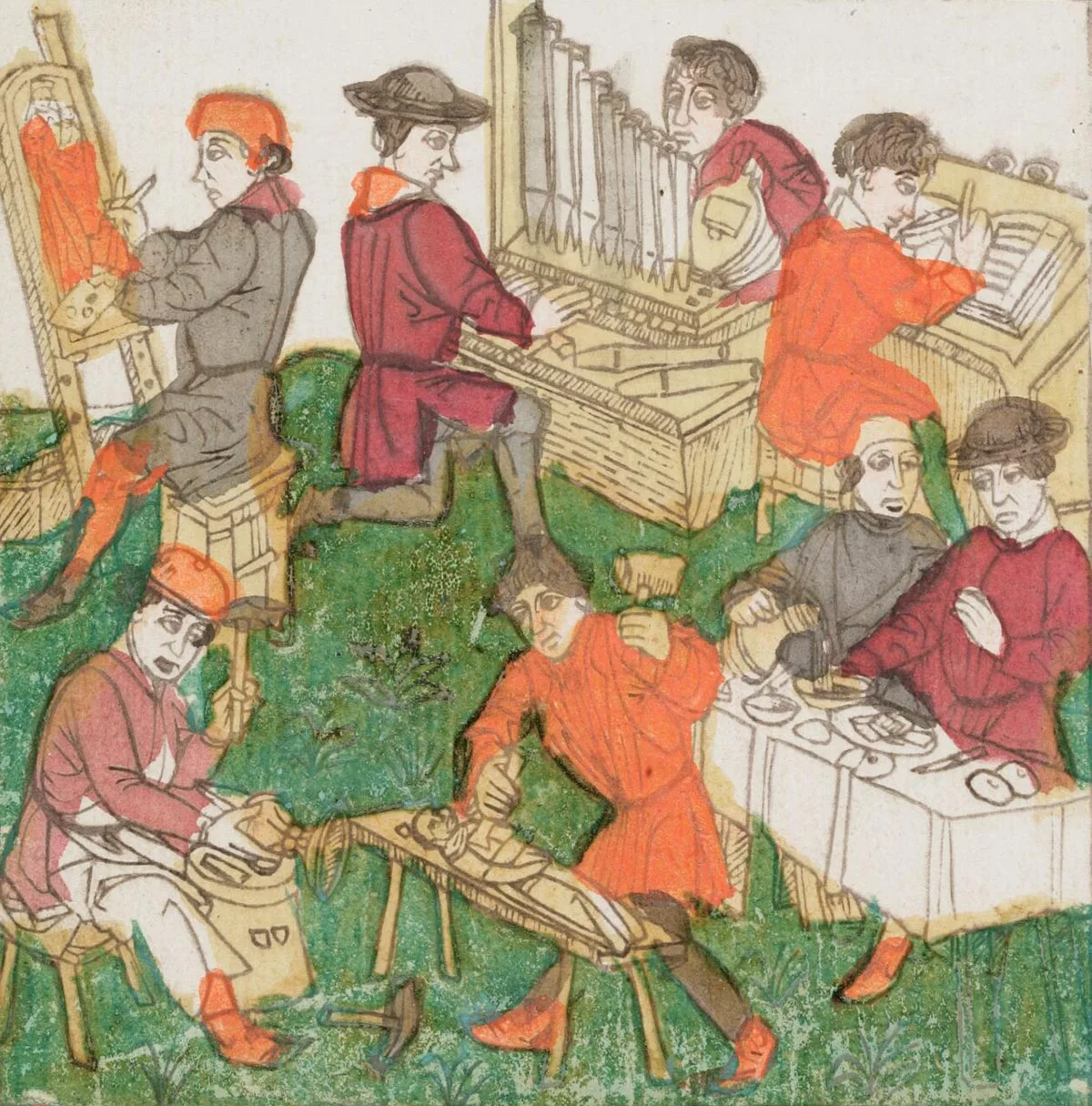
Portrayals of organ builders have also been around since the Late Middle Ages. They are often prominent on woodcuts as children of the planet Mercury. The premodern idea of 'children of the planets' allocated various human activities to the planets. Artistic talents were normally associated with Mercury. Organ building was considered the most complex combination of technical skill and art.
The name of the 'Child of the Planets', or organ builder, who made the oldest parts of the Valère organ, is not known. It is only through the painted organ doors that the instrument can be accurately dated. When closed, the doors show the Annunciation to Mary. When open, the left door shows Saint Catherine and her mystical betrothal to the infant Jesus. The right door depicts the resurrected Jesus appearing to Saint Mary Magdalene.
The organ in a late-medieval depiction by Gall Kemli from St Gallen.
The organ in a late-medieval depiction by Gall Kemli from St Gallen. e-codices
The prominent representation of Saint Catherine indicates that the organ must have been made after 1424. That’s because the Valère basilica was built from ca. 1100 to 1300 and rededicated from the Virgin Mary to Saint Catherine in 1424. According to the surviving records from that period, the painter Peter Maggenberg from Fribourg painted the organ doors around 1437.

Cloth, a lighter altern­at­ive to wood

Organ doors were commonly used to protect the valuable instruments from vermin, mice, rats and bats as well as providing sound insulation. They also served as vehicles for theologically suitable iconography. The Valère door paintings were done on taut, primed fabric and not on wood as was the standard for altars at that time. This reduced the weight of the doors. The doors in the nave of the basilica are replicas. The delicate originals are in the adjoining museum.
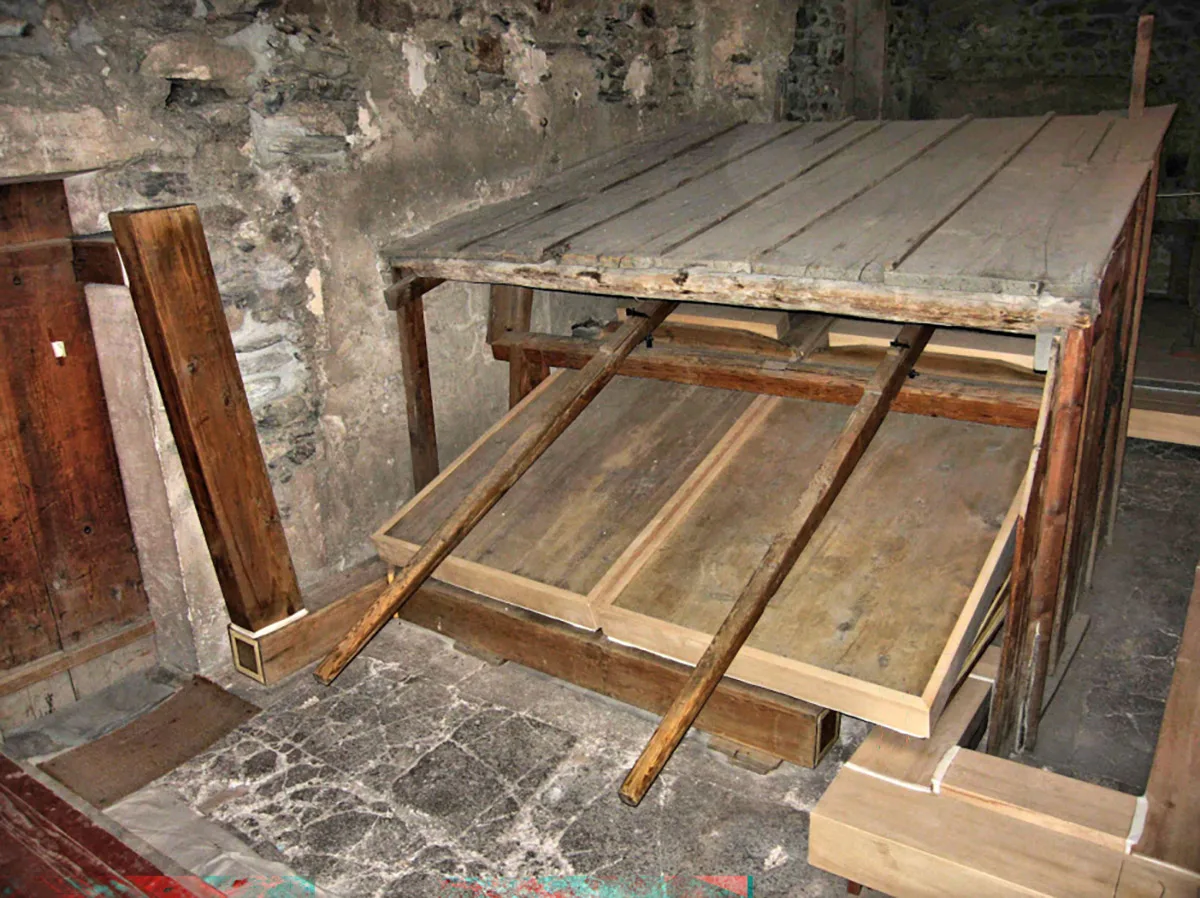
Not immediately apparent to the visitor is the large space behind the wall with the organ. It contains two imposing organ bellows. Before electric organ blowers were invented, these bellows were pumped by hand using large wooden levers operated by helpers known as calcants while the organ was in use. This filled the bellows with air. As the top boards gradually sank, the pressurised air powered the windchest. Big pipes for low sounds need more air than small ones; playing with many registers at the same time also uses a lot of air. That is why organs tended to be small for a long time: they would have run out of puff otherwise.
The bellows are kept behind the organ at Sion. They were used to pump the air into the pipes in the Middle Ages.
The bellows are kept behind the organ at Sion. They were used to pump the air into the pipes in the Middle Ages. Orgelverzeichnis der Schweiz
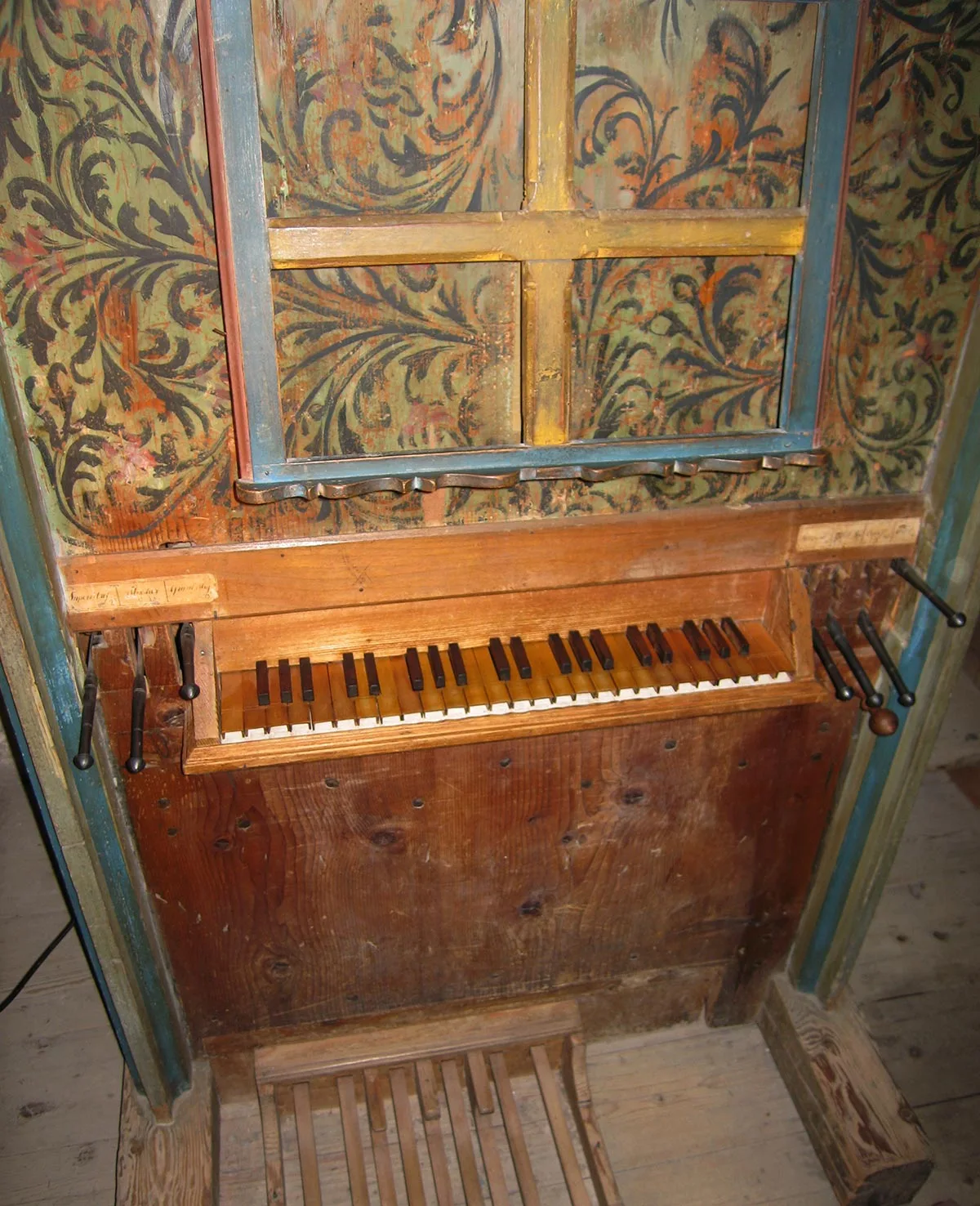
The organ was expanded from its original 135 pipes to approximately 380 pipes in the 17th century. Nonetheless it appears delicate and rather fragile. It has only one manual, which is shorter and smaller than the standard keyboards of today – and therefore takes some getting used to. It is normally played without thumbs.
The Valère organ enables the authentic rendition of music from the Late Middle Ages and Renaissance, for example works by Girolamo Frescobaldi, Jan von Lublin or Jan Pieterszoon Sweelinck. It is less suited to organ music from later periods; not least due to the meantone temperament restored in 2022. This adds a pronounced purity to the basic pitches of the organ’s strong registers, providing an extraordinarily moving audio experience in the unique acoustics of the basilica.
The Valère organ only has 45 instead of the usual 56 keys and they are unusually short. So, it takes practice to play this showpiece.
The Valère organ only has 45 instead of the usual 56 keys and they are unusually short. So, it takes practice to play this showpiece. Orgelverzeichnis der Schweiz
The Valère organ is unique, and not because everything about it dates from 1435 but because it has managed to avoid any major damage despite various additions and changes over such a long period. This is doubtless partly due to the fact that organs were looked after better in the remote, Catholic canton of Valais than in the Reformed cantons, where many instruments failed to survive the Reformation including the swallow’s nest organ in the Zurich Grossmünster (Lutheranism was more accommodating of organ music, mainly because of Bach’s compositions).
After something of a heyday in the Baroque period, many historic organs faced renewed danger in the 19th century. This time it came in the guise of new, romantic sound concepts and sometimes misguided technical experiments. In Sion, ironically, it was the cathedral chapter’s move from the basilica down into the town that spared the Valère organ from ill-advised 'improvements'.
Nonetheless, a small number of pedal keys were added in 1812 as the last tonal addition. The organ fell silent in the 19th century until undergoing an initial, careful renovation in 1954. Insiders knew the instrument as an historical treasure before then.
Its comprehensive restoration under monument-preservation oversight from 2002 to 2004 confirmed that only the organ case with the front metal pipes and organ doors definitely dated back to around 1435.

A patchwork from various epochs

The Valère organ is now a successful patchwork of different eras. It displays its full magic and evokes the roots of Switzerland’s centuries-old organ culture, especially when being played by expert organists at summer concert series. Valais played a key role in the instrument’s fortunes through former organ-building dynasties like Carlen and Walpen.
The Valère organ played by Sietze de Vries in July 2026. YouTube
Today, Swiss organ-building workshops like Kuhn (whose latest masterpiece is the new organ in Tonhalle Zurich) or Mathis (known, for example, for the Sistine Chapel organ in the Vatican) are at the international forefront of their trade. Other established names like Goll, Metzler, Späth or manufacturers specialising in restorations, Füglister for example, can be found on instruments up and down the country. Nonetheless, the cost of maintaining their organs presents a growing challenge to shrinking church parishes. On a more positive note, an organ renaissance is also under way. A new, adventurous generation of musicians is playing popular music, such as film music, jazz, rock or pop on the organ, in addition to the long-forgotten, fascinating historical works.

Further posts