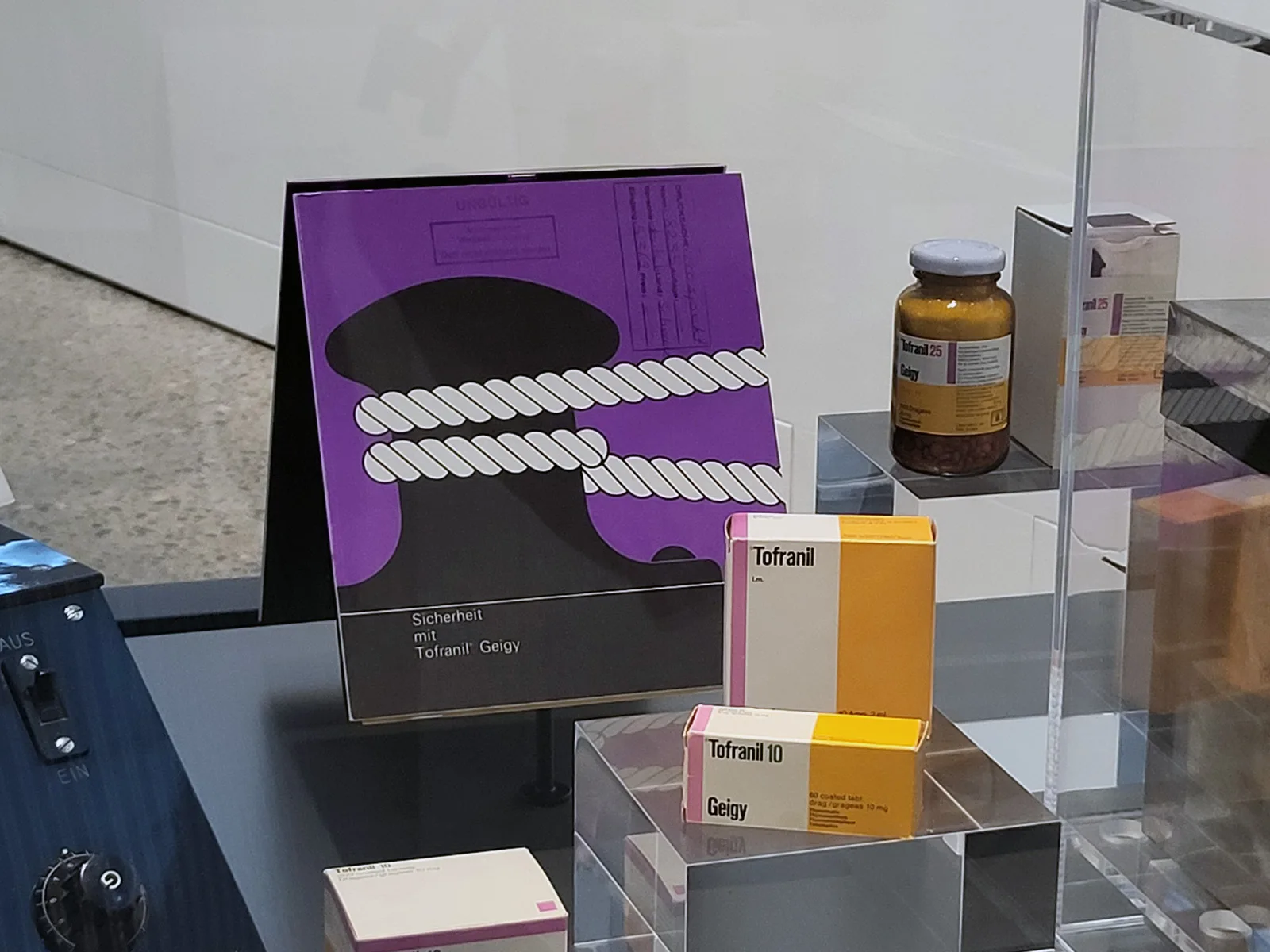
“Sicherheit mit Tofranil” (safety with Tofranil): the advertisement for the drug made by Geigy depicts medicines as safe and effective solutions for mental disorders.
“Sicherheit mit Tofranil” (safety with Tofranil): the advertisement for the drug made by Geigy depicts medicines as safe and effective solutions for mental disorders. Swiss National Museum

Psychotropics – from lab to billboard

From LSD and Largactil to Valium, psychotropic drugs fundamentally changed the treatment of mental disorders in the 1950s and quickly became marketing-driven products. Swiss pharmaceutical companies played a key role in this.

Pascale Meyer

Pascale Meyer

Historian and former curator at the Swiss national museum

In 2023, Swiss pharma company Idorsia launched a sleeping pill which Hollywood star Jennifer Aniston (herself an insomniac) promoted in a video. Advertising prescription drugs and medicines with psychoactive substances such as psychotropics is permitted in the United States, but not in Switzerland. The psychotropics market in particular was once highly competitive, and Swiss pharma companies were instrumental in it.

Drugs rather than electroshocks

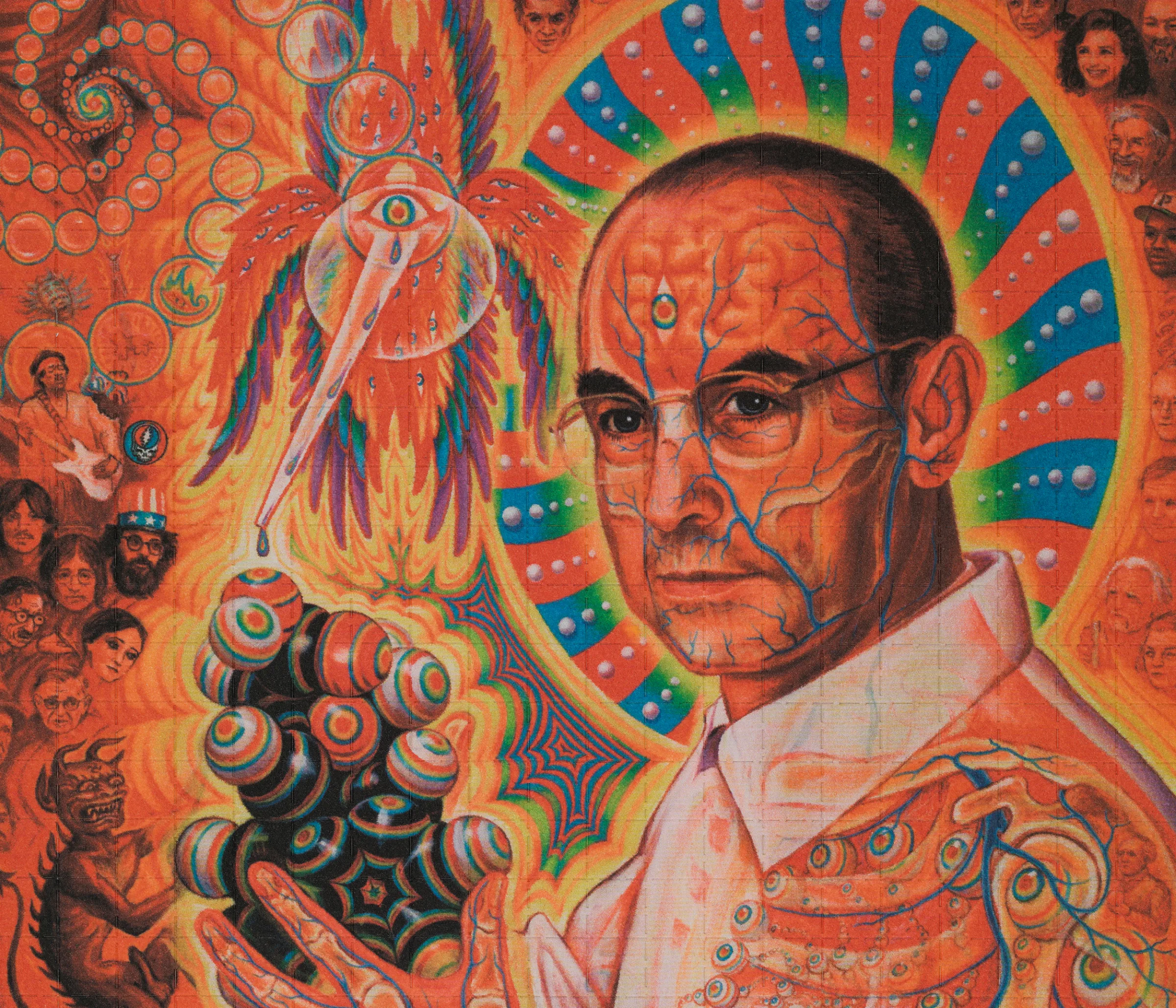
The birth of modern psychotropics dates back just over 70 years. It was preceded by the discovery in 1943 of the psychoactive substance LSD by Albert Hofmann (who was working at Sandoz), and which was then therapeutically tested at the Burghölzli psychiatric clinic in Zurich from 1947. Timothy Leary, an American psychologist and guru of the hippy movement, popularised the idea that hallucinogenic substances such as LSD and Psilocybin could help people tap into their ‘more authentic selves’.
LSD blotter with Albert Hofmann
Albert Hofmann on an LSD blotter. Daniel Allemann, Pharmazeutischer Dienst Bern
But the rise of LSD – the hippy movement’s favourite drug – ended abruptly when it was initially withdrawn from sale in the United States in 1966 and in Switzerland two years later. In parallel, however, research was in full swing in the pharmaceutical labs as the possibility of synthesising new substances unleashed a huge wave of development. Initially, neuroleptics – drugs with a sedative and antipsychotic effect – were used in clinics. Rhône-Poulenc, a French pharmaceutical firm, developed a medicinal substance – Chlorpromazin – which went down in history as the cornerstone of modern psychotropic drug therapy. First used as an anaesthetic, it found its way into psychiatry for the treatment of schizophrenia. Under the brand name ‘Largactil’, it was launched on the Swiss market in 1953 and led to what researchers now call a ‘pharmacological turning point’. The introduction of neuroleptics replaced electro-shock and insulin-shock therapies, which had been carried out in nearly all clinics. This in turn led to a significant decline in patient numbers in clinics, and opened up new therapeutic pathways – beyond in-patient stays, with outpatient practices and clinics becoming available to patients. Nevertheless, criticism was levelled early on at the diverse and severe side effects, and at the notion of revolving-door psychiatry, whereby patients kept returning to clinics as their symptoms would come back if they failed to take their drugs properly or as soon as they stopped taking them.
Before the introduction of neuroleptics, electric shock therapy was used in clinics. Clip from the documentary film ‘Invistas en la psichiatria dal Grischun – part 1: sumbrivas dal passà’. RTR Cuntrasts

Studies conducted without patients’ knowledge
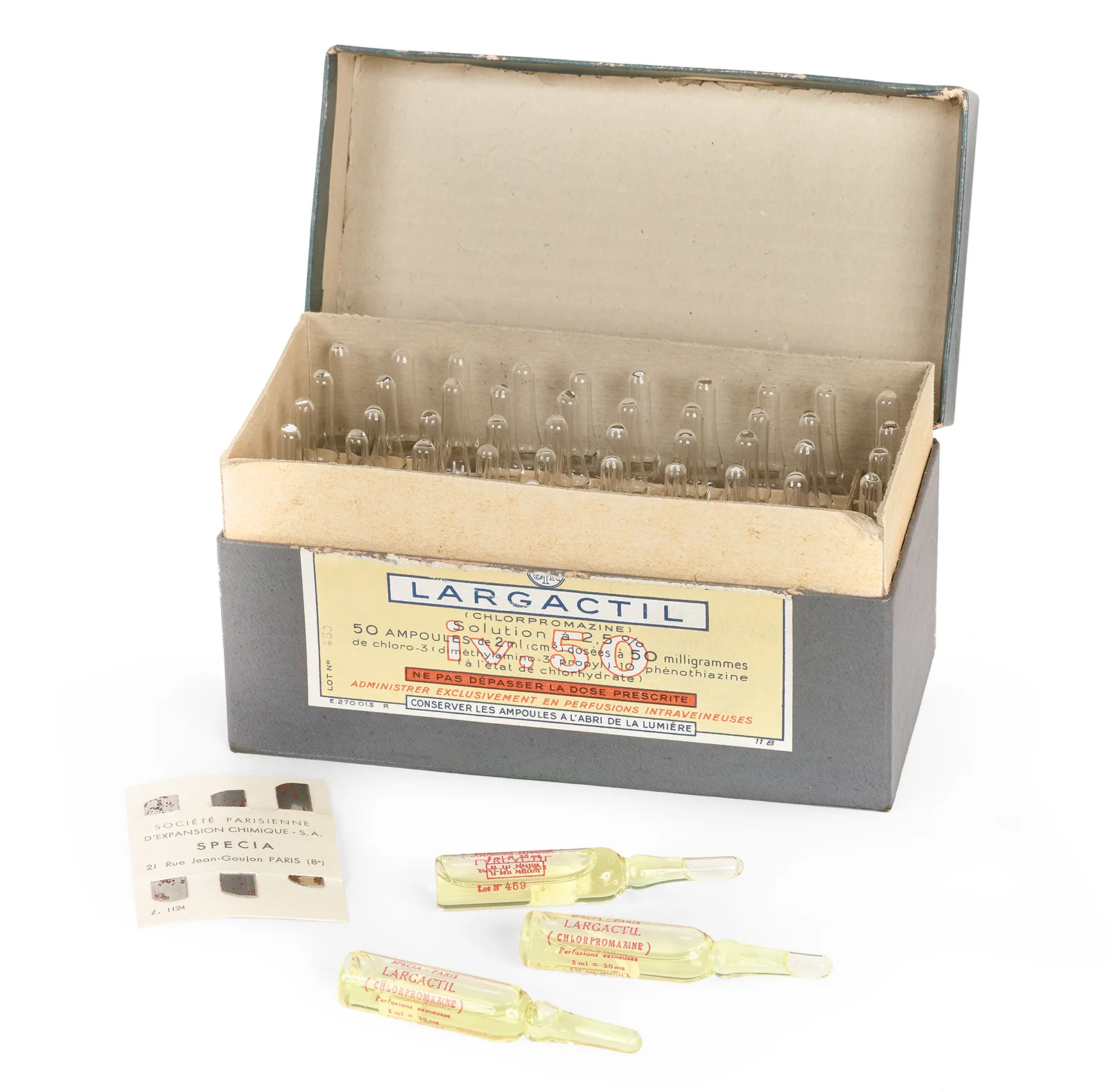
Another criticism only came to light about 60 years later. The Tages-Anzeiger newspaper reported in 2012 that the director of the psychiatric clinic in Münsterlingen, Roland Kuhn, had carried out psychotropic drug trials and patient studies in the 1950s and 1960s – without the knowledge or consent of patients. The tests on patients were paid for by Geigy AG (which became Ciba-Geigy in 1970 and Novartis in 1997), which had a number of its substances tested in this way. The recipient of the payment was Roland Kuhn.
A pack of Largactil, the first neuroleptic, 1950s.
A pack of Largactil, the first neuroleptic, 1950s. Historisches Museum Basel, Natascha Jansen
The success of the first neuroleptic Largactil prompted Basel’s chemicals firms to step up their efforts in this research field. This was soon followed by antidepressants such as Tofranil (imipramine) from Geigy, which was granted marketing approval in 1958. Tofranil was initially tested as an antihistamine (to relieve allergy symptoms), and later as a neuroleptic – by the very same clinic director, Roland Kuhn. The drug was not suited to either of these purposes, but instead took off as the first antidepressant.
‘Schweiz Aktuell’ of 23 September 2019 on drug trials in Münsterlingen. SRF

Valium for housewives

Roche’s triumph was followed by Librium, which was later replaced by Valium. This was a benzodiazepine – a group of drugs that have an anxiety-reducing, sedative and muscle relaxant effect. Valium, which was launched in 1963, immediately became a best-seller, at least in the United States, where it also found its way into music history in the song ‘Mother’s Little Helper’ by the Rolling Stones. The track, released in 1966, referred to the situation of suburban American housewives in the 1960s, supposedly spending their days alone and bored: “Mother needs something today to calm her down. And though she is not really ill, there’s a little yellow pill…”. At the time, Valium was a staple found in nearly every medicine cabinet, alongside painkillers and plasters to treat wounds. Family doctors would readily prescribe it to treat severe and minor deteriorations of mood – addiction and dependency were not (yet) known about at the time. Roche benefited, and in 1969 the company generated 36 per cent of its sales from benzodiazepines.
In ‘Mother’s little helper’ released in 1966, the Rolling Stones sang about Valium use. YouTube/Vevo

Growing marketing budgets

As sales surged, so too did marketing budgets as the psychotropic drugs had to be advertised to potential customers. In the United States, this was less of a problem, as heavily-funded marketing strategies for tranquillisers and antidepressants were implemented, and strong advertising messages sent out in order to tap into the practically endless market. In Switzerland, however, advertising was more difficult as there had been a ban on advertising for prescription drugs since the 1950s. Advertising messages could ‘only’ be directed at healthcare professionals, which led to elaborately-crafted advertising brochures, flyers and adverts flooding into the letterboxes of doctors and pharmaceutical representatives. The advertising messages were aimed at stressed executives and supposedly bored suburban housewives. Then came a new target customer: the ‘overwhelmed working woman’, who had recently decided to pursue an independent career: “Fashion designer, born in 1919. Experienced first symptoms in the form of generalised anxiety in 1953, increasing headaches, weariness, feverishness”, so read a fold-out brochure that Insidon (Geigy) used to advertise a so-called tricyclic antidepressant in 1963. The illustrations were created by Alain Le Foll, a popular French illustrator at the time, who was commissioned to do work for Geigy in the 1960s.
Geigy advertisement for the antidepressant Insidon, designed by Alain Le Foll, 1963.
Geigy advertisement for the antidepressant Insidon, designed by Alain Le Foll, 1963. Museum für Gestaltung
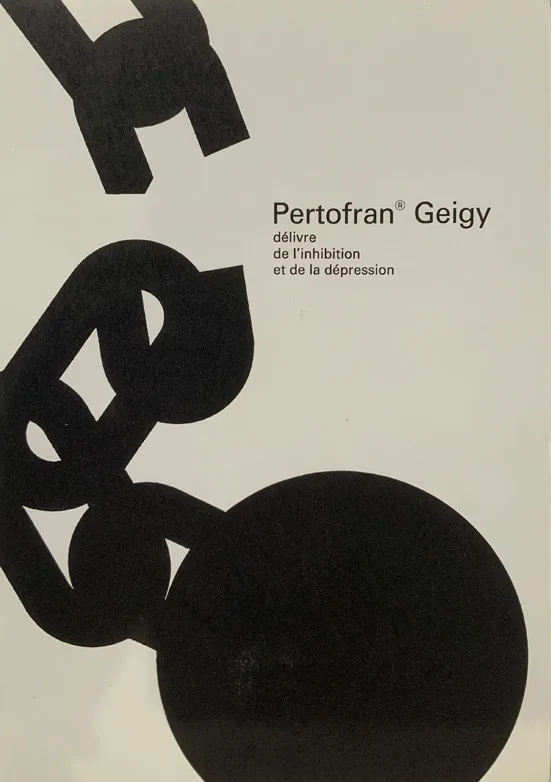
Or the advert for ‘Pertofran’: “…freed from inhibition and depression”, as Geigy advertised in 1962: a ball and chain, designed by Max Schmid – Geigy AG’s art director, drives the point home. At the time, Geigy was able to afford a big graphic design department (it even had its own house style), and Schmid managed to attract 30 talented young designers to the company. However, when Geigy merged with Ciba in 1970, Max Schmid left the firm.
Freedom from the chains of depression. Advert for Pertofran from Geigy AG, 1962.
Freedom from the chains of depression. Advert for Pertofran from Geigy AG, 1962. Novartis company archives
As early as the 1960s and 1970s, something was becoming evident that is blindingly obvious today and that stock market correspondent Jens Korte pointed out on Swiss television in 2022: the pharmaceutical industry has to spend more on marketing than on research. It seems that without huge marketing efforts, it would no longer be possible to sell psychotropics. And this despite the fact that psychotropics are the most commonly prescribed drugs, and according to the statistics platform Statista, account for almost CHF 300 million per year in Switzerland alone.
Yet Idorsia – the Swiss company with Jennifer Aniston as brand ambassador – faced this very problem when it wanted to place a new sleeping pill on the market. The launch of the sleeping pill cost huge sums, according to the newspaper NZZ am Sonntag of 11 June 2023. This led to the company’s share price plummeting, and 500 jobs being cut. What can Jennifer Aniston do about that?

Further posts