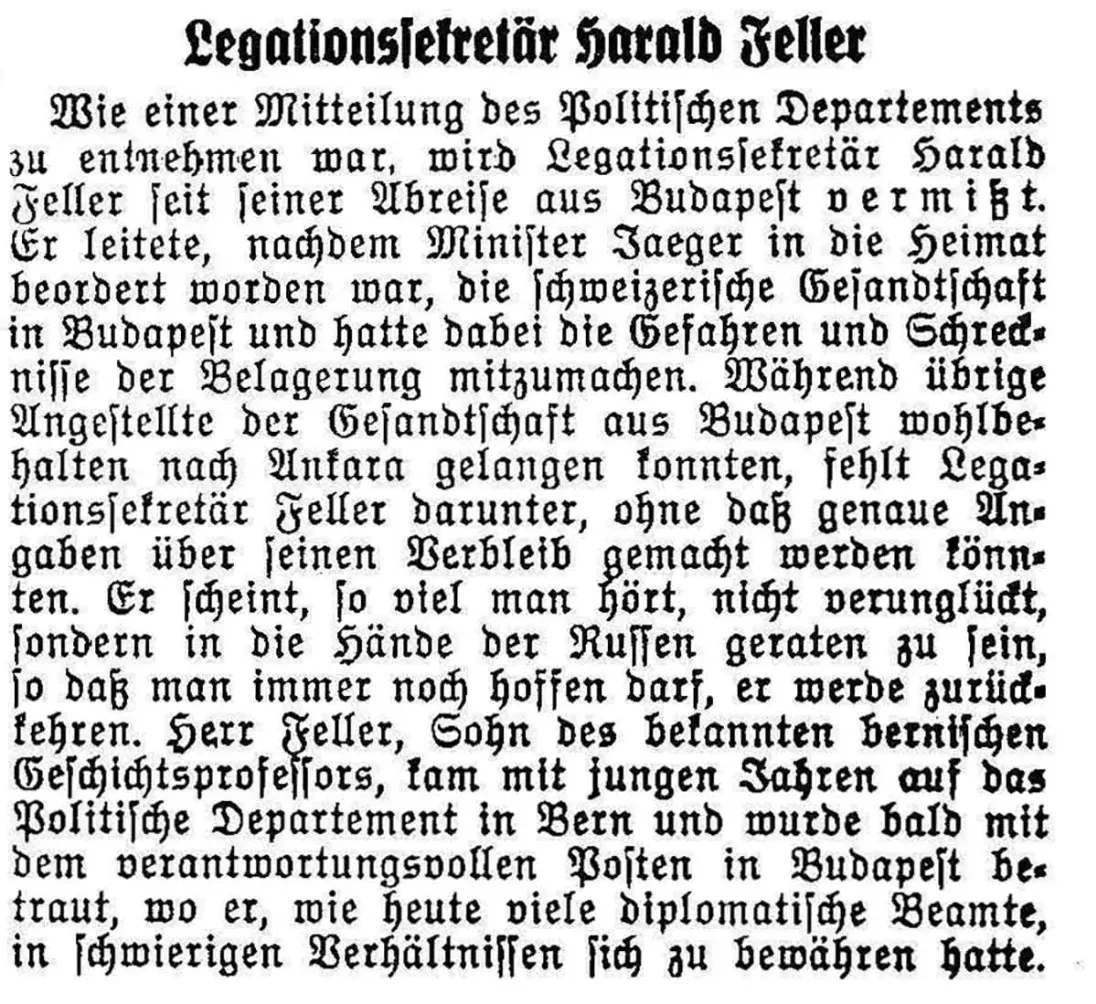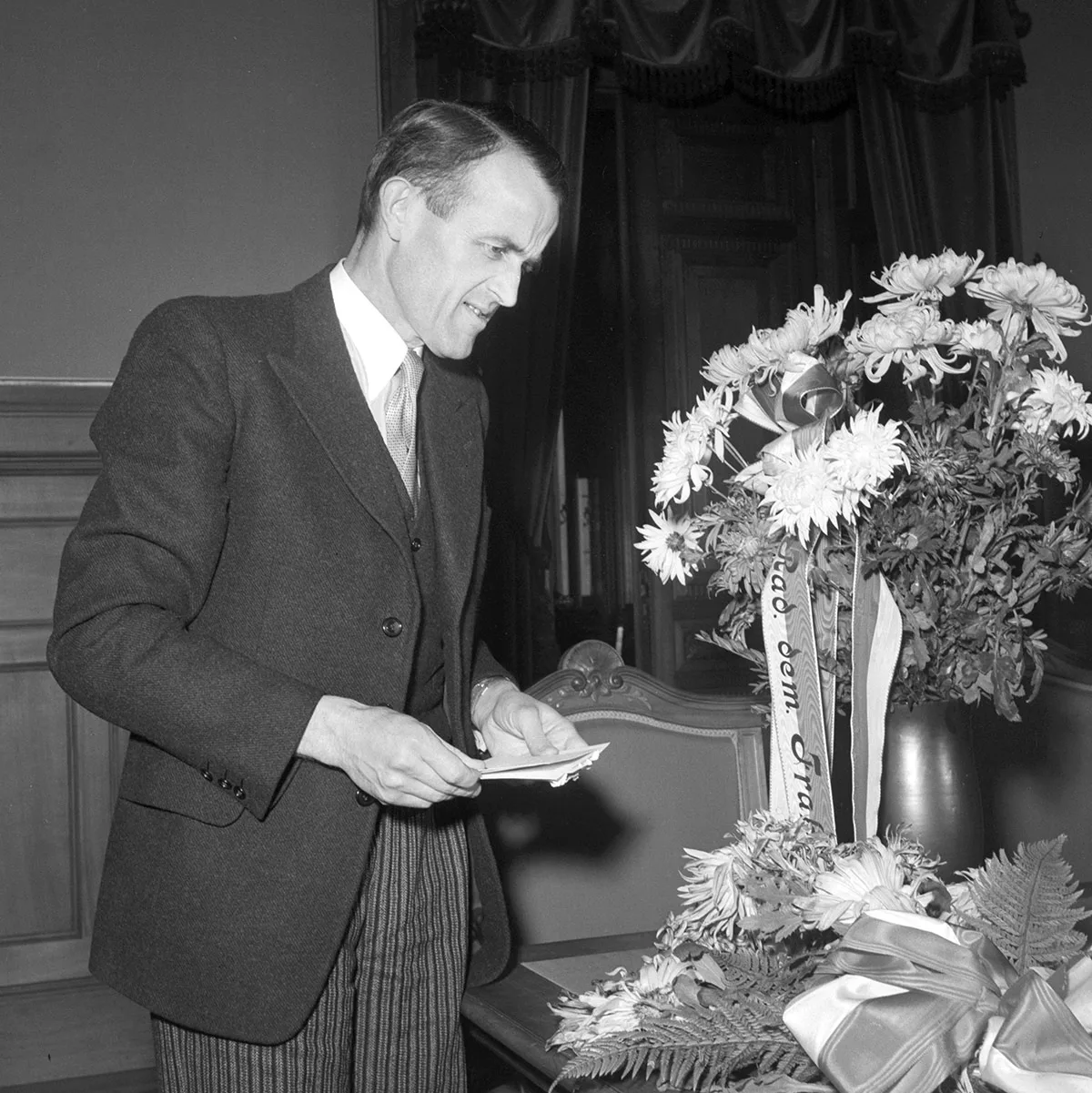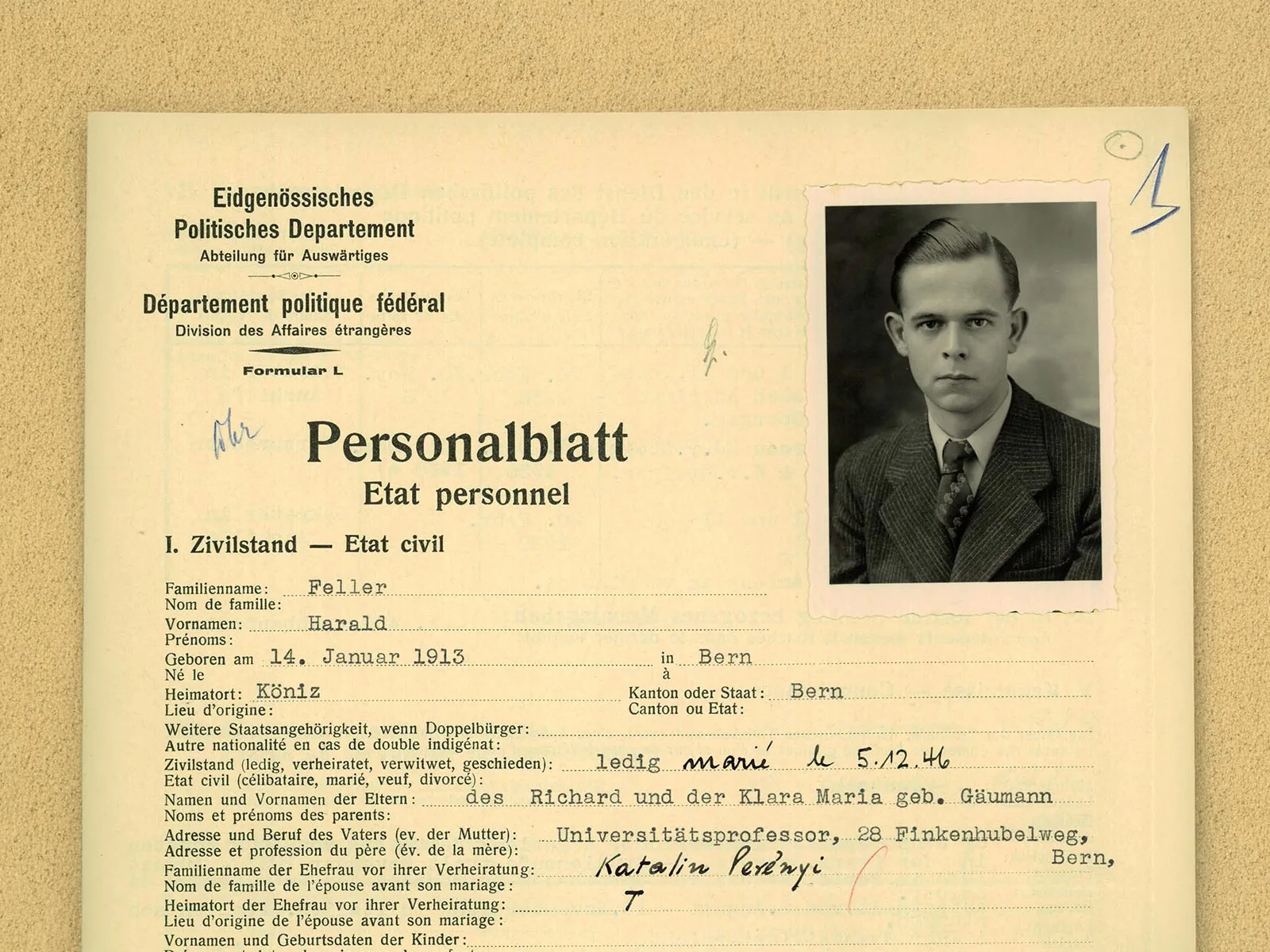
Harald Feller joined the diplomatic service in 1939. In 1943, he was transferred to Budapest, where he was kidnapped by the Soviets in February 1945.
Harald Feller joined the diplomatic service in 1939. In 1943, he was transferred to Budapest, where he was kidnapped by the Soviets in February 1945. Swiss Federal Archives

A Swiss diplomat in Stalin’s jail

Harald Feller was kidnapped by the Soviets in Budapest in 1945. While he languished in Stalin's prisons for a year, Swiss authorities placed him under investigation. After his return, Feller was cleared of all charges. But nobody was interested anymore.

François Wisard

François Wisard

François Wisard is a historian and holds a PhD from the University of Lausanne. He has written several non-fiction books, including one about a Swiss volunteer in the Waffen-SS.
Budapest, 12 February 1945: after weeks of brutal fighting that had claimed around 160,000 lives, the Hungarian capital was liberated by the Red Army. Amidst the ruins of Palais Esterházy in Buda (west of the Danube), the Swiss and Swedish flags were raised. This was a surprising sight at the end of the German occupation: the Swiss embassy had opened a chancellery there, while the premises of the Swedish embassy were located further to the south.
Thirty-two-year-old Bernese diplomat Harald Feller (1913–2003), who had only been in charge of the Swiss embassy for two months, was relieved. Firstly because the 50 or so people who had sought refuge in the Palais Esterházy were fit and well. Also because Swedish ambassador Carl Danielsson was alive, as Feller had granted asylum and fake passports to Danielsson and some of his team after the Swedes had had to leave their embassy when it became the target of an attack by the Nyilas (Hungarian Arrow Cross Party). This pro-Nazi Hungarian party, which had been in power since the military coup of October 1944, spread terror on the streets with its gangs. They shot thousands of Jews and threw their bodies into the Danube.
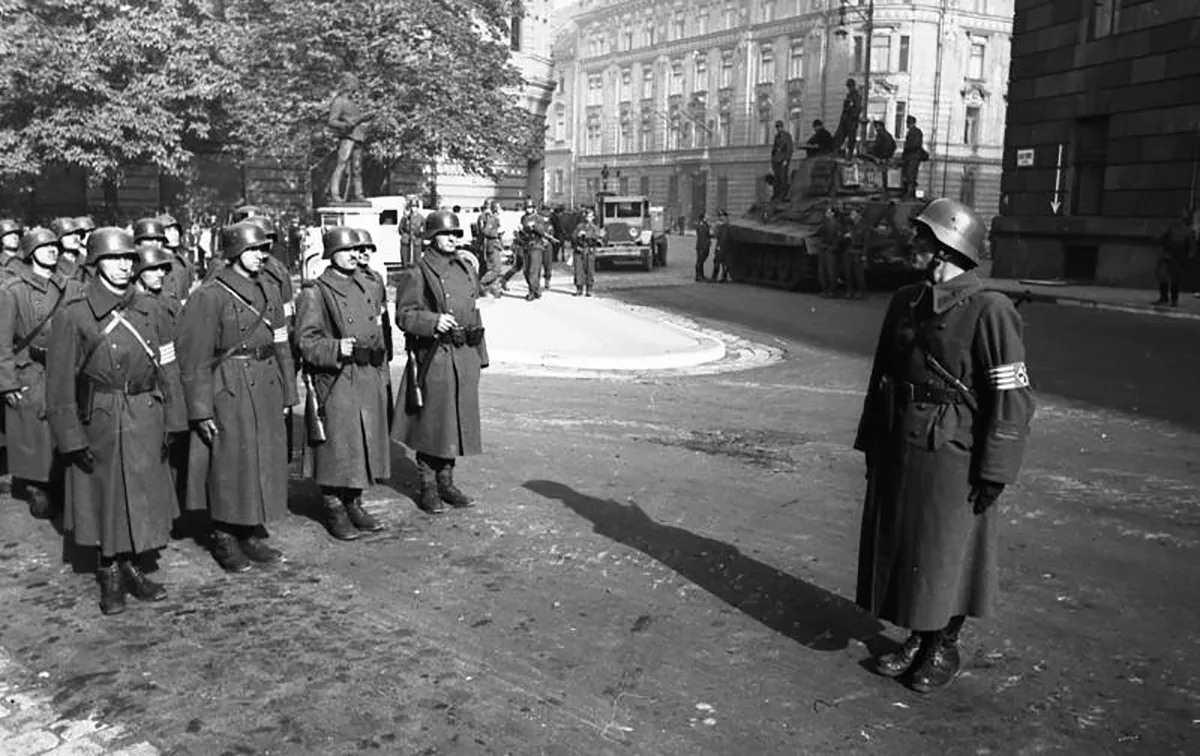
The Hungarian Arrow Cross Party spread fear and terror in Budapest. Photo taken in October 1944.
The Hungarian Arrow Cross Party spread fear and terror in Budapest. Photo taken in October 1944. Wikimedia / German Federal Archives
Another reason why Feller was relieved in February 1945 was because the Jews whom he had hidden and cared for at his residence in Buda, unbeknownst to his colleagues, were now safe. And, if nothing else, he also breathed a sigh of relief because in late December 1944 he too had fallen victim to the Nyilas: abducted, severely physically abused and threatened with death, he was very lucky to have survived.

The Swiss Embassy in Budapest, 1944

The Swiss Embassy (at the time a legation headed by a minister plenipotentiary) had three diplomats and several dozen consular officials, secretaries, interpreters and other staff, both Swiss and Hungarian. It was – and still is – located on Stefánia ut, east of the Danube.

The chancellery that was opened in Palais Esterházy in Buda, west of the Danube in November 1944, had a large air raid shelter. While Harald Feller stayed there, Max Meier – who was responsible for issuing visas – took over as the de facto manager of the building on Stefánia ut.

The important Department of Foreign Interests, headed by Carl Lutz, was set up in the building of the former US embassy in Pest, while Lutz himself resided in Buda. Ambassador Maximilian Jaeger was recalled following the Arrow Cross Party putsch, while his deputy had to return to Switzerland on health grounds. This left Feller in charge of the embassy from early December 1944.
On 16 February 1945, representatives of the neutral states and the ICRC met with a representative of the Soviet military authorities in Buda. Harald Feller and Carl Lutz attended on behalf of Switzerland. After the meeting, an officer ordered Feller to accompany him to Pest: “Mr Feller, you must come with me.” Feller hesitated but had no choice. Before Lutz’s very eyes, he walked away, crossed the Danube in a boat and disappeared.

Soviet interrogations in Budapest and Moscow
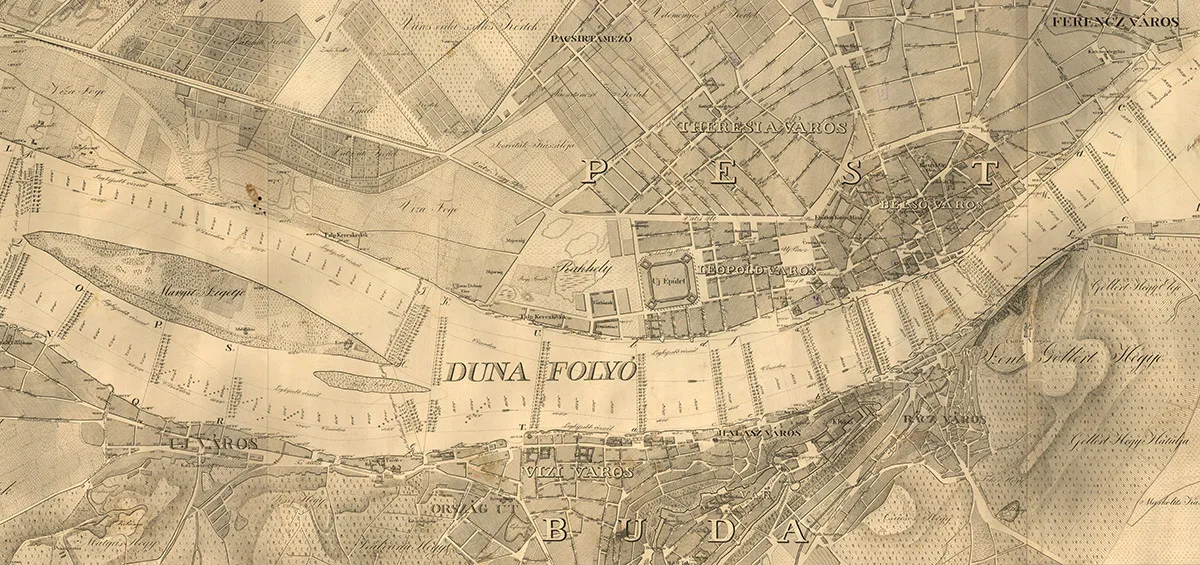
In Pest, the abductee was interrogated by Soviet agents from the secret services: why had the Swiss ambassador and his deputy left the country? Why did he stay in Budapest? A few days later, he was taken to eastern Hungary, where he met his colleague Max Meier. The consular official had been abducted on 10 February in similar circumstances, although Feller had known nothing about it.
Map from 1833. The locations of Buda (bottom) and Pest, which merged in 1873 to form Budapest, are clearly recognisable.
Map from 1833. The locations of Buda (bottom) and Pest, which merged in 1873 to form Budapest, are clearly recognisable. Wikimedia
The two Swiss men were taken by lorry and train to Moscow, where they arrived on 4 March and were interrogated again. First, they were taken to Lubyanka (the headquarters of the KGB), and the next day to Lefortovo Prison, also in Moscow. They felt they were well treated but had to share a tiny cell (4.5 by 2.5 metres) and lived in complete isolation. And they knew nothing of the presence of another inmate, Swede Raoul Wallenberg. But more than anything, they didn’t know why they had been abducted and whether they would ever see their families again.
There had been no communication between Budapest and Switzerland since Christmas 1944. The first reliable news about the abductions reached Bern via Bucharest in late March 1945. At that point, Switzerland did not maintain any diplomatic ties with Moscow. Bern therefore contacted the American and British diplomats to find out more. Unfortunately without much success. Nevertheless, the Soviets did confirm that they were holding Feller and Meier.
Article from the newspaper Der Bund dated 20 April 1945.
Article from the newspaper Der Bund dated 20 April 1945. e-newspaperarchives

Tough negotiations in Bern

In July 1945, the Kremlin sent a military delegation to Switzerland. Its task was to investigate the fate of thousands of military internees in Switzerland and subsequently to organise their repatriation. Meanwhile, Moscow blocked several thousand Swiss expatriates from returning home in areas that were under Soviet military control.
In September, progress on the mutual repatriation was satisfactory, so the second phase of negotiations began, which was to be conducted in secret from beginning to end. Switzerland demanded the release of Feller and Meier and information on the fate of other consular officials who were being held in northern Poland and in the Far East. The Soviets replied: “Return Novikov and Kochetov to us!” Vladimir Novikov was an engineer specialising in the manufacture of new weapons, who had fled Italy to Switzerland. Meanwhile, Gennady Kochetov had landed his Soviet military aircraft at the airfield in Dübendorf. On 3 December 1945, the Federal Council discussed the situation. “If we can save the two Swiss citizens by sacrificing the two Russians, that is something I would be prepared to do,” said Max Petitpierre. However, the new foreign minister was alone in this view. His colleagues failed to support him, and two of them – Philipp Etter and Walther Stampfli – even expressly argued against handing over Novikov, saying there was no legal basis on which to do so.
Max Petitpierre following his election to the Federal Council on 14 December 1944.
Max Petitpierre following his election to the Federal Council on 14 December 1944. Swiss National Museum / ASL
The Federal Council convened for an emergency meeting on 28 December. Moscow had issued an ultimatum: if Switzerland didn’t hand over Novikov and Kochetov, Feller and Meier would not be released. The Swiss government relented. However, the pair only returned via Berlin in early February 1946. The other consular officials who had been held by Moscow but not imprisoned were also repatriated via Berlin.

Investigations under way since May 1945
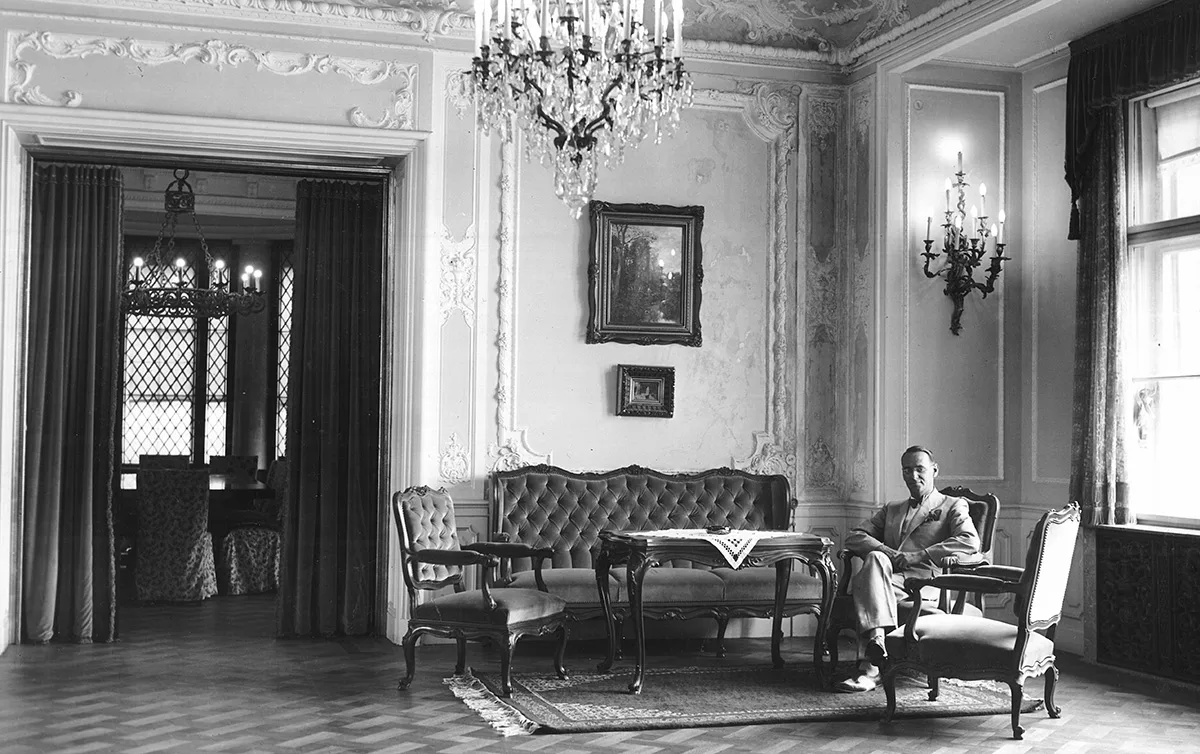
After his return, Harald Feller was shocked to discover that serious allegations had been made against him in public during his imprisonment. He also found himself at the centre of a large-scale investigation that had been launched in his absence. In parallel to the efforts to locate Feller and Meier and bring about their release, Swiss diplomacy also wanted to determine the reason behind the abductions. Former colleagues who had been expelled from Budapest provided answers, or rather criticism. They claimed that Feller had faked protection documents and had maintained very close ties with pro-Nazi groups. They also said that he was homosexual and drank too much. Max Meier, meanwhile, escaped largely without criticism.
TV report on Harald Feller and his eventful life during the Second World War (in German). SRF
As early as May 1945, Federal Councillor Max Petitpierre had ordered the investigation and instructed Judge Jakob Kehrli to look into the circumstances and reasons behind the abductions and to question all Swiss embassy staff. There was a great deal of criticism, although some of the statements were contradictory. Carl Lutz, the only direct witness, described three different versions of Feller’s abduction. He also accused his former superior of having been a “liability”. Judge Kehrli came to the alarming conclusion that many were of the view that Feller had deserved his fate. At this point, nobody knew whether Feller would even return alive.
Even the press got involved. On 14 June 1945, Swiss journalist Bert Wyler, who also contributed to Jewish media outlets, published a damning article in the Swedish newspaper Aftonbladet claiming that Feller had hidden Nazis in his home and had saved them by supplying fake papers. Geneva newspaper La Voix ouvrière went even further on 22 June, saying: “We thereafter took the view that this Mr Zeller [sic] would perhaps have preferred to follow the Germans in their retreat.”
The first investigative report, which was completed in late July 1945, was never published. Max Petitpierre and his department had one clear priority: to ensure the return of Feller and Meier. The negotiations with the Soviet delegation provided a good opportunity for that. This prioritisation was not understood by everyone, least of all by Carl Lutz. Since 1945 he had been complaining that he had not been given a hero’s welcome on his return, and nothing suggested that he was genuinely concerned about the fate of his two former colleagues.
Portrait of Carl Lutz in Budapest, 1943.
Portrait of Carl Lutz in Budapest, 1943. Wikimedia
After Feller had been questioned at length in the spring of 1946, he was finally able to defend himself. The judge subsequently dispelled any suspicion about him, including in relation to his private life. Kehrli merely stated a single breach of the rules: delivery of fake passports to the Swedes. But he went a step further, saying that Harald Feller had not only not collaborated with the enemy, he had saved victims of persecution, namely Jews and Swedes. Jakob Kehrli drew up a list of 32 people saved by Feller. Meanwhile, Max Petitpierre was defending the falsely accused before Parliament. But by then, everyone had lost interest... Up until his retirement, Feller himself remained silent about his extraordinary activities in Budapest and imprisonment in Moscow.
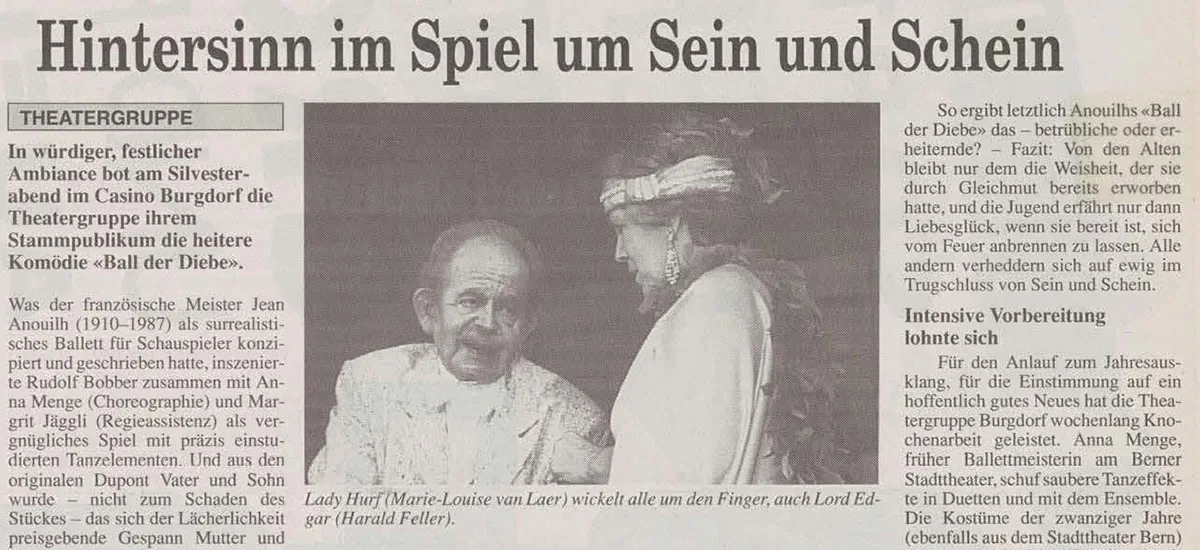
From the 1950s, Harald Feller worked as a public prosecutor in the canton of Bern and made a name for himself on the side as a theatre director and actor. Article from the newspaper Burgdorfer Tagblatt of 4 January 1993.
From the 1950s, Harald Feller worked as a public prosecutor in the canton of Bern and made a name for himself on the side as a theatre director and actor. Article from the newspaper Burgdorfer Tagblatt of 4 January 1993. e-newspaperarchives
What was Feller’s abduction really all about? According to Judge Kehrli, it was nothing to do with his actions or his behaviour. Undoubtedly, people wanted to elicit information from him. After his return, the Swiss diplomat appeared convinced of two things: that the order had come from Moscow, and that it hadn’t been personal. In other words, he had been selected as a bargaining chip.
In 2000, previously unknown Soviet documents were published in Sweden as part of official investigations into the fate of Raoul Wallenberg. There was indeed a written order that had been issued on Stalin’s instruction in January 1945 to capture the Swiss diplomats Harald Feller and Max Meier as well as a Slovak representative in Budapest, and to bring them to Moscow. Prior to that, the order had already been given to arrest Raoul Wallenberg. In both cases, the officials running the operation were agents of the Soviet military counter-intelligence service. We now know that Moscow suspected Wallenberg of espionage.
Might there have been a similar suspicion surrounding the two Swiss nationals? Perhaps. In any case, the abduction of Feller and Meier allowed the Kremlin to successfully demand the extradition of a Soviet engineer specialising in the manufacture of new weapons, and a military pilot. The Federal Council eventually conceded, placing state interests above compliance with the law in order to save officials who had been abducted by agents of a foreign state.

Further posts