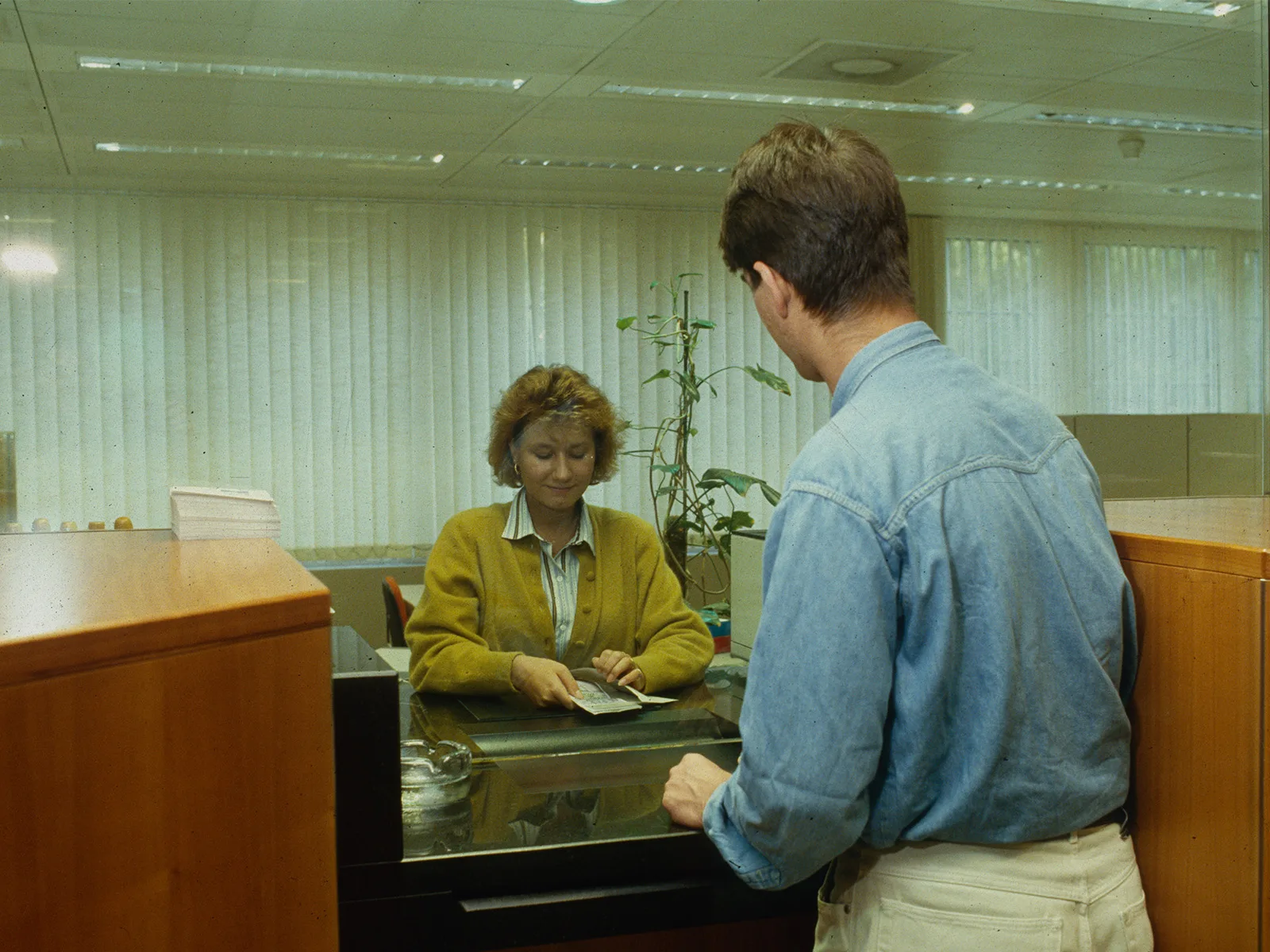
Formerly an established part of everyday life: being served at a bank counter, here at Zürcher Kantonalbank.
Formerly an established part of everyday life: being served at a bank counter, here at Zürcher Kantonalbank. e-pics

Banks in transition: from counters to apps

Today, if we want to transfer money or check our custody account we simply reach for our smartphone. This seemingly straightforward procedure is the product of a lengthy evolution. In just a few decades, the everyday financial activities of the Swiss have moved from the physical to the digital realm: from bank counters to a device kept in our trouser pockets.

Andrea Weidemann

Andrea Weidemann

Andrea Weidemann is the director of the Swiss Finance Museum.
Until a few decades ago a visit to the bank was still commonplace: an established part of everyday life, with a strong focus on personal contact. Banking transactions were tied to a specific location, restricted to opening hours and largely based on trust in the institution. In Switzerland, everyday payments were typically split across two spheres. People’s salaries were paid into their bank account, from which cash was withdrawn at the bank counter. That cash was then used to pay regular household bills at a post office counter.
Today, people hardly ever actually visit a branch in person. Banking services are available 24/7 – anytime, anywhere ‒ and our relationship with our bank has become much more anonymous.
A look back through history shows just how old the tradition of banking is in Switzerland. In the Middle Ages, travelling merchants began lending money before gradually settling down as bankers. Currency exchange offices sprang up in Swiss towns and cities, changing money, extending credit and already assuming some of the tasks that would eventually come to be associated with central banks. The first private banks emerged in the 18th century, and the rise of savings banks, cantonal banks and big banks in the 19th century effectively laid the foundations for the modern-day Swiss financial centre: more than 100 new banks were established in Switzerland between 1895 and 1910.
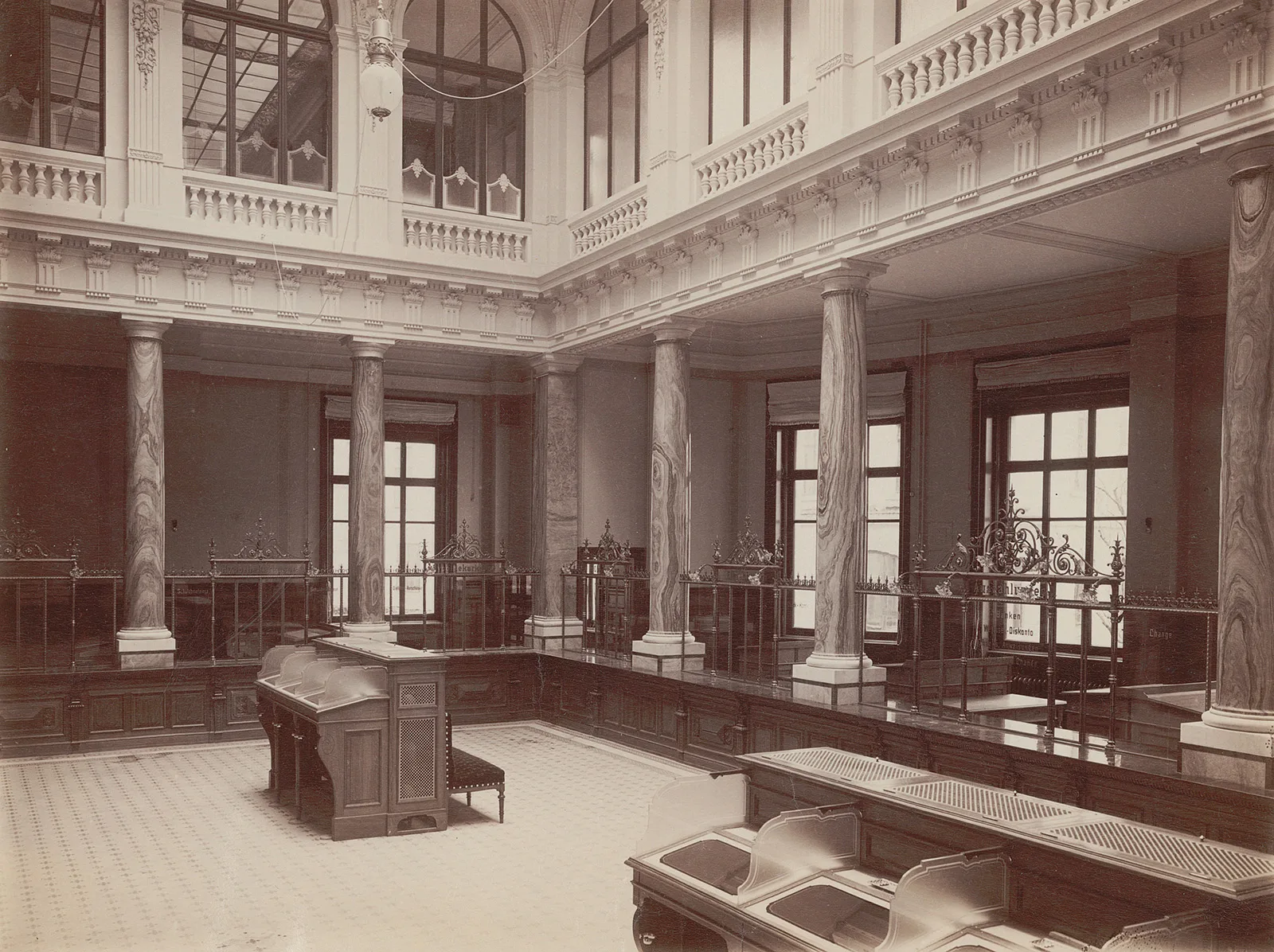
Counter hall at Zürcher Kantonalbank on Zurich’s Bahnhofstrasse, circa 1900. The counters are lined up between the pillars, with writing desks for the bank’s customers in the middle of the floor.
Counter hall at Zürcher Kantonalbank on Zurich’s Bahnhofstrasse, circa 1900. The counters are lined up between the pillars, with writing desks for the bank’s customers in the middle of the floor. Zentralbibliothek Zürich

First steps towards digitalisation

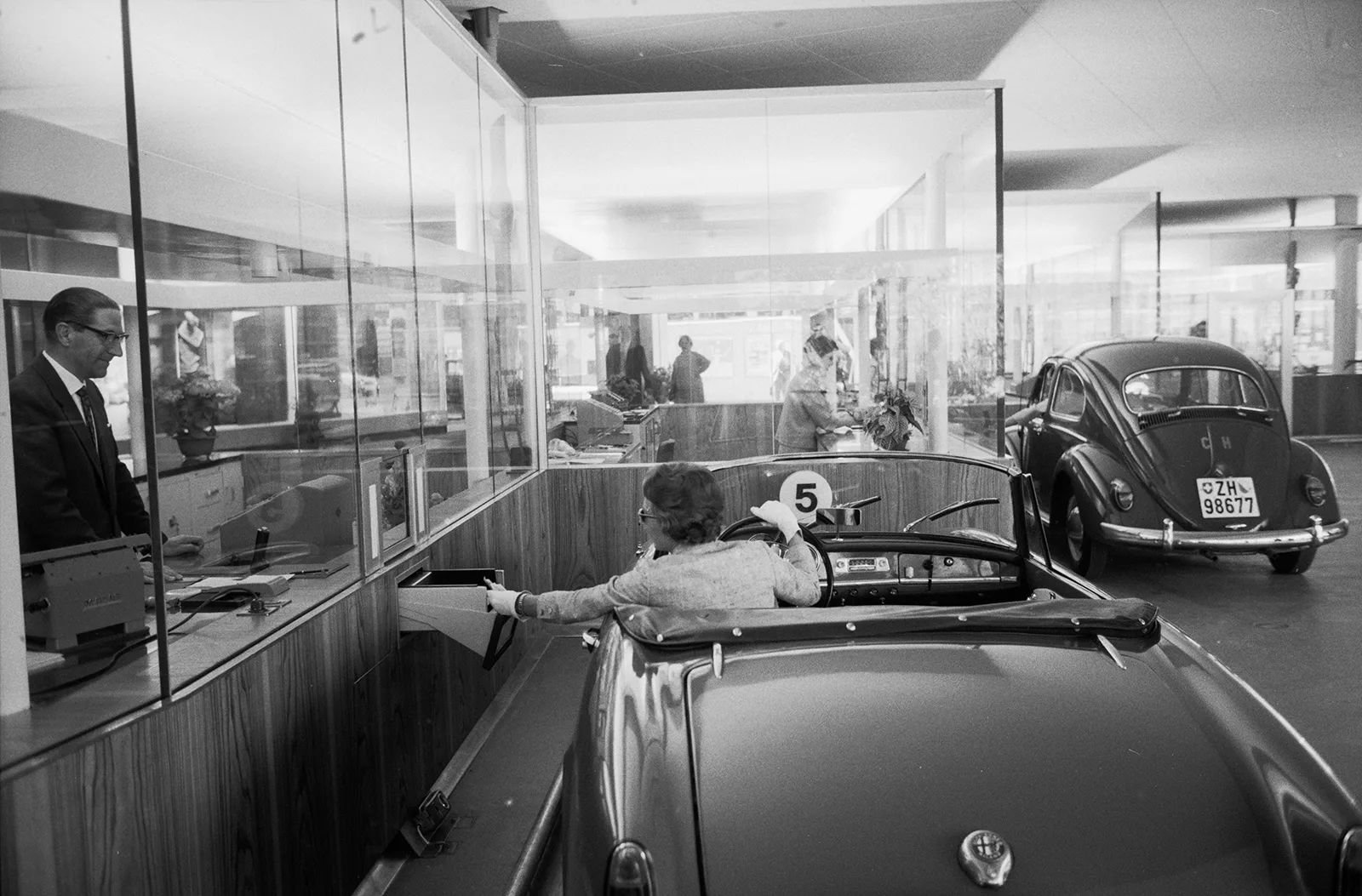
The path to mobile banking did not begin with the smartphone. Its roots actually lie in the first steps towards self-service. Banks started experimenting with new forms of access as early as the 1960s. The Schweizerische Kreditanstalt (the original name of the former Credit Suisse) opened a drive-in bank in Zurich in June 1962, enabling customers to conduct their banking business without getting out of their cars.
A customer at the Schweizerische Kreditanstalt’s drive-in bank on St. Peter-Strasse in Zurich, 1962.
A customer at the Schweizerische Kreditanstalt’s drive-in bank on St. Peter-Strasse in Zurich, 1962. e-pics
One forerunner in many ways to cashless payment had made its debut some time before, in 1950: the universally accepted credit card. For the first time ever, consumers were able to pay at different establishments without the need for immediate cash. The Diners Club charge card could be used in 27 New York restaurants. Dispensing with the need for cash, this system was based on credit, with the amount being settled at a later date.
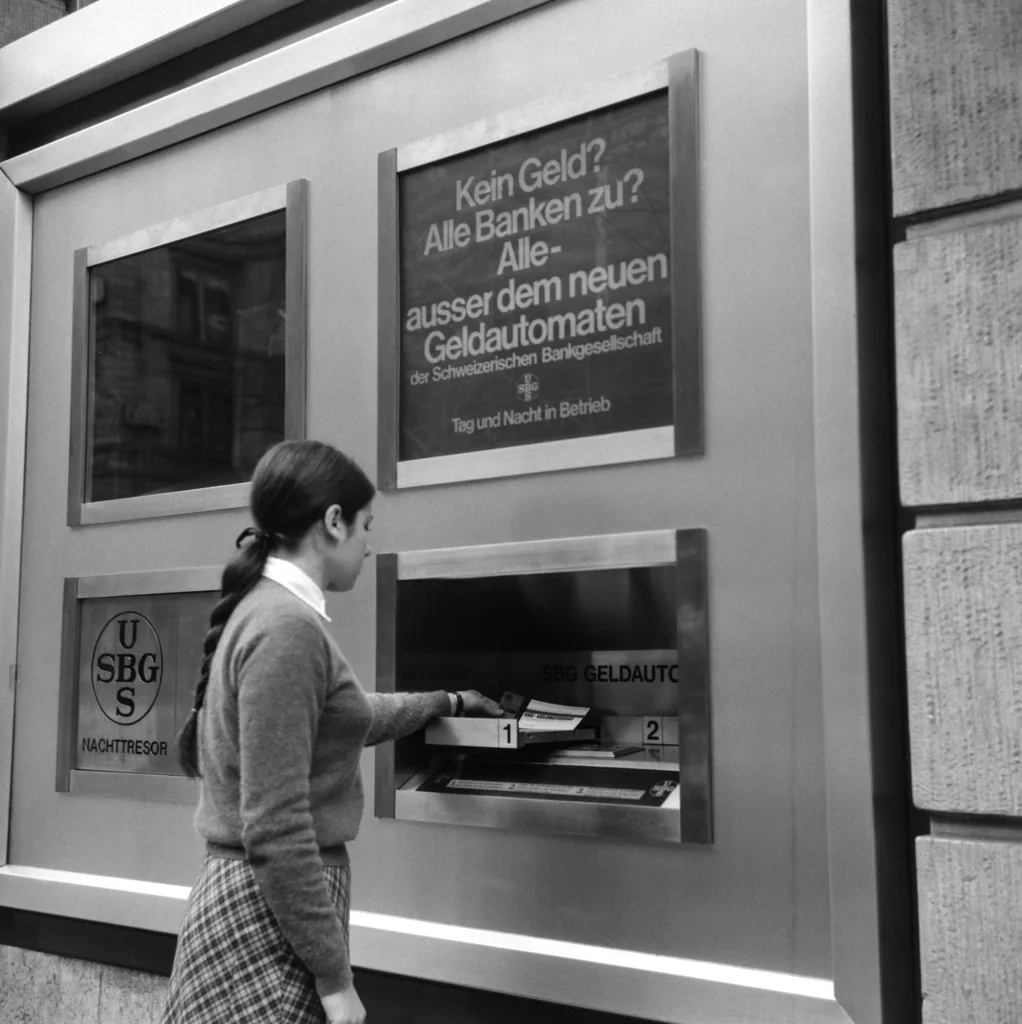
A decisive breakthrough in self-service banking followed in the late 1960s with the introduction of Zurich’s first cash dispenser in 1967. From then on, customers could withdraw money at any time of day or night without having to go to a bank counter. This shifted a commonplace part of banking business away from the counter to the machine.
First ATM of the Schweizerische Bankgesellschaft on Zurich’s Bahnhofstrasse, pictured on 8 November 1967.
First ATM of the Schweizerische Bankgesellschaft on Zurich’s Bahnhofstrasse, pictured on 8 November 1967. Keystone
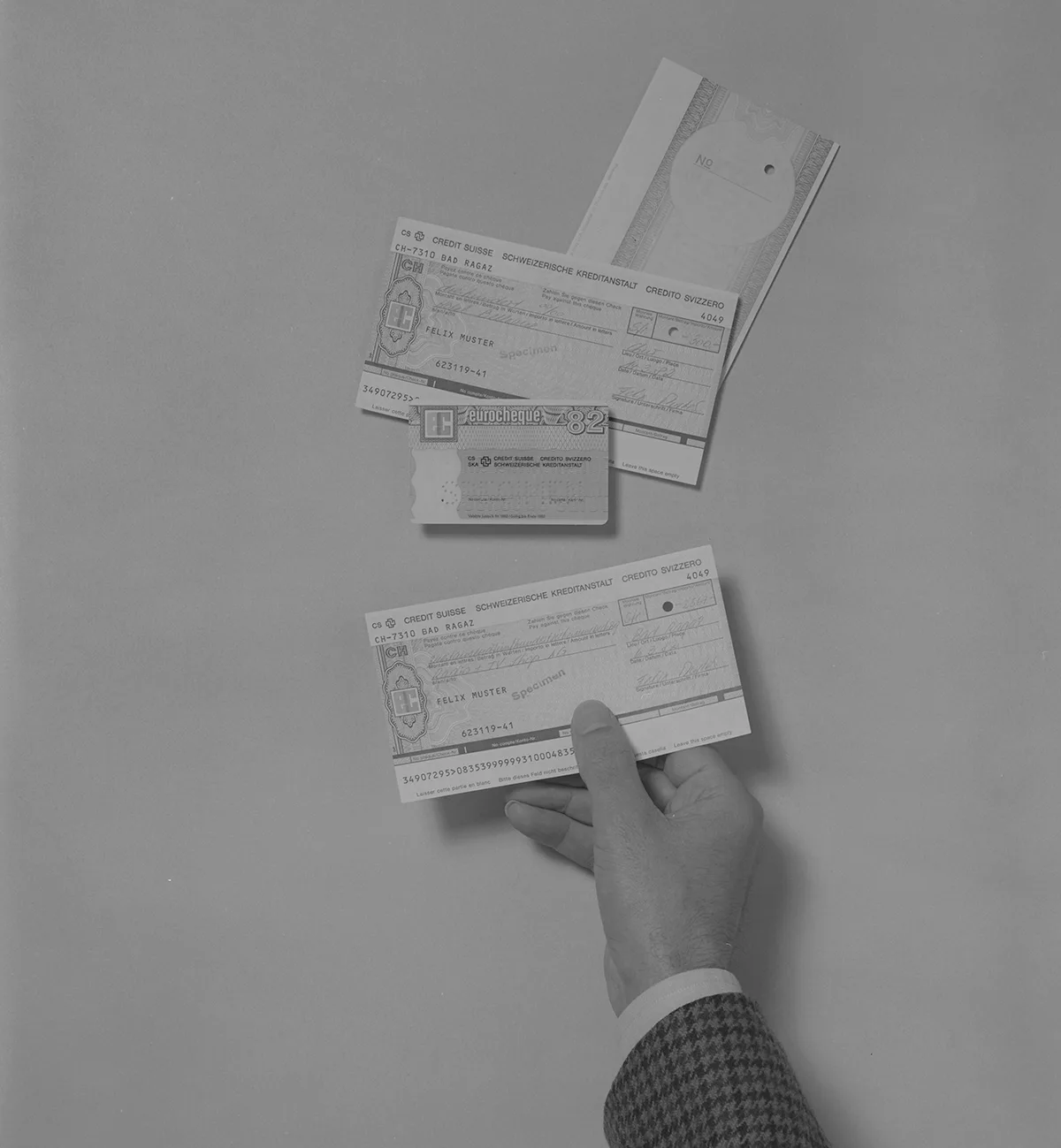
At around the same time, a second form of payment card was emerging. First trialled in the 1960s, debit cards operate under a different logic to credit cards: they are linked directly to the holder’s bank account and payments are debited straightaway. In Europe, debit cards can trace their origins back to the Eurocheque card (generally known as the EC card). Launched in 1978, the EC card originally served as a mere cheque guarantee card against which the signature and card number could be compared. Its function was enhanced from 1985, enabling money to be withdrawn from cash machines. Together with ATMs, it paved the way for increasing automation and eventually for digital payments.
Promotional picture for Credit Suisse Eurocheques and EC card, circa 1982.
Promotional picture for Credit Suisse Eurocheques and EC card, circa 1982. Swiss National Museum
In a parallel development, the 1980s saw the first digital experiments in the banking sector. The Swiss PTT (Post, Telephone and Telegraph) organisation’s Videotex system provided a basis for early telebanking services, enabling information to be called up via special terminals and initial banking transactions to be conducted. This marked the beginning of the shift from physical to electronic banking.
“Can’t I pay my bills from home?” Videotex ad from the 1980s.
“Can’t I pay my bills from home?” Videotex ad from the 1980s. Museum of Communication
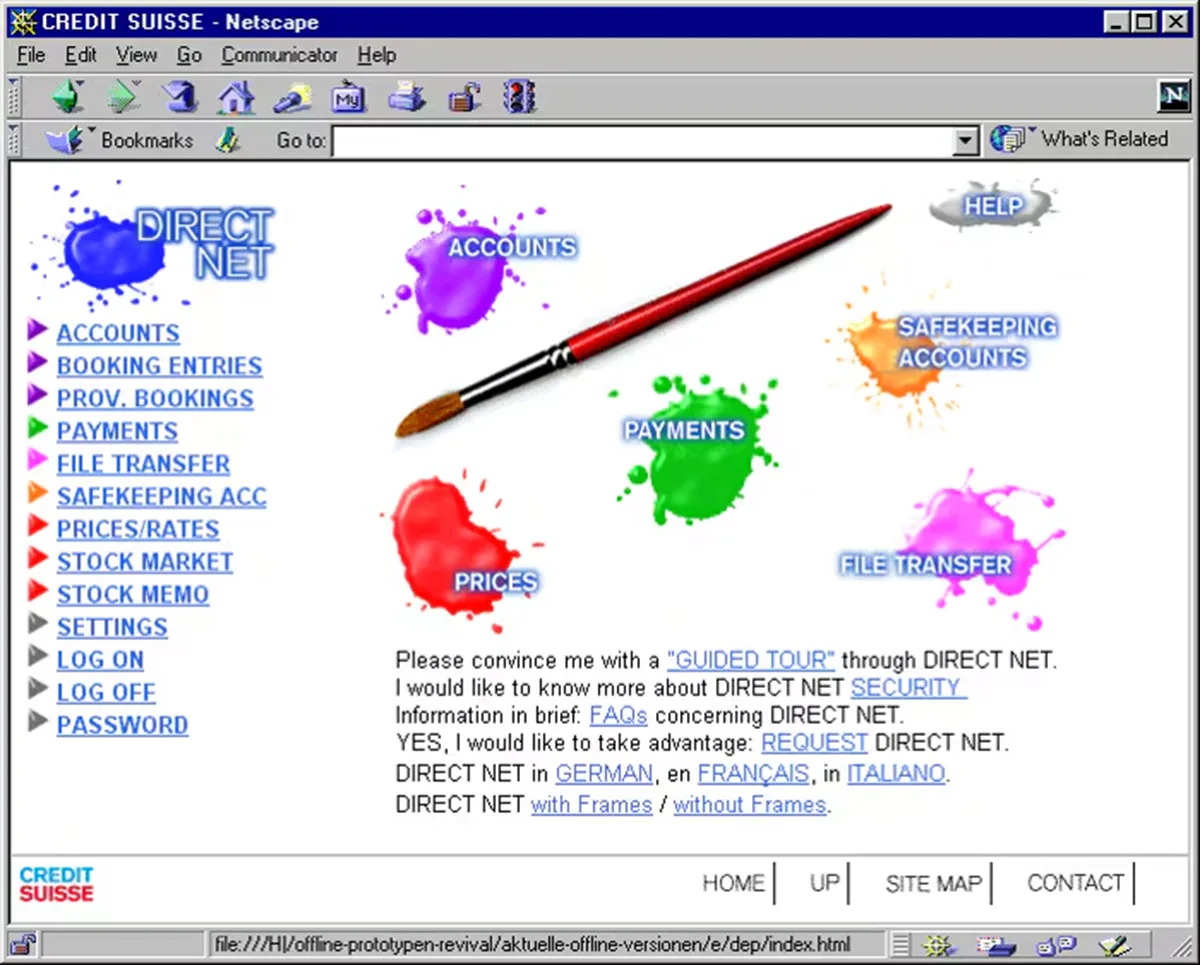
Online banking finally established itself with the rise of the internet. Swiss banks began offering their services on the World Wide Web in the late 1990s. Credit Suisse was first off the mark, launching a wide-ranging internet banking platform at the end of April 1997. It was followed five months later by Zürcher Kantonalbank. From then on, PCs brought bank counters directly into people’s own homes and bricks-and-mortar branches became less and less important.
Direct Net’, Switzerland’s first online banking platform, went online in April 1997. Screenshot of the homepage.
Direct Net’, Switzerland’s first online banking platform, went online in April 1997. Screenshot of the homepage. blick.ch

Banks become mobile

But it is smartphones that have really changed the face of banking since the 2010s, consigning it to a device that most people carry around in their trouser pocket. Account balances can be checked, payments authorised and investments made on the go, often in a matter of seconds.
Customer behaviour mirrors this trend: cash withdrawals are declining whereas mobile payments and app logins are on the rise. Meanwhile, a new player has appeared on the market. Neobanks are entirely digital, operate without a network of branches and usually offer their services at a lower price. They represent the next generation of banking: easy, fast and mobile.
Not so long ago yet already a thing of the past: counter hall of the Schweizerische Bankgesellschaft (now UBS), 1979.
Not so long ago yet already a thing of the past: counter hall of the Schweizerische Bankgesellschaft (now UBS), 1979. e-pics
This market has witnessed a dynamic evolution in recent years, especially in Switzerland. Providers such as Neon, Zak and Yuh have quickly risen to prominence and are reaching a broad clientele of digital natives. At the same time, it hasn’t all been plain sailing for this fledgling segment: some neobanks have been able to establish themselves and operate profitably while others have disappeared or had to adapt their business model and reposition themselves. In other words, the Swiss banking market has entered a phase of growth, experimentation and consolidation – with all the ups and downs that entails.
Once upon a time, the personal touch was important. Nowadays, a large part of our interactions take place in the digital realm – often without any direct contact with another human being. Algorithms have taken over tasks previously performed by a bank’s employees, such as investment decisions now being made by robo-advisors. This naturally gives rise to new questions: who is managing our data? Who are we entrusting our money to? And what role do global technology companies play in the financial system?

Switzerland, the land of banks

12.06.2026 08.11.2026 / National Museum Zurich
Switzerland is one of the world’s leading financial centres – but how did its close association with banking evolve? The exhibition shows how deeply banking is entrenched in Switzerland’s DNA and traces the development of the banking system by displaying an impressive range of items. Jewish moneylenders, Lombardy merchants and, later, urban exchange offices laid the foundation for the modern financial centre. The exhibition goes beyond merely retracing historical developments; it also invites visitors to engage with the land of banks as it is today.

Further posts