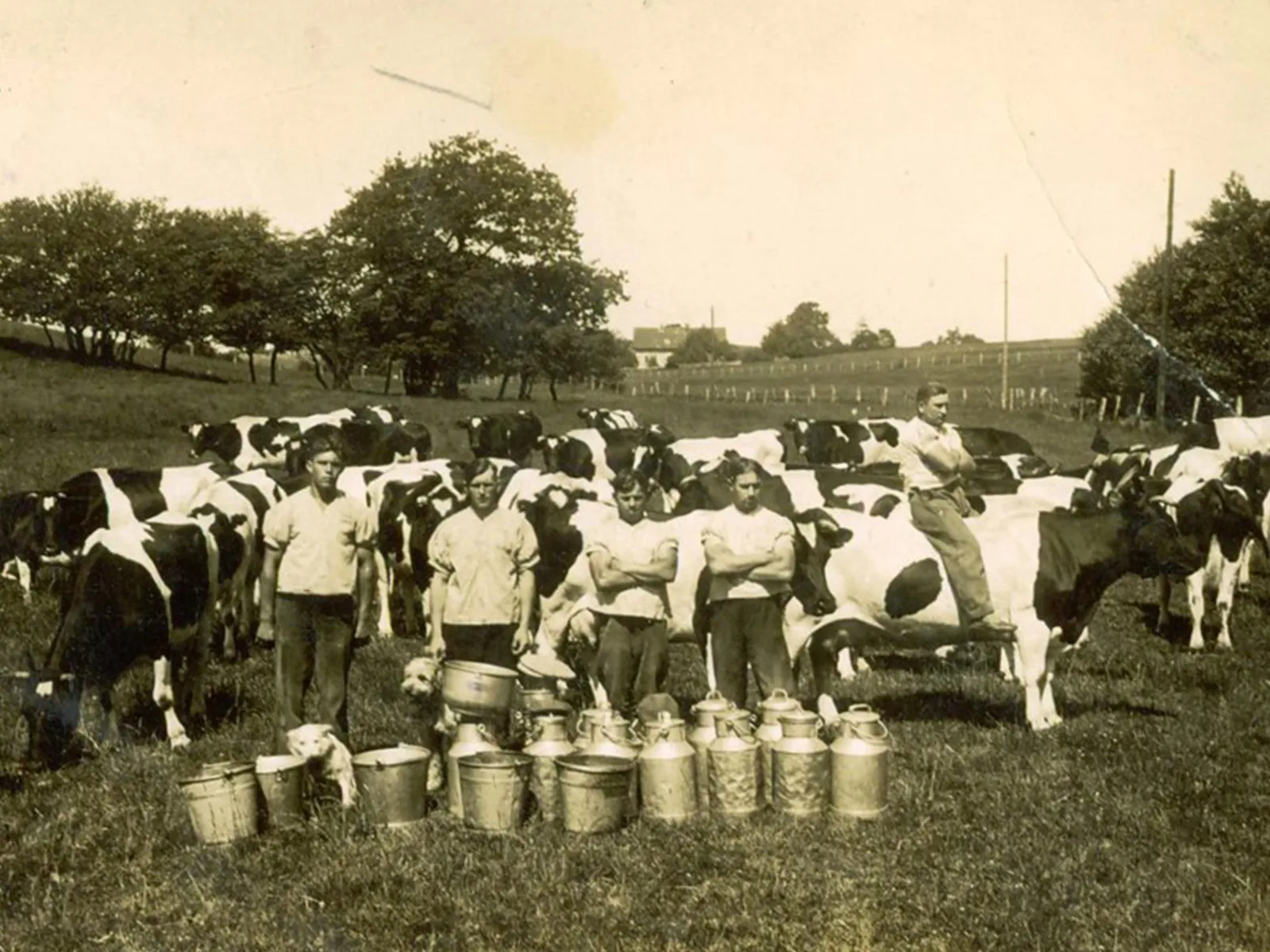
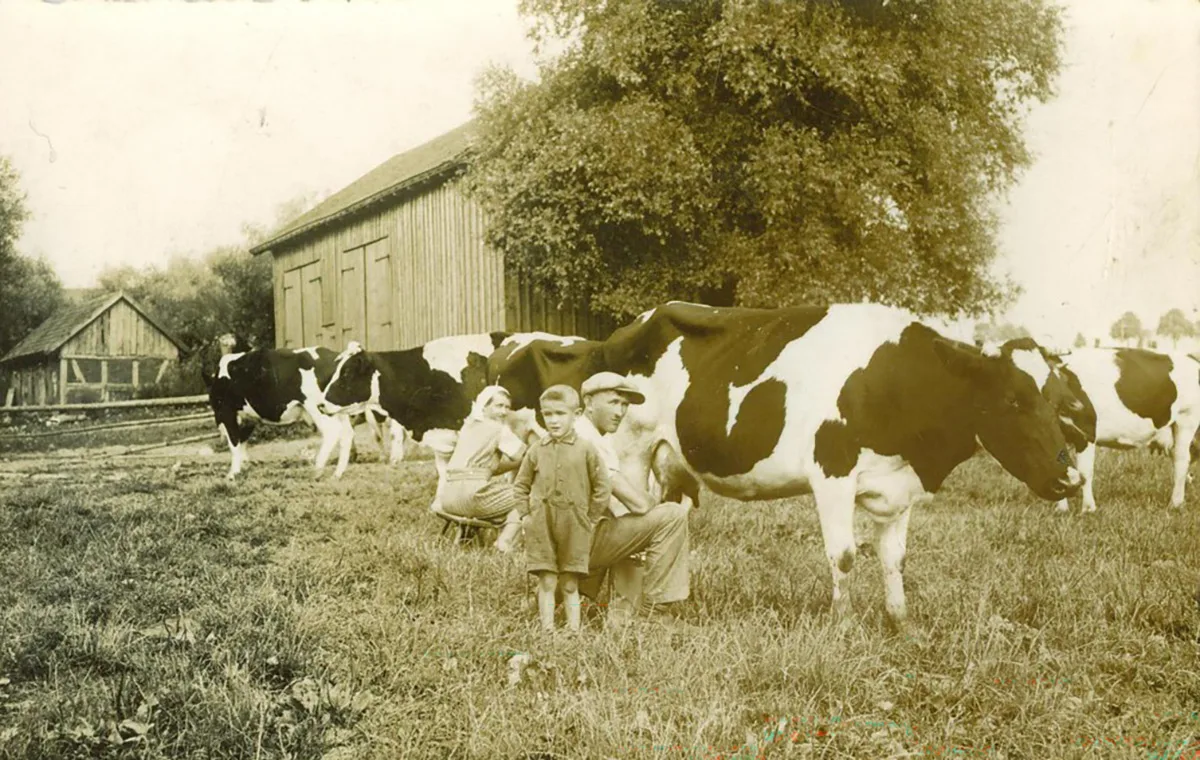
Professional ‘Schweizer’ posing for a photograph in Königsberg, East Prussia.
Professional ‘Schweizer’ posing for a photograph in Königsberg, East Prussia. allerleischweiz.de

When ‘Schweizer’ meant more than Swiss

Milkers and dairy workers from Switzerland were so in demand on German farming estates from the mid-19th century that the term ‘Schweizerei’ came to mean dairy farm, while milkers were known as ‘Schweizer’ or ‘Stallschweizer’.

Gabriel Heim

Gabriel Heim

Gabriel Heim is a book and film author and exhibition organiser. He is principally concerned with research into topics of modern and contemporary history and lives in Basel.
‘Schweizer or capable herder wanted’. This newspaper advertisement from 1873 by a German landowner was not actually for someone from Switzerland (Schweizer) but for someone to milk the cows. Stemming originally from the image of cowherders on lush Swiss alpine meadows and cheese wheels from Emmental, the job title ‘Schweizer’, ‘Stallschweizer’ or ‘Oberschweizer’ and the naming of a dairy farm as ‘Schweizerei’ – which goes back to around 1750 ‒ became the adopted terminology when referring to milkers and their place of work in Germany’s relatively flat terrain. The words did not carry the same meaning in Switzerland, from where growing numbers of young Swiss men moved from the mid-19th century to milk the cows on the large farming estates east of the Elbe.
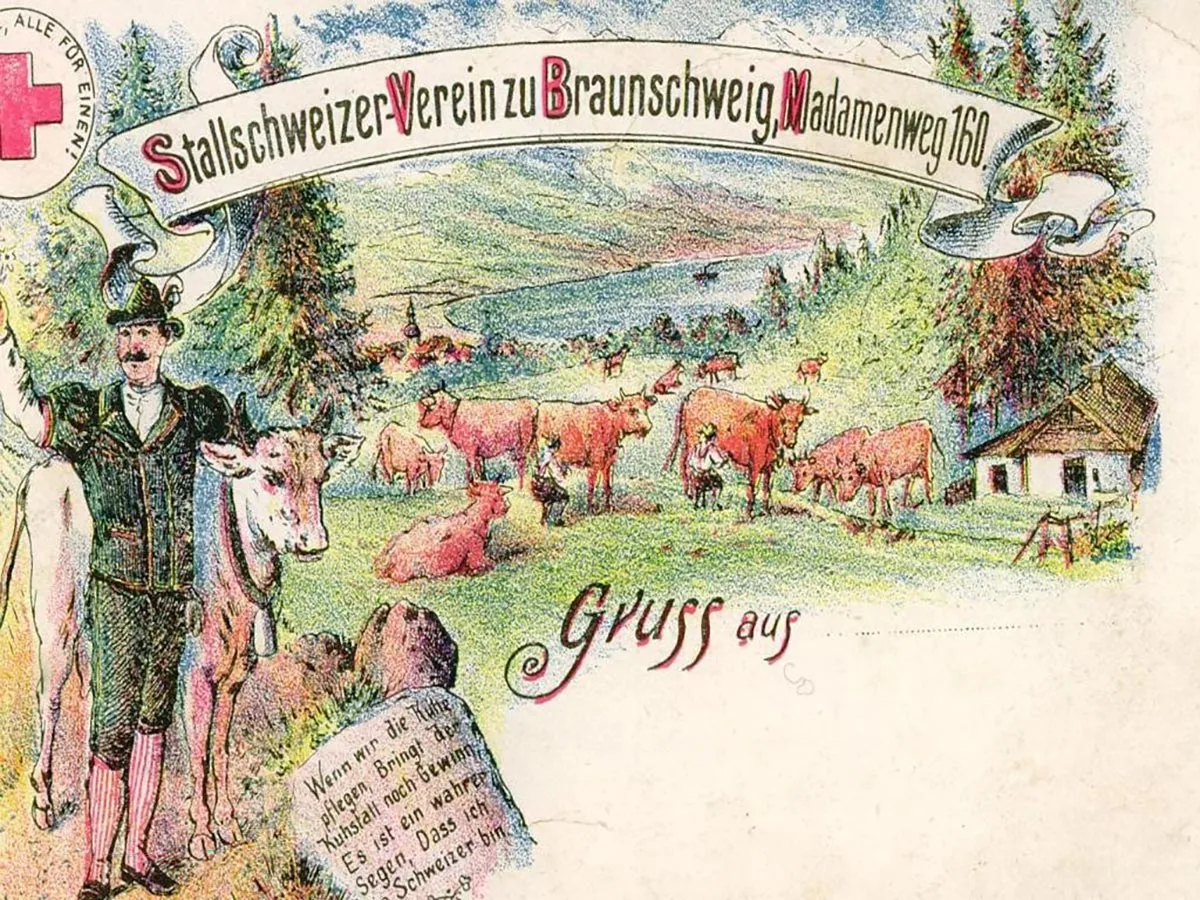
Postcard of Brunswick ‘Stallschweizer Verein’ (association of milkers), in the early 20th century.
Postcard of Brunswick ‘Stallschweizer Verein’ (association of milkers), in the early 20th century. allerleischweiz.de
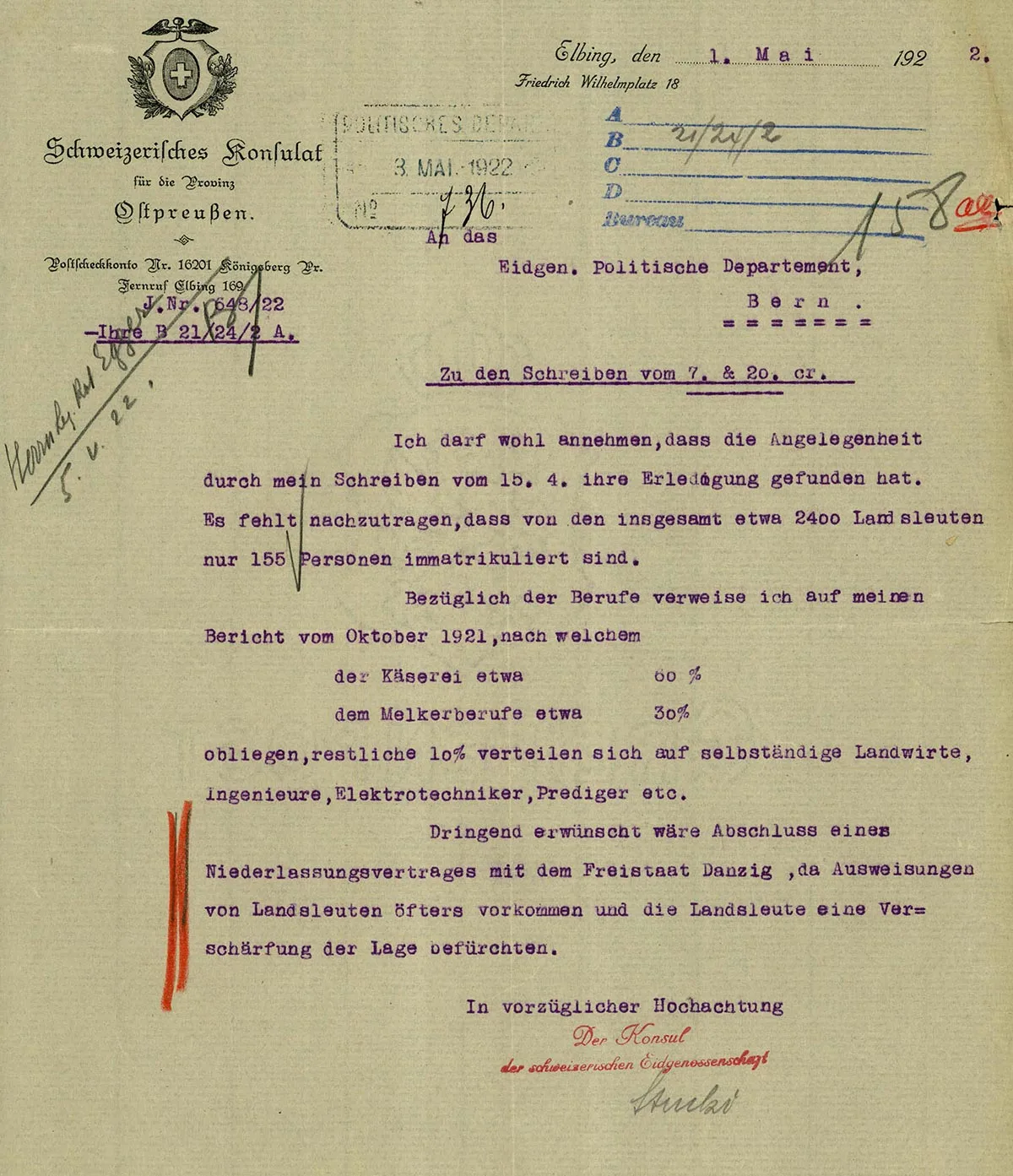
A report from the Swiss consul for East Prussia attests to how appealing this work was at the time. He sent the following message from Königsberg to Bern: “In terms of jobs, I refer to my report from October 1921, according to which cheese making accounts for about 60%, and milking about 30% of jobs.” The other 10% comprised farmers, engineers, electrotechnicians and preachers. Many of the migrants did not return to live in Switzerland. They started families in East Prussia and some acquired wealth with their own Swiss-style dairy. The Swiss migrants were well respected for being adaptable and industrious.
About 90% of Swiss based in East Prussia worked in the milk and cheese business in 1921.
About 90% of Swiss based in East Prussia worked in the milk and cheese business in 1921. Swiss Federal Archives
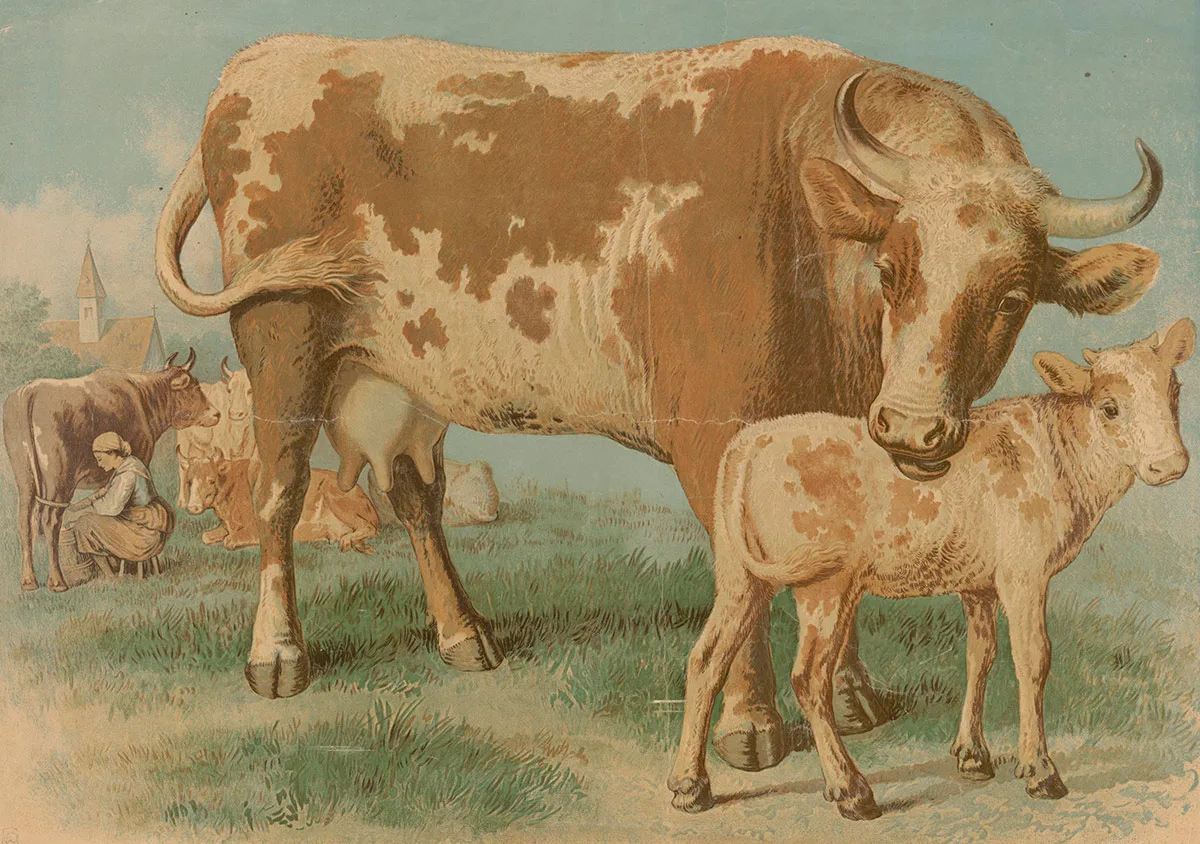
Swiss cattle were also sought after. In fact, the popularity of the black and white patched Berner Schecken resulted in farms with Dutch cows, ‘Holländerey’, being renamed ‘Schweizerey’ within a few years.
Swiss cows as well as labour were valued resources in East Prussia. A milker is at work in the background of this classroom picture.
Swiss cows as well as labour were valued resources in East Prussia. A milker is at work in the background of this classroom picture. Swiss National Museum
In 1897, the Verband der Schweizer Sennen (association of Swiss milkers) was founded in Berlin and it evolved into the Allgemeine Schweizerbund in 1909. The chairman was a Swiss national and a ‘Schweizer’ called Thomas Camenzind. The association introduced proficiency tests, known as ‘Stallschweizer Prüfungen’ for the roughly 40,000 men working as milkers across the industry and wage scales. Members also received the association’s official newsletter Schweizer-Bund. ‘Schweizer’ were among the best paid workers on the numerous grand farming estates of the day, as a well-run cow and calf barn made a material contribution to the operation’s bottom line.
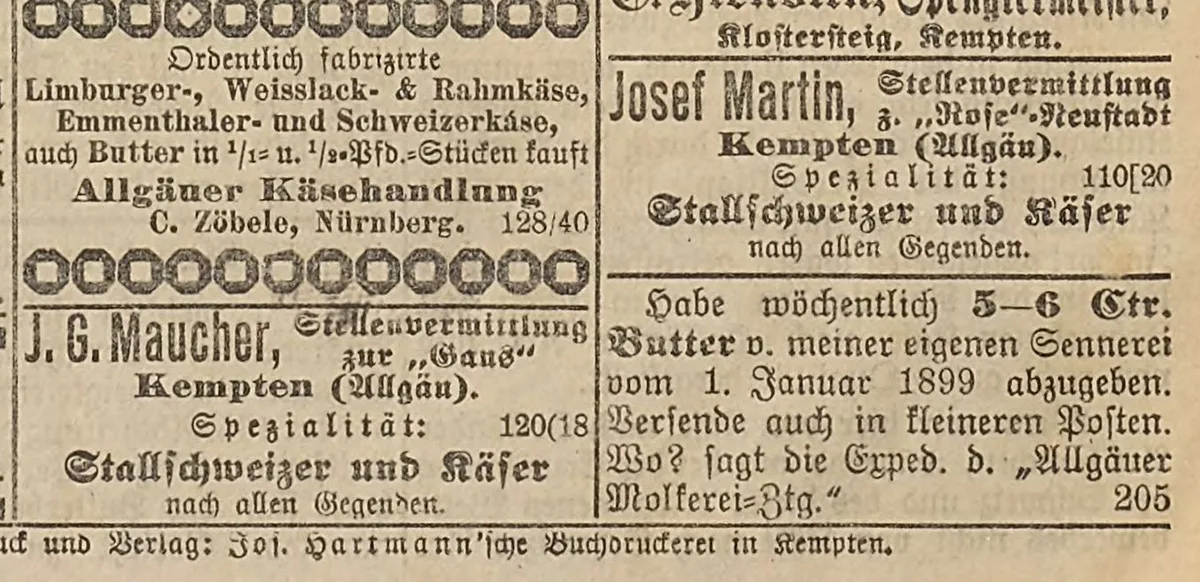
‘Schweizer’ or ‘Stallschweizer’, as milkers were known, were sought after in Germany in the late 19th and early 20th centuries. An advertisement in the ‘Allgäuer Molkereizeitung’ from 1898.
‘Schweizer’ or ‘Stallschweizer’, as milkers were known, were sought after in Germany in the late 19th and early 20th centuries. An advertisement in the ‘Allgäuer Molkereizeitung’ from 1898. Munich Digitization Center
From 1912, the Federal Administration in Bern began objecting to the usage of the word ‘Schweizer’ as a job description in Germany and in the Austro-Hungarian Empire. The Federal Council wanted to take steps, wrote ministry officials, “to replace the improper use of the word ‘Schweizer’ for milkers in official language by other terminology, which does not affront our national feelings."

Once a ‘Schweizer’ always a ‘Schweizer’?
The Allgemeine Schweizerbund vigorously opposed this unwelcome (at least in their eyes) break with tradition in a letter to the Federal Council: “Switzerland is the cradle of the ‘Schweizer’ profession. It is not for nothing that the country has lent its name to dairy work. The ‘Schweizer’ see their profession as a monument to their country of origin in Germany – more lasting than ore, saying to future generations that Switzerland was a pioneer in livestock breeding and the dairy industry. […] The Allgemeine Schweizerbund requests on behalf of and as authorised by several hundred professionals of Swiss origin that the sovereign federal government withdraw its request to the German government to avoid using the name ‘Schweizer’ [for dairy worker].” The matter was shelved for 20 years until a decree by the Reich Minister of Labour in 1931 stipulated that the traditional job description ‘Schweizer’ was to be officially replaced by ‘Melker’ (milker).
A name change from ‘Schweizer’ to ‘Melker’ was not well received by most of the Swiss dairy workers in Germany. They saw it as an affront from their home country to their professional pride.
A name change from ‘Schweizer’ to ‘Melker’ was not well received by most of the Swiss dairy workers in Germany. They saw it as an affront from their home country to their professional pride. allerleischweiz.de
The tradition of Swiss milkers plying their trade on German farming estates started to come to an end in the mid-1930s. Although labour was still in short supply, Nazi ideology wanted German men on German soil. In 1936, the Königsberg consul wrote to Bern: “We are 50 single milkers short. Nonetheless, the local chamber of agriculture was unable to accept Swiss workers, although the consulate offered us the opportunity to look for suitable workers in Switzerland.”
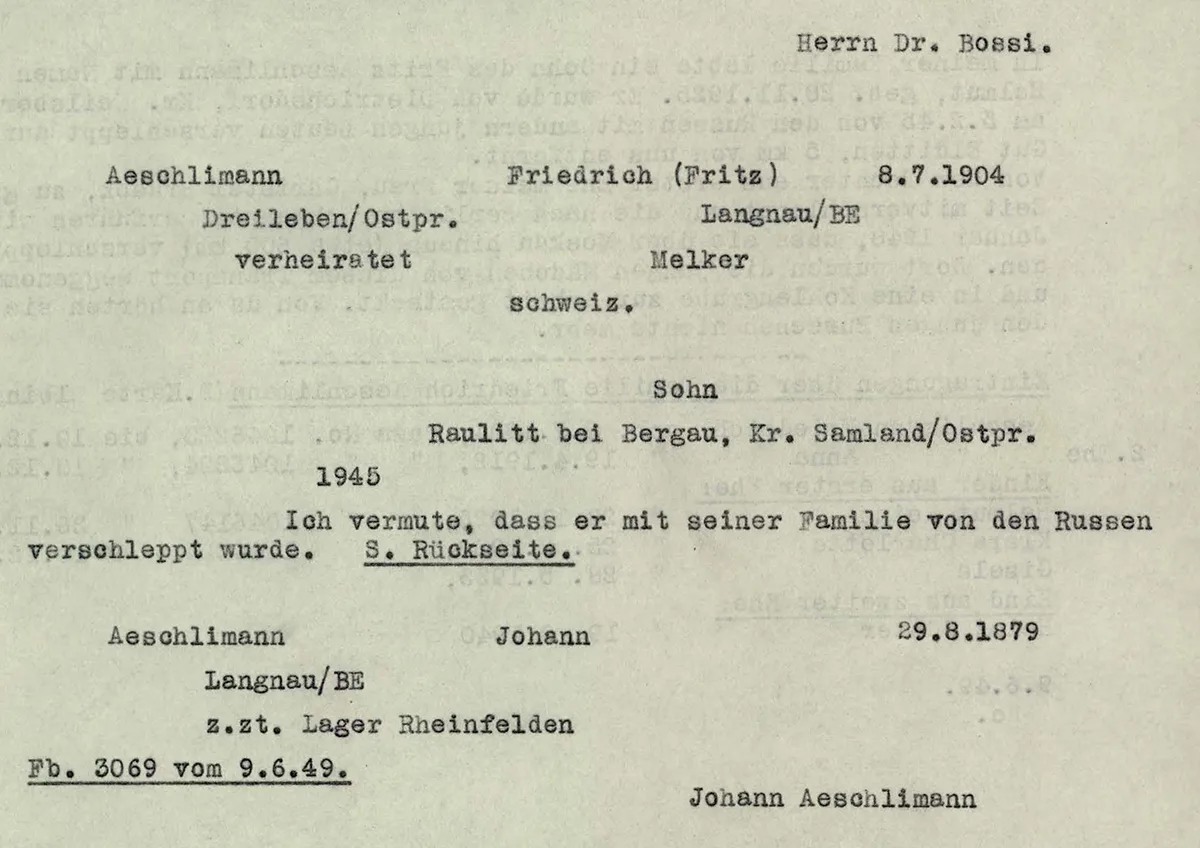
The last signs of the almost 100-year era of the Swiss ‘Schweizer’ and cheesemakers in the east of the German Reich date from 1946 when relatives posted missing person’s notices after the war. For example, a notice was issued for the Bern brothers Albert and Johannes Friedli, both milkers, whose last recorded address was at Rittergut Gauten in Samland. Or Fritz Aeschlimann from Langnau (canton of Bern), who had worked as a milker in Gut Raulitt in Königsberg District. The authorities often didn’t have any precise details and provided vague information, as in the case of Fritz Aeschlimann: “I suspect he was taken by the Russians.” It was the same for Ludwig Grossrieder from Alterswil in the canton of Fribourg, who “had become lost while on the run”. And thus came the end of an era.
Missing person’s notice for Fritz Aeschlimann from 1949. He was abducted along with other persons by Russian troops in February 1945.
Missing person’s notice for Fritz Aeschlimann from 1949. He was abducted along with other persons by Russian troops in February 1945. Swiss Federal Archives
Those areas marked as ‘Swiss’ on the map of Germany proved longer lasting: Franconian Switzerland, Kashubian Switzerland and Saxon Switzerland still exist as very popular locations in the 21st century. Even German restaurants and eateries exploit the Swiss angle through the term Schweiz as a hook to reel in thousands of visitors to the ‘Schweizerhof’, ‘Schweizer Stube’ or ‘Schweizerhaus’. Most of these establishments doubtless also serve milk, an unwitting nod to their dairy connection.

Further posts