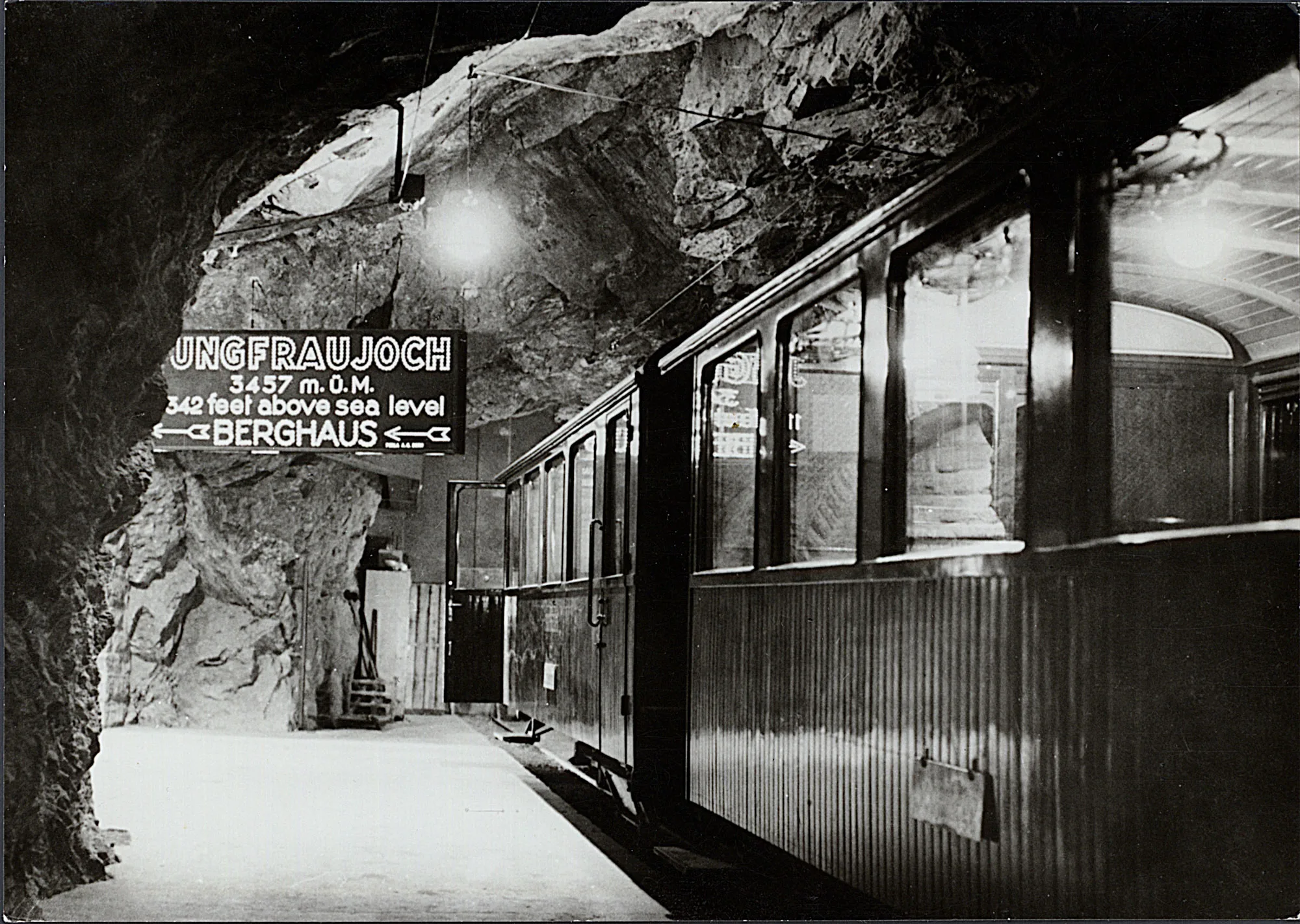
Jungfraujoch station – Europe’s highest railway station.
Jungfraujoch station – Europe’s highest railway station. e-pics

The race to tame the Jungfrau

There was a public fascination in the 19th century with the idea of building a railway to the top of the Jungfrau. A competition launched in the mid-1880s prompted an animated response from the country’s engineers, with each one trying to outdo the other. Adolf Guyer-Zeller cherry-picked their ideas and got rid of the competition. He also opened up the mountain to mass tourism.

Helmut Stalder

Helmut Stalder

Helmut Stalder is a historian, publicist and book author specialising in economic, transport and technical history.

Textile industrialist Adolf Guyer-Zeller from Neuthal in the Zurich Oberland went hiking with his daughter above Mürren in the summer of 1893. They enjoyed the view of the Eiger, Mönch and Jungfrau with the recently opened Wengernalp railway going to Kleine Scheidegg at an altitude of 2,064 metres. An idea then struck the 54-year-old Guyer-Zeller like a lightning bolt. On his return to the hotel in Mürren, he outlined his vision: a sweeping railway line going from Kleine Scheidegg, passing through the Eiger and the Mönch and on up to the top of the Jungfrau. He scribbled down words like ‘summit’, ‘routes’, ‘tunnels’, ‘stations’, ‘summit tower’ and keywords like ‘mountain railway’, ‘accommodation’, ‘ventilation’. He also envisioned the centrepiece of the project, the high-alpine Eigergletscher station from where the train would go into the mountain. He then signed off with the time, date, place and his initials.
 
That page from his notebook now lies secure in the Jungfrau railway archives. It is presented as proof of the flash of inspiration triggered in 1893 by the stunning mountain views and evidence of Guyer-Zeller’s higher calling to build a railway on the Jungfrau. That fits with the narrative of being a fearless genius fondly propagated by the pioneers of the industrial age. However, Adolf Guyer-Zeller actually came late to the party, cherry-picked concepts from previous projects and unceremoniously removed the competition from his path.
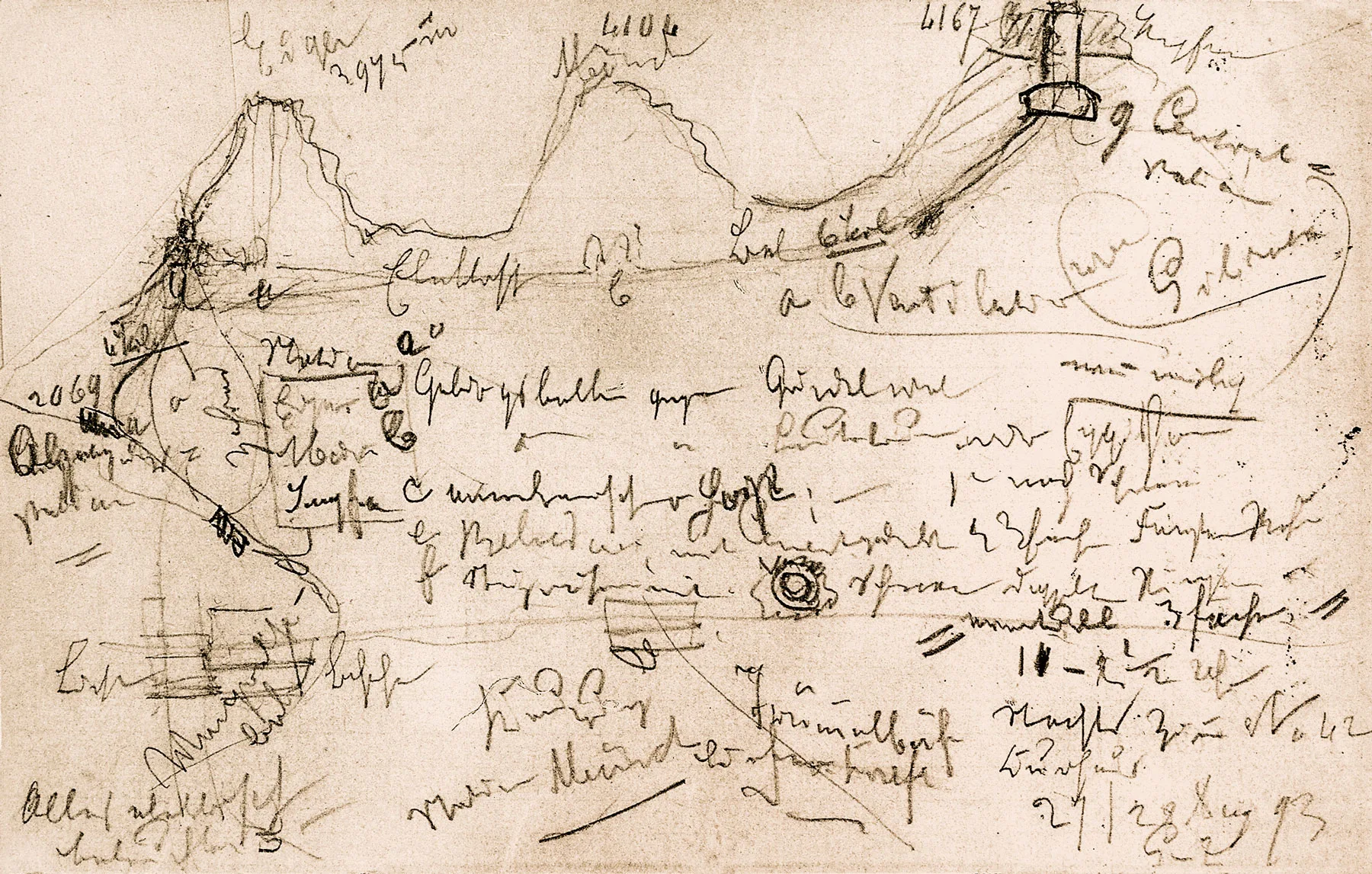
Adolf Guyer-Zeller’s sketch of the proposed Jungfrau railway.
Adolf Guyer-Zeller’s sketch of the proposed Jungfrau railway. jungfrau.ch

The technological conquest of the Alps
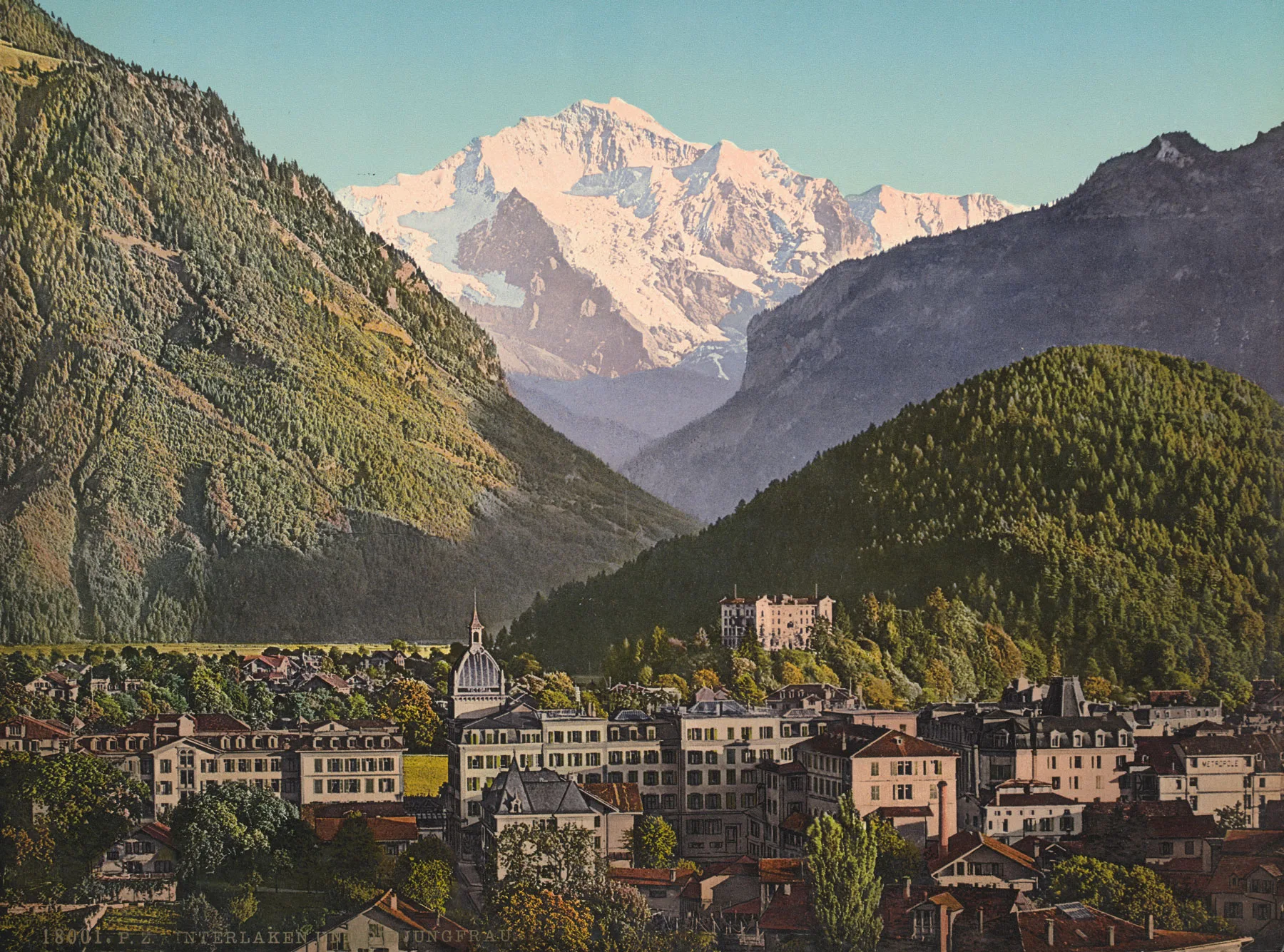
The construction of the Vitznau-Rigi line in 1871, which was Europe’s first mountain railway, sparked a craze in Switzerland. No technological challenge seemed too daunting for the great minds of the day, and the Confederation made “connecting Switzerland by rail” a priority. With pioneers, rail magnates and speculators sensing the money to be made in mass tourism, projects sprang up all over the place during the 1880s. And one of them stood out from the rest: the conquest of the Jungfrau. A railway going up the 4,158-metre high Jungfrau would be the crowning achievement of progress. It would symbolise faith in the future, a pioneering spirit and the technological euphoria of the time.
View of the Jungfrau. Photo print ca. 1900.
View of the Jungfrau. Photo print ca. 1900. Swiss National Museum

It started as a joke

The idea of a Jungfrau railway really captured the public imagination. On 1 April 1886 the Neue Zürcher Zeitung newspaper reported that the International Mountain-Way Company, founded in London, was planning to build both a railway line to the Rottalhütte mountain hut and a hotel at the foot of the Jungfrau. It was a mere 2,600 metres and 1,400-metre ascent as the crow files from there to the top of the mountain. The report claimed that a stairway with solid rails and very broad steps, mainly cut into the rock, would lead up the steep cliff face and that the summit of the Jungfrau would be flattened out and a parapet built around it for visitors to enjoy the view. The article was written by an engineer called S. Ch. Windler (which spells “Schwindler” meaning trickster). It was an April fool by the editor Emil Frey.
 
Fast forward three years and the laughter had stopped. A railway connecting Interlaken to Lauterbrunnen and Grindelwald was under construction, an application for authorisation to build a railway line to Kleine Scheidegg was ongoing. In 1889, an amazed public was presented with three projects for a railway to the Jungfrau.

Monsieur Eiffel enters the frame

The first project was put forward by French-Swiss engineer Maurice Koechlin (1856-1946). He had studied engineering at the Federal Institute of Technology in Zurich and was extremely capable. He was the brains behind several large steel framework bridges, the armature of the Statue of Liberty plus the idea and plans for the Eiffel Tower in Paris.
 
Koechlin’s vision was of a railway going from the Lauterbrunnen valley to the top of the Jungfrau via six tunnels. Cogwheel or funicular systems would enable the trains to negotiate the 3,175-metre climb. Then there would be a hotel and research station on the summit. All for the sum of CHF 9.2 million.
 
The plan was hotly debated in the media, which also touched on Koechlin’s work in designing the Eiffel Tower. “The project is a symbol of our age when technological hurdles are no longer insurmountable. [...] There can be no doubt that the Jungfrau railway would be for the Bernese Oberland what the Eiffel Tower is for Paris, a technological marvel bringing in visitors from all over the world.” The Oberländische Volksblatt newspaper was ambivalent: “In its sheer daring, this plan puts all the others in the shade. If it works, the human spirit will have triumphed again by achieving something which would not have been considered even remotely feasible twenty years ago.” In any case, the newspaper saw this as a sign that “the capitalist juggernaut continues its unstoppable march from valley to the highest mountain top.” The Berner Tagblatt argued that the Jungfrau railway was as tasteless as the Eiffel Tower and would spoil the mountains. “Is the last bastion of purity in our alpine landscape to disappear just for a few sordid francs?” The Nebelspalter satirical magazine hinted at delusions of grandeur by publishing a cartoon with a huge Eiffel Tower as a cable car station.
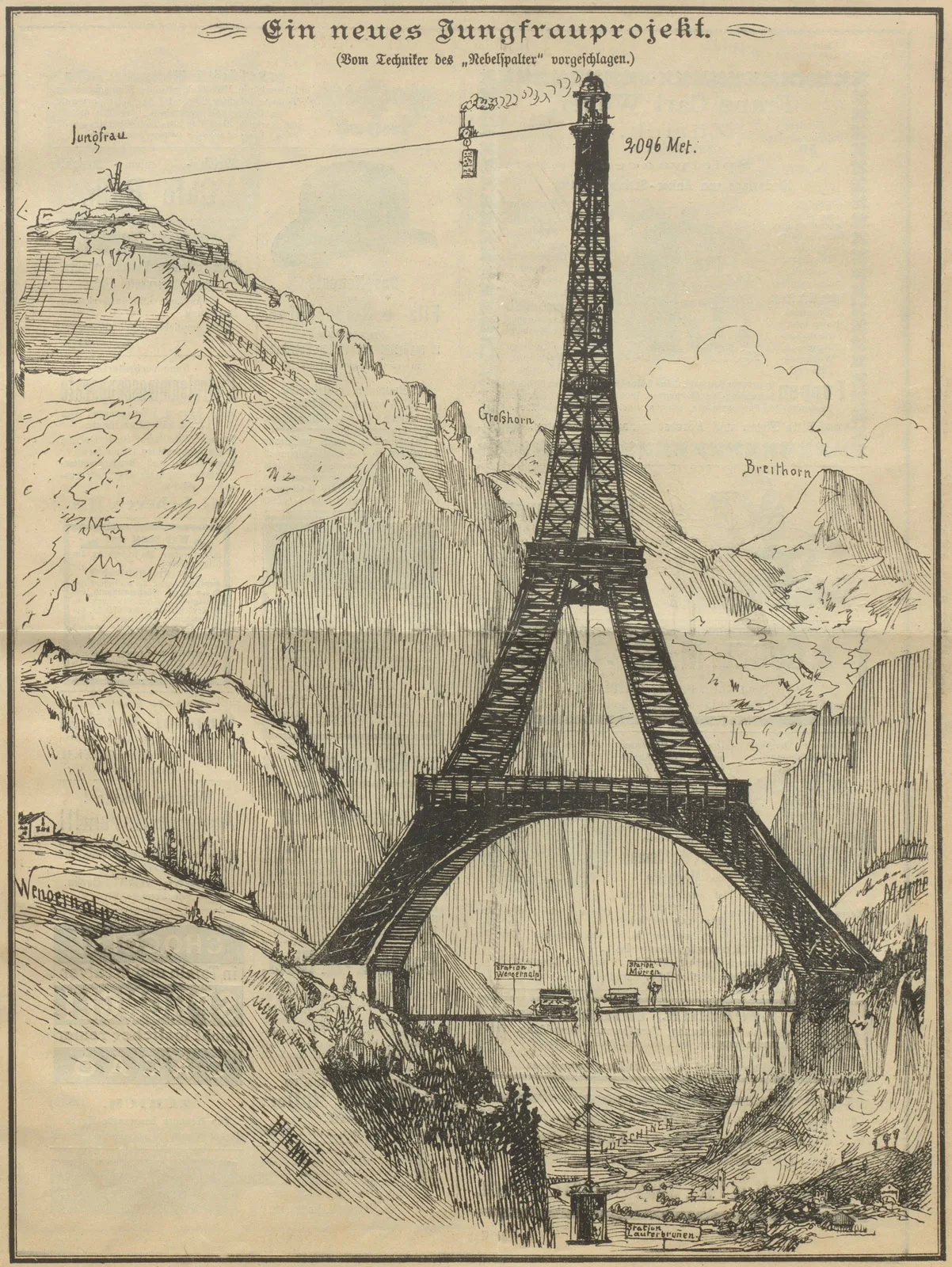
An Eiffel Tower on the Jungfrau? A caricature by the Nebelspalter magazine in response to Koechlin’s project.
An Eiffel Tower on the Jungfrau? A caricature by the Nebelspalter magazine in response to Koechlin’s project. e-periodica
Just three days after Koechlin had gone public with his plans in the autumn of 1889, Alexander Trautweiler (1854-1920), who was also an experienced railway engineer, presented his own project. His plans also saw the Lauterbrunnen valley as the starting point and comprised four lengths of line passing through tunnels on their way to the top of the Jungfrau, with vantage points at the three interchange stations. He envisaged cable cars with propulsion mechanisms powered by compressed air. At a cost of CHF 5.57 million.

A pneumatic tube transport system on the Jungfrau

The third project was the brainchild of Eduard Locher (1840-1910) from Zurich, who had devised the cogwheel system of the world’s steepest rack railway on Mount Pilatus. He proposed sending a train straight to the summit without any stops along the way. While Koechlin’s proposal would have taken up to one-and-three-quarter hours and Trautweiler’s two hours, Locher’s “pneumatic railway with piston-like motion” would have completed the ascent in 15 minutes. “A cylinder-shaped wagon of about 20 metres’ length with room for 50 people runs up and down each of the parallel tubes. The passengers travel from the valley straight to the top of the Jungfrau at a speed of 25 km/h powered by compressed air.” In other words a pneumatic tube system for people. “This is a new application of the [...] pneumatic principle. But it would be a misrepresentation of the theoretically accurate underlying concept and the capabilities of modern technology to say it is impossible”, wrote Locher.
 
The Federal Council was only prepared to grant one licence and insisted that the three competitors work together. They agreed to collaborate on the Jungfrau project under Koechlin’s leadership. In 1891, the parliament granted Koechlin authorisation. However, the Confederation demanded proof of the project’s safety. People were worried that the rapid ascent and time spent at 3,000 metres could pose a health hazard. The railway pioneers had to provide positive supporting documentation, which didn’t help them to find sponsors.

The Eiger project enters the fray

In 1892, engineer Emil Strub (1858-1909) went public with yet another project. He had worked in the Riggenbach workshops, developed a proprietary cogwheel system and been an inspector for the Bernese Oberland railway. He teamed up with Hans Studer to apply for a licence to build a railway to the summit of the Eiger from Kleine Scheidegg. A cogwheel railway would then provide transport up to Rotstock station. The passengers would change over to a tunnel line taking them inside the Eiger to the Eiger observation tower at an altitude of 3,979 metres. The tunnel would have two stations, one at 2,990 and the other at 3,470 metres. Viewing openings would offer “a vista of stunning splendour”, as it said in the proposal. “The two viewing stations will ensure a much more enjoyable journey than the Jungfrau railway tunnel plans.” This brought Strub into competition with the Koechlin project. He quickly obtained approval to proceed with the Eiger railway at a cost of CHF 3.9 million. This signalled the start of a second competition, i.e. Eiger vs Jungfrau.

Appropriation and machination

It was at this point that Adolf Guyer-Zeller, the shrewd, resourceful textile and railway entrepreneur, became involved. In late 1893, he unexpectedly came up with a proposal for an electric cogwheel railway running from Kleine Scheidegg through the Eiger up to the Jungfraujoch and then on to the Jungfrau summit in six stages. Emil Strub was thunderstruck to see fundamental elements of his Eiger project replicated by Guyer-Zeller: the starting point at Kleine Scheidegg, Rotstock station and the routing of the first stretch of line ending there had been copied word-for-word from Strub’s 1892 Eiger plan. The Eigergletscher station was to be at the same height as Strub’s Rotstock station. Strub had also come up with the idea of passing through the Eiger with stop-offs and panoramic viewpoints in 1892, one year before Guyer-Zeller sketched his route through the Eiger and Monch to the Jungfrau that night in Mürren. Strub did raise an objection, but it came to nothing.
 
Guyer-Zeller put all his energy into seeing off the competition. Strub und Studer wanted to strengthen their Eiger project by conferring the rights to the first section from Kleine Scheidegg to Rotstock station at the foot of the Eiger to the Wengernalp railway company managed by Studer, which would have enabled quicker completion of the line. However, the shareholders thought the Jungfrau option offered better potential financially and decided to wait, “until the Federal Assembly has decided whether to grant the licence to Guyer-Zeller’s Eiger-Mönch-Jungfrau railway project”. This was instigated by Adolf Guyer-Zeller. He pushed his argument in the press that the Jungfrau project, which was 191 metres higher, must come first. When the Confederation hinted that it would grant him the licence, the Eiger project was dead in the water. Strub und Studer gave up and transferred the access rights to Guyer-Zeller for CHF 15,000 hush money.
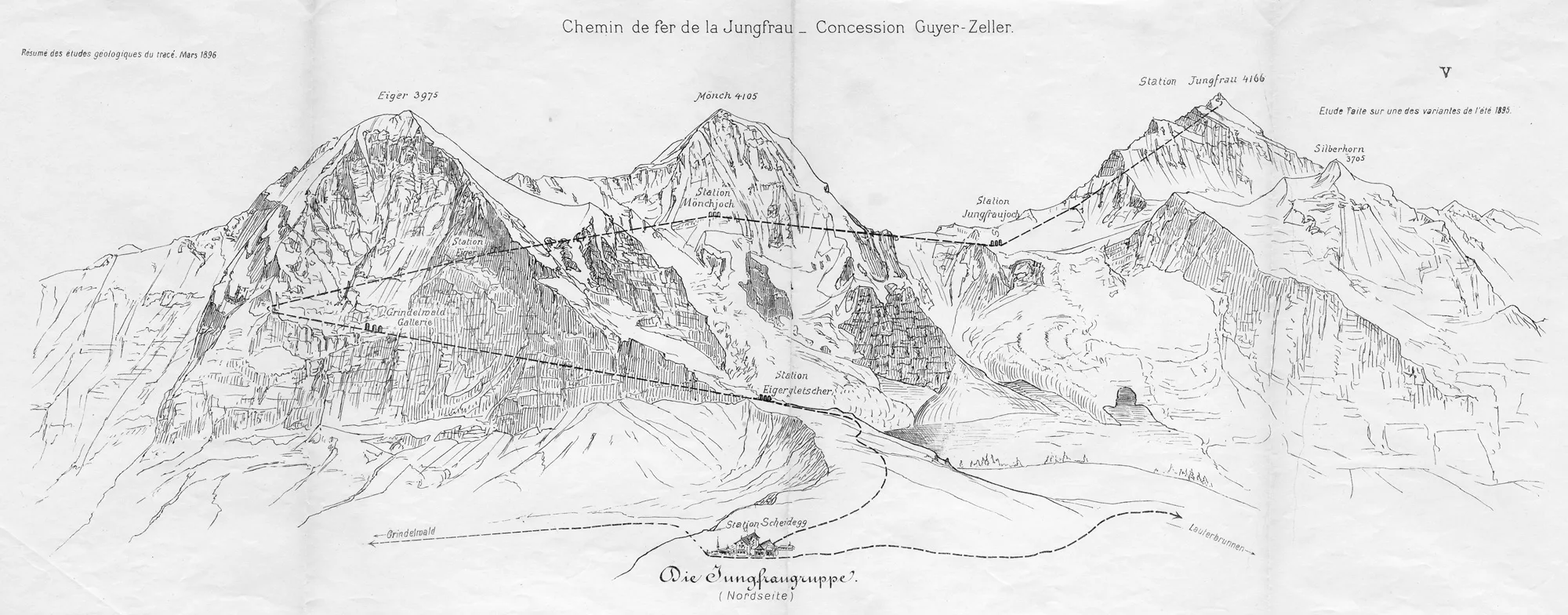
Outline of the route of the Jungfrau railway, 1896.
Outline of the route of the Jungfrau railway, 1896. jungfrau.ch
The Eiger project fell by the wayside. Koechlin’s licence expired without him having secured the requisite financing. Guyer-Zeller thus emerged victorious and received the permit at the end of 1894. He calculated the 15-kilometre route would take seven years to build and cost CHF 7.5 million. Work officially commenced on 27 July 1896. Interestingly, after running a competition for propulsion system proposals, Guyer-Zeller recruited the winner Emil Strub, his erstwhile adversary and inventor of a proprietary cogwheel system, to work as technical director. However, they went their separate ways just a year later due to irreconcilable differences.
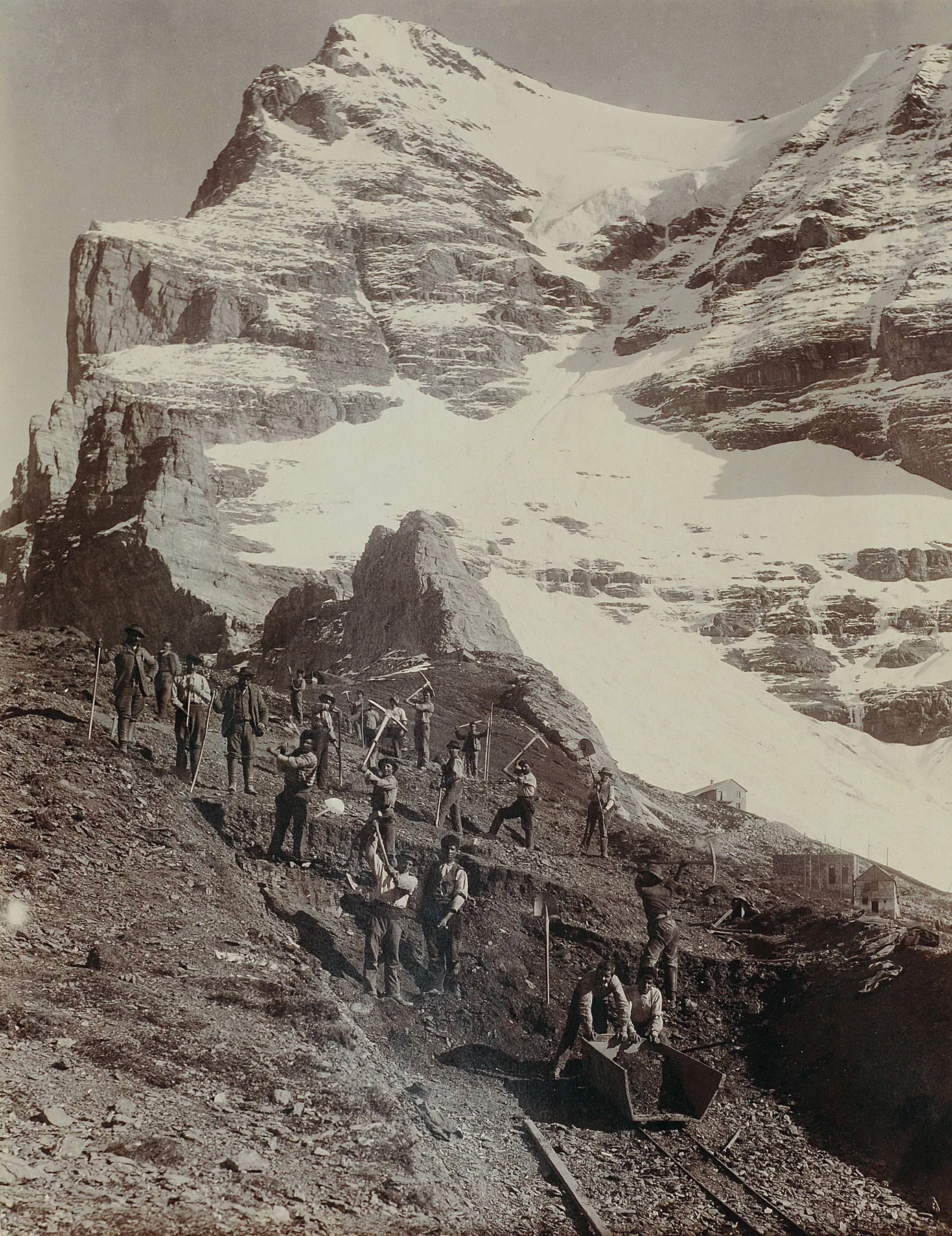
Men at work building the track, ca. 1896.
Men at work building the track, ca. 1896. jungfrau.ch

Unfinished business

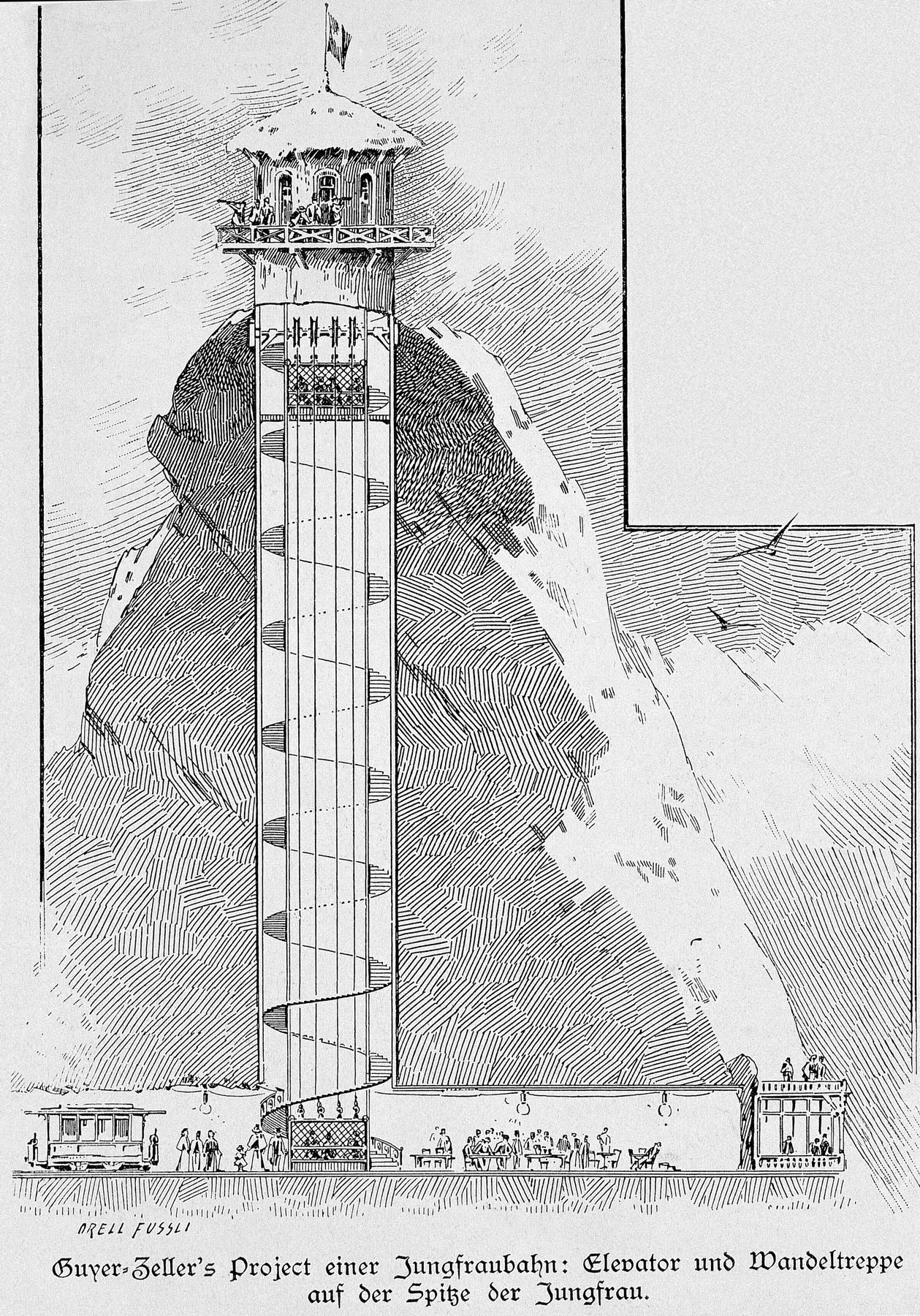
Meanwhile the base camp was set up on the Eiger glacier at 2,320 metres: housing blocks, catering facilities, workshops and sheds. Up to 300 people worked throughout the year on Europe’s highest building site. With shovels, pickaxes and hard physical labour they cleared tonnes of stone for the route and blasted their way into the mountain with hammer drills and dynamite. After the Eigergletscher station, the train was to ascend gently through the Eiger, with the Eigerwand and Eismeer stations offering spectacular views from a “window-like balcony opening”. And a stairwell and lift shaft was to go 65 metres up from the terminus beneath the summit to the top of the mountain.
This shaft with stairs and a lift was intended to help visitors reach the summit.
This shaft with stairs and a lift was intended to help visitors reach the summit. jungfrau.ch
Guyer-Zeller hosted a grand ceremony with 400 guests to mark the opening of the Eigergletscher station in autumn 1898. The parson in Grindelwald said the railway was a godly undertaking because it served “the glorification of the Almighty” and would “bring great pleasure and blessings to thousands upon thousands of His flock”. The technology maestros were feted for “making the snowy realm accessible to all”. No praise was too great for Guyer-Zeller in the eyes of his biographer Konrad Falke: “When the track reached the summit of the Jungfrau,” it marked an accomplishment which was “bigger and more culturally significant than reaching the North Pole”. He likened Guyer-Zeller to Winkelried. Like the hero from Swiss history who opened a crucial line in battle, Guyer-Zeller had dedicated his life to providing an access route for the public.
 
Guyer-Zeller died six months later at the age of 60 from a heart attack, and the project ran into financial difficulty. All efforts were then concentrated on opening the sections up to the Joch to bring money in. The last section “spiralling round the mountain’s highest massif” and the lift to the summit were scratched.
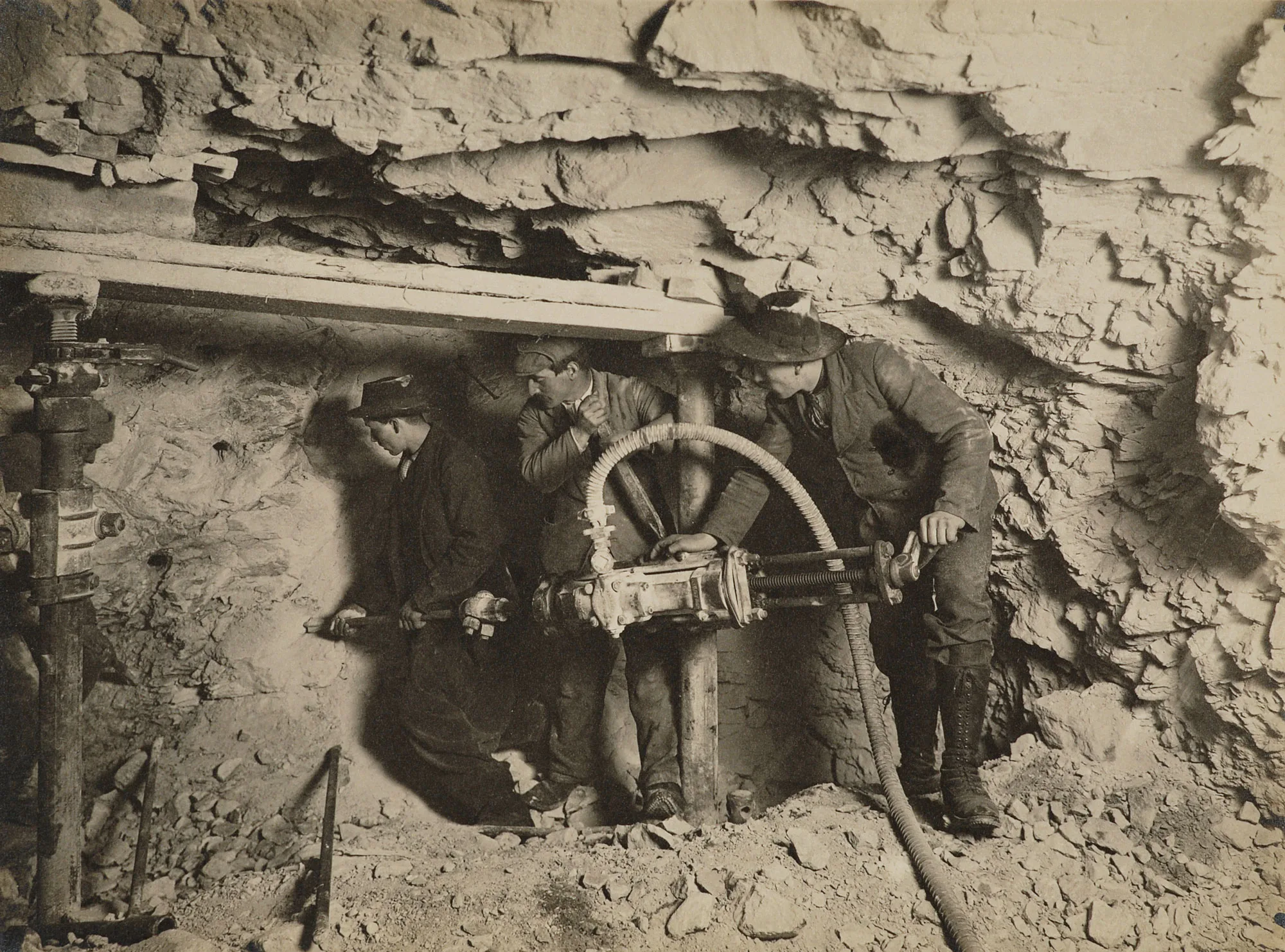
The breakthrough to the Jungfraujoch came in February 1912.
The breakthrough to the Jungfraujoch came in February 1912. jungfrau.ch
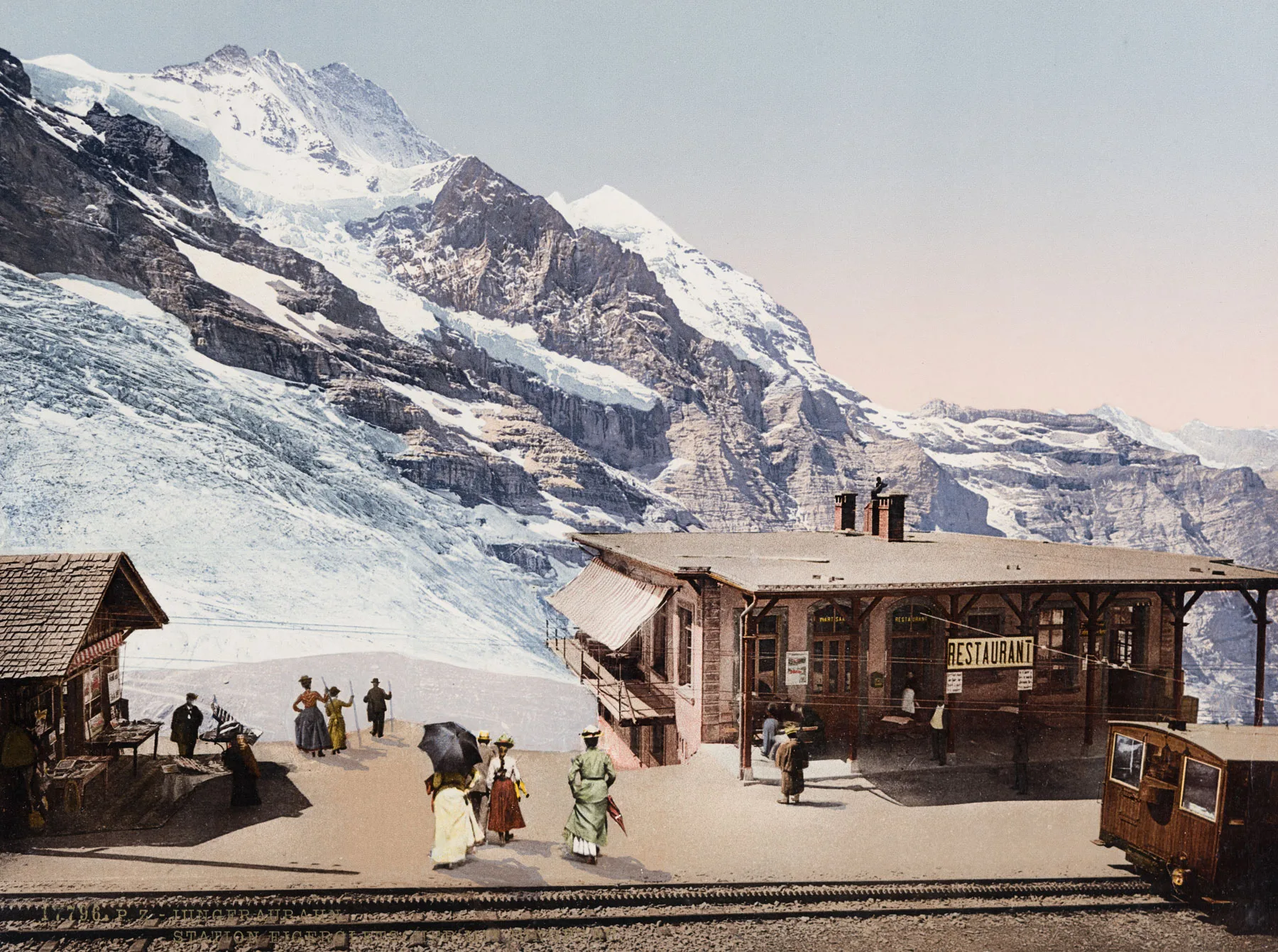
Tourists at Eigergletscher station.
Tourists at Eigergletscher station. Swiss National Museum
A powerful explosion in early 1912 blasted through the last metres of rock on the Jungfraujoch. The railway became operational on 1 August 1912. It is the world’s highest station at 3,466 metres above sea level. Construction took four times longer than planned, costs came to CHF 16 million instead of CHF 7.5 million. 30 workers were killed during construction and 92 severely injured. But that was all glossed over in the wave of euphoria at the project’s completion. The great and the good could henceforth travel to the top of the mountain in all their finery, in security and comfort. The technological conquest of the Alps has continued ever since. The highest peaks and majestic glaciers are now presented like merchandise displayed in a shop window – as readily available goods of international mass tourism intended for rapid consumption.

Further posts