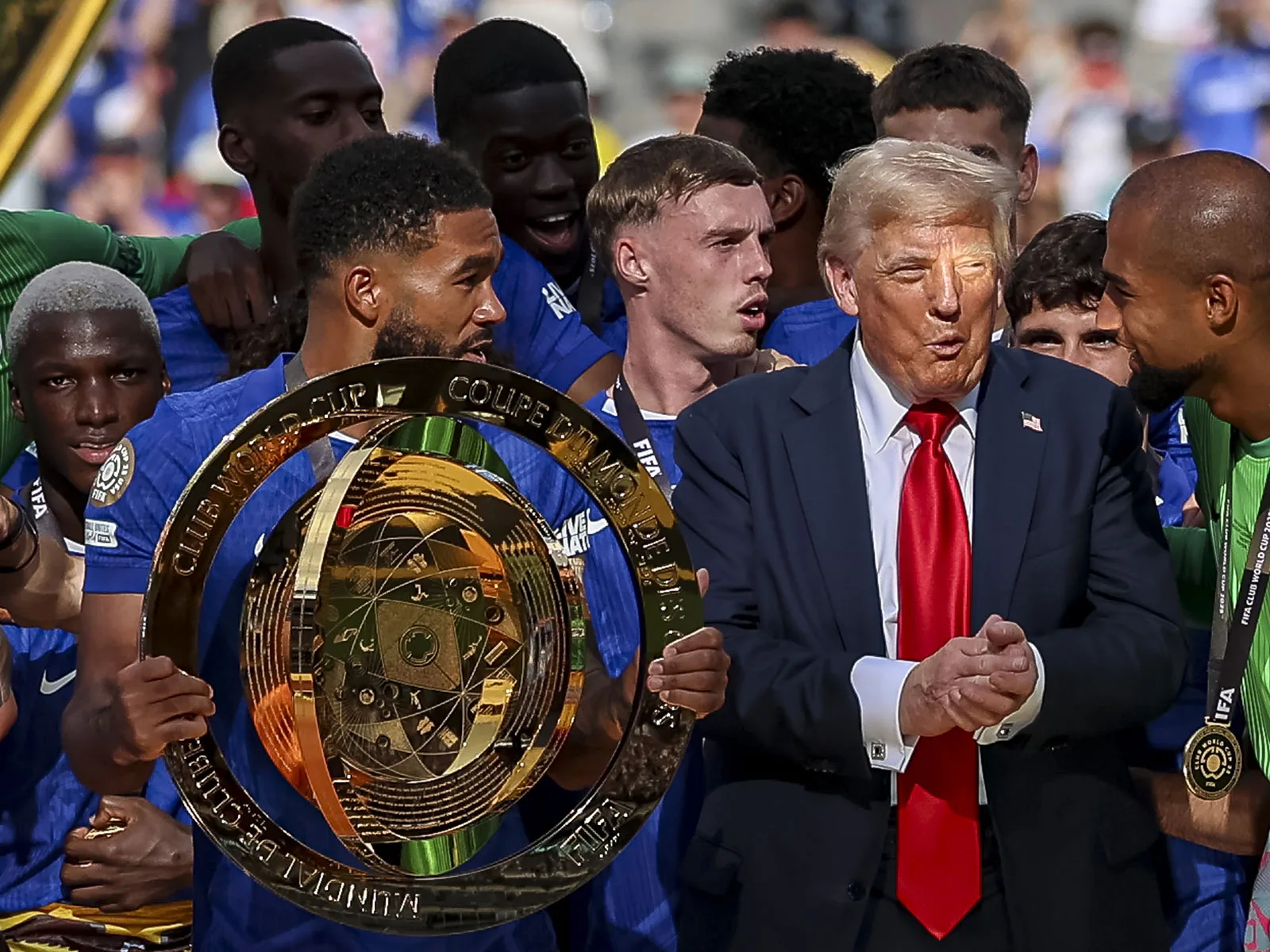
Chelsea won the football Club World Cup in July 2025. However, US President Donald Trump stole the limelight, remaining front and centre on stage as they celebrated lifting the trophy.
Chelsea won the football Club World Cup in July 2025. However, US President Donald Trump stole the limelight, remaining front and centre on stage as they celebrated lifting the trophy. Dukas

Games of power

Throughout history, rulers have used sport as a stage to present themselves and their ideals in a certain light. The practice began in Roman amphitheatres and continues to this day. Even in Switzerland.

Simon Engel

Simon Engel

Simon Engel is a historian and is responsible for public relations work at Swiss Sports History.

US President Donald Trump has decreed the 2026 World Cup to be a matter worthy of his own personal attention. As chairman of the World Cup Taskforce, he has made the tournament a central focus of his political work. But Trump is no exception. Ever since Classical Antiquity those in positions of supreme power have been using the general public’s enthusiasm for sport to portray themselves in a positive light, gain followers and spread political messages. Sport is an ideal vehicle for this, given that games are seen primarily as a competition or contest and not as a political event. Let us take a look at some examples from history.

Antiquity: games and imperial mercy
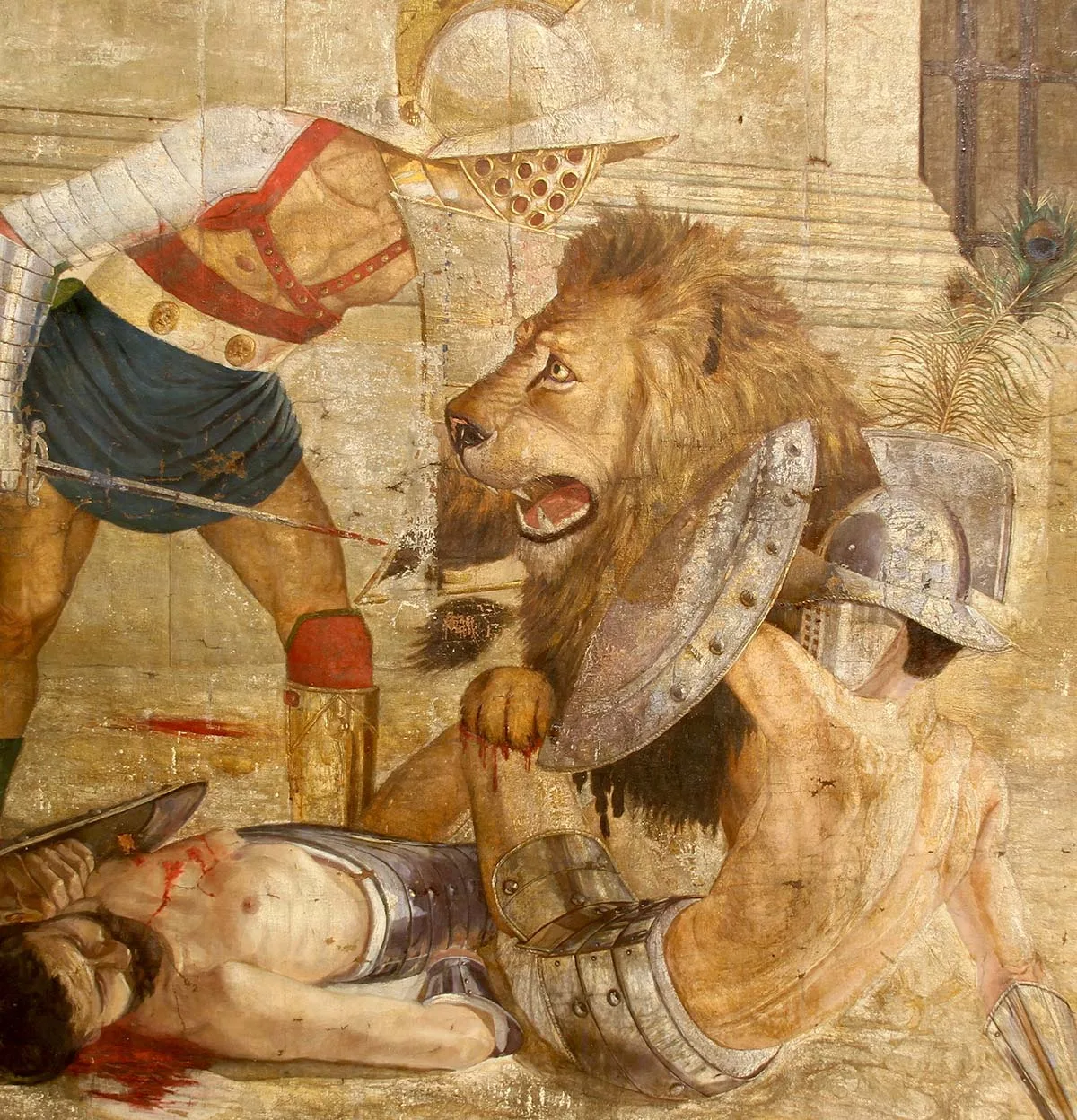
Major sporting events were already being held in Europe back in Antiquity. The Greeks had their Olympic Games involving foot races and wrestling, while the Romans loved their chariot races, animal baiting and gladiator games. The latter also took place on the territory of what is now Switzerland. The Romans completed their conquest of the area by 15 BCE, and the local inhabitants gradually began adopting the Roman way of life. Latin became widely spoken, and towns were remodelled along Roman lines to include thermal baths and amphitheatres. These arenas served as venues for theatrical performances as well as gladiatorial duels and staged animal hunts.
People were not the only ones to die in Roman arenas: numerous animals also met their end at events known as venationes, which were extremely popular with audiences.
People were not the only ones to die in Roman arenas: numerous animals also met their end at events known as venationes, which were extremely popular with audiences. Wikimedia
Gladiator fights are thought to have their origins in Etruscan burial rites at which the blood spilled was seen as a sacrifice for the dead. In Ancient Rome, they evolved into state-organised mass spectacles known as munera that took on a political significance. The games became more and more extravagant in their staging, especially during the imperial period, with growing numbers of combatants and an increasing focus on the ruler adding a whole new political slant. The emperor’s presence in the arena allowed him to display his power in a way that was plain for all to see. When deciding whether a defeated gladiator should be allowed to live or die, he could demonstrate either clementia, i.e. mercy, or unyielding severity. Passing judgement in this way in front of tens of thousands of his subjects was a direct expression of the emperor’s might.
However, aware of the need to maintain popular support, emperors often allowed the wishes of the braying crowd in the arena to dictate their decision. It is no coincidence that citizens were able to attend these spectacular events free of charge. They were a means of entertaining the masses while at the same time binding them to their ruler. In other words, gladiator games were also a politically motivated gift to the populace from those in power, as reflected by the famous saying ‘bread and circuses’.
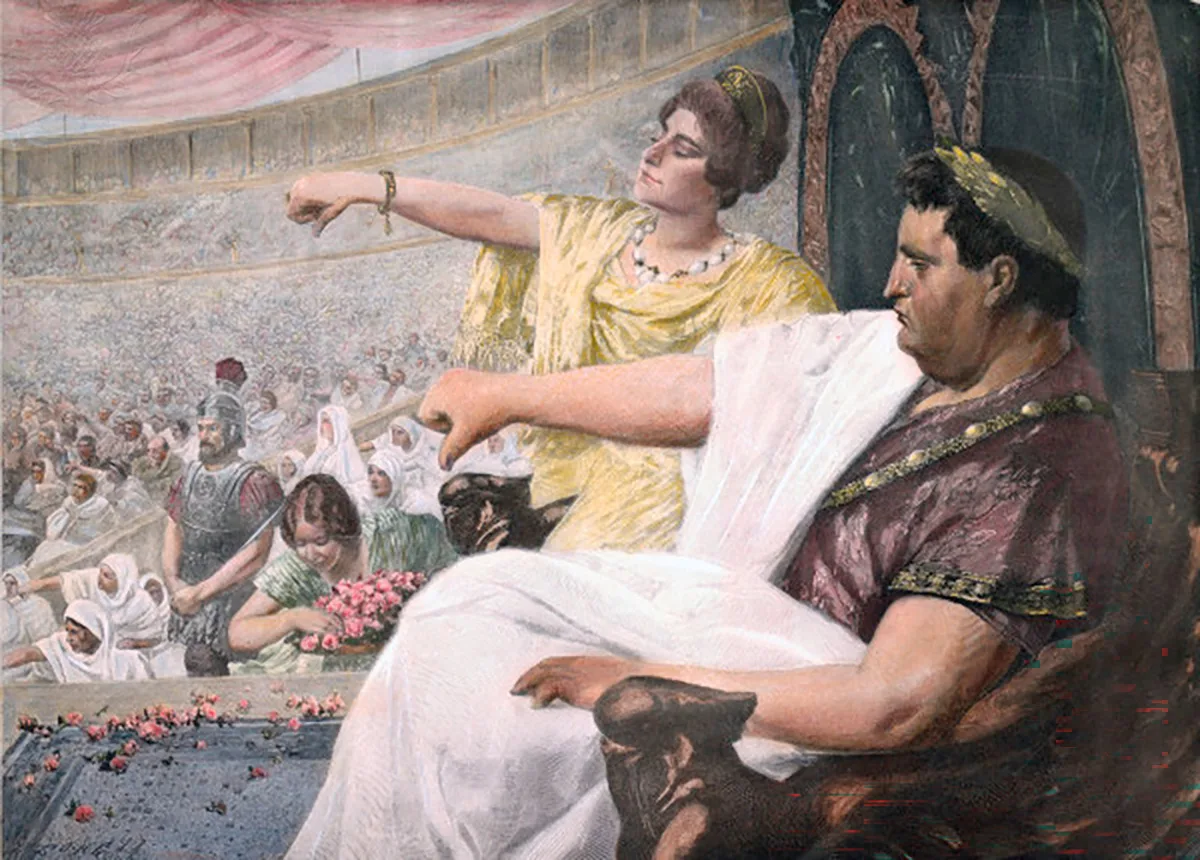
Life or death? In the amphitheatre, a Roman emperor’s power was manifested in a single hand gesture. Here we see Nero giving the thumbs-down on a painting dating from 1900.
Life or death? In the amphitheatre, a Roman emperor’s power was manifested in a single hand gesture. Here we see Nero giving the thumbs-down on a painting dating from 1900. akg-images / Universal Images Group
Eight amphitheatres have been excavated in modern-day Switzerland, demonstrating the erstwhile popularity of these games in this region, especially in Augusta Raurica. While there are no written sources detailing exactly what happened at these combat events, we do have evidence that two emperors spent time in Augusta Raurica during Late Antiquity. So, it’s entirely possible that the techniques of dominance beloved of Roman rulers were celebrated there.

The Middle Ages: jousting tournaments as a form of power politics
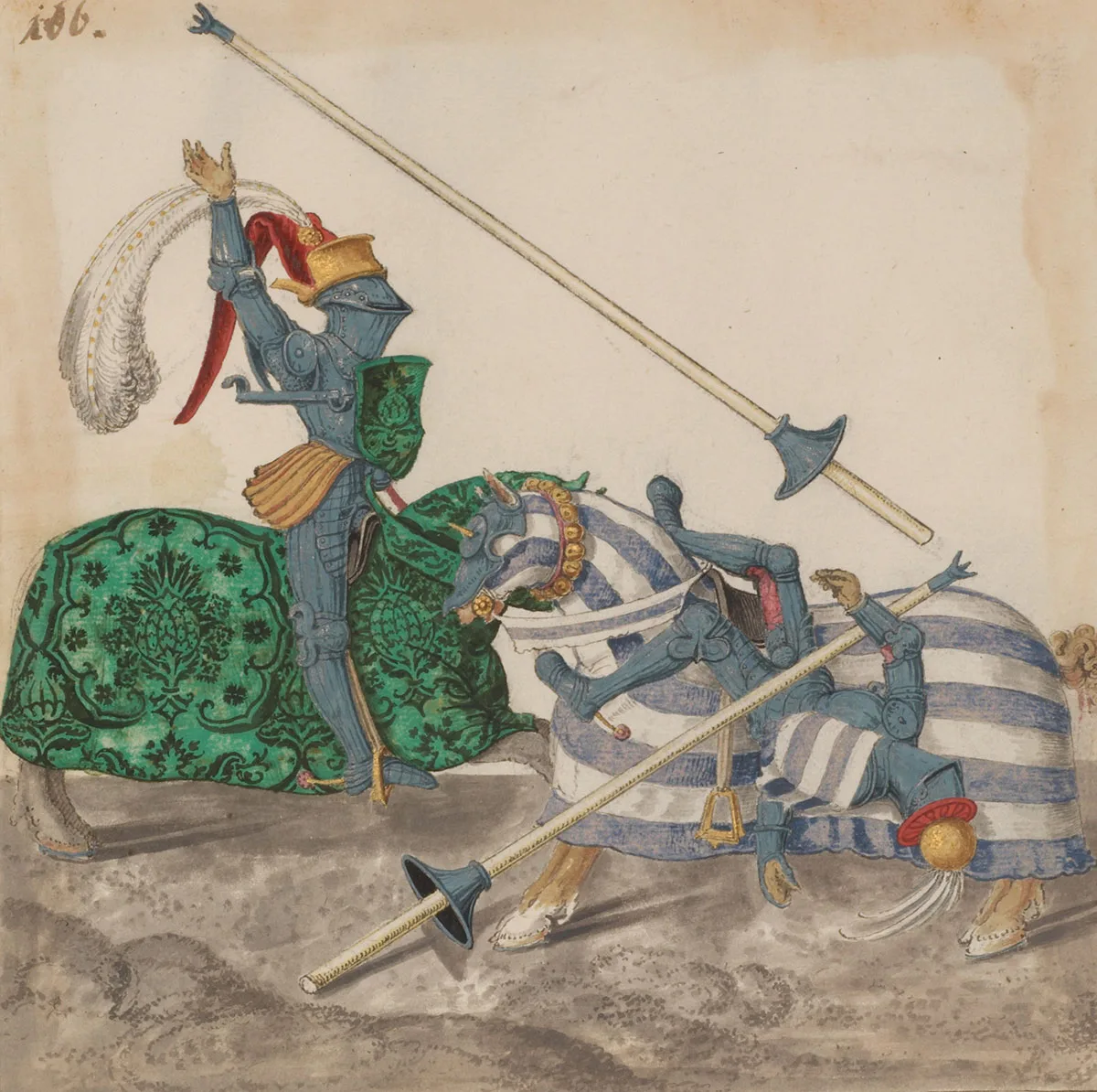
In the medieval period, the sporting repertoire consisted of wrestling, stone putting, ball games, shooting contests and jousting tournaments. Many of these competitive events also served a political function. Marksmen’s festivals, for example, were an opportunity for friendly exchange between the members of the Old Swiss Confederacy. Some, like the Zurich Freischiessen of 1504, even attracted participants from beyond the country’s borders. Conceived as an honourable, peaceful competition (‘eerliche Schiessen’), the event was intended to stabilise relations with Emperor Maximilian I and the southern German cities after the Swabian War.
Maximilian I himself is a good example of a ruler who was fond of using sport as a political platform. He was head of the vast yet politically fragmented Holy Roman Empire, of which the Old Swiss Confederacy was also part. Securing his power as emperor required him to curry favour with kings, princes and local elites. Jousting tournaments were one way of doing so. They brought high-ranking aristocrats, princes and loyal knights from all parts of the empire to Maximilian’s court – thus strengthening their ties to him, as being close to the emperor meant wielding political influence. At the same time, tournaments provided the ideal backdrop for informal discussions with foreign envoys, leaving strict court protocol aside.
Image from the Freydal, a tournament book recounting the life of young Maximilian in an allegorical narrative. The book was created in the early 16th century.
Image from the Freydal, a tournament book recounting the life of young Maximilian in an allegorical narrative. The book was created in the early 16th century. Wikimedia / Kunsthistorisches Museum Vienna
Unlike many other rulers of the time, Maximilian continued to take part in jousting tournaments until a relatively advanced age. His sporting successes – including the prestigious victory over famous Burgundian knight Claude de Vauldrey at the Diet of Worms in 1495 – were public demonstrations of his physical strength, virility and courage. Given the bellicose nature of society at the time, this earned him considerable respect. At the same time, Maximilian used the setting of the arena to display his generosity as emperor, immediately passing on to his vanquished opponents any prizes he was awarded.

The modern era: wrestling staged for political purposes
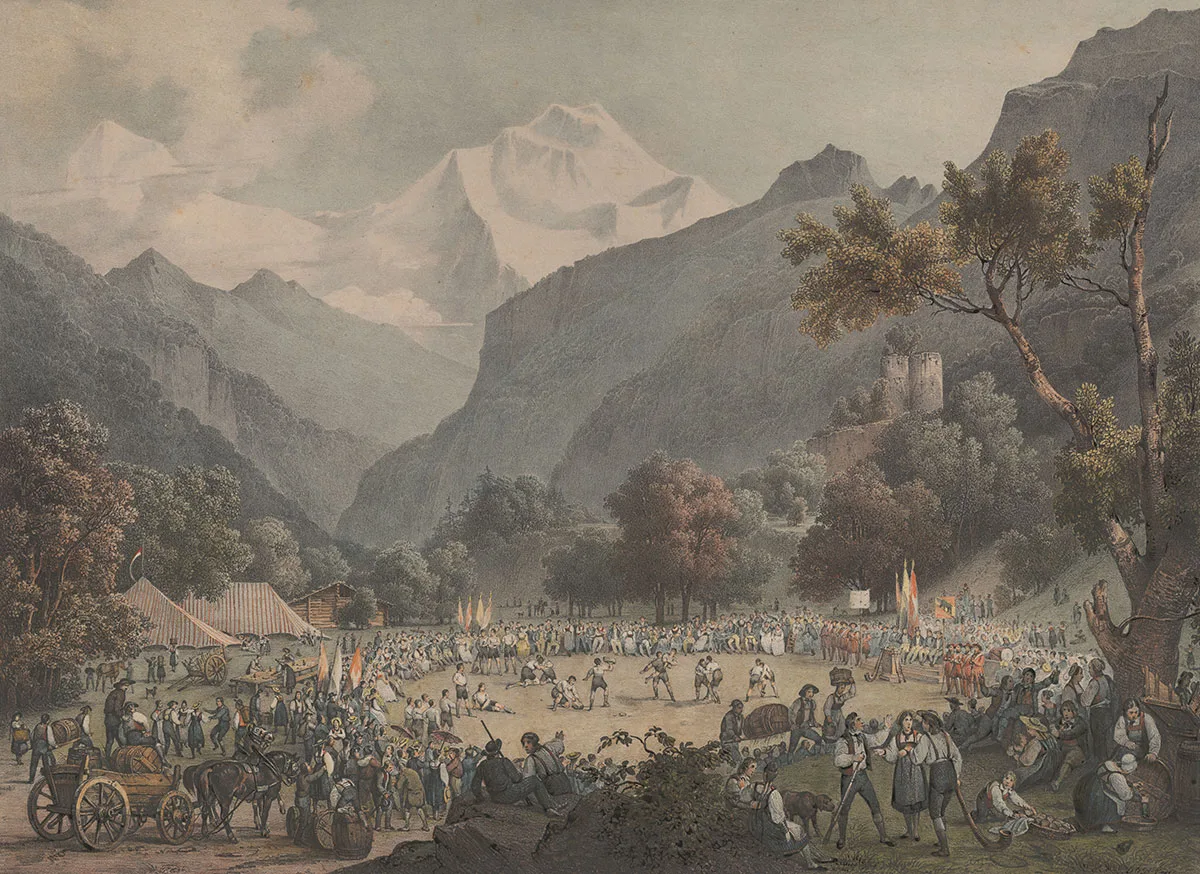
In the late 18th century, in the wake of the Enlightenment, the European elite began to rediscover the splendours of the natural world ‒ especially those of the Alps. Whereas the mountains had previously been associated with poverty, isolation and natural hazards, they now became a place of projected longing. In Switzerland, this newfound fascination also manifested itself in the embracing of Alpine customs and traditions, with an increasing focus on hornussen, stone putting and Swiss wrestling. These were all sporting activities practised in the main by Alpine herdsmen. But the latter had now become the very epitome of what it meant to be Swiss: upright, modest, down-to-earth – qualities that could be derived directly from the Alpine landscape.
The Unspunnen Festival, depicted by Godefroy Engelmann the Elder, 19th century.
The Unspunnen Festival, depicted by Godefroy Engelmann the Elder, 19th century. Swiss National Museum
It was during this same period that the idea of nations and nationhood began to take hold throughout Europe. Political and cultural elites were on the lookout for traditions and characteristics that could be considered ‘typical’ of their respective countries. This often meant elevating local customs to the status of national cultural property. It was this spirit that prompted the Mayor of Bern Niklaus Friedrich von Mülinen and other notable citizens of the city to launch the very first Unspunnenfest in 1805. The programme included wrestling and stone putting as well as sporting contests. The aim was to ease the tensions between the cities and the rural areas that had previously been their subject territories by emphasising what they held in common.
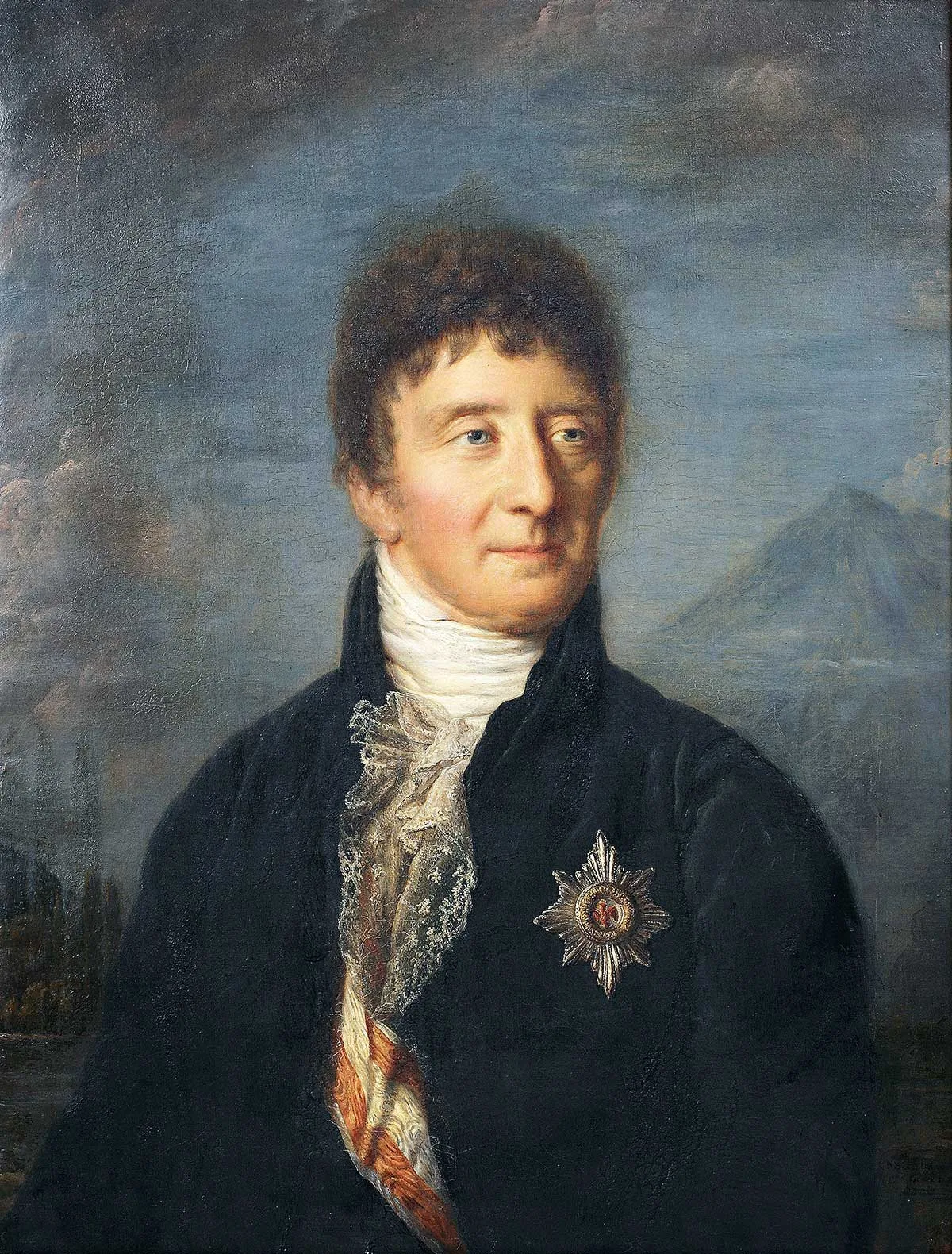
Portrait of Niklaus Friedrich von Mülinen, 19th century.
Portrait of Niklaus Friedrich von Mülinen, 19th century. Wikimedia / Bern History Museum
The irony of it all: von Mülinen and his fellow initiators were proponents of the ancien régime. They rejected the values of the French Revolution imposed on Switzerland by Napoleon and thus did not believe the rural population to be of equal legal standing. In other words, the Unspunnen Festival was an act of political showmanship dressed up as a celebration of traditional customs and sport. The people were on show – but it was the old elite who sat in the director’s chair.

The 20th century: symbolic politics of a team shirt and showing off on the ski slopes

When we think of sport being used for political ends in the 20th century, authoritarian regimes and dictators quickly spring to mind. The staging of the 1936 Olympic Games by the Nazis is probably the best-known example. But sport continues to be used as a platform by heads of state to this day, even in democratic countries. Admittedly, the cult of personality is usually less pronounced than in ancient times or the Middle Ages. Nowadays, the focus is more on the message the representative of state wishes to convey. Sport has entered the realm of symbolic politics.
One example of this is Nelson Mandela at the 1995 Rugby World Cup. South Africa’s first black president turned up at the final against New Zealand wearing the colours of the South African national team. Rugby had traditionally been a sport played by the country’s white citizens. In appropriating a symbol that the majority black population associated with apartheid and donning the rugby shirt in front of an audience of millions, Mandela thus embodied the spirit of reconciliation between white and black people in the country.
Nelson Mandela’s stadium appearance has gone down as one of the key moments in recent world history. YouTube
Members of the Federal Council make similar attempts at symbolic, national integration whenever they appear at national Swiss wrestling festivals and present the values of the sport as values that underpin the state: in 2013 in Burgdorf, Ueli Maurer told the crowd that “roots, values and foresight” were a political formula for Switzerland’s future. Karin Keller-Sutter claimed at the 2025 event in Mollis that wrestling ideals such as decency, respect, camaraderie and modesty were also universal Swiss values.
However, sport is not merely suited to spreading national messages, it is also ideal for cultivating a distinct personal image. Especially so if the politician in question is able to demonstrate their own sporting prowess, something that former member of the Federal Council Adolf Ogi was particularly adept at. As a former ski instructor and successful Director of the Swiss Ski Association he personified Swiss sport like almost no other. His attendance at sports events was never just for appearance’s sake. This was made particularly evident at his first official engagement as sports minister in early 1998 when he opened the annual ski camp for young people: Ogi not only gave a speech, he also strapped on a pair of skis and zipped down the slopes alongside the youngsters. It was a typical piece of showboating by the man, presenting himself as sporty and with a common touch but nevertheless statesmanlike.
Almost a kind of ‘advertorial’ for the new sports minister Adolf Ogi (in German). SRF

Swiss Sports History

This text was produced in collaboration with Swiss Sports History, the portal for the history of sports in Switzerland. The portal focuses on education in schools and information for the media, researchers and the general public. Find out more at sportshistory.ch
Further posts