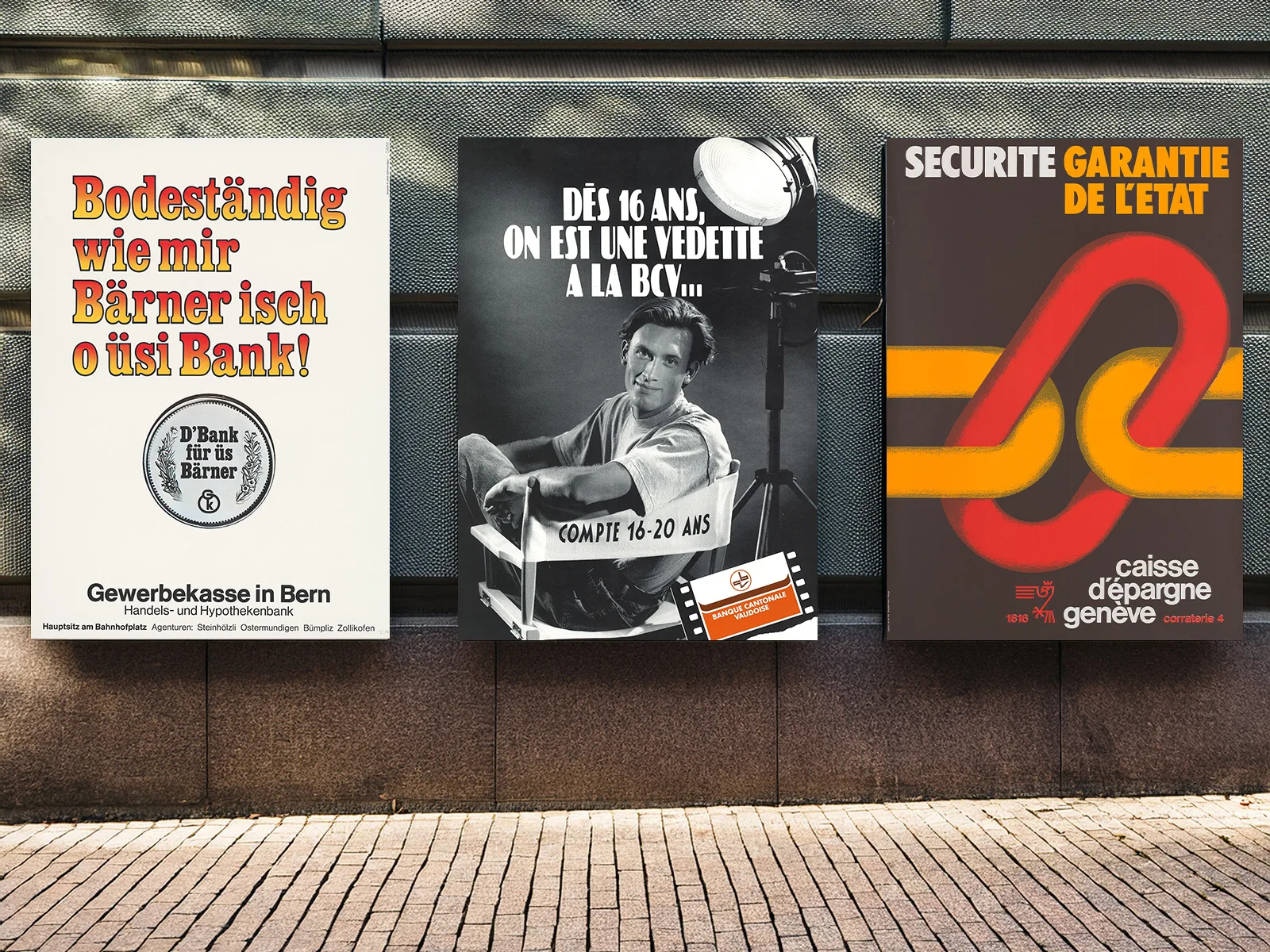
Posters of financial institutions that have long since gone out of business show that every small town and village once had its own bank.
Posters of financial institutions that have long since gone out of business show that every small town and village once had its own bank. Montage: Swiss National Museum

Banking secrecy and the demise of banks

What did banking secrecy look like before it fell out of general favour? The images portrayed in advertising for Swiss banks reveal a great deal about the sector’s history, reflecting both the international rise of the financial centre and its unparalleled consolidation.

Daniel Di Falco

Daniel Di Falco

Daniel Di Falco is a historian and editor of the "NZZ Geschichte" magazine.

Is it a parody? A joke about the sector’s less than virtuous side? You could be forgiven for thinking so. However, the poster is genuine and dates back to 1964. A business suit, crisply pressed trousers, a briefcase and a figure whose face cannot be seen but whose posture and intention are clear: take the case to the bank and deposit the money in an account. Much like the finely checked pattern of the figure’s suit, nothing that is happening here is likely to attract undue attention.
This advertisement is portraying the bank’s promise that it can be relied on to exercise discretion. However, the fact that the customer remains incognito, their face and name unknown, is somewhat at odds with the personal nature of the message being conveyed through the choice of words “mon compte” (my account) and “j’ai choisi” (my choice). Who/where is the ‘I’ speaking here meant to be? And yet the whole thing somehow comes together. After all, this disappearing act, leaving a blank space to be filled, is the very method that made the Swiss financial centre legendary. In other words, the form of institutionalised discretion known as ‘banking secrecy’.
This 1964 poster created a lasting image of that secrecy, a visual cypher. And it did so at a time when the practice had not yet been discredited. First enshrined in Article 47 of the 1934 Banking Act, banking secrecy obliged the sector’s institutions to protect information about their clientele from being disclosed to third parties – including foreign tax authorities. Switzerland was the only country with such a provision in its laws at the time. Policymakers had thus given the nation’s bankers a trump card right in the middle of the Great Depression of the 1930s: not only did they henceforth have a duty to maintain a code of silence, it was also their statutory right to do so. This competitive advantage played a key role in the spectacular rise of the Swiss financial centre and contributed to its success as a safe haven for international capital.
That is the view taken today by historians such as Sébastien Guex and Jakob Tanner. According to Tanner, the business model of the major Swiss banks in the 20th century was fundamentally predicated on the “link between asset management and tax evasion by foreign clients”. But there were also other success factors, including the fact that the country had come through two World Wars relatively unscathed, its neutrality, hard currency and political stability. Nevertheless, Tanner believes that Switzerland would not have become “the world’s largest private vault” so quickly without banking secrecy.
Customer safe from the headquarters of Schweizerische Volksbank, Basel, 1912
A symbol of banking secrecy: Customer safe from the headquarters of Schweizerische Volksbank, Basel, 1912. Swiss National Museum
It is true that the banking sector grew rapidly in the post-Second World War period. In the 1960s, Switzerland rose to become the world’s third largest financial hub. And in the following decade, the sector decoupled its growth from that of the rest of the economy. The international asset management business was a key factor in this development, given that it “generated welcome turnover in years of recession and became a veritable cash cow in phases where the economy was booming,” as Malik Mazbouri, Sébastien Guex and Rodrigo Lopez write.
By around the year 2000, the sum total of private assets entrusted to the Swiss financial centre was nine times higher than the country’s entire economic output. Almost one-third of all transnational assets worldwide were managed by banks in Switzerland, making it the most important offshore platform for private wealth management. And the biggest player in this line of business was UBS ‒ a Swiss institution.
The information about the history of the banking sector in this text is taken mainly from the chapter entitled ‘Finanzplatz Schweiz’ by Malik Mazbouri, Sébastien Guex and Rodrigo Lopez in the standard work Wirtschaftsgeschichte der Schweiz im 20. Jahrhundert, published in 2012. Information on the history of modern advertising and on advertising as a historical source can be found in the 2002 anthology Bilder vom besseren Leben, edited by Daniel Di Falco, Peter Bär and Christian Pfister.
However, when it comes to foreign clientele, banking secrecy is now a thing of the past. Repeatedly criticised as a means of cross-border tax evasion, it came under mounting political pressure from Washington and Brussels in the wake of the 2007/2008 financial crisis. The internationalisation of criminal standards then sounded another death knell. Switzerland was forced to adopt the OECD Convention on Mutual Administrative Assistance in Tax Matters in 2009 and agreed in 2014 to join the international treaty on the “automatic exchange of information” with authorities abroad. Since then, only Swiss customers have been able to rely on their identity and bank balance remaining as anonymous as that of the suit-wearer on the Union de Banques Suisses (Union Bank of Switzerland) poster.
Once a proverbial virtue, secrecy has now become a literal problem. That’s what makes the poster from 1964 so astonishing: it shows the degree of self-assurance with which a bank was still able to present itself in those days ‒ and the extent to which people’s attitudes have changed in the meantime. Why does advertising from the past often have an unintentionally comic effect? Because it so readily embraces values that people no longer identify with.
But this glimpse of yesterday’s world is not the only thing that stands out when looking at the poster from 1964. Although there has been no systematic study of advertising by Swiss banks to date, it is safe to assume that banking secrecy was not overly publicised – despite the crucial role it played in the industry. And for one very good reason: making an active display of discretion contradicts the whole principle of discretion.
Modern advertising can do many things: it can project domestic happiness onto something you spread on your bread, it can sell social mobility in the guise of a new motor car, or it can let the adventure of a lifetime begin with a cigarette. And it can also successfully transform relatively abstract services like investment funds into something higher and greater. But it is reasonable to assume that banking secrecy is a slightly different matter: the public sphere is not the ideal place to promise anonymity. Any bank willing to make a talking point of its discretion risked losing its credibility. Especially among those high to very-high-net-worth clients whose financial power and cachet were so crucial to business. All of which means this 1964 piece of publicity for the Union Bank of Switzerland is likely something of a rarity.

From small banks to greedy big banks

Admittedly, the Union Bank of Switzerland has also been consigned to history. After a long time as one of the five largest banks in post-war Switzerland, it disappeared shortly before the end of the century owing to a development that coincided with the rise of the country’s financial centre ‒ banks kept growing in size, while at the same time decreasing in number. The very first thing that strikes the viewer when looking at old advertisements for Swiss banks is all those companies that have faded away. It’s like walking through a museum of extinct species diversity. What the advertising directly reveals is the consolidation that took place within the sector in the second half of the 20th century.
Until then, small to medium-sized banks of one kind or another had existed all over the country: mortgage-lending banks, commercial and trade banks, savings banks and building societies whose names people can now barely remember. Many had been established in the 19th century, in an era when there was no such thing as social insurance, making saving all the more important – as a means of setting money aside for old age and infirmity or unemployment.
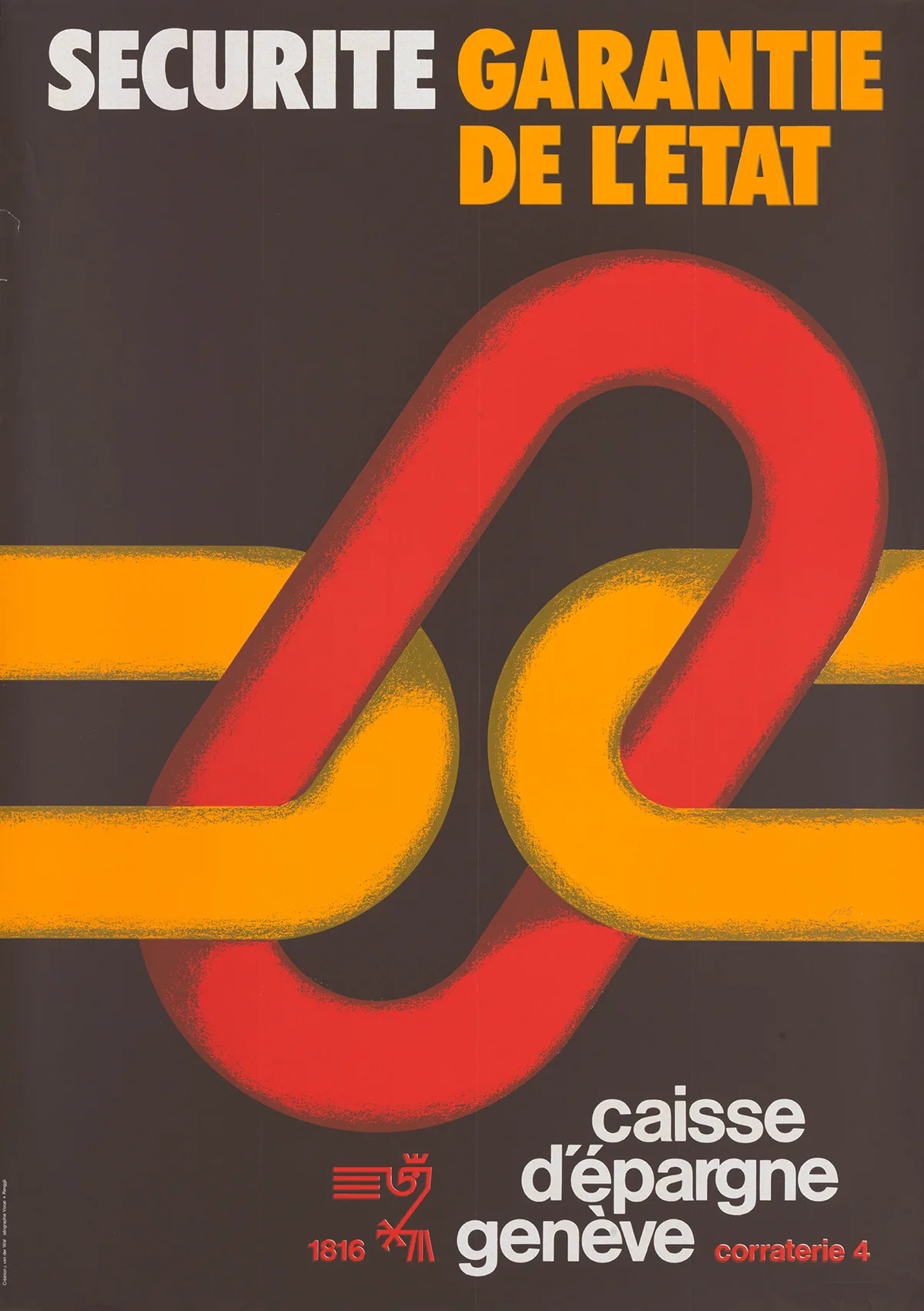
From the museum of banks that have vanished: 1975 poster for Caisse d'Epargne de Genève. The savings bank had been founded in 1816 by philanthropists who wanted to enable ordinary working people to save for a rainy day. In 1993, it merged with the Banque hypothécaire to form the Banque Cantonale de Genève, the current cantonal bank.
From the museum of banks that have vanished: 1975 poster for Caisse d'Epargne de Genève. The savings bank had been founded in 1816 by philanthropists who wanted to enable ordinary working people to save for a rainy day. In 1993, it merged with the Banque hypothécaire to form the Banque Cantonale de Genève, the current cantonal bank. Caisse d'Epargne de Genève
All that changed in the mid-20th century. Old Age and Survivors’ Insurance (OASI) was introduced in 1947, with other forms of social insurance to follow. Personal saving therefore lost some of its importance. At the same time, small institutions were feeling the squeeze as the big banks attempted to seduce their customers. The new branches being opened by the big players up and down the country heralded the consolidation that was soon to take place in the banking system.
That process started off slowly. Three dozen local and regional banks went out of business between 1950 and 1970, their number falling from 290 to 254. The Union Bank of Switzerland pursued a particularly aggressive policy of expansion. By 1970 it had significantly more branches than its two greatest rivals, the Schweizerische Kreditanstalt (SKA, Swiss Credit Bank, later to become CS) and the Schweizerischer Bankverein (SBV, Swiss Bank Corporation). And it occupied the top spot among Swiss banks in terms of total assets and equity.
The recession of 1973 to 1976 marked the beginning of a phase of accelerated concentration. The global economy was no longer moving in a clear direction, policymakers were pushing for liberalisation and deregulation, financial market risks were growing, and competition was becoming “more brutal and more intense” (Mazbouri/Guex/Lopez). This situation saw the big banks battling to secure their position in international asset management and gain access to new markets like investment banking. But they also wanted to extend their influence in the domestic market, specifically in the retail banking business where a large number of small customers had savings and mortgage loans. That meant even more branches, more advertising and more presence. Offers aimed especially at young – and old – savers show the extent to which the entire sector was determined to build up a broad client base.
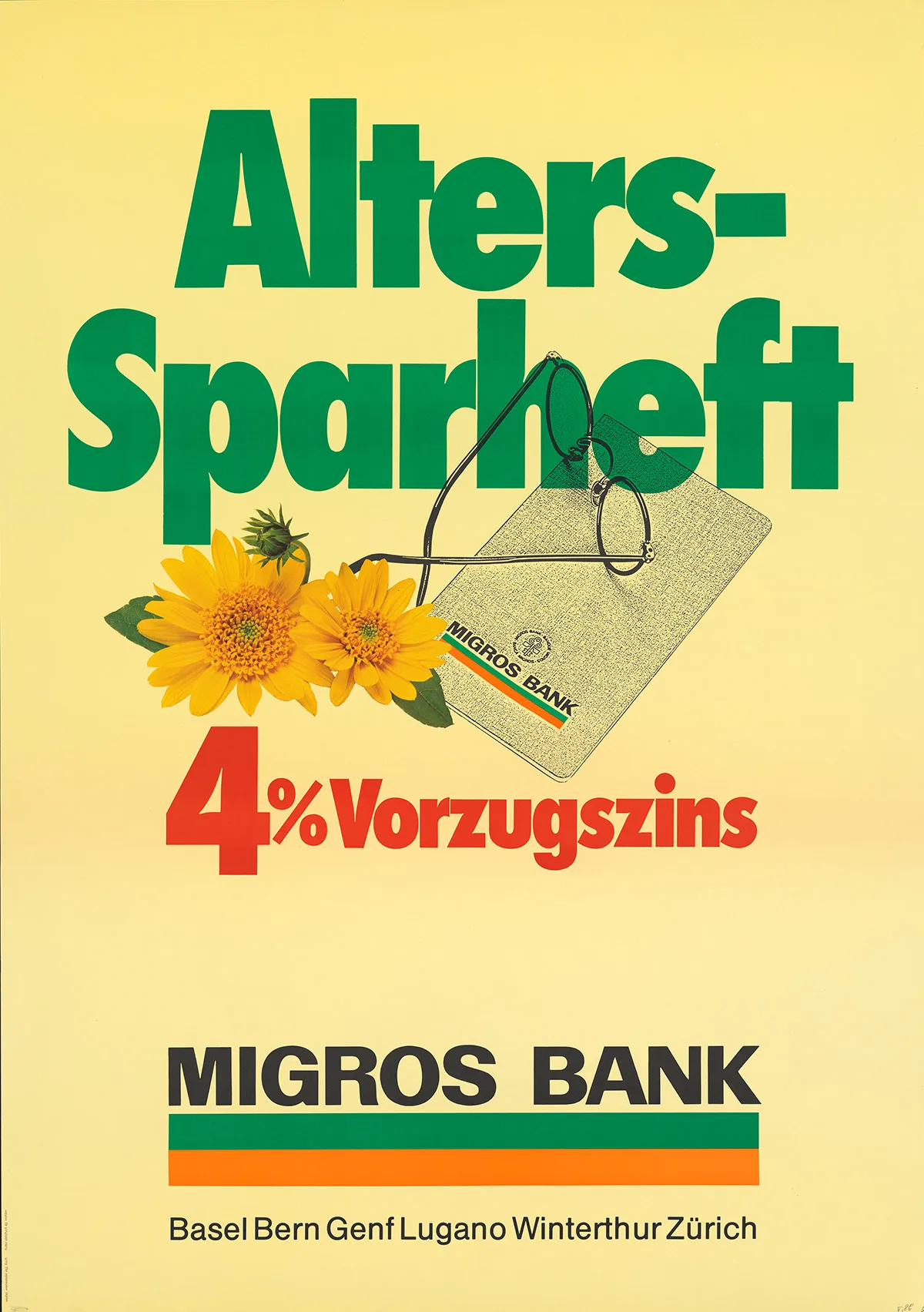
From the cradle to the grave: banks competed for the savings of a broad clientele. Adverts for the Banque Cantonale Vaudoise (1990) and the Migros Bank (1981).
From the cradle to the grave: banks competed for the savings of a broad clientele. Adverts for the Banque Cantonale Vaudoise (1990) and the Migros Bank (1981). Banque Cantonale Vaudoise / Swiss National Library
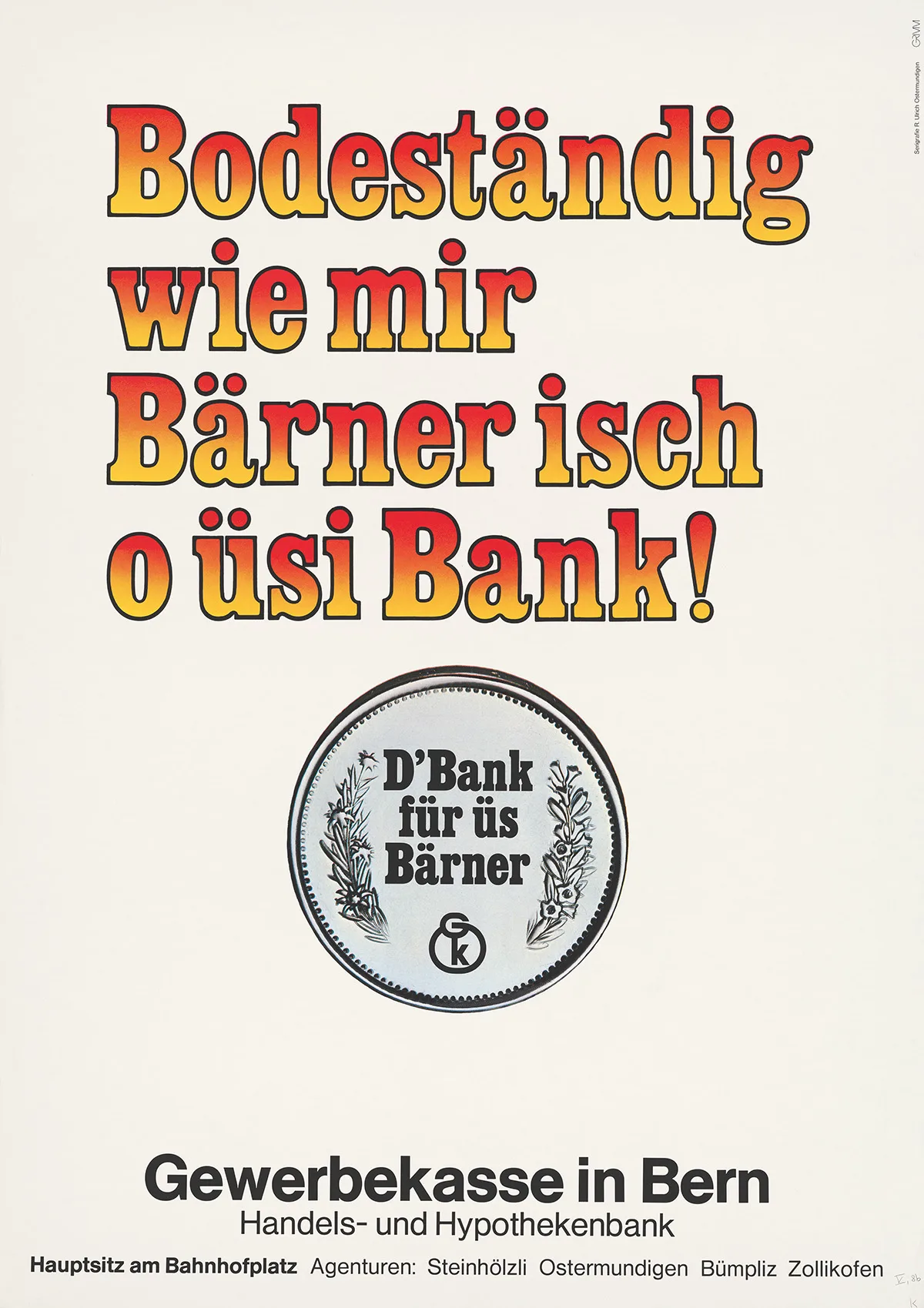
At the same time, those who believed they had a home advantage made that their main selling point. In the money business, closeness, not size, should be the key to building trust. Thus, for example, the Ersparniskasse Biel advertised itself as “the bank for the people of Seeland” in 1981, arguing that it was geared towards its clients’ needs. And one of the ways it specifically aimed to cater to those needs was through its “Autobanker” drive-in counter ‒ considered modern at the time ‒ located in the bank’s own car park right in the centre of Biel-Bienne.
In 1983, the Banque Cantonale du Valais claimed to be even closer to its customers, i.e. “just two steps away”. Its poster featured the faces of 90 members of staff in passport photo format. These were “our representatives, local people”. The big banks were left with what would later come to be known as ‘Swissness’: a fairly generalised association with their country of origin that was put to good use both at home and abroad. In 1982, during a phase of spectacular expansion, the Swiss Credit Bank, already known internationally as Credit Suisse, used a dog to demonstrate that Swissness: a larger-than-life Saint Bernard graced its posters, accompanied by the slogan “Incredibly Swiss”.
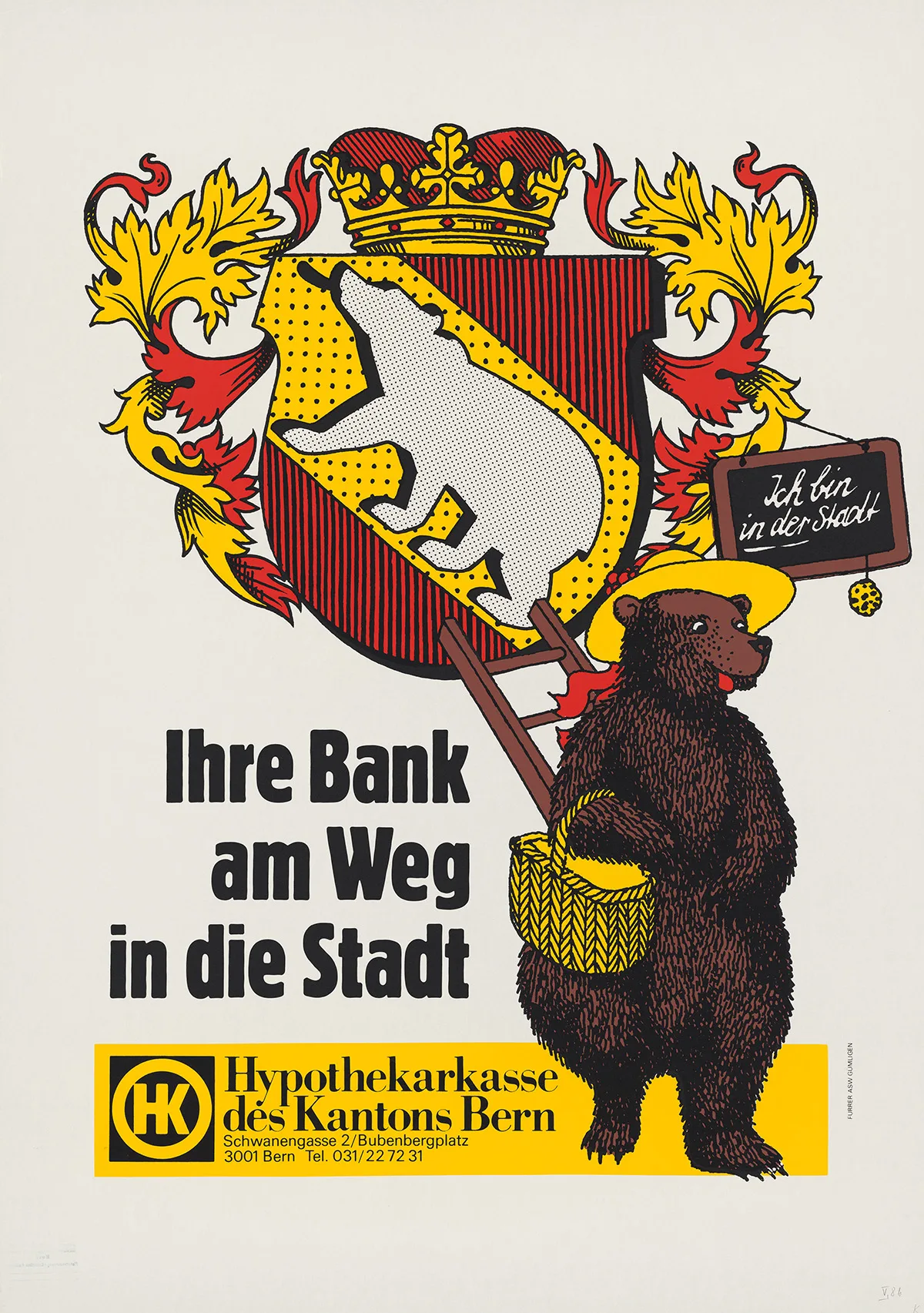
Feeling the squeeze from the expanding big banks, small institutions played up their tradition and closeness to customers. 1977 poster for the Gewerbekasse in Bern (became Valiant in 1997) and 1981 poster for the Hypothekarkasse des Kantons Bern (became Berner Kantonalbank in 1991).
Feeling the squeeze from the expanding big banks, small institutions played up their tradition and closeness to customers. 1977 poster for the Gewerbekasse in Bern (became Valiant in 1997) and 1981 poster for the Hypothekarkasse des Kantons Bern (became Berner Kantonalbank in 1991). Swiss National Library / Swiss National Library
The small institutions were the losers. The big banks doubled their share of domestic savings deposits and tripled their share of mortgage lending between 1970 and 2000, at the expense of the cantonal banks and even more so of the regional and savings banks. The real estate crisis of the early 1990s and the outlawing of several cartel agreements in the domestic market accelerated this trend towards consolidation – the big banks grew even bigger by swallowing up the small banks.
The result was the veritable demise of many banks. The number of financial institutions in Switzerland fell from 495 to 375 in the period from 1990 to 2000 alone. Half of the 200 or so regional and savings banks disappeared; those not taken over by the cantonal banks were swallowed up by the big banks. For example, in 1994, the Neue Aargauer Bank – the largest regional bank at the time – became part of CS Holding. However, the cantonal banks also came under pressure: the cantonal bank of Solothurn was acquired by the Union Bank of Switzerland in 1995, and that of Appenzell-Ausserrhoden by the Swiss Bank Corporation in 1996.
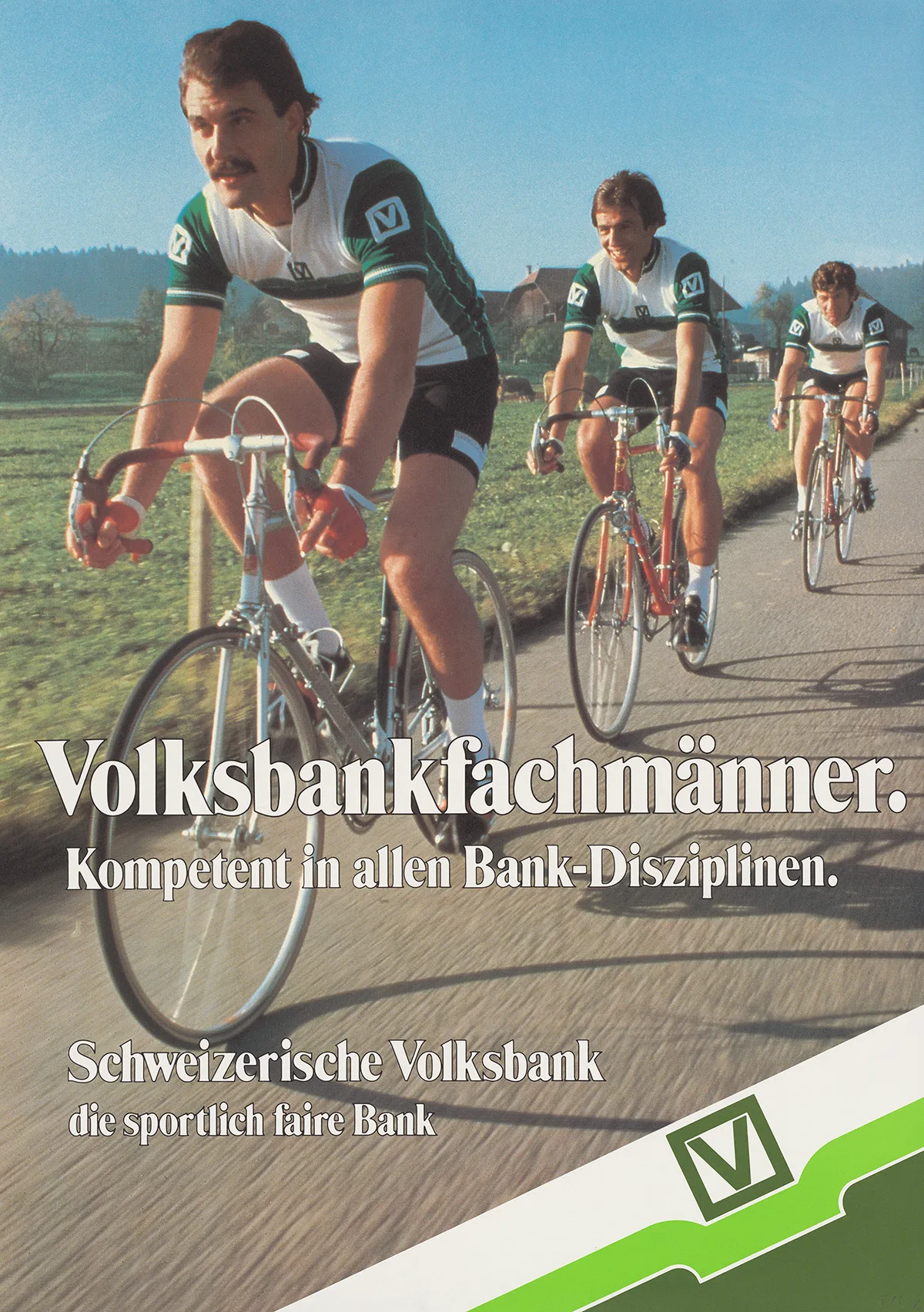
Finally, relationships between the big banks who were driving concentration forward began to crumble. Initially, five remained. Then CS Holding bought Bank Leu in 1990 and the Swiss Volksbank in 1993. It thus overtook the Union Bank of Switzerland, which had also had the ailing Volksbank ‒ on the brink of collapse following losses during the real estate crisis ‒ in its sights.
A victim both of the fight for survival among the big banks and of the real estate crisis at the start of the decade: the Swiss Volksbank disappeared in 1993 (poster from 1979).
A victim both of the fight for survival among the big banks and of the real estate crisis at the start of the decade: the Swiss Volksbank disappeared in 1993 (poster from 1979). Swiss National Library
The Swiss financial centre underwent its most seismic shift of the 20th century in 1998. The Union Bank of Switzerland had long been the main proponent of the ‘sink or swim’ mentality but had lost some of its verve after years of expansion. And it now found itself as a takeover candidate following an offer from CS, which had previously outbid it in the battle to acquire the Volksbank.
Instead, the Union Bank of Switzerland merged with the Swiss Bank Corporation. The result was a “colossus”, according to Mazbouri/Guex/Lopez: the new UBS was the world’s largest asset manager and at home its total assets made up almost half of those of all Swiss banks.
Three big banks had already gone out of business. Now there were only two: CS and UBS. But, as we now know with the benefit of a quarter of a century’s hindsight, even that constellation was not to last forever.

Switzerland, the land of banks

12.06.2026 08.11.2026 / National Museum Zurich
Switzerland is one of the world’s leading financial centres – but how did its close association with banking evolve? The exhibition shows how deeply banking is entrenched in Switzerland’s DNA and traces the development of the banking system by displaying an impressive range of items. Jewish moneylenders, Lombardy merchants and, later, urban exchange offices laid the foundation for the modern financial centre. The exhibition goes beyond merely retracing historical developments; it also invites visitors to engage with the land of banks as it is today.
Further posts