The power of the cooperative
The principle of the cooperative was indispensable to the establishment of Swiss democracy. The UN International Year of Cooperatives in 2025 demonstrates that this type of cooperation is also important at a global level.

René Roca
René Roca has a PhD in history and is a secondary school teacher and Director of the Research Institute for Direct Democracy fidd.ch.
Swiss historian Adolf Gasser (1903–1985) highlighted the significance of the cooperative principle with particular clarity. He basically saw European history as a manifestation of two contrasting concepts, i.e. dominion and cooperative. Gasser stressed that these two systems were diametrically opposed: one being based on governance from the top-down, and the other one wielding power from the bottom up. In other words, power over the people as opposed to power through the people.
Why the principle of the cooperative matters
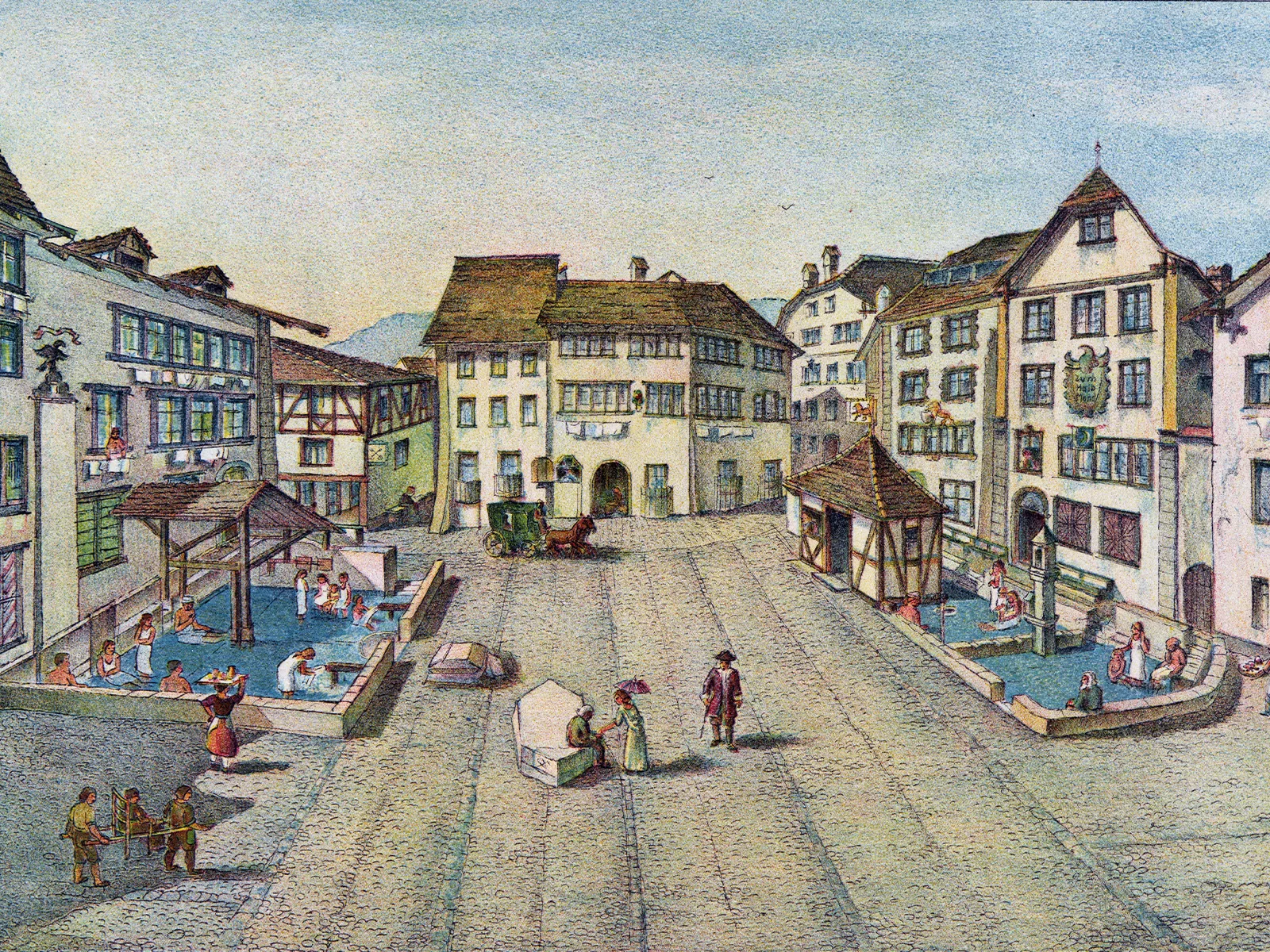
The cooperatives were usually a legacy of the medieval land parcelling laws, i.e. communally owned land in the Middle Ages known as ‘mittelalterlicher Gemeinmark’. These early manifestations of the cooperative system are important to understanding how the Swiss political system works. In Switzerland, the general spread and structure of the cooperatives was based on common land (land owned by the community). They were areas that had to be accessible to all, whether as pasture, woodland or wasteland.
The common land normally came to be designated as such by the inhabitants of a group of settlements – one or more villages, hamlets or groups of farms – who selected a defined area for a collective economic purpose. Taking a farming family as an example, the common land gave them access to three zones: they had their private land for farming plus the place where they lived with the farmstead and garden; the common land was a third area under collective management. From the early Middle Ages, European nobility tried to determine or at least influence the rules governing the use of common land. In many places however, including the territory now known as Switzerland, the principle of the cooperative stood firm. As each community had their own way of organising their cooperatives, many different cooperative forms came into being.

The formation of citizens’ communes
The cooperative members thus became villagers and the village cooperatives evolved into village communes. This led until 1798 to the formation of ‘Bürgergemeinde’ (citizens’ communes) that still exist in many cantons today. The Helvetic Republic distinguished between citizens’ communes and ‘Einwohnergemeinde’ (electoral communes). This had a knock-on effect on the common land. Some areas were converted to leaseholds or private ownership, others were claimed by electoral communes or evolved into corporations under private law. The corporations and citizens’ communes remain an important tradition in Switzerland to the present day and they represent personal connections to the history and culture of a commune.

The cooperative movement of the 19th century
The American political scientist Elinor Ostrom (1933–2012) conducted a global, landmark study in the 1980s ‘Governing the Commons’ for which she became the first woman to receive the Nobel Prize in Economic Sciences in 2009. She used historical examples from different continents to demonstrate the importance of the principle of the cooperative in modern times. She used common land to demonstrate how people organise themselves into a community to solve complex problems with scarce natural resources. Ostrom concluded through her extensive studies that the management of local resources on common land was better in many cases when performed by the people who used the land cooperating together than when under state control or private ownership. In other words she came down emphatically in favour of the principle of the cooperative.
The future of the cooperative
The three ‘selfs’ in conjunction with the tradition of part-time public service known as the militia system enable a special type of democratic culture in Switzerland. Viewed historically, the cooperative concept was thus a central reference point in many ways and basis for the emergence and development of direct democracy and the formation of the Swiss federal system. Switzerland is the only country to acknowledge its cooperative past in its name ‘Eidgenossenschaft’ (Genossenschaft = cooperative).