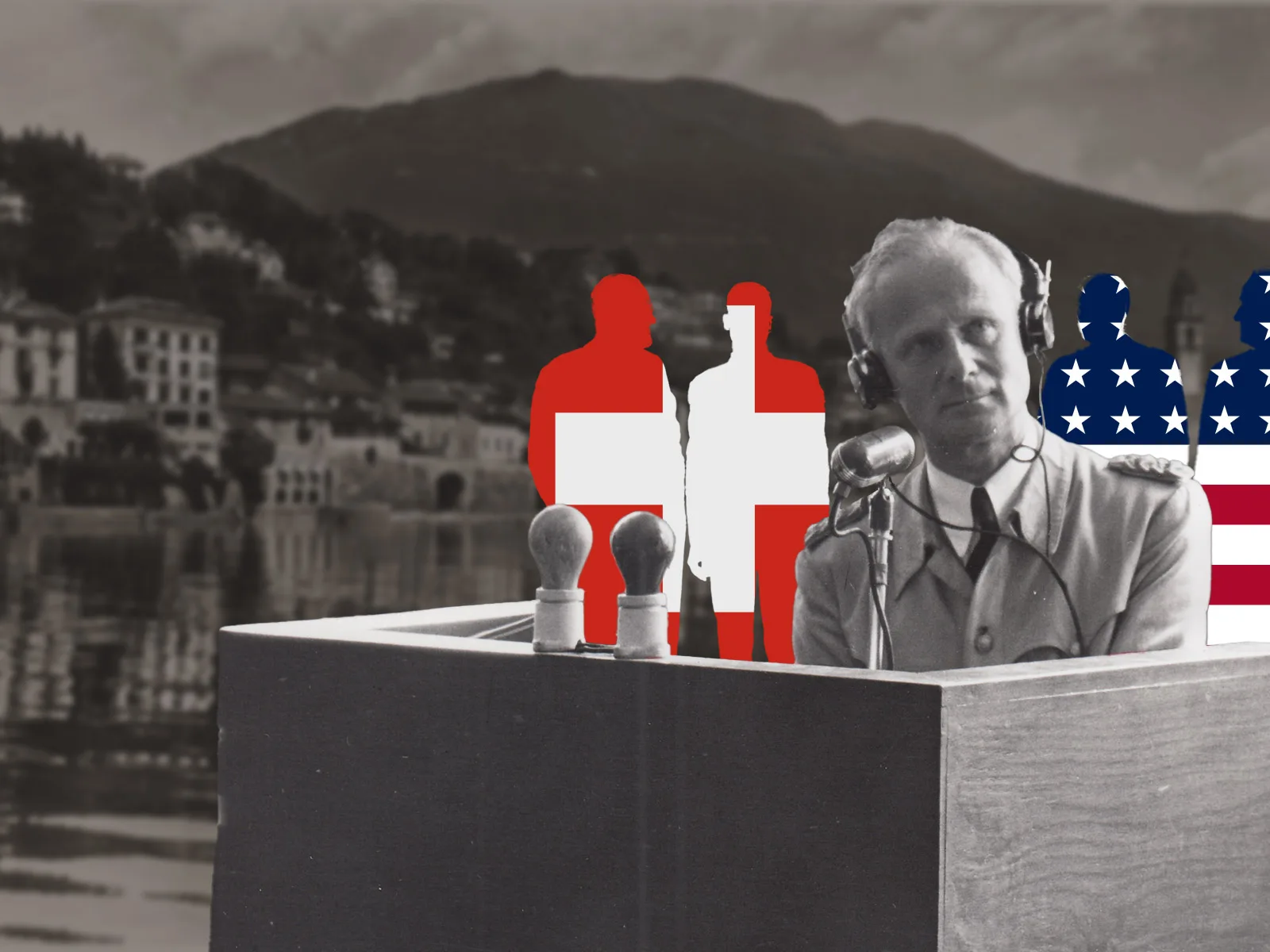
The meeting in Ascona in March 1945 paved the way for Karl Wolff’s subsequent protection.
The meeting in Ascona in March 1945 paved the way for Karl Wolff’s subsequent protection. Images: Wikimedia, e-pics; Montage: SNM

When Switzerland came to the aid of an SS General

In March 1945, Karl Wolff negotiated with the Allies in Ascona over a German surrender in northern Italy. After the war, the SS General was shielded from prosecution for war crimes by Switzerland and the United States.

Andrej Abplanalp

Andrej Abplanalp

Historian and communications chief of the Swiss National Museum.
In early August 1947, Swiss teacher Max Husmann wrote a long letter to General Telford Taylor, chief prosecutor in Nuremberg, where the trials against Nazi leaders had been going on since 1945. Husmann called on the American not to prosecute Karl Wolff: “But if we made a promise to General Wolff and his fellow combatants of loyal treatment and possible cooperation in the new Germany, and if Wolff kept his promise at risk to his life, none of us has a right to break our promise on the grounds that he is an SS General and that the whole SS has been declared a criminal organisation.” Max Husmann was referring to Operation Sunrise, the secret negotiations that took place in Ascona in March 1945 and led to the early surrender of the German forces in northern Italy on 2 May 1945.
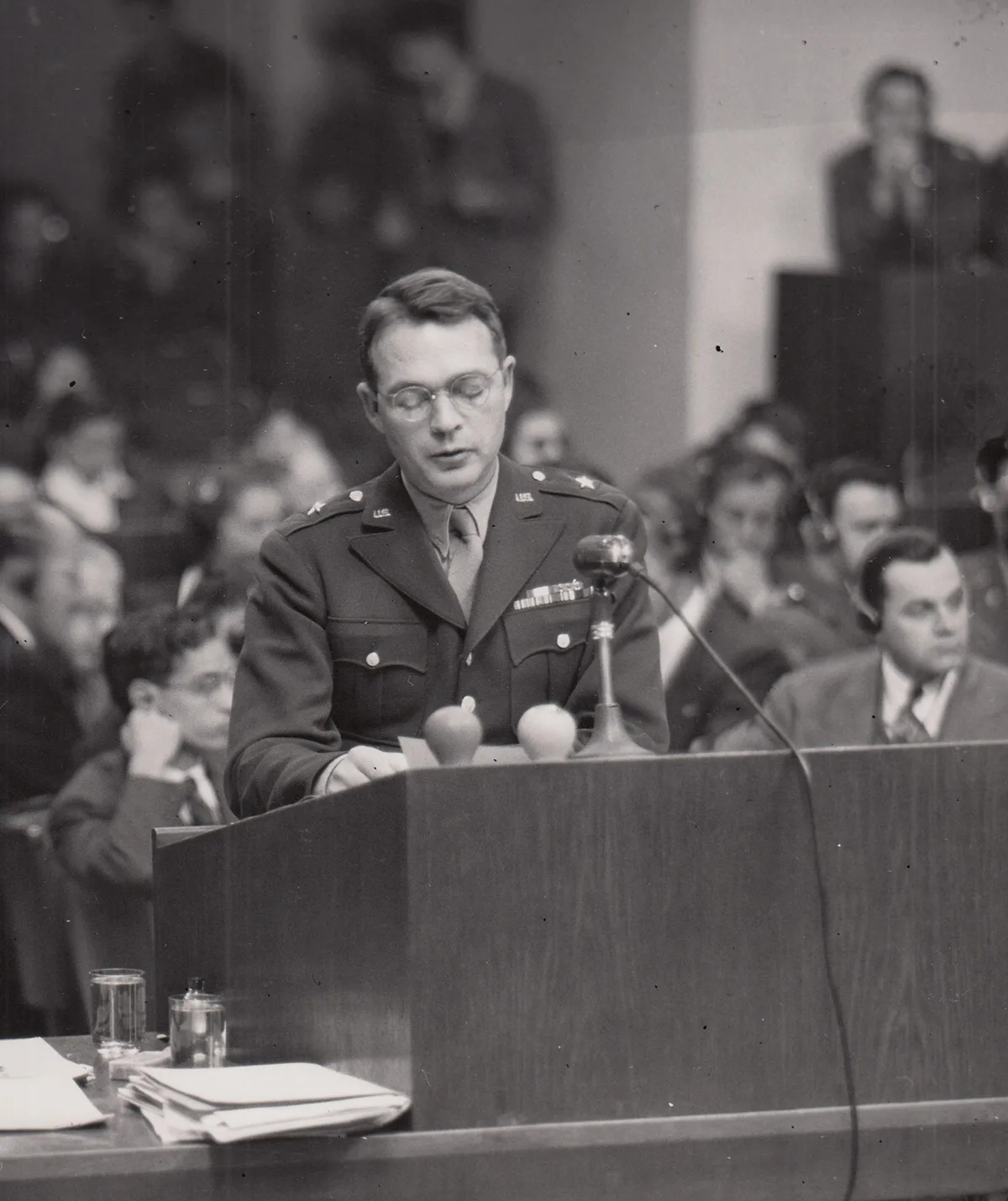
Telford Taylor, American chief prosecutor, pictured in December 1946 at the Nuremberg Trials.
Telford Taylor, American chief prosecutor, pictured in December 1946 at the Nuremberg Trials. National Archives

Operation Sunrise

In the spring of 1945, secret negotiations had taken place in Ascona on an early surrender of the German forces in northern Italy. For the first time since the beginning of the war, high-ranking representatives of the Third Reich and the Western Allies were brought to the negotiating table. The meeting between SS General Karl Wolff and the allied generals Lyman Lemnitzer (US) and Terence Airey (United Kingdom) had been orchestrated by the Swiss and US intelligence services. Max Husmann played a key role in this rapprochement. Husmann, the founder of the Montana boarding school on Zugerberg, put the SS officers stationed in Italy in touch with Max Waibel from the Swiss intelligence service. But how did a Swiss schoolteacher end up mediating between the most senior SS figure in Italy and the Allies?
From left to right: Max Waibel, Lyman Lemnitzer and Terence Airey during the surrender negotiations in March 1945 in Ascona.
From left to right: Max Waibel, Lyman Lemnitzer and Terence Airey during the surrender negotiations in March 1945 in Ascona. Swiss Federal Archives, J1.188#2004/353#5* / Novalis Verlag
In the autumn of 1944, Karl Wolff realised that the war was definitively lost for the Germans and started looking for a way out. He was head of all SS troops and police forces, the Gestapo, all partisan fighter units and the auxiliary troops in Mussolini’s fascist Salò Republic. The SS General was therefore too high profile within the German Reich to take action himself. Through middlemen such as Italian Baron Luigi Parrilli, he tested the waters to gauge whether contact could be made with the American secret service, the Office of Strategic Services (OSS), which had been headquartered in Bern since 1942.

From headmaster to facilitator of surrender negotiations
This is where Max Husmann entered the picture. Parrilli contacted Husmann in February 1945 as his nephew had attended the school on the Zugerberg. Husmann in turn knew Max Waibel, with whom he had been in regular touch for some years. In his role as intelligence officer, Waibel had close ties to OSS director Allen Dulles. This is ultimately how the connection between Karl Wolff and the Western Allies came about. But Husmann’s role didn’t end there. Quite the opposite, in fact – at first a minor facilitator, he ended up helping lead the negotiations. The boarding school headmaster not only conducted the preliminary talks with two senior SS officers in Lugano, he also accompanied Wolff to his first meeting with Allen Dulles, which took place in Zurich on 8 March 1945. Husmann made use of the journey from Switzerland’s southern border to Zurich to brief the SS General about the situation and to prepare him for the meeting with Dulles. In his book ‘Operation Sunrise ‒ 1945 Capitulation in Northern Italy’, penned in 1946, Max Waibel wrote that Husmann had exerted a decisive influence on Karl Wolff, which is what had made the subsequent negotiations even possible in the first place.
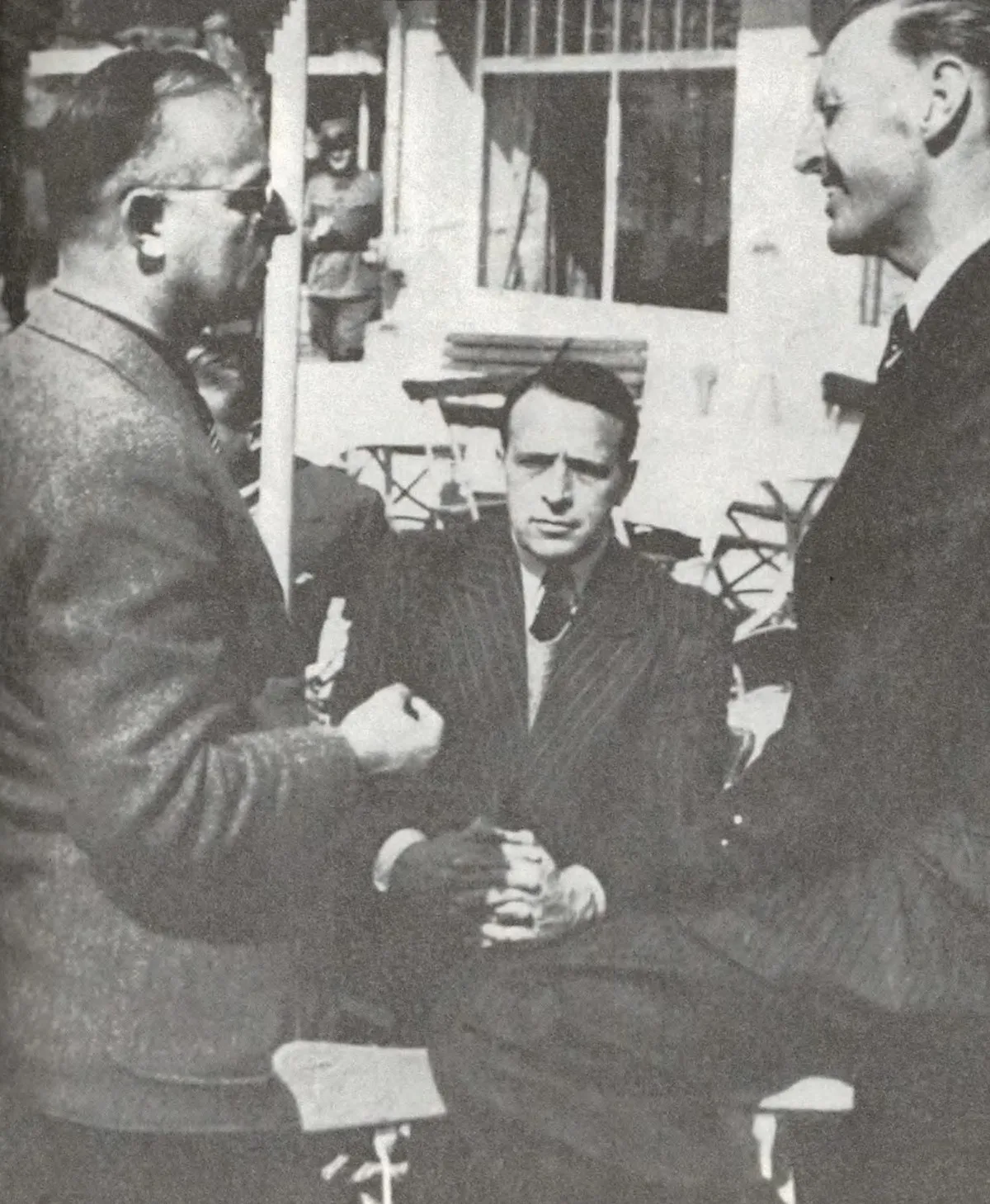
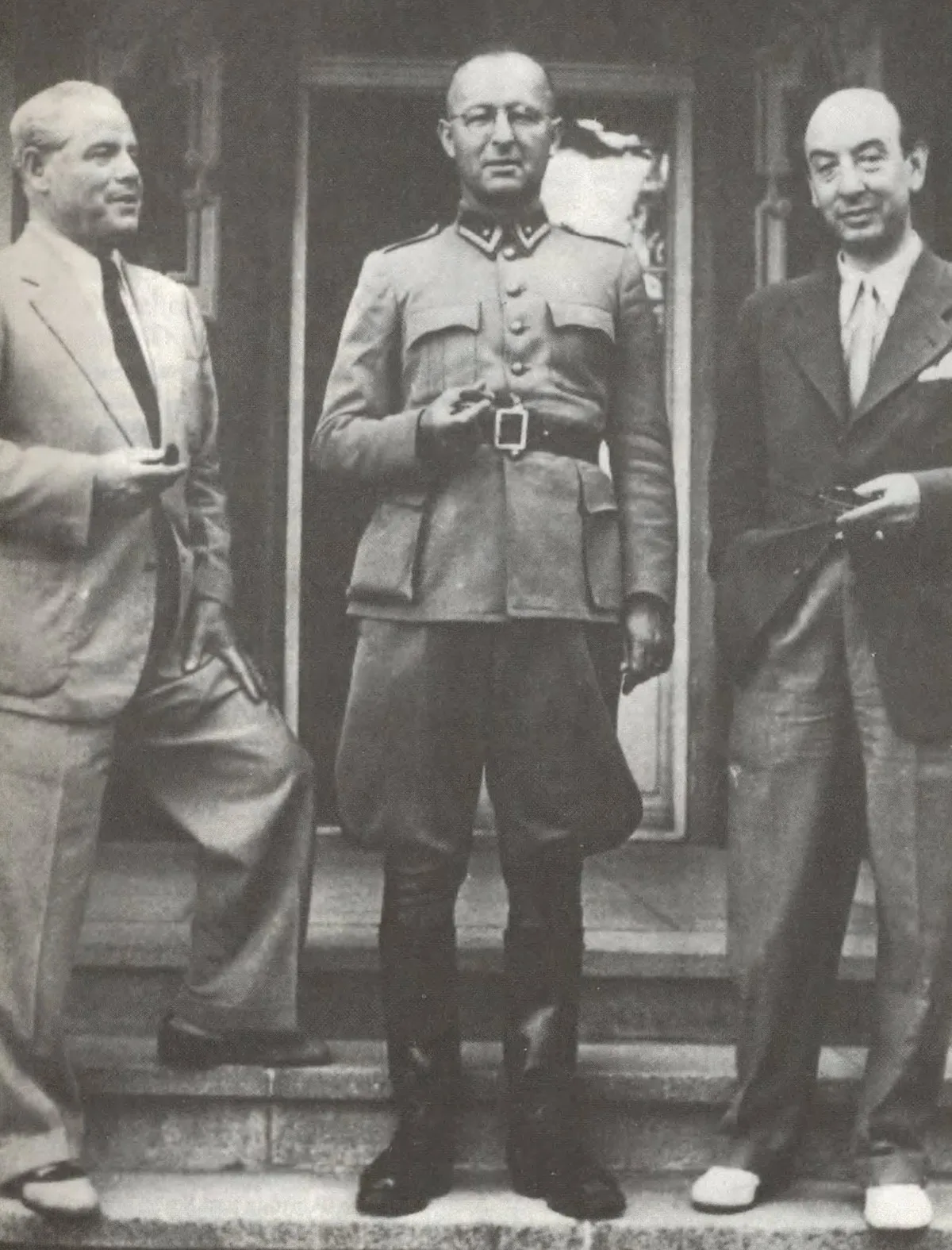
The main architects of Operation Sunrise. From left to right: Max Husmann, Max Waibel and Luigi Parrilli, photographed on Waibel’s Dorenbach estate near Lucerne.
The main architects of Operation Sunrise. From left to right: Max Husmann, Max Waibel and Luigi Parrilli, photographed on Waibel’s Dorenbach estate near Lucerne. Swiss Federal Archives, J1.188#2004/353#5* / Novalis Verlag
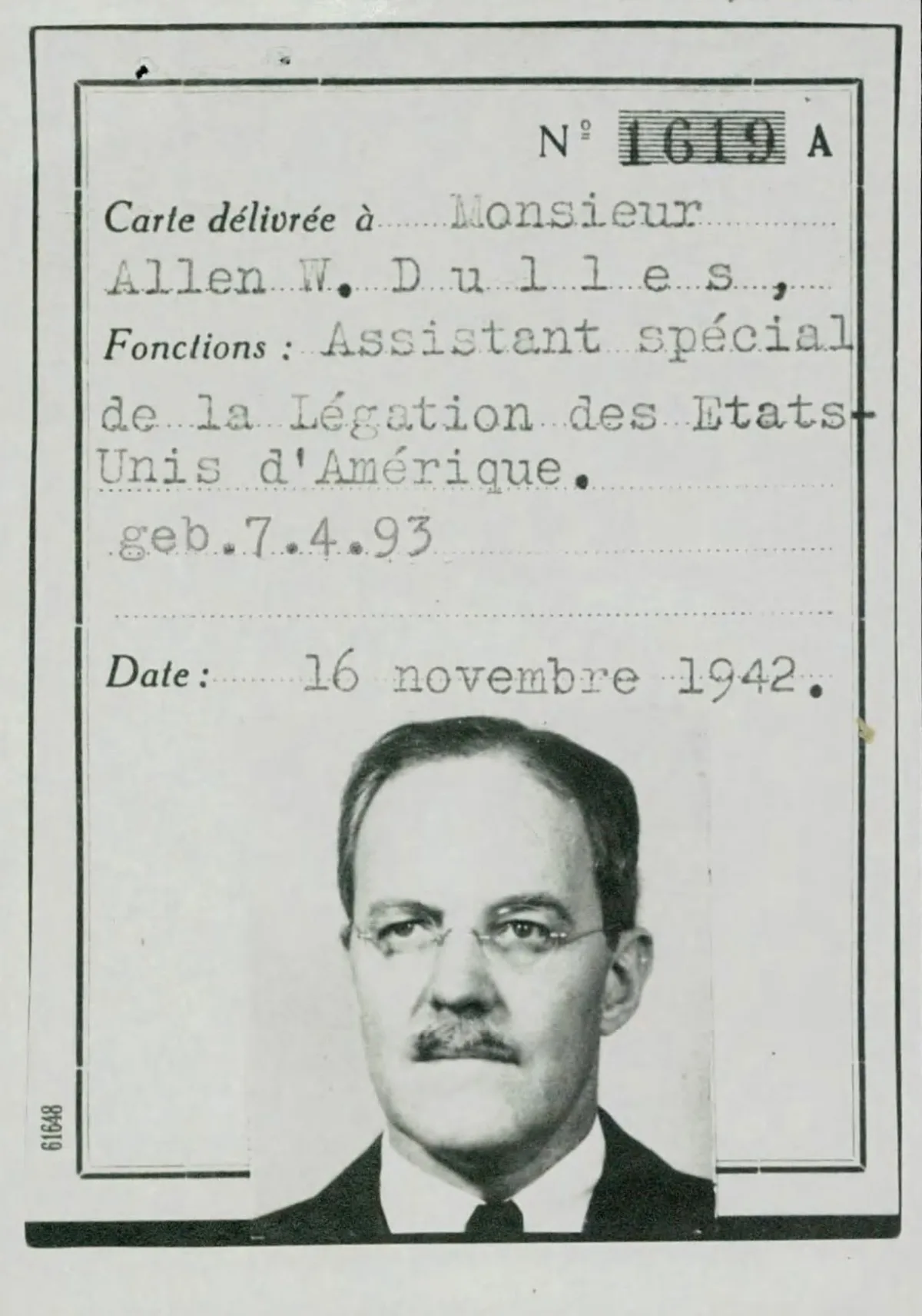
American diplomatic identity card belonging to OSS chief Allen Dulles, November 1942.
American diplomatic identity card belonging to OSS chief Allen Dulles, November 1942. Swiss Federal Archives / E4320B#1990/266#5772*
The capitulation of the German forces in Italy ended up being signed on 29 April 1945 in Caserta near Naples, and entered into force on 2 May, six days before the official surrender of the Third Reich. Operation Sunrise saved many lives and preserved the majority of northern Italy’s infrastructure from destruction, which Adolf Hitler had ordered in his ‘Nero Decree’ (scorched earth tactic) on 19 March 1945.
Film footage of the surrender of the German armed forces in Italy, 29 April 1945. YouTube / War Archives

The Sunrise connection remained intact after the war
The German surrender in northern Italy enhanced Allen Dulles’ otherwise modest track record as head of the OSS. This was seen by the western allies as a geostrategically important move, and was one of the reasons he was appointed director of the CIA – the successor organisation of the OSS – in 1953.
But the SS figures involved also benefited. They were effectively shielded from prosecution by the Americans to ensure they remained silent about Operation Sunrise. Details of the negotiations would have seriously affected the already very fragile relations between the western Allies and the Soviet Union. In Ticino, the US and United Kingdom had gone against the Allies’ intention to only accept a full and unconditional surrender. Furthermore, the agreement with the SS contradicted the Allies’ public stance, which viewed the Schutzstaffel (SS) as a criminal organisation. Had this come to light, it would have seriously undermined the credibility of the Western Allies. And despite all these risks – including for the Swiss, who were acting in a private capacity – they brought about partial surrender and thus secured an advantage in the control of the Mediterranean region. These were the first signs of the emerging Cold War.
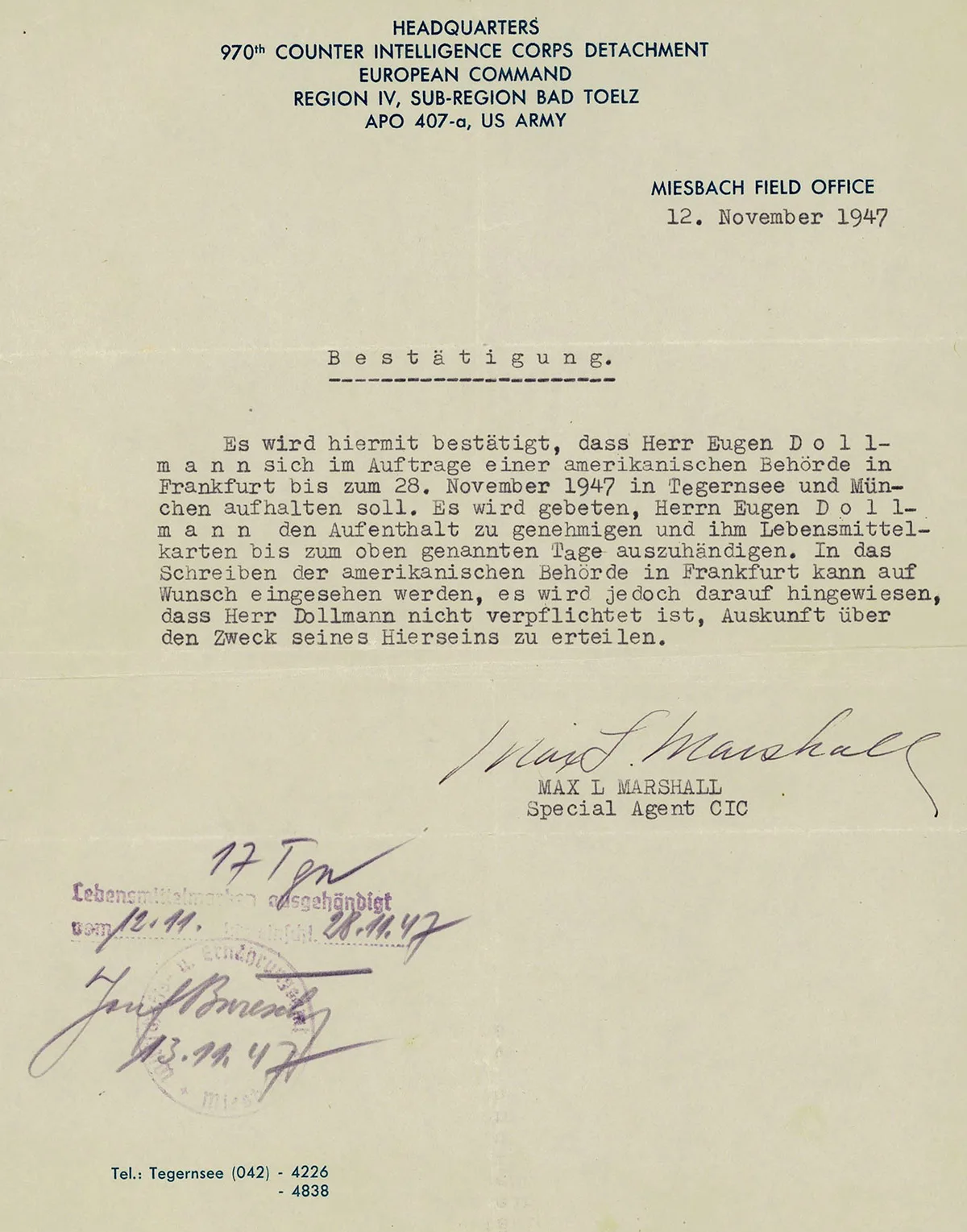
US pass for former SS Officer Eugen Dollmann, who was also involved in Operation Sunrise.
US pass for former SS Officer Eugen Dollmann, who was also involved in Operation Sunrise. Swiss Federal Archives, E4320B#1973/17#1455*
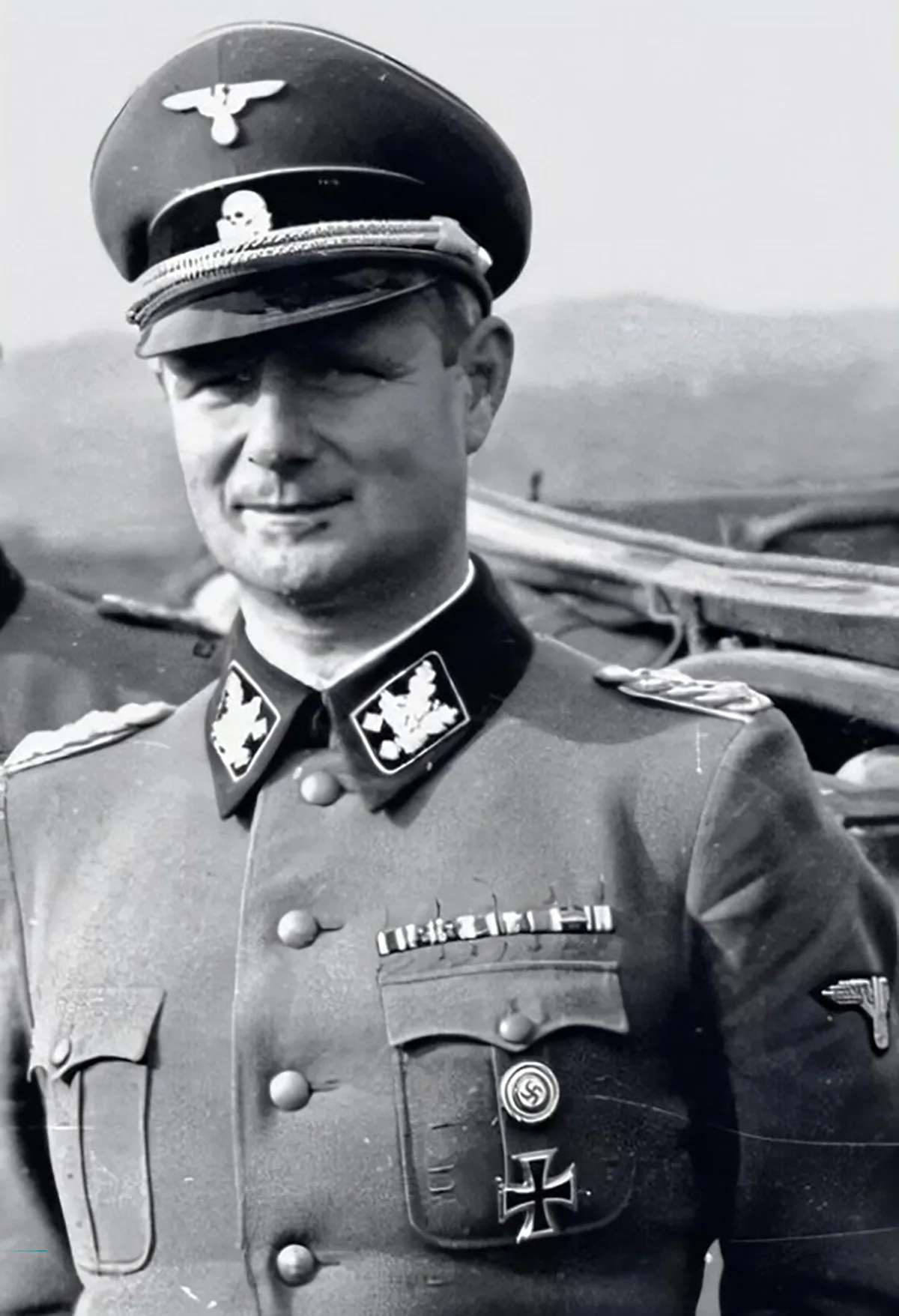
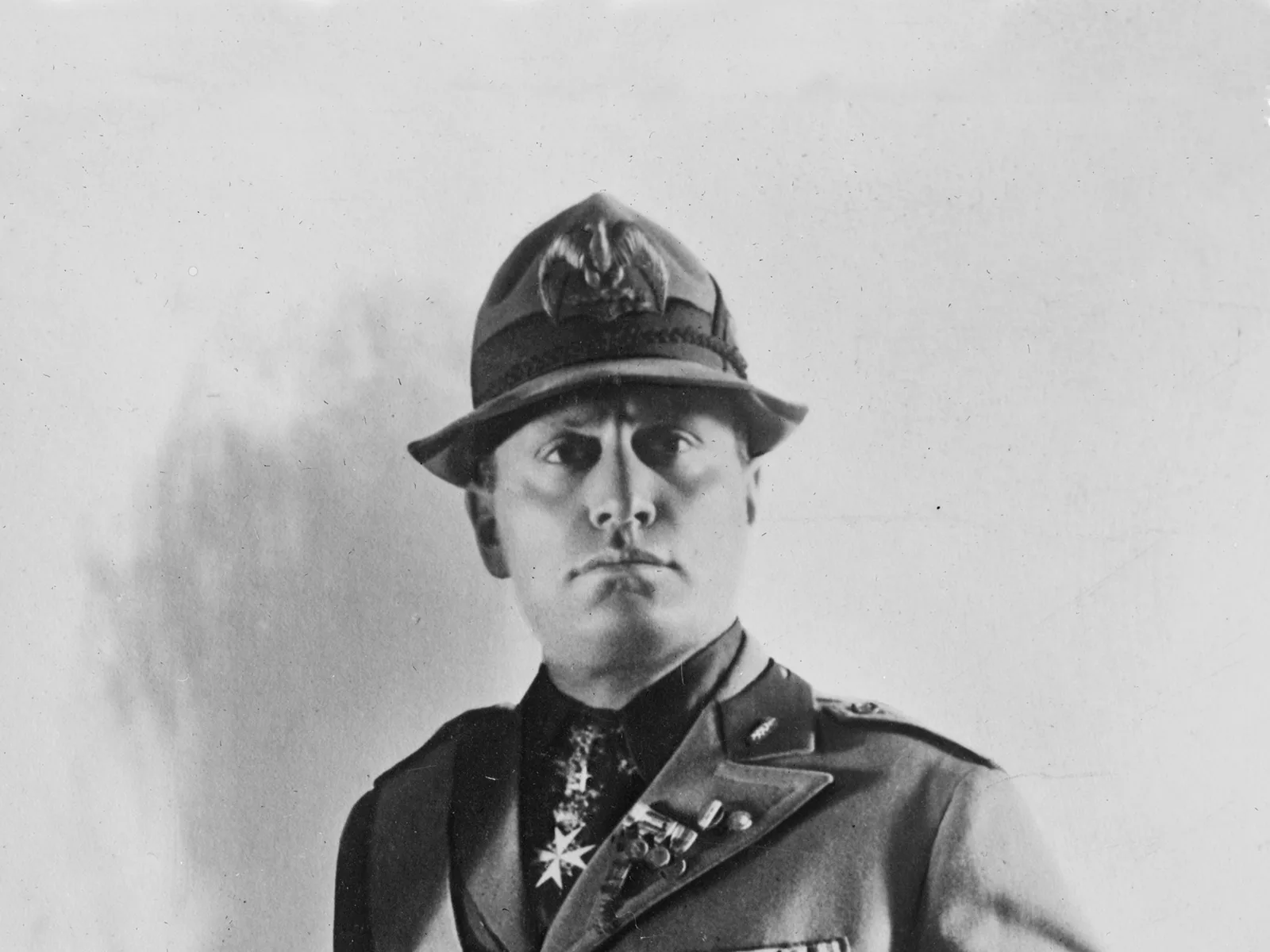
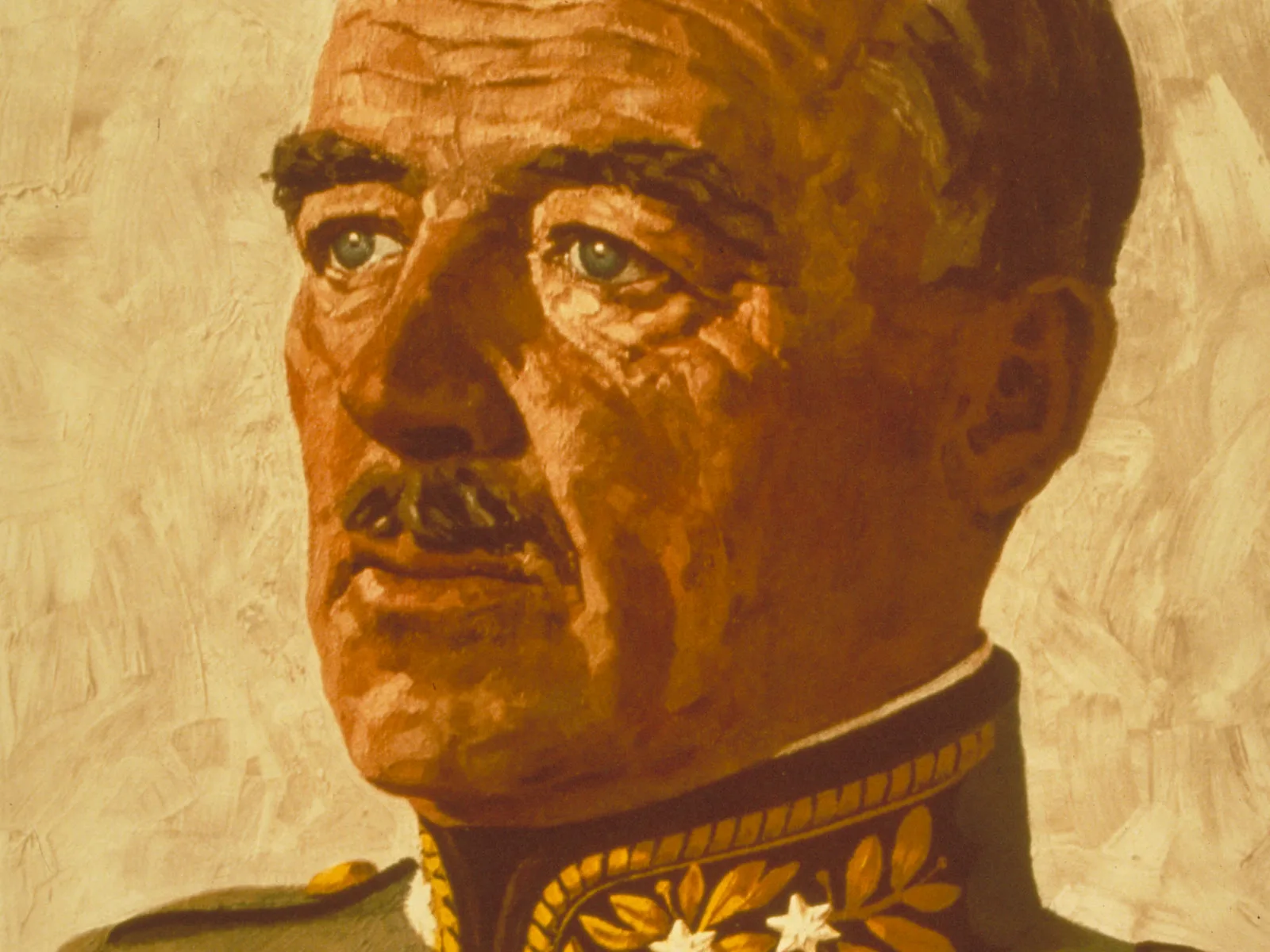
Portrait of Karl Wolff, 1942.
Portrait of Karl Wolff, 1942. Wikimedia
On account of these vested interests on the part of the Western Allies, even Karl Wolff – who had been the right-hand man of SS leader Heinrich Himmler for years before his time in Italy – was barely brought to justice after the war. He was detained by the Allies until 1947, although not as a defendant but merely as an informant and witness. He appeared at the Nuremberg Trials against the Nazi regime in 1946 to explain the structure and working methods of the SS. The past only caught up with Wolff in 1964 when a German court sentenced the former SS General to 15 years in prison for his role in the murder of 300,000 Jews in Treblinka. The fact that Wolff was released from prison on grounds of ill health in 1969 fits the pattern of Germany’s handling of Nazi war criminals.
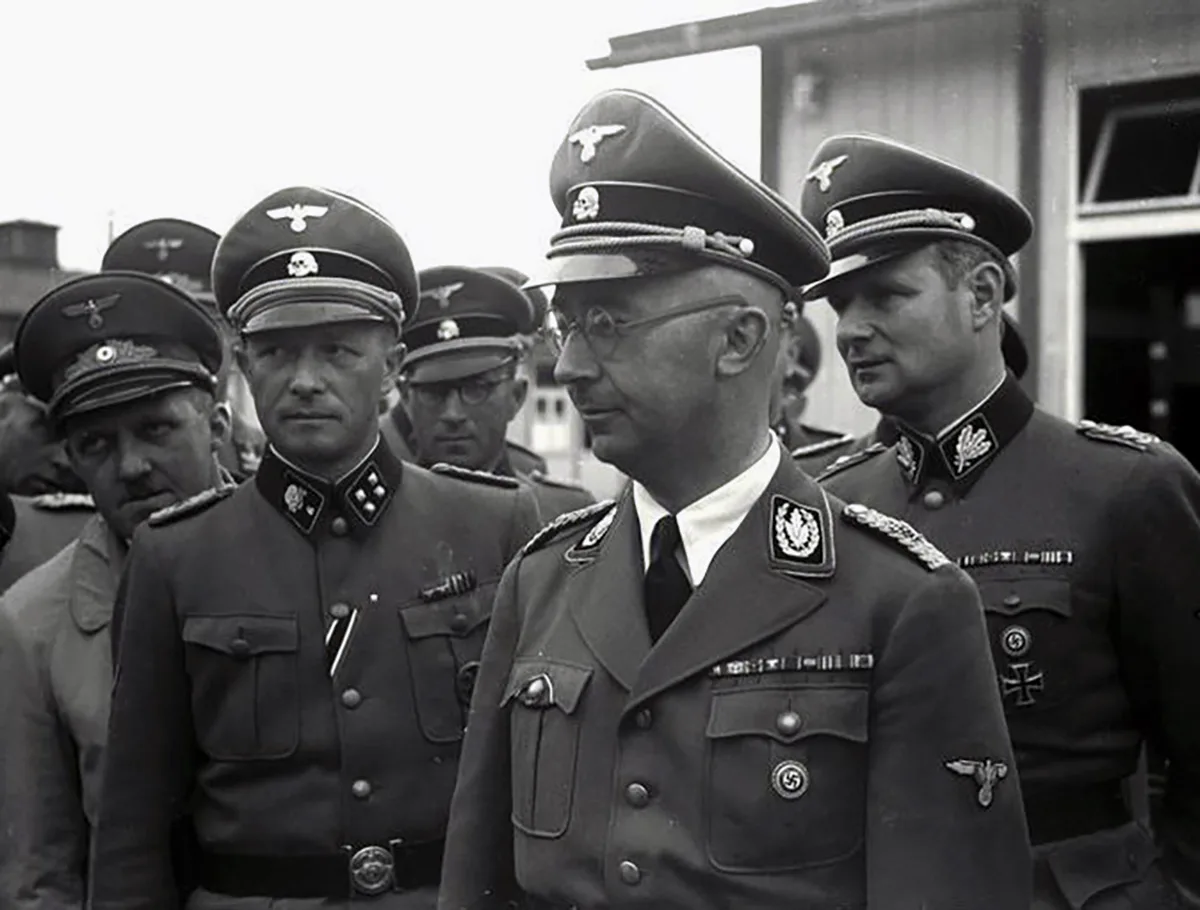
Karl Wolff (right) visiting Mauthausen concentration camp with Heinrich Himmler (second right), April 1941.
Karl Wolff (right) visiting Mauthausen concentration camp with Heinrich Himmler (second right), April 1941. Wikimedia / German Federal Archives
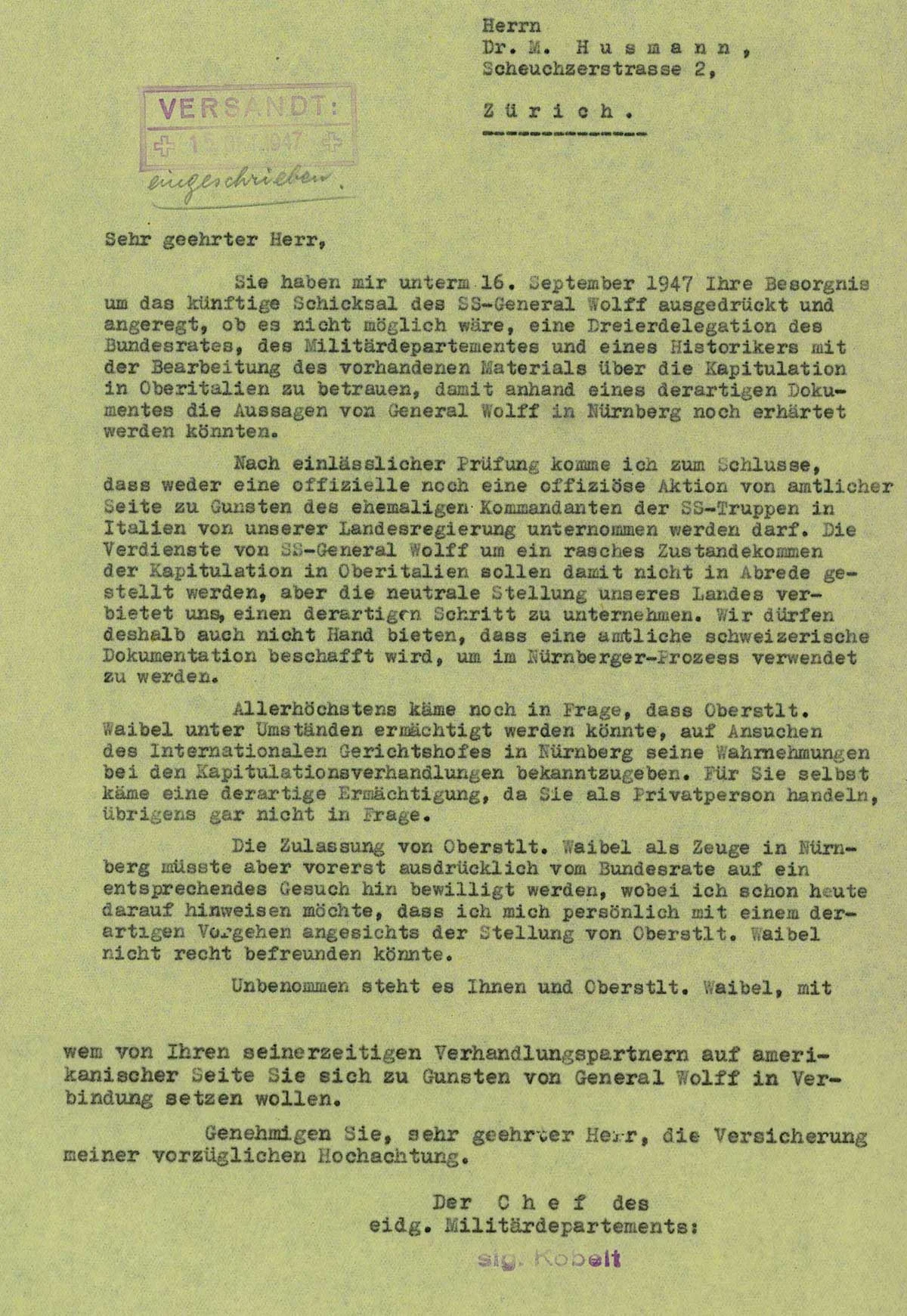
Karl Wolff was detained for just under ten years in all. In the 1940s in particular, he was able to count on the tireless support of Max Husmann. Wolff’s tragic situation was a constant weight on Husmann’s mind, as the teacher wrote to Alfred Zehnder, head of the political division at the Swiss Federal Political Department in late August 1947. Husmann left no stone unturned in trying to help his former negotiating partner. On 16 September 1947, he even proposed the idea to Federal Councillor Karl Kobelt, head of the Military Department, of setting up a three-member commission “consisting of a delegate from the Federal Council, one from the Military Department and a historian.” The commission would gather the available evidence about the surrender and “interview those involved in person if at all possible.” A few weeks later, Kobelt declined the offer: “After considering the matter in depth, I conclude that our national government should not undertake any official or semi-official action in favour of a former commander of SS troops in Italy.” He did not wish to call into question the merits of SS General Wolff regarding the surrender in northern Italy, he said, but that “the neutral position of our country prohibits such an action.”
In mid-October 1947, Federal Councillor Karl Kobelt sent a polite letter of refusal to Max Husmann.
In mid-October 1947, Federal Councillor Karl Kobelt sent a polite letter of refusal to Max Husmann. Swiss Federal Archives, E27#1000/721#9540*

Merely a moral duty?

In the early years after the war, Karl Wolff had enjoyed effective protection, mainly from OSS boss Allen Dulles. But there were certainly groups among the Allies who wanted to bring a charge against the German, and tried to do so on several occasions. This was probably what was so concerning to Max Husmann – who had supported Wolff tirelessly since 1945 – that he escalated the issue all the way to the Federal Council. Husmann consistently argued in his letters that during Operation Sunrise, promises had been made to Karl Wolff. For example, in his letter to Telford Taylor, he wrote that, as Swiss, he and Max Waibel had provided assurances “that the British and Americans would honour their promise, even without any written contract”. Although Husmann never stated what exactly had been pledged, the “promise of loyal treatment and possible cooperation in the new Germany” that he set out to Taylor, implied that it should mean protection from prosecution.
Max Waibel and especially Max Husmann felt morally obliged to keep this promise made to Karl Wolff. They considered honouring the promise ‘a matter of conscience’. Husmann even went so far as to offer to Taylor to cure the former SS General of his Nazi disposition: “In Nuremberg people told me that Wolff is still a Nazi. I don’t doubt it, but I’m convinced that I would only need to spend a short time in his company to cure him completely.” Was this really just about a moral duty to keep his word?
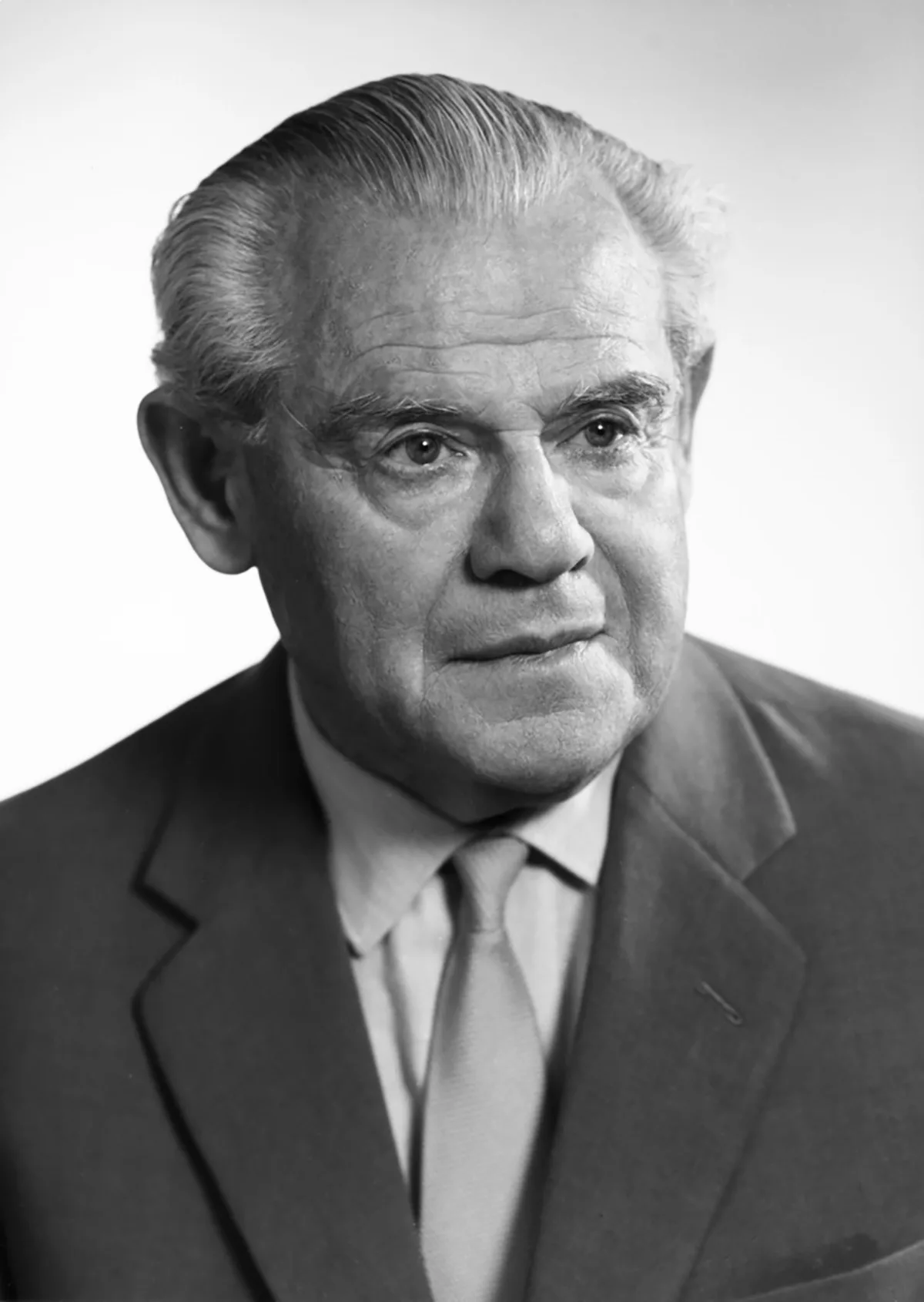
Max Husmann pictured in the 1950s.
Max Husmann pictured in the 1950s. Keystone / STR
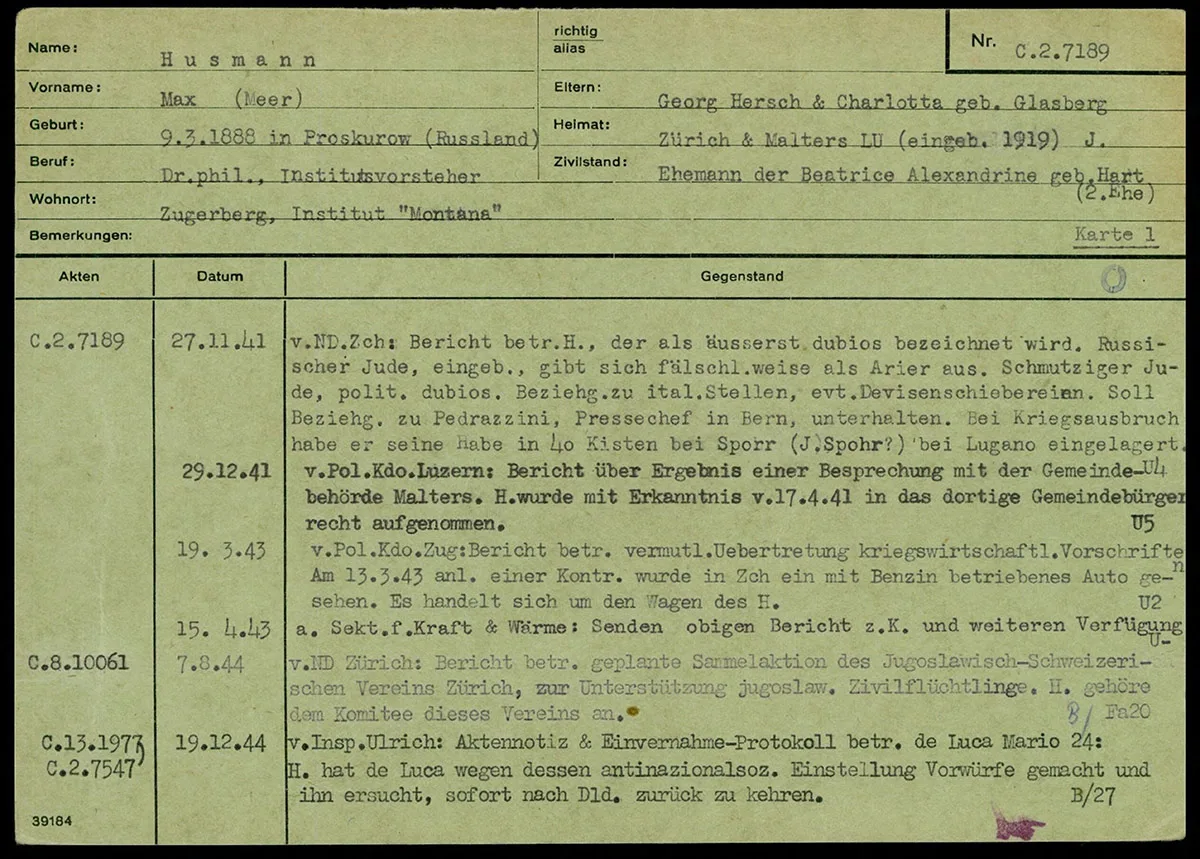
Max Husmann originally hailed from Proskurov in current day Ukraine. He emigrated to Switzerland with his family in 1899 and was naturalised in 1919. On a file held by the Office of the Attorney General of Switzerland, he was described as “Filthy Jew, politically dubious”. He was suspected of being pro-German and vilified as being someone who “would betray Switzerland, his current homeland, at any time if it would benefit him.” After the surrender of the German units in northern Italy, Husmann was celebrated as a ‘peace broker’. For example by the magazine Weltwoche, which on 8 June 1945 carried an in-depth report on the negotiations, highlighting the schoolteacher’s leading role. The magazine emphasised that Dr. Husmann had managed “to disabuse General Wolff of the dangerous illusions that he shared with so many other Germans in key positions, that it would be possible to bring about cooperation with the British and Americans against the Russians.” Such words must have been gratifying for him. The positive image of Max Husmann as a humanitarian Swiss mediator and loyal patriot would, however, have been tarnished by Wolff’s conviction. Presumably it was very important to Husmann, thinking of his reputation, that the former SS General was perceived as a morally irreproachable negotiating partner rather than a convicted war criminal.
Max Husmann’s police file covering the period from 1941 to 1953.
Max Husmann’s police file covering the period from 1941 to 1953. Swiss Federal Archives, E4320-01C#1996/203#233*
In the denazification proceedings, Karl Wolff was sentenced to five years in prison in 1948 for his membership of a criminal organisation, the SS. In the trial, however, Max Husmann testified in favour of the defendant. Following an appeal, the verdict was reduced to four years in 1949 and Wolff was released as he had already spent this time in internment camps. The former SS General was a free man.

Further posts