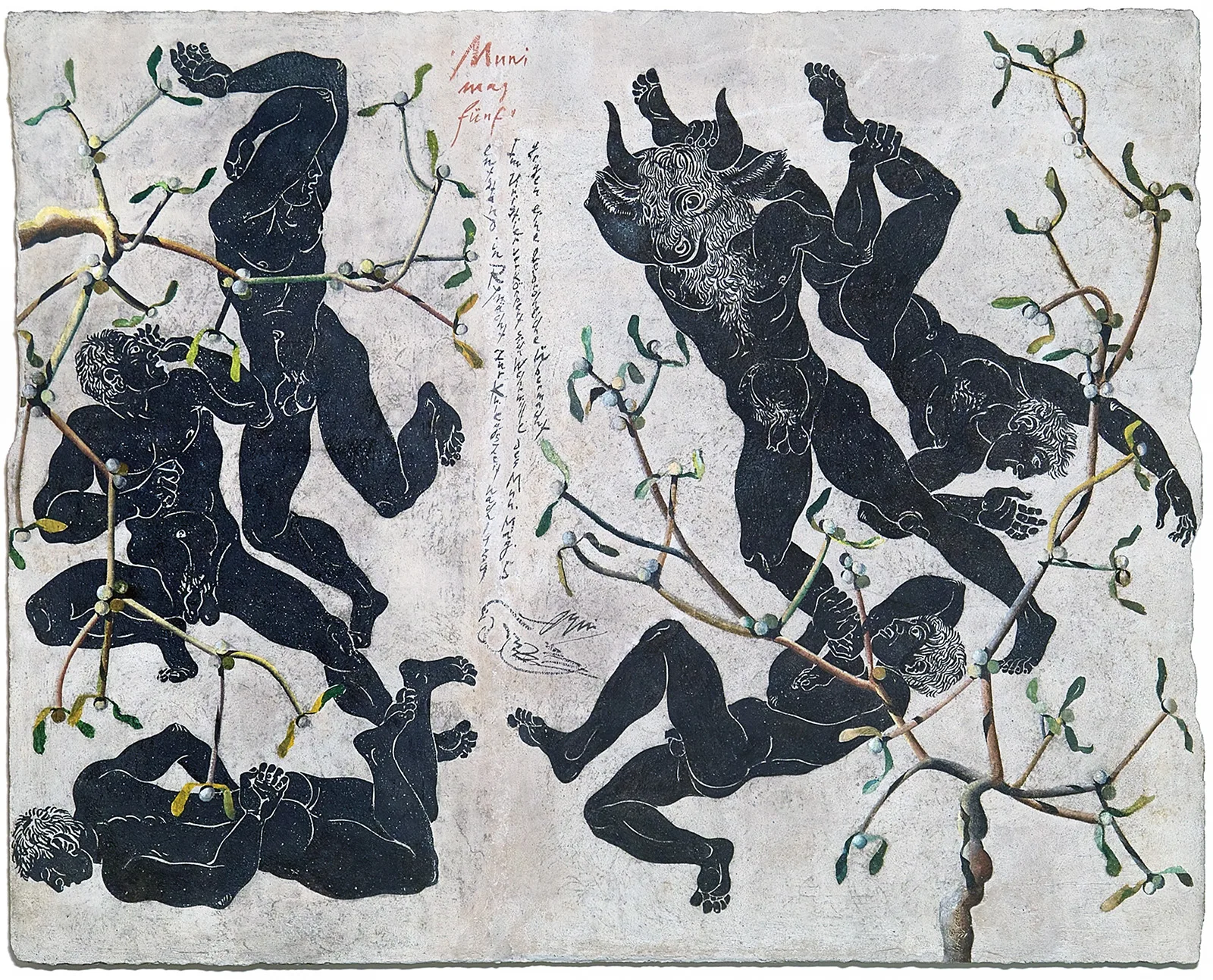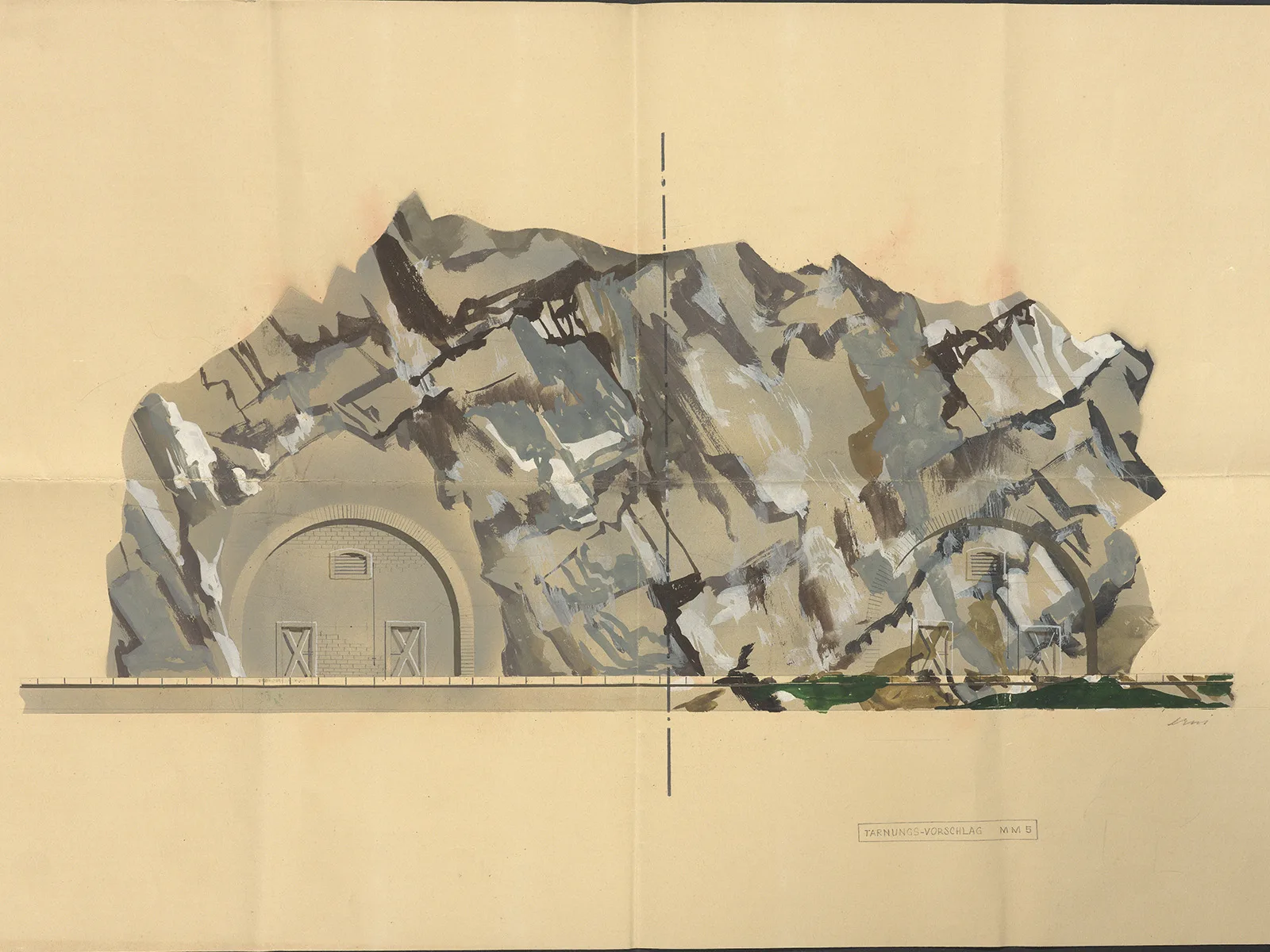
Camouflage proposal by Hans Erni for ammunition depot 5 in Rynächt, 1940.
Camouflage proposal by Hans Erni for ammunition depot 5 in Rynächt, 1940. Swiss Federal Archives

Hans Erni and the art of camouflage

In 1939 Hans Erni painted the mural "Die Schweiz, das Ferienland der Völker", which was designed to showcase Switzerland to the world. A year later – during the Second World War – he helped conceal alpine military installations from the enemy. Two commissions, one artistic eye.

Jose Cáceres

Jose Cáceres

Jose Cáceres is a historian and curator at the Swiss National Museum
On 14 March 1940 Hans Erni (1909–2015) received an unusual letter. Colonel Mezener from the Federal Military Department wrote to him from Bern saying that the ammunition depot built into the rock face in Altdorf had been inspected, and potential camouflage work had been considered – in other words, the painting of military buildings with camouflage patterns. He explained that this was a special case “where an artist’s eye was needed”. Colonel Mezener asked Erni whether he would accompany him on another inspection in Altdorf.
What a commission this was for a painter who just a few years earlier had been in London at the heart of Europe’s abstract and avant-gardist art movement as a cosmopolitan of non-representational art.
But, according to a contemporary report, the circumstances were “chilly towards progressive ideas”. By the mid-1930s, a climate had arisen in Switzerland in which avant-gardist art was eyed with mistrust and occasionally accused of ‘Cultural Bolshevism’. Ironically, it was in this environment that Erni was approached in 1937 to produce one of the biggest commissions for the National Exhibition in Zurich. A year later, this mood intensified. In late 1938, Federal Councillor Philipp Etter called for Geistige Landesverteidigung (spiritual national defence) in a landmark dispatch in which he said that Switzerland needed to focus on its democratic tradition and cultural uniqueness. The National Exhibition in 1939 became its symbol.
Although London had provided Erni with excellent professional and artistic opportunities during these years, he decided to move back to Switzerland in 1938. This marked a departure from abstraction and the beginning of the visual communication of societal content – with a few camouflage assignments thrown in.
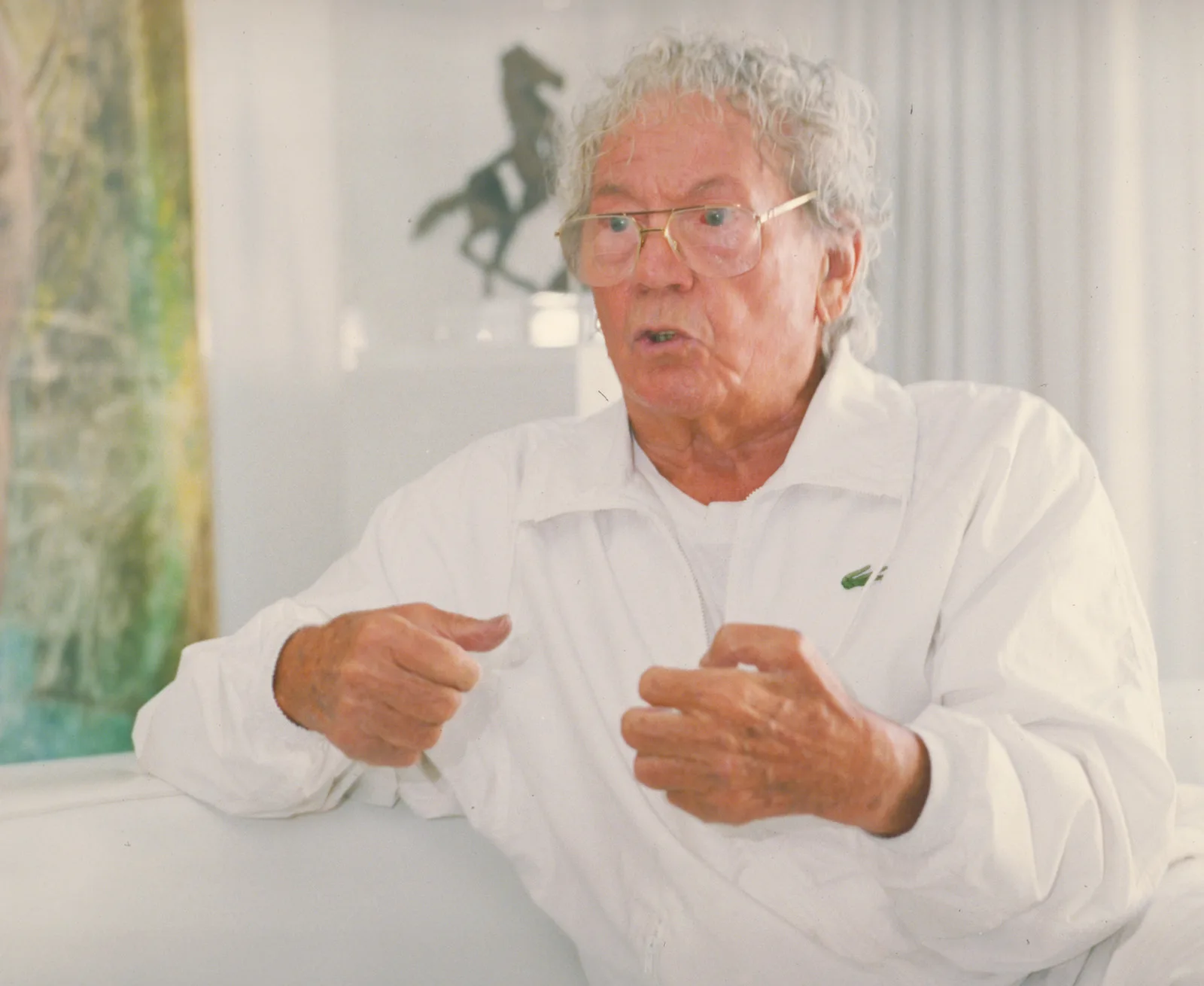
Hans Erni, 1997.
Hans Erni, 1997. Swiss National Museum

The ‘Landibild’ mural for the National Exhibition
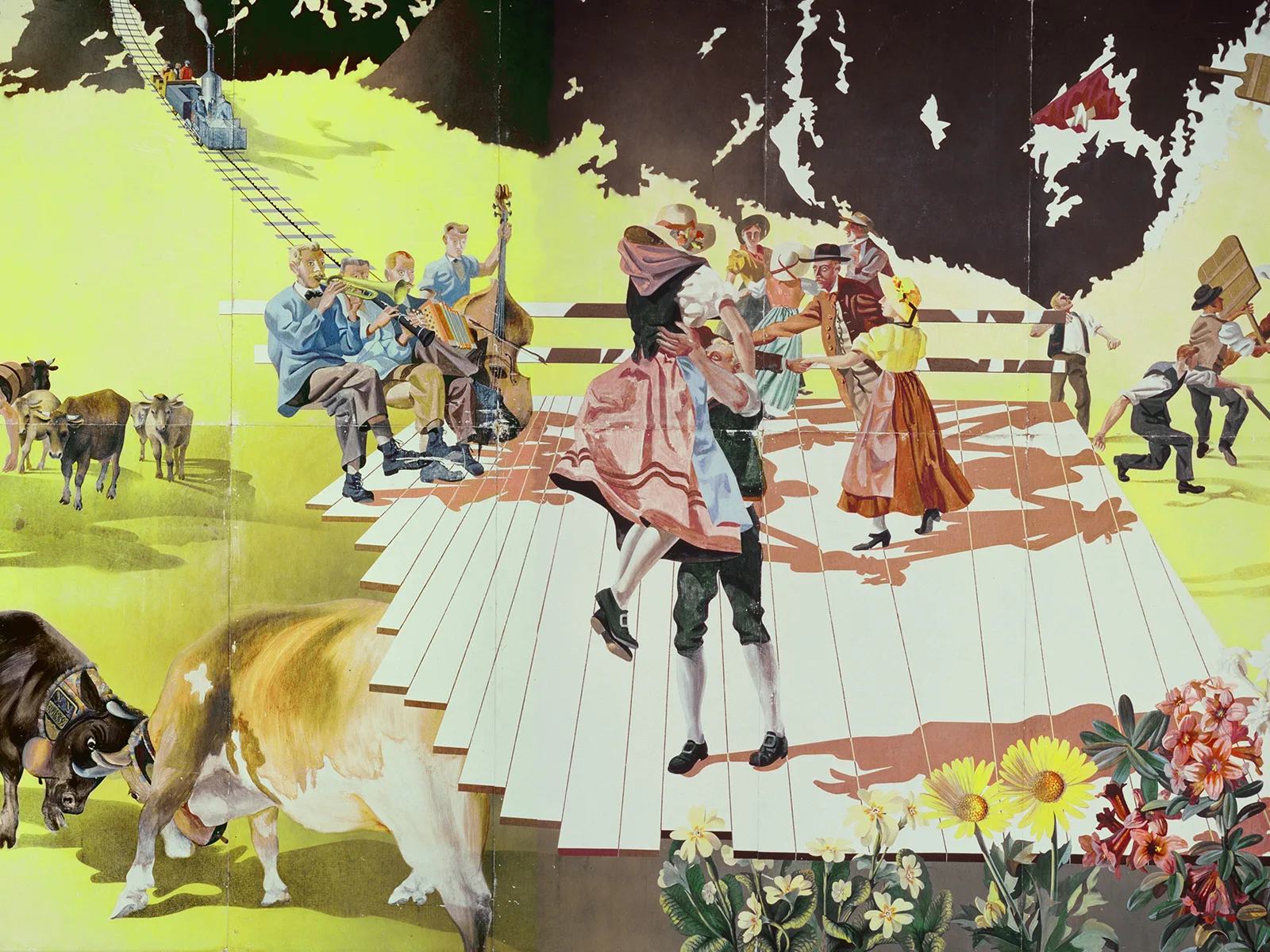
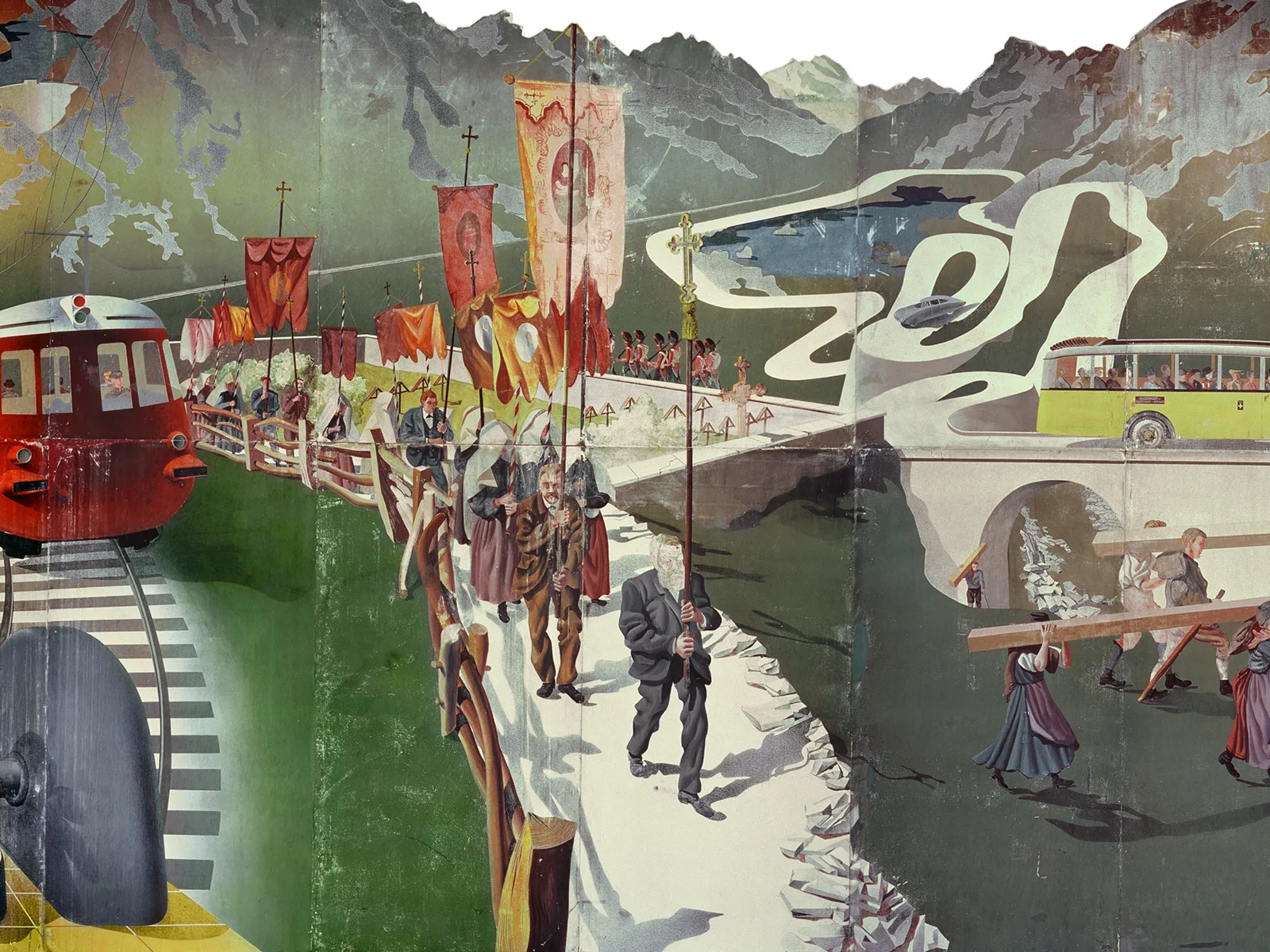
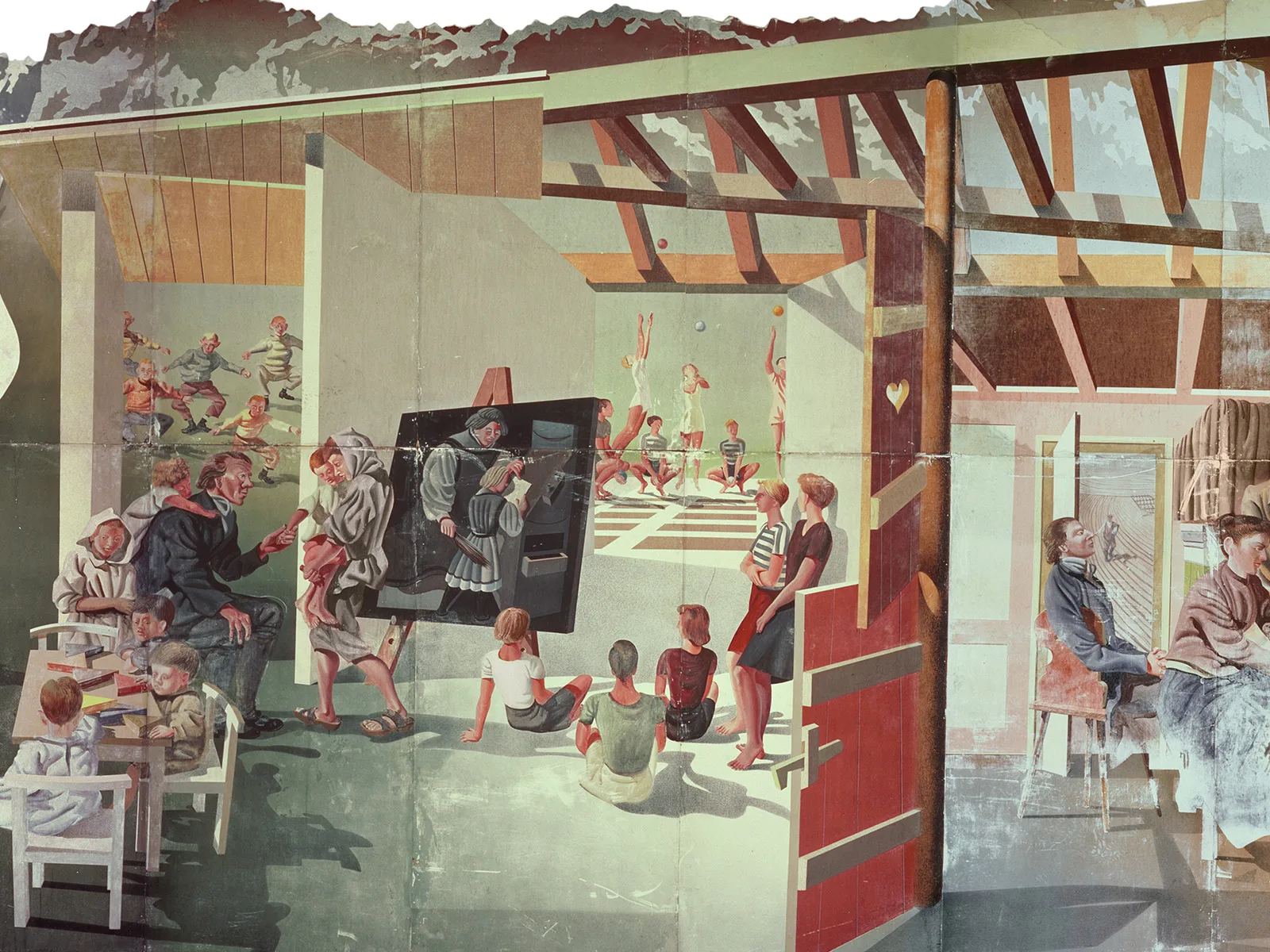
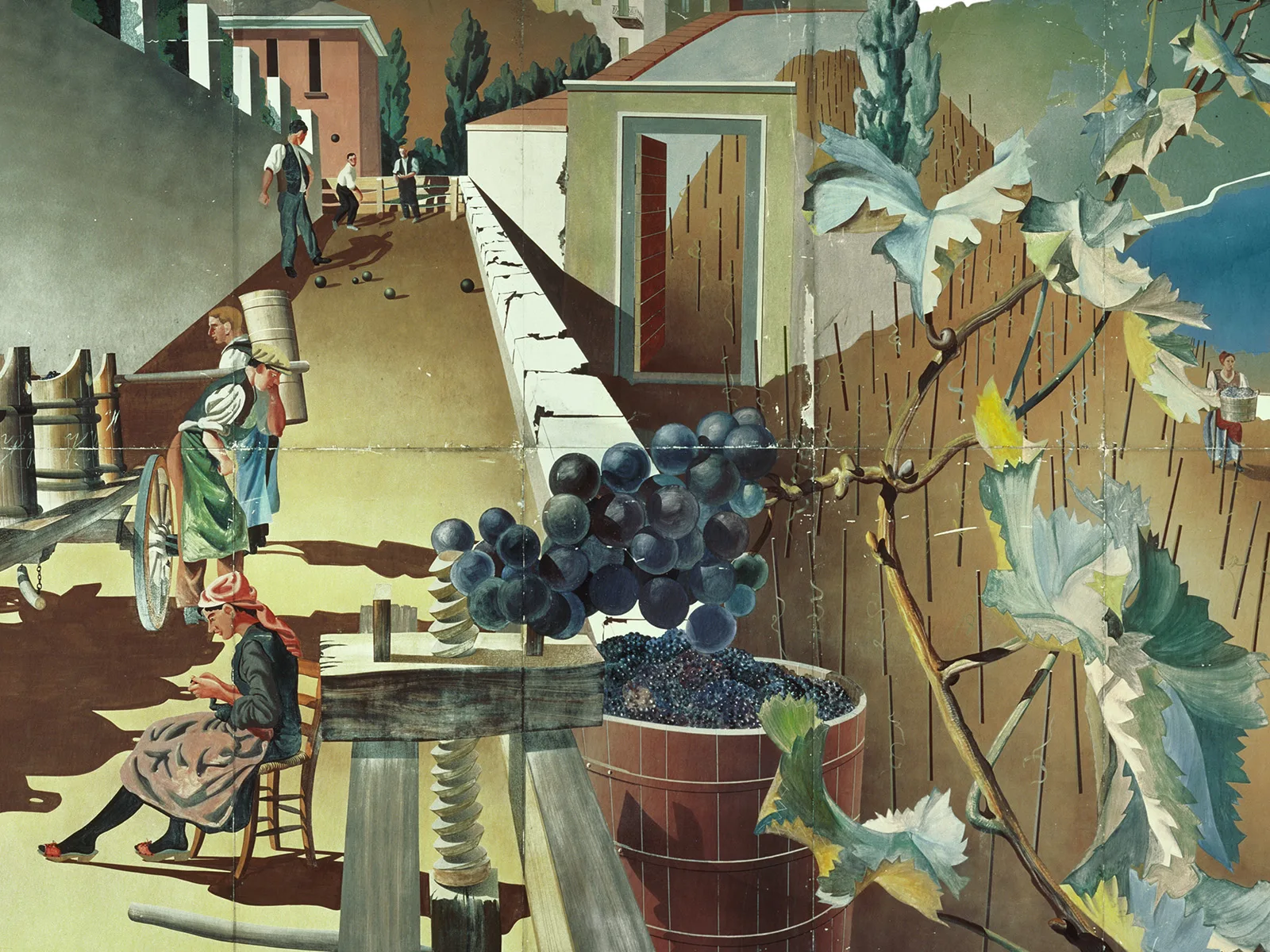
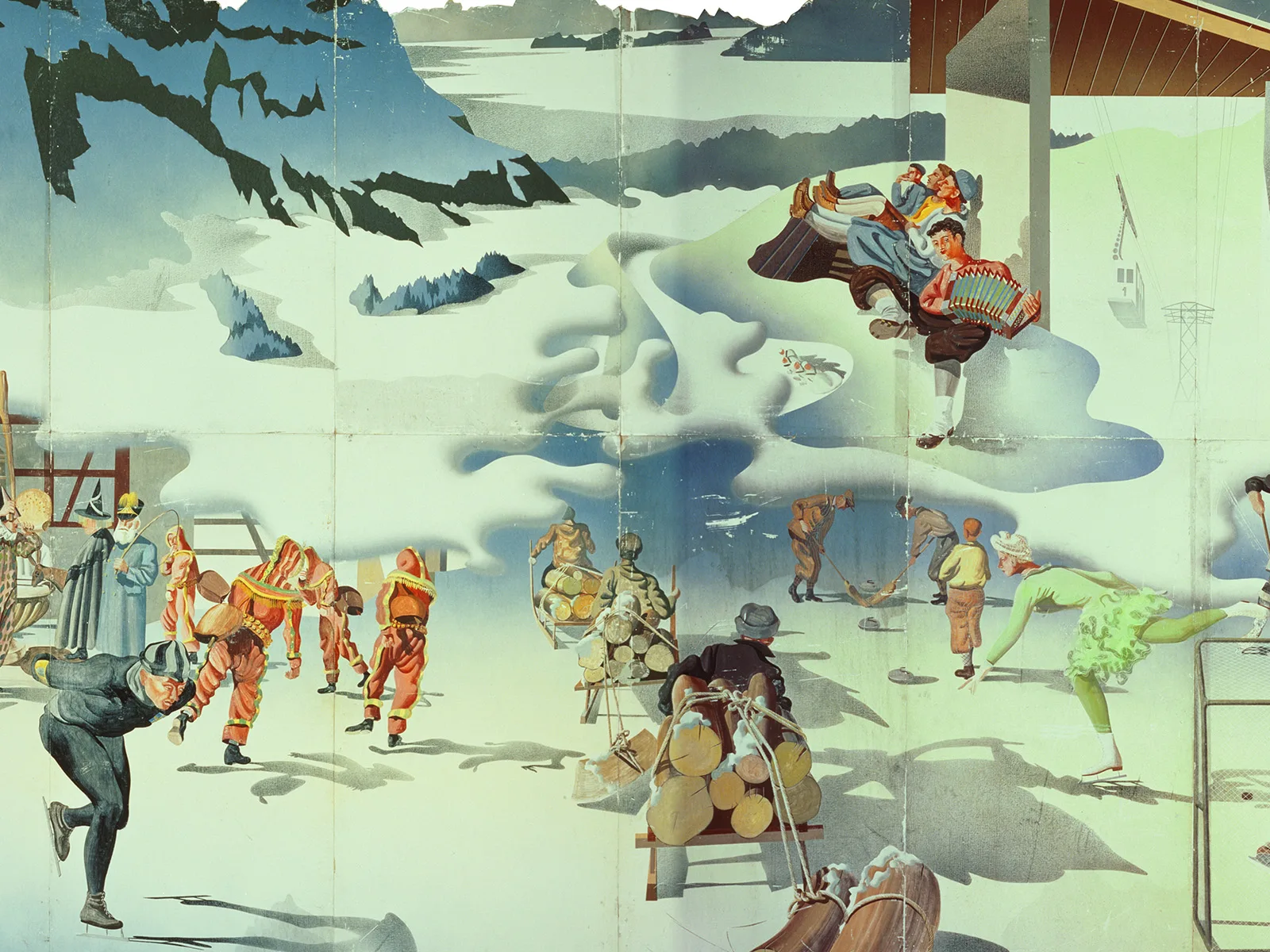
Together with his friend and art scholar Konrad Farner, Hans Erni developed the visual concept for the national exhibition: a 100-metre-long mural depicting Switzerland with its different landscapes – Swiss Plateau, Alpine foothills, Alps, southern region – throughout the four seasons. History, rural life, customs, technology and science – all interwoven onto a single narrative scene. As he later wrote, Erni wanted to highlight the relationship between humans and enduring nature, and “to visually connect the past with the present”.
The mural was a hit with the public. Critic Manuel Gasser wrote in Weltwoche magazine that “here was a young Swiss man recounting the beauties of his homeland in a completely new way”, underscoring the identity-building relevance of the National Exhibition. The extent to which Erni was consciously aiming to achieve this is shown by his own remarks before creating the ‘Landibild’ in 1938. He said that he wanted to create a sequence that seemed to unfold according to a causal logic. The only approach that lent itself to this was the chronological course of Swiss history. Historical contrasts, such as the Reformation wars and the Sonderbund War, had to be consciously ‘eradicated’ as the objective of the National Exhibition lay “not in division but in unification”. The ‘Landibild’ mural brought Hans Erni overnight fame as an artist. Yesterday’s avant-gardist became the nation’s narrator.
Details from the mural ‘Switzerland, Holiday Land of the People’, produced in 1939.
Details from the mural ‘Switzerland, Holiday Land of the People’, produced in 1939. Swiss National Museum
Image 01 of 05
Details from the mural ‘Switzerland, Holiday Land of the People’, produced in 1939.
Details from the mural ‘Switzerland, Holiday Land of the People’, produced in 1939. Swiss National Museum
Image 01 of 05
Details from the mural ‘Switzerland, Holiday Land of the People’, produced in 1939.
Details from the mural ‘Switzerland, Holiday Land of the People’, produced in 1939. Swiss National Museum
Image 01 of 05
Details from the mural ‘Switzerland, Holiday Land of the People’, produced in 1939.
Details from the mural ‘Switzerland, Holiday Land of the People’, produced in 1939. Swiss National Museum
Image 01 of 05
Details from the mural ‘Switzerland, Holiday Land of the People’, produced in 1939.
Details from the mural ‘Switzerland, Holiday Land of the People’, produced in 1939. Swiss National Museum
Image 01 of 05
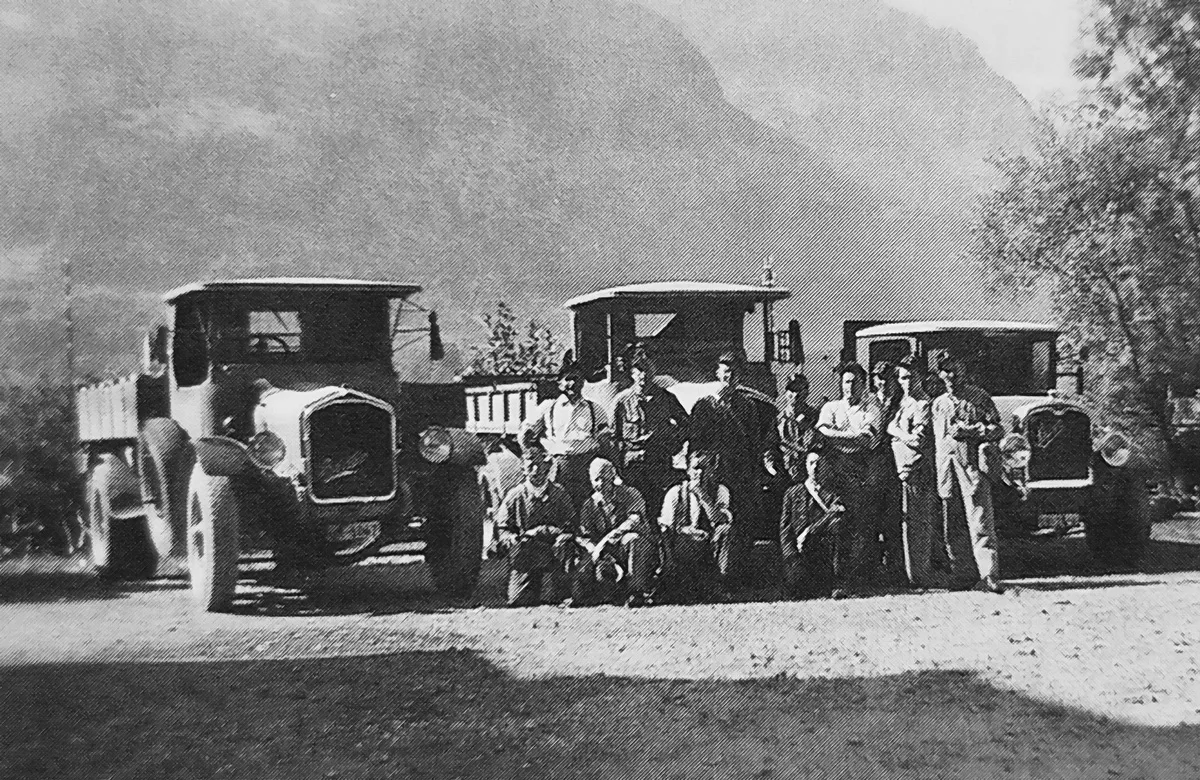
The Second World War broke out on 1 September 1939, during the Swiss National Exhibition in Zurich. That same day, General Guisan ordered the general mobilisation of the army, with 430,000 men entering into active service in the following days. Hans Erni was also called up for military duty. He was initially assigned to the Intellectual Auxiliary Service (IAS), but the Military Administration wasn’t interested: as a driver he was to transport ammunition in the canton of Uri – untrained and with old and heavy trucks. A subsequent request to reassign him to the IAS was declined. People didn’t believe that “as an artist he could be of much use to the IAS.” Yet his artist’s eye was soon sought after – albeit by the Army Equipment Administration.
Truck detachment, ammunition depot 5, 1939.
Truck detachment, ammunition depot 5, 1939. Hans-Erni Foundation

Erni, the camouflage painter

As early as October 1939, the Military Department instructed Colonel Mezener to look into camouflaging “vital military buildings”. Considering the growing destructiveness of air forces in the war throughout Europe, the camouflaging of military buildings took on a new urgency. Switzerland also had to quickly rectify its own weak points.
A report by the command of the air force and anti-aircraft troops of February 1940 stated in no uncertain terms that making larger buildings completely invisible was a practically impossible task. All they could strive for was the best possible result, it said. Colour was crucial. According to the report, during a dive-bombing attack the pilot would briefly lose sight of the target as he pushed the aircraft into the dive; in that short interval, he would find it significantly harder to relocate a dark, matte object than a light one. Even when approaching with a sighting telescope from a distance of 10 to 15 kilometres, it said, a dark point in the landscape would be more likely to be lost. Hence the demand to create matte, dark, irregular surfaces – no colourful patterns, but rather understated black-green.
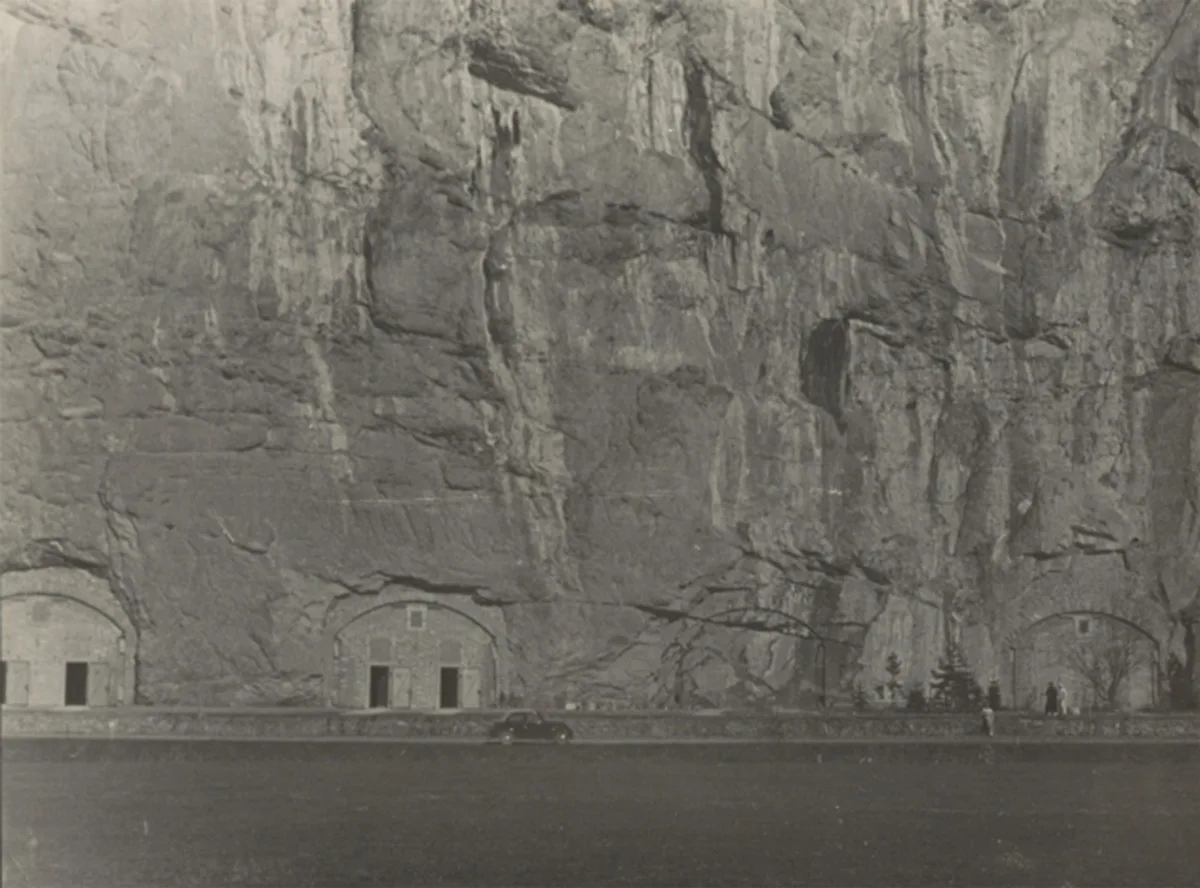
What on paper sounded rather uninspiring became a specific task for Erni in the spring of 1940, when he travelled to Altdorf. The armament factory and ammunition depot there were on the list of important buildings that urgently needed camouflaging from the outset. The depot was built into the rock face. For this very reason, it was not only about colour: the form of the camouflage was crucial as tunnel portals and access ramps formed a structural regularity, which could draw the attention of pilots. Colonel Mezener was impressed by Erni’s suggestion of making the entrances well and truly “disappear” into the landscape.
The ammunition depot with and without camouflaging.
The ammunition depot with and without camouflaging. Swiss Federal Archives
In the subsequent months Erni prepared additional camouflage programmes for various military structures, such as the high-mountain shelters above Realp in 1942 and the fortifications on the San Carlo fortress summits. In a presentation to the construction management unit for the Teufelswand, he was very specific, pointing out that the gun positions on the slope were camouflaged with colours that were too light, and on top of that, the smooth paintwork was causing reflection. Erni wrote that he recommended “a darker, impasto, rough, dabbed paint application.” He said that the summits of San Carlo should be partly covered with flat stone blocks arranged naturally, and that shrubs native to the surrounding area should be planted.
Impasto, dabbed, rough – this is not the language of an administrative official, but of a painter. Did these works therefore remain purely official assignments, separate from Erni’s actual artistic oeuvre? Or did they tie in with his earlier paintings?
Hans Erni the bunker painter, Schweiz Aktuell of 25 June 2009 (in German). SRF

Muni mag 5

In 1944 Erni painted a fresco for the soldiers’ mess room in Rynächt near Schattdorf featuring a ‘Uristier’ – an animal based on the Minotaur from classic mythology that single-handedly drove off five attackers, despite being outnumbered. The title ‘Muni mag fünf’ is a double pun: on the one hand on the name ‘Munitionsmagazin 5’ (ammunition depot 5), and on the other, on the Swiss German dialect word ‘Muni’ meaning ‘bull’ and ‘mag’ in the sense of ‘overpower’.
This fusion of military service and legend is no coincidence. While serving as a driver in the military, Erni got to know doctor and folklorist Eduard Renner, accompanying him on visits to the mountain valleys of Uri. During their travels the pair talked about Renner’s book ‘Goldener Ring über Uri’ (Golden Ring over Uri), which interpreted the legends and customs of mountain farmers as reflecting a magical view of the world. These stories fed into Erni’s ‘Uristier’ – the Minotaur from antiquity meets the myths and legends from the canton of Uri.
This small work therefore combines two unlikely things: day-to-day military life and ancient myth, professional duty and artistic freedom. Once again, the artist was serving society, and once again connecting present and past. Just like he had done in his ‘Landibild’ mural five years earlier.
Hans Erni, ‘Muni mag fünf’, 1944.
Hans Erni, ‘Muni mag fünf’, 1944. Staatsarchiv Uri

To delight and to serve

Decades later, commenting on his own life, Erni himself looked back at this relationship between artist and society. A public commission, he wrote, must engage the public. He could master a task with a clearly defined programme just as well as one guided purely by intuition.
So was his ‘Landibild’ mural such a task? And the camouflage work too? Erni once summed up his life’s goal as: “to delight and to serve”. He sought to delight with his mural in 1939 and to serve with his mountainside camouflages in 1940. Perhaps there is no contradiction between the two, merely a shifting of focus – from the visible to the invisible, and from celebration to emergency. Seen through the same eye.

Wars and us

17.04.2026 17.01.2027 / National Museum Zurich
Warfare has been a defining element of Switzerland’s history. The exhibition brings together a variety of perspectives, showing how ‒ from the late Middle Ages to the present day ‒ wars have influenced the nation’s political structures, economic interests and social order. It also invites visitors to question popular ideas of Switzerland’s relationship with war ‒ even when that war often seems distant, but is etched deeply in the collective memory.
Further posts