The Swiss public seem to have forgotten the war that broke out in Yugoslavia in 1991. Nonetheless, it did (and still does) affect people living in Switzerland who came from the war zone. They were stigmatised during and after the war, while the influx of people from ex-Yugoslavia has left a mark on Swiss culture and everyday life.
Jelica Popović studied German, eastern European history and Bosnian, Croatian, Montenegrin and Serbian (BCMS) literature. Her dissertation was about the concept and discourse of the 'Balkans' and how it is perceived in post-Yugoslavian rap. She works as an advanced researcher at the University of Teacher Education Zurich and is a freelance translator.
“There has been no war in Europe since the last world war”, according to a report on Swiss news programme ‘10 vor 10’ in reference to Russia’s invasion of Ukraine. This statement fails to acknowledge the Yugoslavian wars from 1991 to 2001 and is indicative of how these wars are overlooked in Switzerland. This selective memory is disconcerting and hurts people living in Switzerland who have ties to the post-Yugoslavian countries. A feeling of bitterness. A tired smile. Powerlessness. Outrage. These are the feelings or situations brought about by this collective forgetfulness. Why this amnesia? Or is it ignorance?
What are the Yugoslavian wars?
The Yugoslavian wars began in 1991 with the collapse of socialist Yugoslavia. Following a brief war in Slovenia, the conflict escalated in Croatia and, from 1992, mainly in Bosnia-Herzegovina. Serbian, Croatian and Bosnian forces clashed over territory and political control. Sarajevo was under siege for almost four years. The Dayton Accords brought the Bosnian war to an end in 1995. Repression, armed uprising and counterviolence in Kosovo then caused hostilities to flare up again in 1998. Serbia withdrew from Kosovo in 1999 following aerial bombing by NATO.
Major war crimes were committed, including massacres, rape, the running of concentration camps, torture and the systematic displacement and murder of civilians. The 'ethnic cleansing' in Bosnia-Herzegovina was particularly egregious. In July 1995, Bosnian Serb troops murdered more than 8,000 Muslim men and boys in Srebrenica. International courts classified the crime as genocide. The wars and collapse of the multinational state saw the integrative, 'multi-ethnic' southern Slavic idea give way to the single-nation state characteristic of the rest of Europe.
Programme on the outbreak of war in Croatia from 17 October 1991 (in German).SRF
What do the people from ex-Yugoslavia living in Switzerland remember? The outbreak of the Yugoslavian wars changed how people with roots in Yugoslavia and Kosovo based in Switzerland were perceived. Before the wars, they had been fellow human beings from a European country, valued workers, especially in food service, healthcare and construction. Once war broke out, they were stigmatised. Why was that?
Rapper Bossnak talking about his experiences as a refugee from war and how hard he has worked to build his life in Switzerland (in Swiss German).YouTube / SRF Bounce
From fellow human beings to ‘yugos’
For a start, Western Europe didn’t want to know about war having just seen the Cold War come to an end. In the early 1990s, there were easily 350,000 people with Yugoslavian roots living in Switzerland, which was a significant presence in relation to the local population. So, when the war broke out it had a direct and tangible impact on Switzerland. There were fears of conflict breaking out among the different ethnicities in Switzerland; at the same time people wanted to escape the fighting and gravitated towards Switzerland due to having done seasonal work in the country or, in most cases, because they had relatives there.'Yugo,' which means 'south' in BCMS, became a derogatory word. People whose surname ended in ‘-ić’ experienced trouble finding work, apprenticeships and accommodation, as did people with Albanian-sounding names. Someone looking for an apartment was even asked whether they were one of those “Karadžić people” – a reference to Radovan Karadžić, the Bosnian Serb politician convicted of genocide.
Rapper Brazzo feat. Steveomentals subverts the racist connotation of the term in his song 'Yugo': an act of self-assertion.YouTube / Loft Records
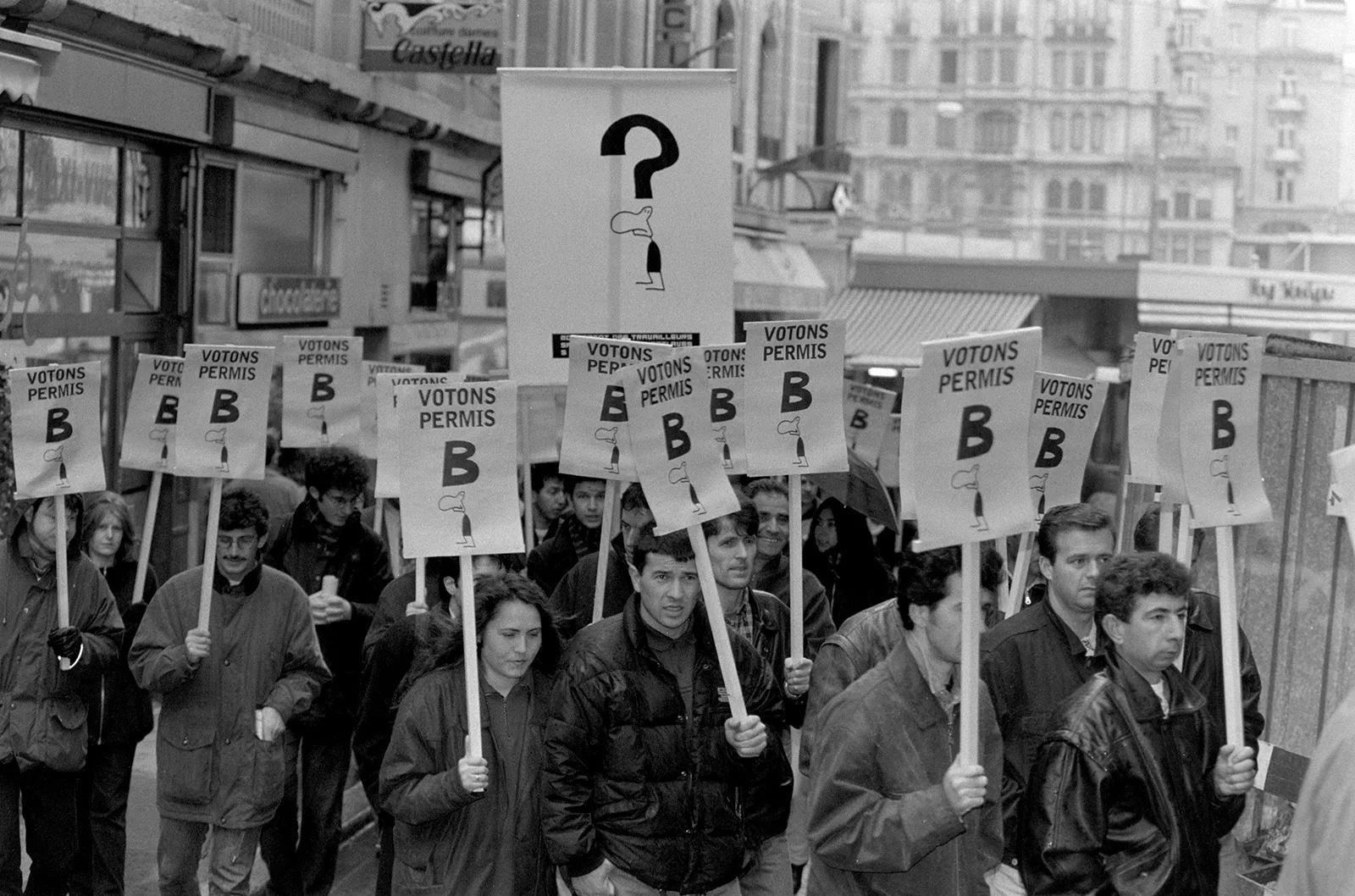
Moreover, people from Yugoslavia were not just downgraded informally. This treatment also extended to the political and administrative sphere: having been in the 'second circle', i.e. one of the traditional countries for recruiting labour, and which shared religious, cultural and social values with Switzerland, Yugoslavia was relegated to the 'third circle' in 1991. As the furthest removed from the centre, no immigration was intended from the third circle. The states that emerged from the break-up of Yugoslavia thus inherited this status similar to that of non-EU/EFTA countries today. This meant people from ex-Yugoslavia living in Switzerland had to be in the country for ten years to acquire the precious C (unlimited) residence permit. Job advertisements often stated: 'for C permit holders only'. The media, and the general public, kept talking about the 'Balkans'.Workers from ex-Yugoslavia demonstrating for a residence permit in March 1998 in Lausanne.Swiss National Museum / ASL
The perception of the ‘Balkans’ as an uncivilised space
Historian Maria Todorova has studied how the Balkans are perceived following the break-up of Yugoslavia and how the region has been covered in the Western media. The word 'Balkans' does not just refer to a geographical area. It also conveys a host of negative stereotypes, known as Balkanisms. Geographically, the Balkans are part of Europe, but the area is represented culturally as the 'inner other'. In other words, the Balkans are associated with many negative features, which the 'European Europeans' and the 'West' claim to have left behind long ago. 'Yugos' are thought to be aggressive, barbaric, half-civilised, semi-oriental, backward and primitive. These characteristics have a long tradition. However, they were reactivated and strengthened in Switzerland during the Yugoslavian wars of the 1990s. This led to people being stigmatised because of where they came from. As a result, the ex-Yugoslavians tried not to attract attention, regardless of whether they had lived in Switzerland before the war or had fled the fighting. They did their best to conform and kept quiet about their trauma – with the possible exception of a few footballers – to avoid being discriminated against. The attitude at the time was: “You are/were at war, because that’s the way you are: aggressive, barbaric, half-civilised, semi-oriental, backward, primitive". These accusations persist even today. There are different strategies to circumvent them; people either overcompensate by going the extra mile to fit in and blend into society, or they go the other way and overidentify with these characteristics, turning them into positives.
Playing with clichés: Zurich MC Hero: living up to Balkan clichés, tracksuit, jewellery, BMW in the track 'Ok, ok'.YouTube / MC Hero ft. Drini
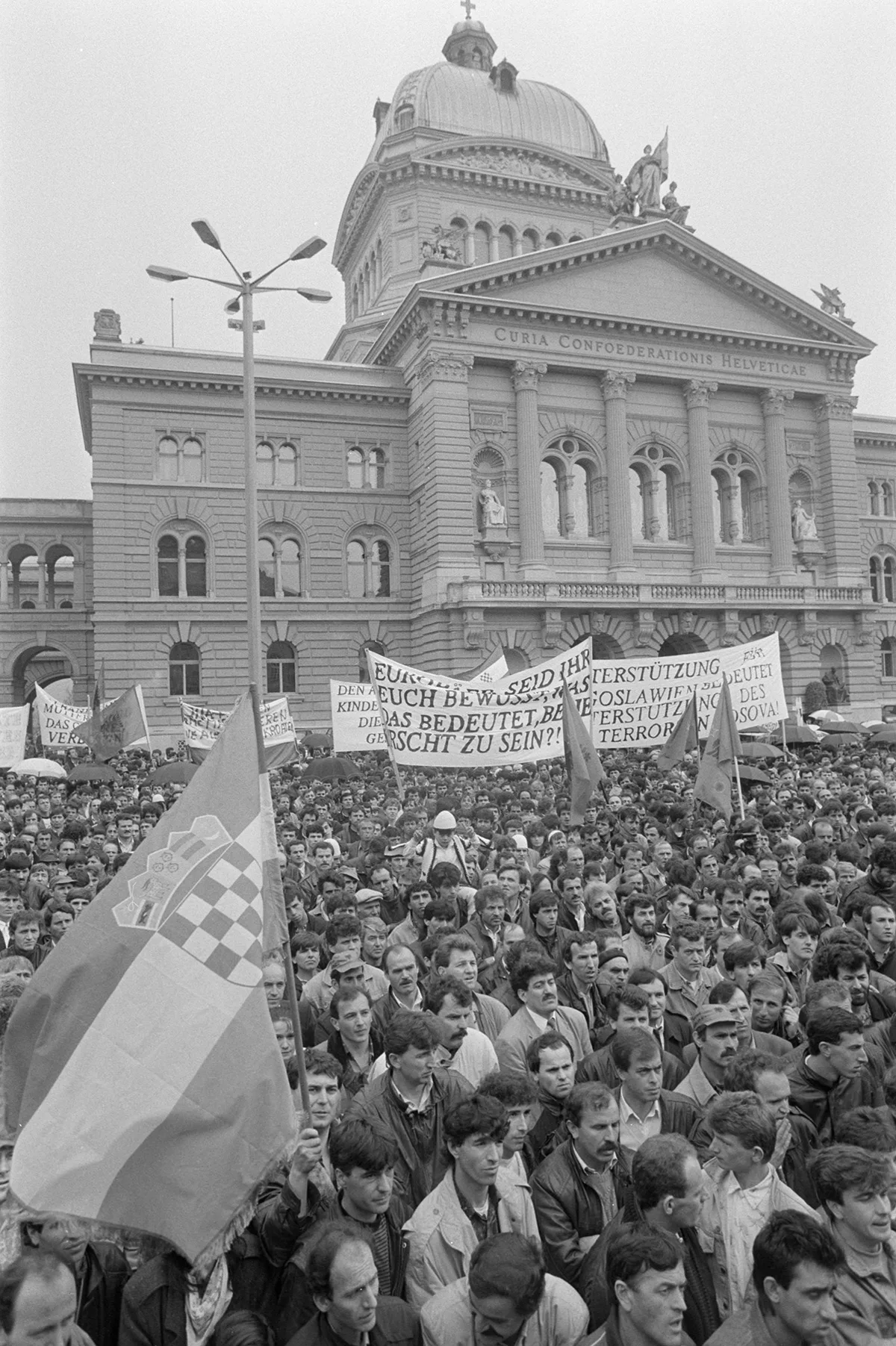
When war broke out in Ukraine, the reaction in Switzerland among the public and in political circles was one of solidarity, dismay and empathy. Status S was fortunately brought in to facilitate entry for the refugees. After all, war had broken out in 'Europe'. So, why was the Swiss public so quick to forget about the Yugoslavian wars? The ex-Yugoslavian communities in Switzerland have not forgotten the war or the stigmatisation and stereotyping that came with it – as they still encounter them every day. What does being European mean? Was ex-Yugoslavia not European enough? But what does that even mean? How does that affect the way they suffered? How can their experiences be remembered and recognised? What role does local migration policy play in supporting this forgetfulness?As Rohit Jain has noted, assimilationism – this doctrine of conformity that leaves no room for hybrid identities or treats them as a problem – was especially acute for the so-called second generation: to be successful, you have to join the majority – almost be more Swiss than the Swiss. Anything that went before – war, trauma, worry – is suppressed, ignored, marginalised. These issues get pushed off onto the communities. This simply stokes the already widespread ignorance among most of the population.Demonstration of 4 May 1991 on Parliament Square in Bern against the oppression of the minorities in Kosovo.Swiss National Museum / ASL
The influence of the ‘yugos’ on Swiss youth and everyday culture
The (post-) Yugoslavian influx has definitely made a difference to everyday culture. Take language for example. Young people talk slang known as 'Balkan slang' which causes indignation in some middle-class Swiss families when their children omit prepositions and speak with a certain accent. 'Balkan slang' has become a way of speaking for young people and as such is a type of Swiss German. As regards swearing, mother curses have become part of Swiss German, whether in the original language, Albanian or BCMS, or translated into Swiss German. These linguistic interferences (influences from one language on another) are closely connected with the hip-hop culture and rap, for which the spoken word, more specifically slang words, are key to establishing authenticity. MCs with post-Yugoslavian or Albanian roots are the main movers shaping the Swiss rap scene.
Zurich rapper Danase does not have a post-Yugoslav background, but he still uses the slang term 'Jebem ti majku' on SRF Cypher 2025 (a rap event) and mentions Duško Dugouško, as Bugs Bunny is called in BCMS.YouTube / SRF Bounce
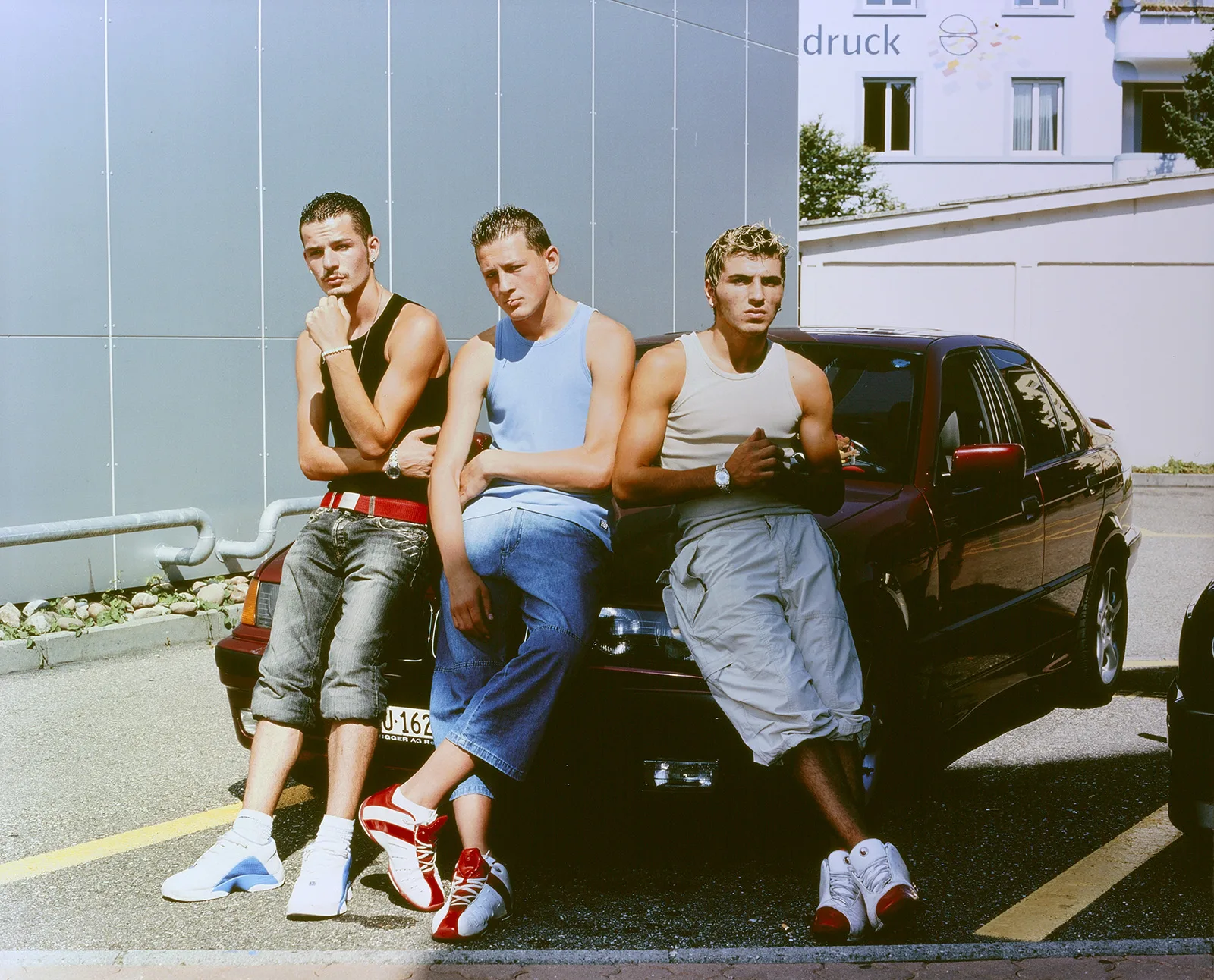
Its influence is also evident in everyday life: for example there are the negative connotations and stereotypes associated with tracksuit bottoms, which are now considered trendy despite all the bans on them in school and the workplace. All the major retailers now offer pite and burek pastries to take away. The Balkan section is also a staple of their offering.The post-Yugoslavian influence is especially prevalent in youth culture. Young men with a Kosovan-Albanian background posing in front of a BMW. Photo by Paco Carascosa, 2004.Swiss National MuseumThe collapse of Yugoslavia has been covered repeatedly and extensively in post-Yugoslavian creative culture – in literature, film, music, rap music, and visual art. There are also many second-generation creative artists in Switzerland who are now adding their input, especially in literature. For example, the authors Tanja Miljanović who wrote Wenn wir wieder Menschen sind ('When We are People Again'); Meral Kureyshi Elephants in Our Yard, Mina Hava Für Seka ('For Seka') and Melinda Nadj Abonji Fly away, Pigeon. Plus the list would not be complete without adding Dragica Rajčić-Holzner (Post bellum), a first-generation migrant who was instrumental in sharing the experiences of guest workers through poetry. They all make reference to the wars in ex-Yugoslavia. Nonetheless, this subject is not (yet) sufficiently familiar to the Swiss public for them to relate in any meaningful way to the wartime experiences of their fellow humans with ex-Yugoslavian or Kosovan roots. The works mentioned above address the stories of the people who saw the war; are written from their perspective and told with their voice. They do not just present ex-Yugoslavia through the stereotypical lens of war. Instead they aim to show the collapse of Yugoslavia, i.e. the Yugoslavian wars and the Kosovo war, as being intertwined with Swiss history and to create the requisite awareness and scope to enable that.
Warfare has been a defining element of Switzerland’s history. The exhibition brings together a variety of perspectives, showing how ‒ from the late Middle Ages to the present day ‒ wars have influenced the nation’s political structures, economic interests and social order. It also invites visitors to question popular ideas of Switzerland’s relationship with war ‒ even when that war often seems distant, but is etched deeply in the collective memory.
Michael van Orsouw08.05.2024Aarmühle was a place in the Bernese Oberland. As a name it was rather uninspiring and thus unlikely to appeal to potential visitors from all over the world. Hence the renaming of Aarmühle as Interlaken in 1891, which turned the town into a tourist destination of international renown.
James Blake Wiener19.09.2023Around 400 years ago, scholars began to address the education of deaf people and developed sign language for the first time. Switzerland played an interesting, complex and perhaps outsized role in this process.
Peter Egloff21.03.2023In his ‘Rätoromanische Chrestomathie’, unconventional Graubünden politician and cultural scholar Caspar Decurtins (1855-1916) created the most important older source text on the Romansh culture of his home canton. And did so while accomplishing a great deal more.