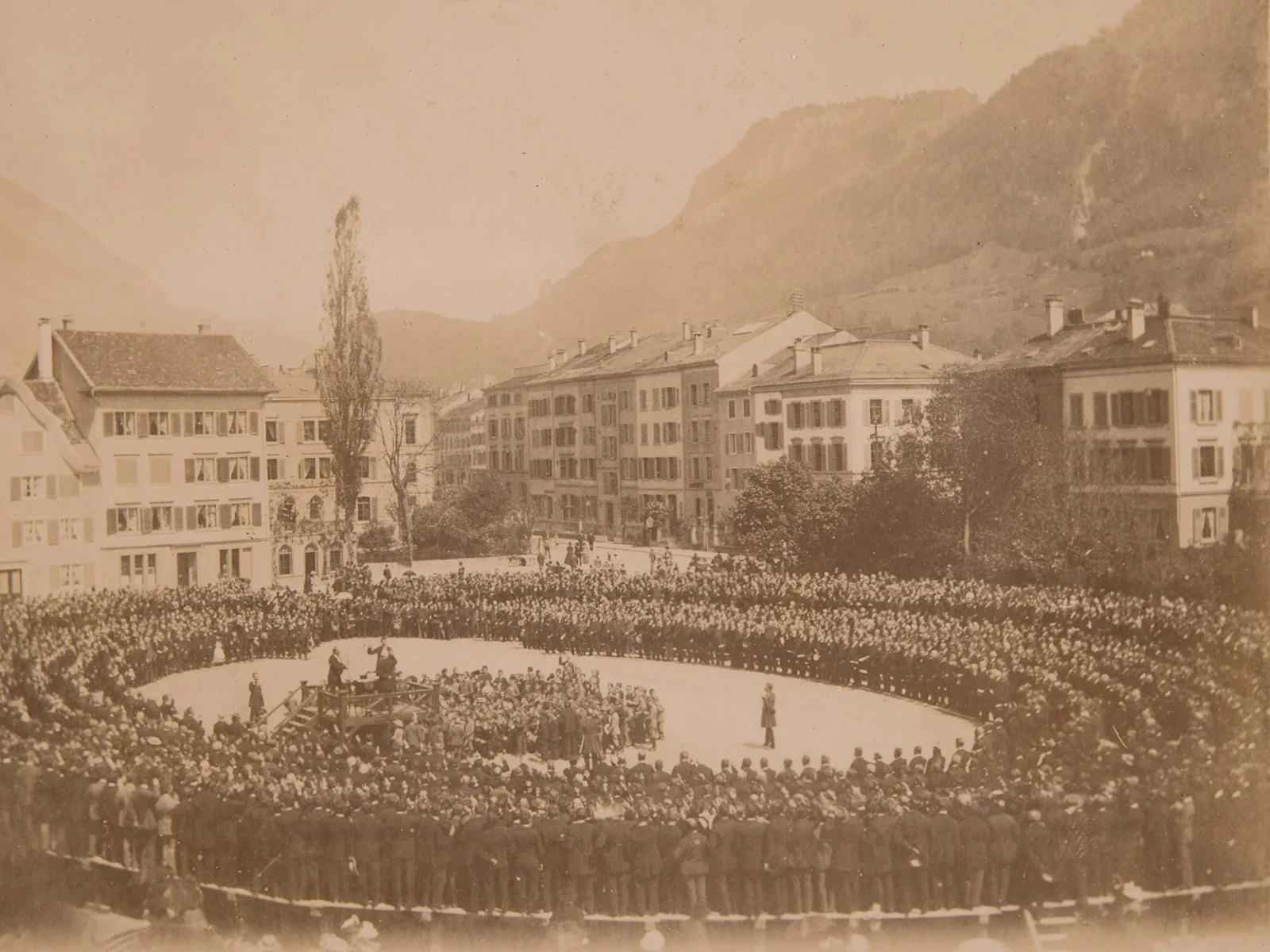
People’s Assembly in Glarus, photograph probably dating from the late 19th century.
People’s Assembly in Glarus, photograph probably dating from the late 19th century. Swiss National Museum

People’s Assemblies in Switzerland and their contribution to direct democracy

Glarus holds its People’s Assembly every first Sunday in May. This tradition goes back to the early days of democracy in the Middle Ages.

René Roca

René Roca

René Roca has a PhD in history and is a secondary school teacher and Director of the Research Institute for Direct Democracy fidd.ch.
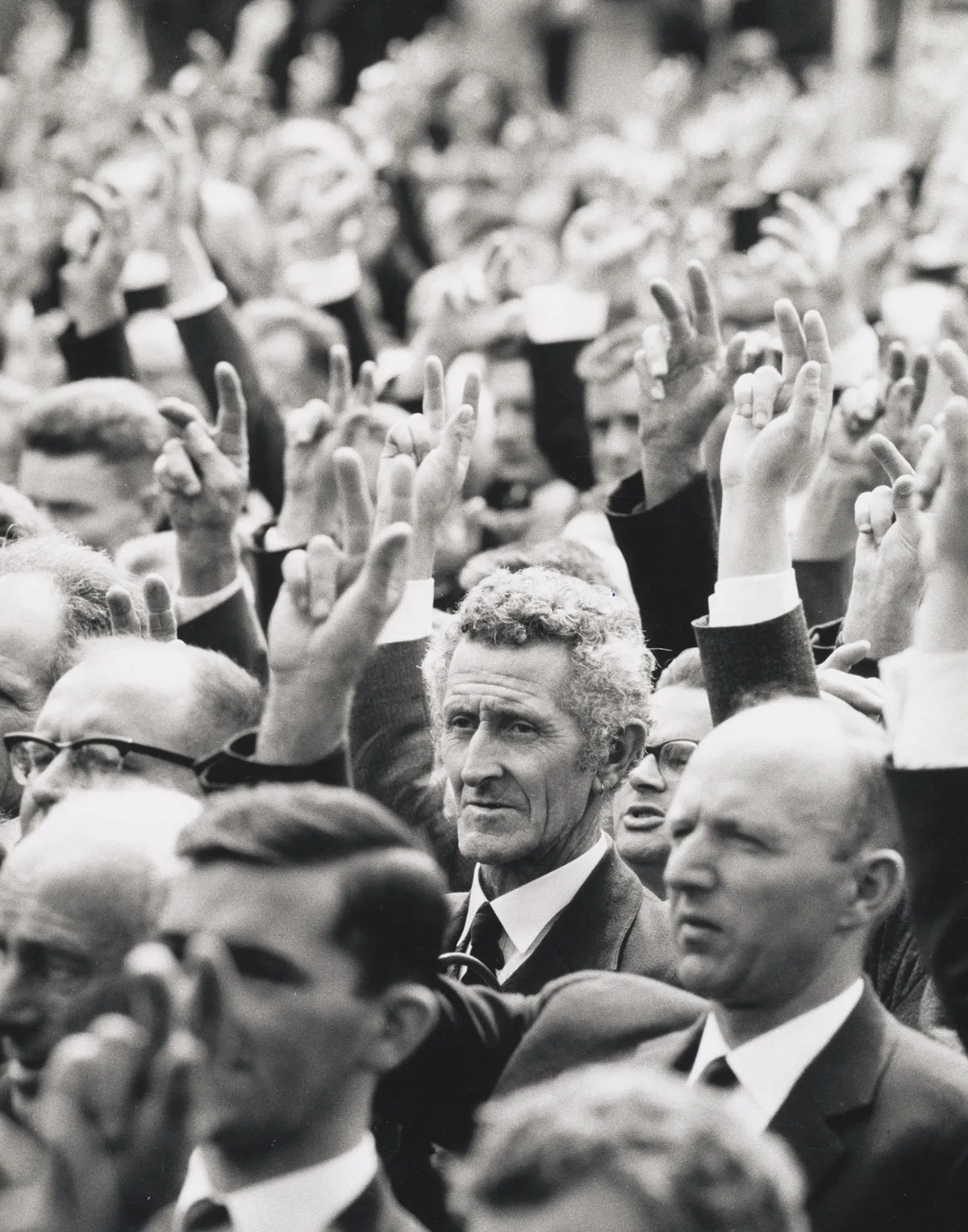
The canton of Appenzell Innerrhoden will again hold its People’s Assembly on the last Sunday in April this year and Canton Glarus on the following Sunday. They are the only Swiss cantons to have retained this tradition, which has a long history in Switzerland. It was an early example of democracy in practice and helped foster the emergence and development of direct democracy.
The origins of the People’s Assembly date back to the late Middle Ages (13th to 15th centuries). Sources dating from earlier are unclear. However, there were gatherings of some kind in what is now Switzerland during the Celtic and Germanic periods. The Confederacy was part of the Holy Roman Empire from the 13th century until it gained independence in 1648. During the time of the Old Swiss Confederacy (1291–1798), Uri, Schwyz, Obwalden, Nidwalden, Zug, Appenzell and Glarus were known as ‘Länderorte’ which loosely translates as rural cantons. From the late Middle Ages, these areas had their own sets of rules, each with its own specific structure, governing the procedure for the People’s Assembly. All the rural cantons were in the Alps or Alpine foothills and had communal land mainly comprising woods, large fields and alpine meadows. These areas were managed and used by the people and mainly belonged to small cooperatives, communes for example. The communal use of these areas was integral to the people’s political awareness. It formed the basis of municipal-cooperative civil society in Switzerland. The communes comprising these cooperatively organised societies and the cantonal People’s Assemblies were thus instrumental in the emergence of the Old Swiss Confederacy as a counterweight to the more autocratic ruling system prevalent in Europe at the time.
The Appenzell People’s Assembly of 1966.
The Appenzell People’s Assembly of 1966. Swiss National Museum

The importance of imperial immediacy

Uri was holding these assemblies as far back as 1231. The first accounts for Schwyz date back to 1294. Imperial immediacy played an important role in both rural cantons, i.e. the absence of any intermediary (noble class) between the people and Emperor. Agricultural areas in Switzerland had held regular village meetings since the late Middle Ages, as was standard practice in the Holy Roman Empire. Numerous written sources attest to that. These meetings were usually held once in the spring and once in the autumn and were normally chaired by bailiffs or local officials and instigated by the landowner. Following the expulsion of the Habsburgs and their accompanying class of nobles from German-speaking Switzerland, the farming communities selected these public officials from among their own ranks. These positions of responsibility were often kept within the same families over decades as they usually proved up to the job and able to prevent any deterioration in the quality of the village meetings. Over time, the village meetings evolved into People’s Assemblies for all the people in the rural canton.
Unterwalden had a People’s Assembly from 1309, and when it was divided into two around the middle of the 14th century, Obwalden and Nidwalden each had their own assembly, albeit with just one vote at the Swiss Federal Diet. The Swiss Federal Diet was the seat of political power in the Old Swiss Confederacy where the urban and rural cantons were both represented. Zug had a People’s Assembly from 1376, Appenzell from 1378 and Glarus from 1387. All the rural cantons were imperially immediate, despite repeated efforts to change the system. As a result, the 13th to 15th centuries saw these cantons forcibly resist any attempts to impose a ruling class on them to act as a conduit between the people and the Emperor. This particular bone of contention was not restricted to the rural areas as the urban cantons were very much on the same page.

The People’s Assembly as the sovereign authority
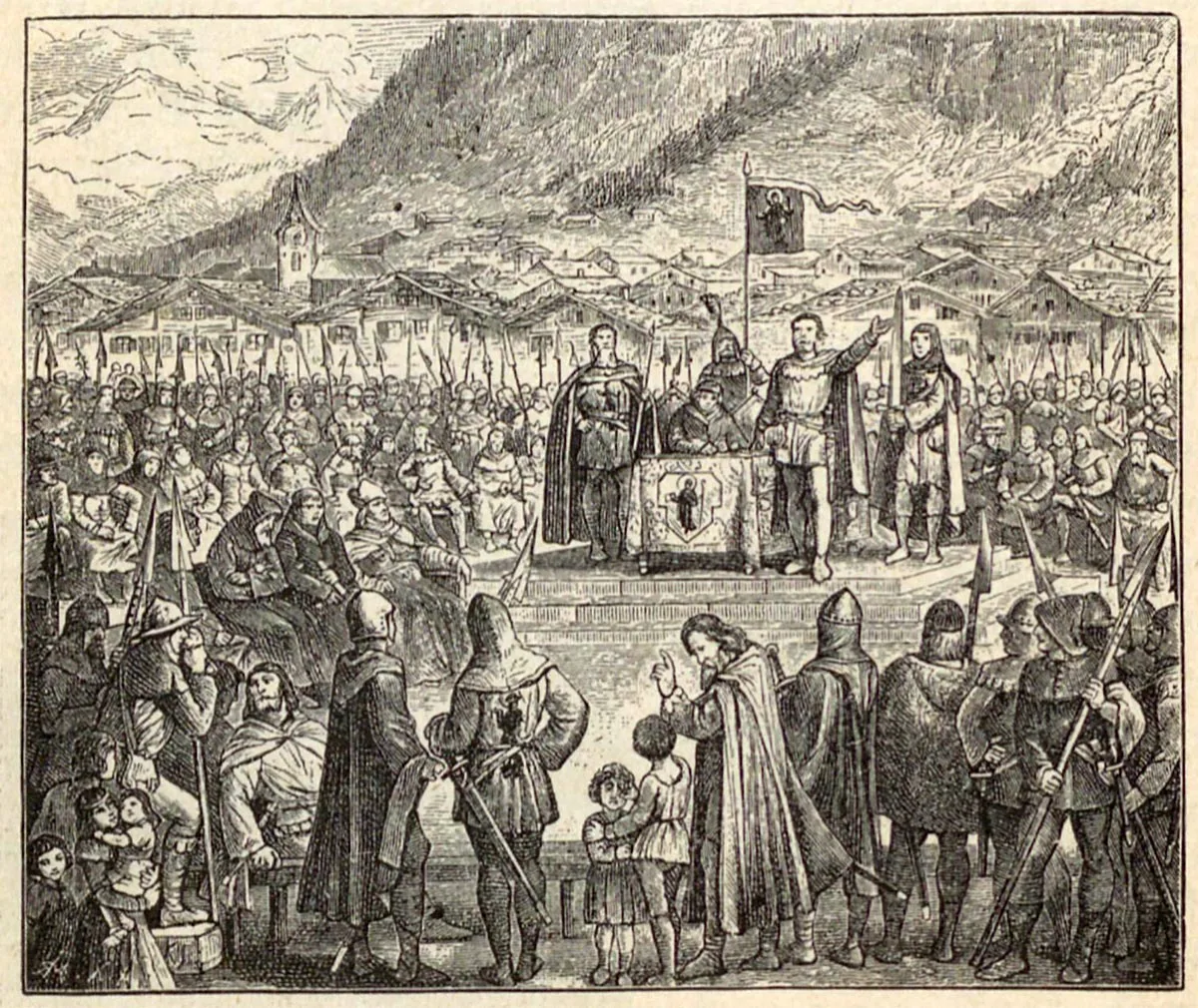
The People’s Assembly was the supreme authority in all the rural cantons of the Old Swiss Confederacy. There was no division of powers at that time. The People’s Assembly passed and implemented the laws as well as being the supreme electoral and legal authority. Voting was by a show of hands. There was an ordinary People’s Assembly every year in May or June plus several extraordinary ones for major decisions, military campaigns for example. They were convened and chaired by the public official who invited people to speak and oversaw the voting.
The first open-air People’s Assembly in 1387 in Glarus.
The first open-air People’s Assembly in 1387 in Glarus. Wikimedia / Georg Eckert Institute
The solemn ceremony at the start of the People’s Assembly with an ‘oath’ or religious service was part of the Christian culture. All upstanding citizens were obliged to attend the People’s Assembly; the voting age was 14 or 16 and restricted to males at the time. Every citizen entitled to vote was allowed to propose a motion. The People’s Assembly met at set times in the open air in the village square.
In the Old Swiss Confederacy there were also small communities in the territories and valleys attached to rural or urban cantons and with their own People’s Assemblies and rules, such as the valley communities of Ursern, Bellinzona and Engelberg, the Republic of Gersau, March, Einsiedeln and Küssnacht from 1433, the valley community of Entlebuch and the Earldom of Toggenburg. The assemblies in these subject territories did not qualify as sovereign instances (with the exception of Gersau), although they did enjoy a significant level of internal autonomy, which they usually guarded and defended with zeal.

There was no aristocracy in Switzerland
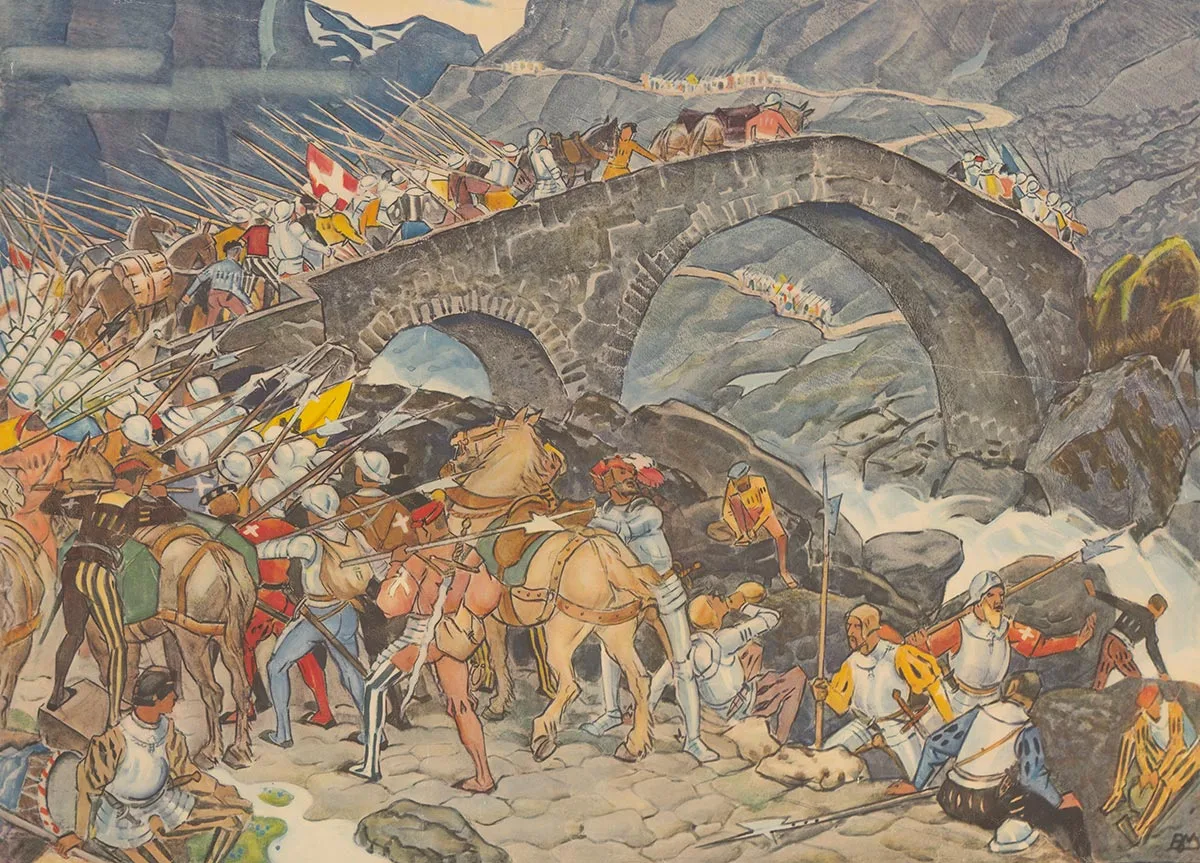
In the 13th and 14th centuries, the political leadership (public official, council and court) came from noble or ministerial families; although there were exceptions, such as in Schwyz where farmers assumed these tasks. The aristocrats and ministerial nobility (noble bondsmen) were either overthrown or abolished in the 14th and 15th centuries. At the same time, there was a defeudalisation of land and church in favour of the farmers and parish members. Large farm owners and prominent families took over the reins. They acquired influence and power in such places as Appenzell or Glarus with the help of mercenaries, ownership of property and capital plus industrial and commercial dealings. As a result, high-profile and influential personalities repeatedly emerged, occasionally leading to conflict. Combating abuse of power was a recurring theme at the People’s Assemblies. There was social mobility regarding the assignment of offices in the rural cantons, so the lower levels of society could aspire to important positions within the community. That prevented the emergence of an aristocracy in those areas, despite the existence of an elite class.
Serving as a mercenary was a lucrative business enabling many families, noble or otherwise, to climb the social ladder. Classroom picture from 1936.
Serving as a mercenary was a lucrative business enabling many families, noble or otherwise, to climb the social ladder. Classroom picture from 1936. Burkhard Mangold / Ingold Verlag
The People’s Assembly was an egalitarian system whereby the leadership always had to seek consensus with the people. To prevent the buying of public office, positions were sometimes awarded through a lot-drawing system.

‘Premodern democracies’ elsewhere in Europe

There were also other forms of ‘premodern democracy’ throughout Europe in parallel to the Swiss People’s Assemblies. For example, there were democratic areas in the mountain valleys of the Alps and Pyrenees in the late Middle Ages, in far-flung coastal areas of Friesland and Dithmarschen by the North Sea, in the impassable Hotzenwald in the Black Forest and in the Forêt de Roumare in France. However, the number of democratic areas decreased in the Early Modern Period. They receded to the area in current day Switzerland: Graubünden, Uri, Schwyz, Unterwalden, Zug, Glarus, Appenzell and Upper Valais to be precise. The other areas were occupied by the expansionist European monarchies and princes and came under their rule.

The Helvetic Republic had no need of a People’s Assembly
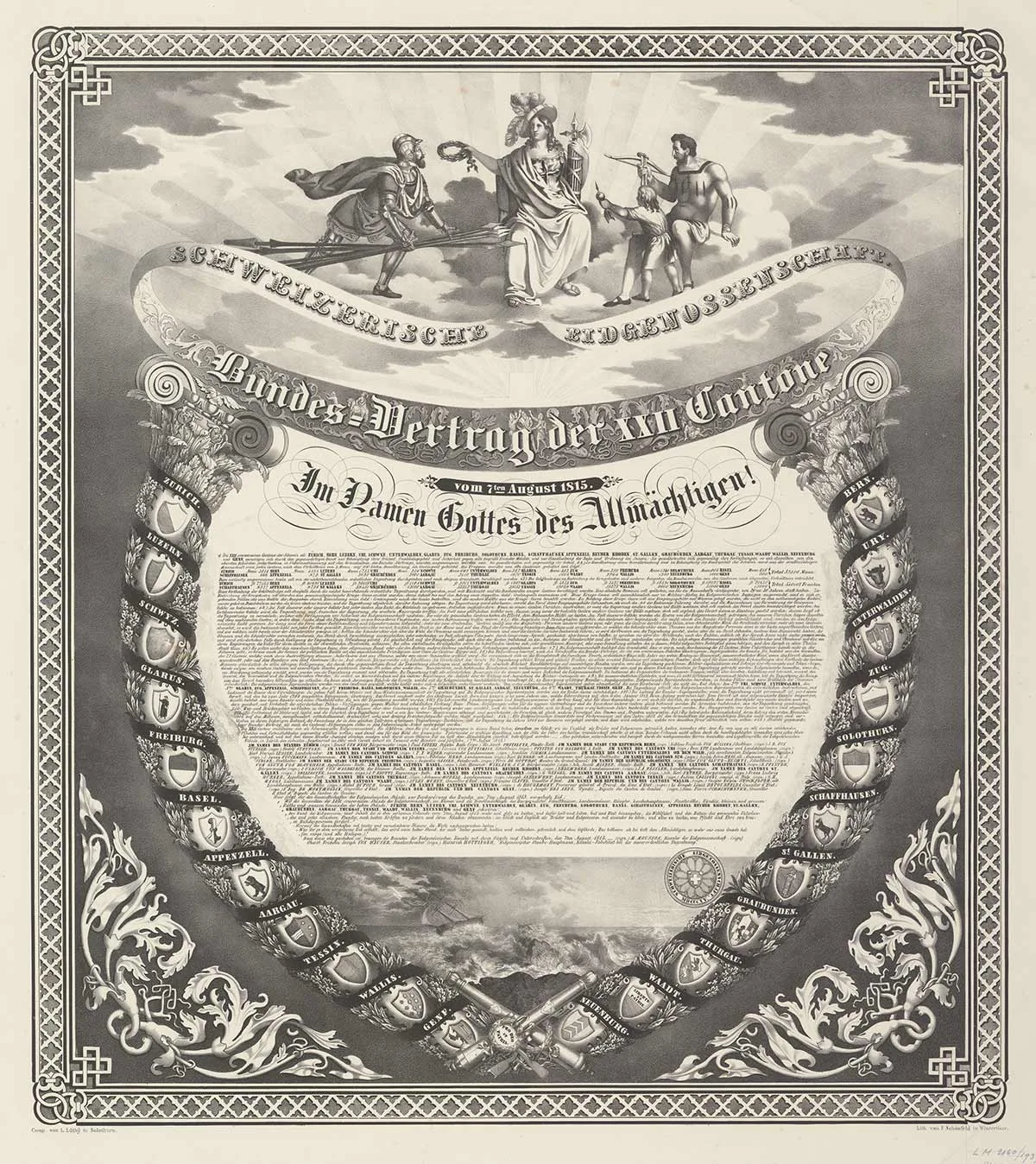
The People’s Assemblies remained an entrenched societal custom after the Swiss Confederacy gained independence in 1648. They only really fell from favour following the Helvetic Revolution in 1798 and the French military occupation, leading ultimately to their abolishment. The cantons and communes lost their autonomy when the centralist Helvetic constitution came into force and were downgraded to executive bodies. Nonetheless, the People’s Assembly remained synonymous with democracy and freedom for many people. The cantons had to wait until the Act of Mediation in 1803 to reinstate the People’s Assembly, which is what all the rural cantons proceeded to do. However, the internal workings and competencies of the People’s Assemblies had to be continually aligned with whatever national law was in force at the time, i.e. the Act of Mediation in 1803, the Federal Treaty of 1815 and as part of the 1848 Federal Constitution and its total revision in 1874. The People’s Assembly evolved from a ‘pre-modern’ form of democracy to a modern and enlightened one in the second half of the 19th century.
The Federal Treaty of 1815 had to be kept flexible to make room for direct democracy in the form of People’s Assemblies.
The Federal Treaty of 1815 had to be kept flexible to make room for direct democracy in the form of People’s Assemblies. Swiss National Museum
Many Swiss cantons and the Confederation used the People’s Assembly model to boost democratisation in the 19th century. It was invoked on many occasions by insurgents and members of the opposition in various conflicts during the Old Swiss Confederacy and served, particularly from 1798, as a ‘democratic model’.
The People’s Assemblies were also instrumental in the Swiss regeneration from 1830. The canton of St. Gallen, for example, was the first to introduce a legal veto to Switzerland (the precursor of the optional referendum) in the cantonal constitution of 1831. The neighbouring canton of Glarus set the tone with its People’s Assembly (in addition to Appenzell Innerrhoden and Ausserrhoden). All the Swiss cantons ended up adopting the legal veto over time as well as a form of the initiative whereby citizens can propose amendments to the constitution. And then came democracy through the People’s Assembly with the introduction of direct democratic people’s rights at federal level as part of the revised Federal Constitution in 1874. The introduction of the optional referendum blurred the lines between liberal-representative democracy and a show of hands at public meetings based on the historic example of the People’s Assembly. This enabled the introduction of the constitutional initiative in 1891.

The relevance of the People’s Assembly today

What is the role of the People’s Assembly in Switzerland today? At the cantonal level, as mentioned previously, it only exists in Appenzell Innerrhoden and Glarus now and there are also a few districts in Schwyz where votes are made at town meetings (known as ‘Bezirkslandsgemeinden’). The cantonal People’s Assembly was abolished in Zug and Schwyz in 1848 and in Uri in 1928. In 1996 it was abolished in Nidwalden, in 1997 in Appenzell Ausserrhoden and in 1998 in Obwalden. Since Oberallmeind in Schwyz and Korporation Uri opted to retain some communal ownership rights in 1833 and 1888 respectively as the Swiss Confederation was gradually taking shape, there are two institutions left in those cantons, which can trace their roots directly to the People’s Assembly, and this is strikingly illustrated in the traditional ‘Ring zu Ibach’ assembly in the canton of Schwyz.
TV programme about the Appenzell People’s Assembly from spring 2018 (in German). SRF
The People’s Assembly made a major contribution to the political culture of the Swiss Confederation. The original name of Switzerland, the ‘Confederacy’ also goes back to the People’s Assembly, making it the only country in the world whose name indicates how its people want to live together.

Further posts